If you own a Mercedes EQE or you’re thinking about buying one used, 2026 is a critical moment to understand its resale value. Early EQE models are now several years old, incentives and discounts have distorted sticker prices, and the luxury EV market has been softer than most owners expected. This Mercedes EQE resale value guide for 2026 pulls together real price data, depreciation patterns, and battery–health insights so you can make smarter decisions whether you’re buying, leasing, or selling.
At-a-glance: EQE resale in 2026
Why Mercedes EQE resale value matters in 2026
The EQE arrived as Mercedes’s midsize electric counterpart to the E‑Class, with MSRPs that often pushed into $75,000–$95,000 territory once options were added. A few model years in, it’s clear that luxury EVs like the EQE are depreciating faster than legacy gas sedans. That’s painful if you bought new, but it can be a huge opportunity if you’re shopping used in 2026.
Unlike a gas E‑Class, the EQE’s long‑term value isn’t just about miles and maintenance records. Battery health, software support, charging experience, and changing EV incentives can move prices thousands of dollars either way. That’s why Recharged focuses on verified battery diagnostics and fair‑market pricing when evaluating used EQEs, there’s simply more going on under the surface than with a traditional luxury sedan.
Mercedes EQE resale value snapshot (U.S., early 2026)
What are used Mercedes EQE models selling for in 2026?
Used-market pricing is moving constantly, but by spring 2026 there’s a clear band where most EQEs are trading in the U.S. Looking across valuation tools and live listings, you’ll often see:
Typical U.S. used Mercedes EQE price ranges (early 2026)
Approximate retail asking prices for common EQE variants, assuming clean titles and average mileage. Local markets can sit above or below these bands.
| Model & year | Typical mileage | Typical asking range | Notes |
|---|---|---|---|
| 2023 EQE 350+ / 350 4MATIC sedan | 20k–35k miles | $35,000–$45,000 | Early cars with big MSRP discounts now represent strong value plays. |
| 2024 EQE 350+ / 350 4MATIC sedan | 10k–25k miles | $40,000–$52,000 | Newer software and minor feature tweaks; still well below original window stickers. |
| 2023 EQE SUV 350 / 500 | 20k–35k miles | $40,000–$55,000 | SUV body style and popularity help it hold a bit more than sedans in many markets. |
| 2024 EQE SUV 350 / 500 | 10k–25k miles | $47,000–$60,000+ | Well‑optioned Pinnacle trims and AMG Line packages can stretch higher. |
| AMG EQE sedan / SUV (all years) | Low‑ to mid‑20k miles | $55,000–$70,000+ | Performance trims saw heavy initial discounts; used prices vary widely by spec. |
These are directional ranges, not offers. Recharged evaluates each EQE individually with live market data and its Recharged Score.
Beware of MSRP illusions
This is why looking only at percentage drop from MSRP can mislead you. To judge whether an EQE is fairly priced in 2026, you want to compare it against current used comps, not outdated window stickers. That’s exactly what Recharged’s pricing engine does when it builds each car’s Recharged Score Report.
1–5 year Mercedes EQE depreciation outlook
So how fast is the Mercedes EQE likely to lose value from here? Broadly, there are two ways analysts look at it: traditional depreciation models that see steep early losses, and EV‑specific analyses that emphasize steadier declines for in‑demand trims.
Conventional depreciation view
- Some mainstream valuation tools model the EQE close to other luxury EVs, with 40–55% of value gone in the first three years in a soft market.
- Higher MSRPs, heavy incentives, and rapid EV tech improvements all push values down early.
- From years 4–5, depreciation tends to slow in absolute dollars, but you’re still seeing several thousand dollars a year in losses on higher‑trim EQEs.
EV‑specialist view
- Analysts focused on EQE 350+ data have observed closer to ≈15% per‑year depreciation in the early years when you normalize for incentives and outliers.
- That implies an EQE that cost around $75,000 new might reasonably sit in the low‑$50,000s after two years and the low‑$40,000s after four.
- Battery reputation, range, and software support become more important than the original sticker once the car is out of its initial lease bubble.
Illustrative Mercedes EQE 5‑year depreciation path
Example projection for a well‑spec’d EQE 350+ around a $75,000 actual transaction price. Real results will vary by trim, incentives, and mileage.
| Vehicle age | Example market value | Approx. value retained | Comment |
|---|---|---|---|
| New (year 0) | $75,000 | 100% | Approximate real‑world transaction after discounts on a nicely equipped EQE 350+. |
| Year 1 | $62,000–$64,000 | 83–85% | First‑year drop of ~15% is common once initial lease cash is accounted for. |
| Year 3 | $42,000–$48,000 | 56–64% | By year three, many EQEs have moved into the mid‑$40k band, especially sedans. |
| Year 5 | $32,000–$38,000 | 43–51% | Assuming good battery health and no accidents, this is where many EQEs may stabilize. |
Think of this as a directionally realistic glide path rather than a guarantee. Recharged uses live data when valuing any individual EQE.
How to use these numbers
How the EQE compares to other luxury EVs on resale
Luxury EVs as a group have taken heavier early depreciation than many buyers anticipated, but there are still meaningful spread between models. The EQE tends to sit in the middle of the pack: not as durable on resale as segment leaders, but not the worst of the bunch either.
EQE vs other luxury EVs: resale positioning
Broad 3–5 year patterns, assuming similar price and mileage.
Tesla Model S / Model 3 Performance
Resale: stronger
- Bigger used‑buyer pool and charging ecosystem halo.
- Early cars took hits after price cuts, but later values stabilized faster.
- Software‑driven perception of tech leadership helps at resale.
Mercedes EQS
Resale: softer
- Higher MSRPs and aggressive discounting led to steep dollar losses.
- Some trims saw near‑50% one‑year drops at the extreme.
- That sets a ceiling for how high EQE prices can realistically climb used.
BMW i5 / Audi Q8 e‑tron
Resale: broadly similar
- Discounted leases up front, then 3–5 year used prices in the 45–60% of MSRP band.
- Spec, brand loyalty, and dealer footprint drive small regional differences.
Where the EQE shines as a used buy
Battery health, warranty, and their impact on EQE value
With the EQE, a big chunk of the resale story lives inside the battery pack and software. Two 2023‑build cars with the same mileage can be thousands of dollars apart if one shows clear evidence of healthy capacity and the other raises questions.
- Most EQEs in the U.S. carry an 8–10 year high‑voltage battery warranty, usually to at least 100,000 miles, against defects and excessive degradation.
- In practice, Mercedes evaluates whether usable capacity has dropped below a specified state‑of‑health threshold (often around 70%) during the warranty period.
- Early owner data on Mercedes EQ‑series cars shows relatively gentle degradation in the first 30,000–50,000 miles when charged and driven normally.
- Software updates can change displayed range and charging behavior without necessarily indicating a hardware problem, something a good inspection will parse out.
Don’t assume the warranty guarantees high value
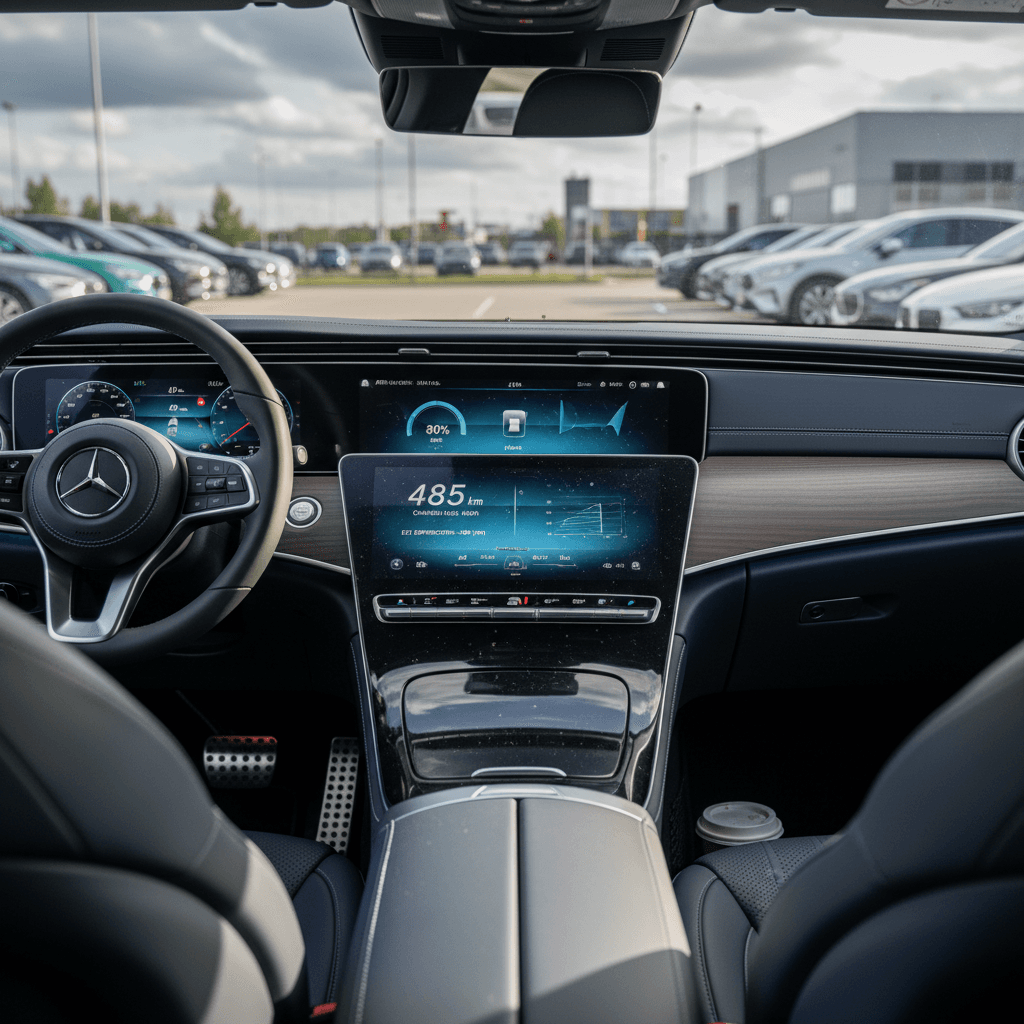
At Recharged, every EQE we list comes with a Recharged Score Report that includes third‑party battery‑health diagnostics in addition to Carfax‑style history data. That gives both buyers and sellers a more objective baseline when they negotiate value, especially important in a segment where on‑screen range numbers don’t always tell the full story.
EQE sedan vs EQE SUV: resale differences
Mercedes sells the EQE in both sedan and SUV forms, and while they share platforms and naming, the market doesn’t treat them identically. Body style, practicality, and regional demand all matter.
EQE sedan
- Often sees deeper discounts new, which sets a lower floor for used prices later.
- Resale strongest for efficient EQE 350+ trims with desirable option packs.
- In some markets, sedans lag SUVs in demand, putting additional pressure on values.
EQE SUV
- Family‑friendly packaging and higher seating position support better demand used.
- Generally holds slightly more value at a given age/mileage than a comparable EQE sedan.
- Heavier and less efficient, so buyers do notice real‑world range differences vs. sedans.
Which EQE holds value better?
Top factors that move EQE resale up or down
Every used EQE has its own story, but the market tends to reward (or punish) the same patterns. If you’re trying to understand why one EQE is worth more than another, or how to protect your own car’s value, start with these levers.
Key value drivers for a used Mercedes EQE
1. Real-world battery health
Verified state‑of‑health, realistic range, and a clear charging history are among the biggest drivers of confidence for used‑EV buyers, and therefore of price.
2. Warranty runway left
An EQE with several years of battery and basic warranty remaining will typically command thousands more than an otherwise similar car that’s about to age out of coverage.
3. Trim, options, and wheels
Popular specs (350+ drivetrain, driver‑assist packages, heated seats/wheel) boost demand. Oversized wheels, niche color combos, or sparse equipment can hurt resale.
4. Software, recalls, and updates
Up‑to‑date software, completed recalls, and documented dealer visits reassure buyers that they won’t be catching up on neglect at their own expense.
5. Mileage and use pattern
The market still uses mileage as a shorthand. A 20,000‑mile EQE with mostly home charging is easier to sell than a 60,000‑mile car that lived on DC fast chargers.
6. Accident and title history
Structural damage, airbag deployments, or branded titles are value killers on any car, but EV shoppers are especially wary given potential battery involvement.
Tariffs, incentives, and macro swings
Buying a used Mercedes EQE in 2026: what to look for
If you’re shopping for a used EQE in 2026, you’re in a buyer‑friendly window: early depreciation has already happened, but most cars are still young in EV terms. The challenge is separating genuinely good deals from problem children that are cheap for a reason.
How to evaluate a used EQE before you buy
Combine data, inspection, and a little skepticism.
1. Decode the original build
Get the original window sticker or build sheet. Confirm:
- Exact trim (350+, 350 4MATIC, 500, AMG).
- Driver‑assist and comfort packages.
- Wheel size and tire type.
These details matter for range, ride, and value.
2. Demand a battery report
Ask for independent battery‑health diagnostics, not just dash‑displayed range.
On Recharged, every EQE listing includes a Recharged Score with battery‑health testing so you don’t have to guess.
3. Inspect for EV‑specific wear
In addition to a normal pre‑purchase inspection, have a tech look for:
- Charge‑port and cable wear.
- Evidence of underbody or pack damage.
- Uneven tire wear from weight and torque.
- Pull a full history report to check for accidents, frequent ownership changes, and mileage consistency.
- Test‑drive the EQE on mixed roads and verify that advertised range feels realistic for your climate and driving style.
- Verify that you’ll have reliable home or workplace charging; this matters more than your nearest DC fast charger for daily livability.
- Compare the asking price against at least three similar EQEs in your region or on a transparent marketplace like Recharged.
Why shop EQEs on Recharged?
Ready to find your next EV?
Browse VehiclesSelling or trading in your Mercedes EQE: maximizing your payout
On the sell side, your goal is simple: convince the next buyer (or dealer) that your EQE is one of the good ones. That means proving condition, battery health, and a responsible ownership story.
Practical steps to boost your EQE’s resale value
1. Document service and software history
Gather invoices, recall confirmations, and proof of software updates. A tidy folder or PDF packet can meaningfully improve buyer confidence.
2. Get ahead of cosmetic issues
Fix curb‑rashed wheels, windshield chips, and minor dents before listing. The cost is often lower than the discount buyers will demand to live with them.
3. Refresh tires and brakes if needed
Luxury‑EV shoppers expect road‑trip‑ready cars. Worn tires or marginal brakes are a negotiation lever that buyers will pull hard.
4. Obtain a third‑party battery report
Pay for independent battery diagnostics (or sell through a platform like Recharged that includes them). Being able to say "Here’s verified battery health" is powerful.
5. Time your sale strategically
If your EQE is about to cross a mileage or warranty milestone, like 50,000 miles or the end of basic coverage, consider selling a bit earlier to capture more value.
6. Compare retail, trade‑in, and consignment
Selling privately can net more than a trade‑in, but it’s more work. Recharged offers instant offers and consignment options that blend convenience with stronger pricing.
Trade-in vs. instant offer vs. consignment
FAQ: Mercedes EQE resale value in 2026
Common questions about Mercedes EQE value and depreciation
Is the Mercedes EQE a smart used buy in 2026?
If you’re shopping in 2026, the answer is often yes, with the right car and the right price. Early EQE depreciation has turned very expensive new cars into approachable used buys, especially if you’re cross‑shopping with gas E‑Class or mid‑size luxury crossovers. The key is to treat battery health and software support as first‑class citizens alongside mileage and cosmetic condition.
For current owners, the message is more mixed: the ship has largely sailed on early‑year depreciation, but you can still protect what’s left by maintaining your EQE carefully, keeping software current, and timing your exit before major warranty cliffs. Whether you’re buying, selling, trading in, or just curious, a data‑driven valuation and a transparent battery‑health report are your best allies. That’s exactly what Recharged was built to provide for used EV shoppers and sellers across the country.