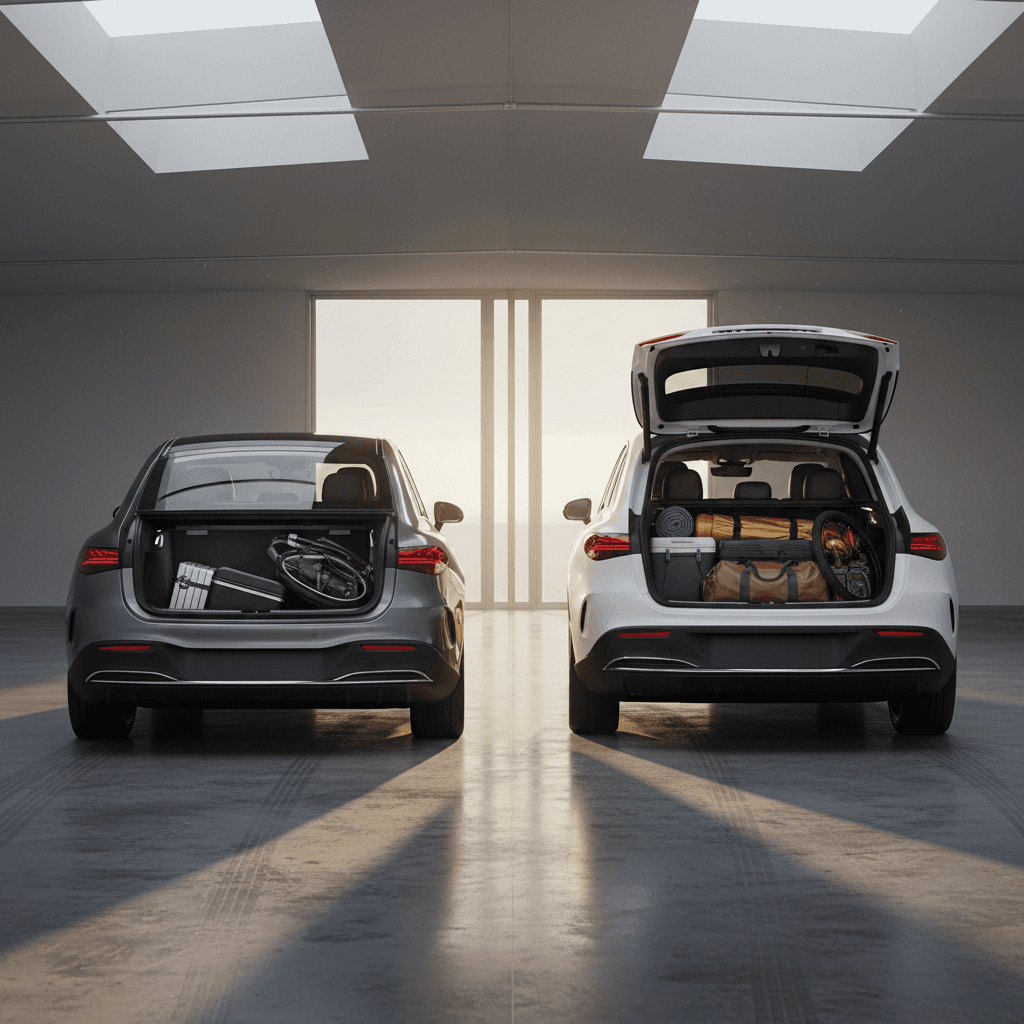
If you’re cross‑shopping electric SUVs and sedans, you’re probably wondering how much **Mercedes EQE cargo space with the seats down** you really get, and whether it’s enough for road trips, Costco runs, or kid duty. The answer depends heavily on whether you’re looking at the EQE SUV or the EQE sedan, because they package cargo very differently.
Two EQEs, two cargo stories
Overview: Mercedes EQE cargo space with seats down
Quick Mercedes EQE cargo snapshot
For most shoppers, the headline is this: **the Mercedes EQE SUV offers roughly mid‑50s cubic feet of cargo volume with the rear seats folded**, while the EQE sedan offers a much smaller, trunk‑style opening that’s better for luggage than for bulky gear. Let’s break down what that means in the real world.
Mercedes EQE SUV cargo space with seats down
Mercedes and independent testers don’t all quote exactly the same number, because some measure below the window line and others all the way to the roof. But across 2023–2026 EQE SUV reviews and spec sheets, you’ll see two consistent figures:
- Cargo behind the second row (seats up): about 18–21 cubic feet, depending on model and measurement method.
- Cargo with the rear seats folded (seats down): about 55–59 cubic feet of maximum volume.
Why you’ll see 55 vs. 59 cu ft
What that looks like in everyday use
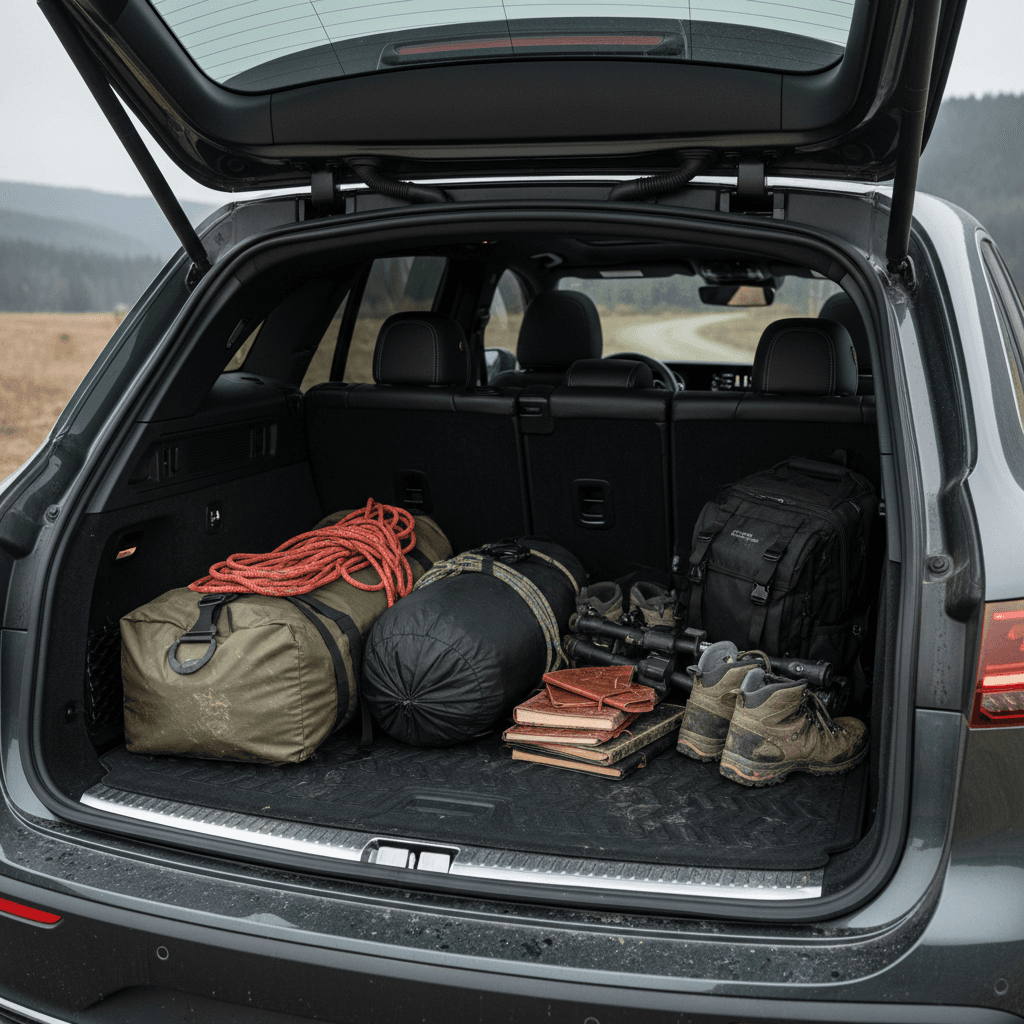
With the **seats down in an EQE SUV**, you’re working with a low, wide load floor and a tall roof. In practical terms, that usually means you can carry:
- 4–5 full‑size suitcases plus several duffel bags stacked on top.
- A large stroller, travel crib, and a week’s worth of family luggage.
- Flat‑pack furniture boxes up to about 6–7 feet long, angled slightly between the front seats and tailgate.
- Two adult bicycles with wheels removed, or one bike fully assembled if you’re willing to angle the front wheel.
Pack to the roof, safely
EQE SUV seats‑up vs. seats‑down
Mercedes EQE SUV cargo: everyday vs. max load
How EQE SUV cargo space changes when you fold the rear seats.
| Configuration | Approx. volume | Best for |
|---|---|---|
| Seats up (5 passengers) | ≈18–21 cu ft | Groceries, 2–3 suitcases, compact stroller |
| 40/20/40 partial fold | Mix between seats up/down | Skis or long boxes with 2–3 rear passengers |
| All rear seats folded | ≈55–59 cu ft | Road trips, moving days, Craigslist furniture hauls |
Use this as a quick reference when you’re deciding whether the EQE SUV is big enough for your lifestyle.
What about the Mercedes EQE sedan?
If you’re comparing the **EQE SUV** with the **EQE sedan**, cargo space is one of the biggest practical differences. The EQE sedan’s battery‑platform packaging frees up a reasonably deep trunk, owners often quote around 430 liters, or roughly **15–16 cubic feet**, but it’s still a traditional sedan trunk opening, not a hatchback.
EQE sedan trunk character
- Good for luggage: Deep well that swallows roller bags easily.
- Narrow opening: Large boxes, bikes, and big strollers are harder to angle in.
- Fold-down seatbacks vary: Some trims offer split‑folding rears, but the pass‑through is still sedan‑sized.
EQE SUV cargo character
- Liftgate access: Full-height opening makes bulky items far easier.
- Fold-flat floor: Seats fold into a largely level surface.
- More practical volume: The quoted mid‑50s cubes feel much more usable than the sedan’s trunk figures.
Don’t be fooled by raw cubic feet
Real-world fit: Luggage, strollers, and flat-pack furniture
Most shoppers don’t think in cubic feet, they think in suitcases, strollers, and IKEA trips. Here’s how **Mercedes EQE cargo space with the seats down** translates into everyday objects in the SUV:
What fits in an EQE SUV with the seats down?
Practical examples to help you picture the space.
Family road trip
Fold the rear seats and you can stack multiple full‑size suitcases, duffels, and a cooler without blocking the rear glass. Think family of four for a week with room to spare.
Strollers & kid gear
Travel systems, wagons, and pack‑and‑plays fit much more easily in the SUV than in the sedan. With seats down, you can usually carry two large strollers plus luggage.
Flat‑pack furniture
Long boxes up to about 6–7 feet will slide in diagonally. For typical flat‑pack bookshelves and dressers, an EQE SUV with seats folded is comparable to other luxury midsize EV SUVs.
Measure your “problem items”
EQE SUV cargo vs. Mercedes EQB and EQS SUV
Within Mercedes’ own electric lineup, the EQE SUV sits between the compact, boxier EQB and the larger EQS SUV. That shows up clearly when you compare cargo space with the seats down.
Mercedes EQ EV cargo space comparison (seats folded)
Approximate maximum cargo volumes with rear seats folded in current U.S. models.
| Model | Row configuration | Approx. max cargo with rear seats folded | Character |
|---|---|---|---|
| EQB SUV | 2 or 3 rows | ≈57–62 cu ft | Boxier shape, surprisingly roomy for its footprint. |
| EQE SUV | 2 rows | ≈55–59 cu ft | More coupe‑like profile, slightly less boxy space than EQB. |
| EQS SUV | 2 or 3 rows | ≈71–74 cu ft | The true cargo king of the family, but bigger and pricier. |
Use this table to see where the EQE SUV lands among other Mercedes electric SUVs.
Where EQE SUV really sits
How the EQE’s rear seats fold and configurations
On the EQE SUV, Mercedes uses a **40/20/40‑split rear seat** rather than the more common 60/40 split. That’s a big win for usability, especially if you ski or carry long objects regularly.
- 40/20/40 split: Fold just the center section to carry skis or long boxes while keeping two adult‑sized seats usable.
- Full fold: Drop all three sections for the flattest, longest cargo floor and the ≈55–59 cu ft max volume.
- Remote releases: Many EQE SUVs include handles or buttons in the cargo area so you can drop the seatbacks from the tailgate, then walk around to push them flat if needed.
- Seatback angle: Some trims allow a more upright “cargo” setting for the second row to reclaim a few extra inches of space while still carrying passengers.
Mind the load floor and weight
Folding the EQE SUV’s rear seats for max space
1. Clear the rear footwells
Before you fold the seats, move any bags, toys, or mats off the rear seat cushions so the seatbacks can drop fully and lie as flat as possible.
2. Slide front seats slightly forward
If you’re loading very long items, bump the front seats one or two clicks forward and more upright. This gives the rear seatbacks room to lie flatter and extends the usable floor length.
3. Use the cargo‑area releases (if equipped)
Many EQE SUVs have levers by the tailgate that drop the rear seatbacks. Test these on your test drive; they’re the difference between a one‑handed fold and climbing inside the back each time.
4. Double‑check for level
Run your hand along the seam where the rear seatbacks meet the load floor. If there’s a step, try adjusting seatback angle or removing thick cargo mats to regain a truly flat surface.
Shopping for a used EQE: cargo checks to make
If you’re eyeing a **used Mercedes EQE SUV or sedan**, cargo space isn’t just about cubic‑foot specs, it’s about how the previous owner used (or abused) that space. This is exactly where a transparent marketplace like Recharged can help you avoid surprises.
Cargo-related checks for a used Mercedes EQE
Quick things to verify before you sign on the dotted line.
Inspect the cargo floor and trim
Look for gouges, cracked plastic, or crushed side panels, signs of repeated overloading. In an EQE SUV, carefully lift any movable floor panels to check the underfloor storage as well.
Test the rear seat mechanisms
Fold and unfold each section of the 40/20/40 seat several times. It should latch positively and lie nearly flat. A sticky latch or uneven seatback can be a red flag.
Check for aftermarket wiring
If a previous owner added audio equipment or lighting in the cargo area, make sure wiring is tidy and nothing interferes with folding seats or load‑floor panels.
Review the Recharged Score Report
On Recharged, every used EQE comes with a Recharged Score Report that covers battery health and condition details. Pair that with your own cargo inspection so you know the car is as practical as it is powerful.
Why shop an EQE on Recharged
Ready to find your next EV?
Browse VehiclesTips to maximize Mercedes EQE cargo space
Even if you don’t drive with the seats down every day, a few smart habits can make your EQE feel much roomier when you need it.
- Use soft‑sided luggage: Duffel bags are easier to compress and stack than hard‑shell rollers, especially under the EQE SUV’s sloping roofline.
- Add an organizer, not clutter: A low cargo organizer keeps groceries from sliding without stealing too much floor space.
- Consider a roof box for seasonal gear: If you ski or camp a few times a year, a quality roof box keeps wet, sharp, or bulky items out of the cabin and frees up space for people.
- Leave the center section down for long items: In the EQE SUV, running skis or fishing rods through the 20‑percent center section lets you keep four seats usable most of the time.
- Remove unnecessary accessories: Cargo covers, dog barriers, and bulky floor trays all eat into the quoted volume. Stash them when you’re doing a big haul.
Safety first when loading your EQE
Frequently asked questions about Mercedes EQE cargo space
Mercedes EQE cargo space FAQ
Bottom line: Is Mercedes EQE cargo space enough for you?
If your priority is a refined electric SUV that still plays nicely with real‑world cargo, the **Mercedes EQE SUV with its seats down** delivers “enough but not excessive” space. You’re looking at roughly mid‑50s cubic feet of usable volume, a flexible 40/20/40 rear seat, and a low, wide load floor that makes big‑box runs and family trips straightforward.
The **EQE sedan**, meanwhile, is better viewed as an electric luxury sedan that happens to have a decent trunk, not a cargo workhorse. Its numbers look fine on paper, but the EQE SUV’s hatch and folding seats are a night‑and‑day improvement if you carry bulky items even occasionally.
If you’re still on the fence, your best move is to load the EQE like you live: bring the stroller, the golf clubs, or those awkward storage bins to a test drive. And if you’re shopping used, Recharged can pair that hands‑on evaluation with hard data on battery health, pricing, and nationwide delivery so you end up in an EQE that fits both your life and your budget.