If you’re eyeing a Ford F-150 Lightning, especially a used one, it’s natural to worry about battery degradation. The pack is huge, expensive, and it’s the heart of the truck. The good news: early data suggests the F-150 Lightning battery is aging more gracefully than many people fear, as long as it’s used and charged sensibly. This guide breaks down how Ford F-150 Lightning battery degradation really works, what hurts it, and how to shop confidently for a used truck.
Key takeaway up front
F-150 Lightning battery basics: size, chemistry and buffers
Ford F-150 Lightning battery at a glance
Ford fits the F-150 Lightning with a large, liquid‑cooled lithium‑ion pack. There are two main sizes: a Standard Range battery with about 98 kWh of usable energy and an Extended Range battery with roughly 131 kWh usable. Above that usable capacity, Ford keeps an invisible safety buffer, total capacity is higher, but you can’t access the top and bottom few percent. That buffer is exactly what helps control long‑term degradation and lets you charge to “100%” on the dash without truly maxing the cells.
Chemistry‑wise, the early Lightnings rely on nickel‑rich NMC‑type cells that favor energy density over low‑cost chemistry like LFP. That’s part of how Ford squeezes a 240–320‑mile EPA range from a full‑size pickup. The flip side is that NMC cells are more sensitive to high temperatures and long periods at very high state of charge than LFP. For you, that just means habits, how you charge, where you park, and how often you fast‑charge, matter more than a single spec sheet number.
Usable vs. total capacity
How EV battery degradation actually works
Before zooming in on Ford’s truck, it helps to understand how any EV battery loses capacity. Degradation happens through two main paths: calendar aging (time + temperature) and cycle aging (charging and discharging). You can’t stop either entirely, but your habits can dramatically change the rate.
- Calendar aging: Lithium‑ion cells slowly lose capacity just by existing, faster when they sit hot and near 100% charge for long periods.
- Cycle aging: Every time you use the pack, drive it down, charge it back up, you add tiny bits of wear. Bigger swings (10% to 90%) count more than small ones (40% to 60%).
- High C‑rates: Fast charging and repeated, hard acceleration heat the pack and put more stress on the chemistry.
- Mechanical and thermal stress: Lots of potholes, extreme cold or heat, and frequent full‑throttle towing all add incremental stress.
You’ll also see a difference between “soft” range loss and true degradation. Cold weather, heavy loads, big tires and racks, and high speeds can all cut range dramatically on a given day without changing the underlying battery health at all. When the weather warms or you slow down, the truck’s range estimate bounces back.
Don’t confuse winter range loss with battery wear
Real-world Ford F-150 Lightning battery degradation so far
By early 2026, the oldest F-150 Lightnings on the road have about three to four years and tens of thousands of miles under their belts. While Ford doesn’t publish fleet‑wide degradation data, owner reports, service anecdotes and third‑party logging apps paint a reasonably consistent picture: Lightning packs are holding up well when treated decently.
What owners are seeing
- Many Standard and Extended Range trucks with 20,000–40,000 miles report roughly 3–8% loss in displayed usable capacity.
- Well‑cared‑for trucks, garage‑kept, mostly AC charged, rarely fast‑charged, tend to live at the low end of that range.
- Work trucks fast‑charged frequently and parked outside in hot climates skew higher, as you’d expect.
Why the numbers vary
- Ford’s software occasionally recalibrates state of charge and estimated range after updates, which can make the pack look better or worse overnight.
- Big wheel/tire packages, lift kits and accessories add aerodynamic drag and weight, exaggerating any perceived loss.
- Cold‑climate owners often underestimate how much weather, not degradation, is affecting them.
The important point: we’re not seeing a wave of early Lightning packs falling off a cliff. Instead, degradation appears to follow the same curve as other modern EVs: a slightly faster drop in the first couple of years as the cells "settle," then a slower, long plateau. Ford’s buffer helps here, some early capacity loss is absorbed by that hidden top and bottom margin before it shows up in your day‑to‑day range.
How the warranty fits in
What really kills F-150 Lightning range day to day
When an owner says, “My Lightning has lost 30% of its range,” and you dig into the details, it’s usually not 30% battery degradation. It’s 5–10% battery wear layered on top of several real‑world factors that the original EPA number didn’t capture.
Biggest F-150 Lightning range killers (that aren’t battery wear)
These are the knobs you can actually turn to get range back.
Speed and aero
Cold weather
Payload & towing
Then there are build‑and‑options realities. The Platinum trim, for example, weighs more and wears bigger wheels than a basic Pro, so its EPA range is lower even with the big battery. Add a roof rack, crossbars, and a bed rack, and you’ve changed the truck’s profile yet again. None of that is degradation, it’s physics.
Why your used truck’s range may not match the window sticker
How to slow F-150 Lightning battery degradation
You don’t have to baby a Lightning to keep the battery healthy, but a handful of simple habits will noticeably slow long‑term degradation. Think of it as routine dental care for your battery, small, boring things that pay off over eight or ten years.
Practical habits to protect your Lightning battery
1. Live in the middle of the pack
For daily driving, try to keep the battery between about 20% and 80%. Use 100% only when you truly need the range, like the morning you head out on a long trip or expect a heavy towing day.
2. Favor Level 2 home charging
A 240‑volt Level 2 charger in your garage or driveway is easier on the pack than frequent DC fast charging. It also lets the truck precondition quietly at home, so you’re not wasting energy heating the cabin on the road.
3. Save DC fast charging for road trips
High‑power DC fast charging is great when you’re covering interstate miles, but making it your everyday strategy will add heat and wear. Occasional fast charges won’t hurt; relying on them several times a week will.
4. Watch heat and sun exposure
Whenever you can, park in shade or indoors, especially in hot climates. High ambient temps plus a big, dark truck can keep battery temperature elevated for hours.
5. Update software and use battery care modes
Keep your Lightning’s software up to date, Ford can tweak charging curves and thermal management over time. If your truck has charge‑limit or “battery protection” settings, use them for daily use.
6. Avoid sitting full or empty
Try not to leave the truck parked for days at 100% or near 0%. If you’re storing it, aim for a middle state of charge (40–60%) and plug into a modest Level 2 charger so the truck can manage itself.
Home charging helps resale value
Towing, hauling and their effect on Lightning battery life
The F-150 Lightning was built to work, tow, haul, power job sites, and it can absolutely do those things. The question is what that workload does to the battery over time. The answer is nuanced: heavy use will show up in your energy consumption long before it shows up as permanent degradation, but it can accelerate wear at the margins if you’re constantly towing at the limits in hot conditions.
- Occasional towing, boats, campers a few weekends a year, will mostly cost you range on those days, not long‑term health.
- Regular commercial use at or near max tow capacity, especially in hot climates with frequent DC fast charging, will be harder on the pack.
- Ford’s thermal management is robust; the truck actively heats and cools the battery. But no system can fully erase the extra stress of constant heavy loads.
Work truck reality check
Evaluating battery health on a used F-150 Lightning
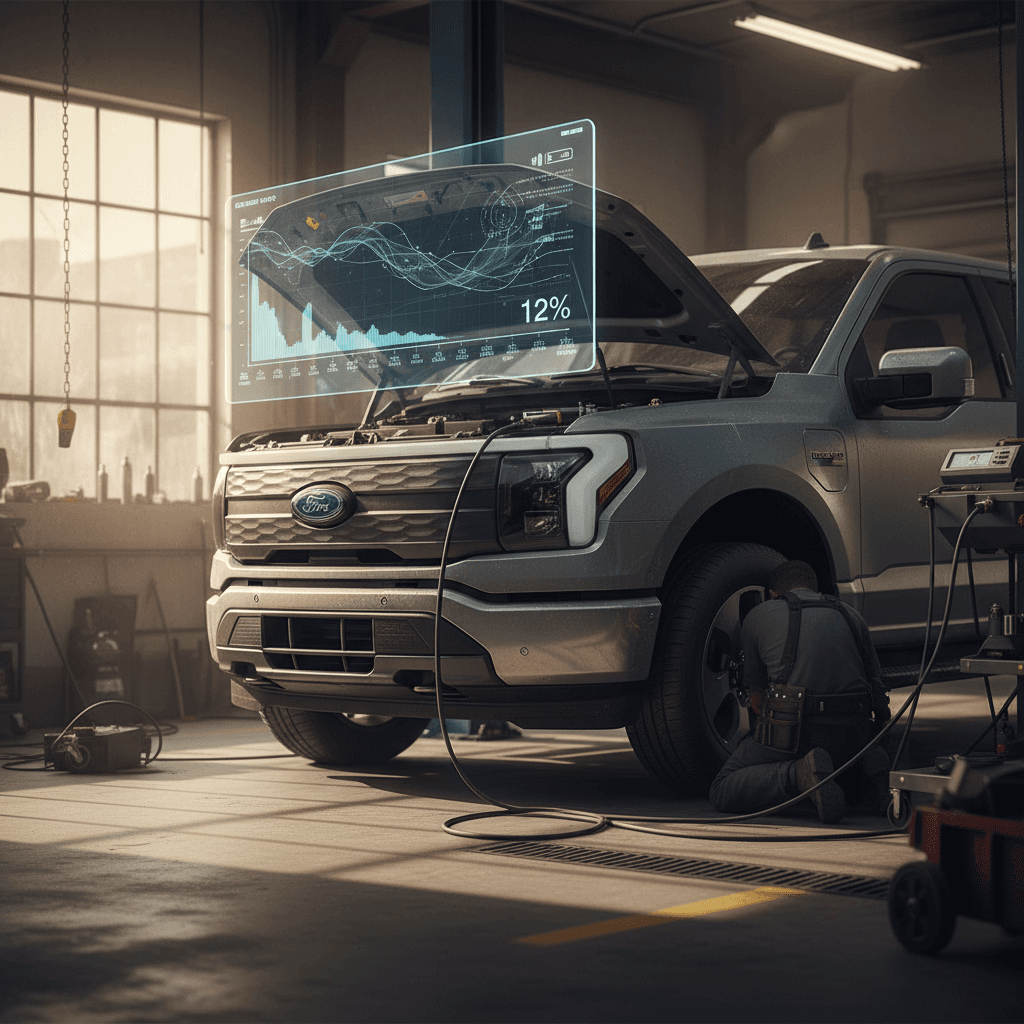
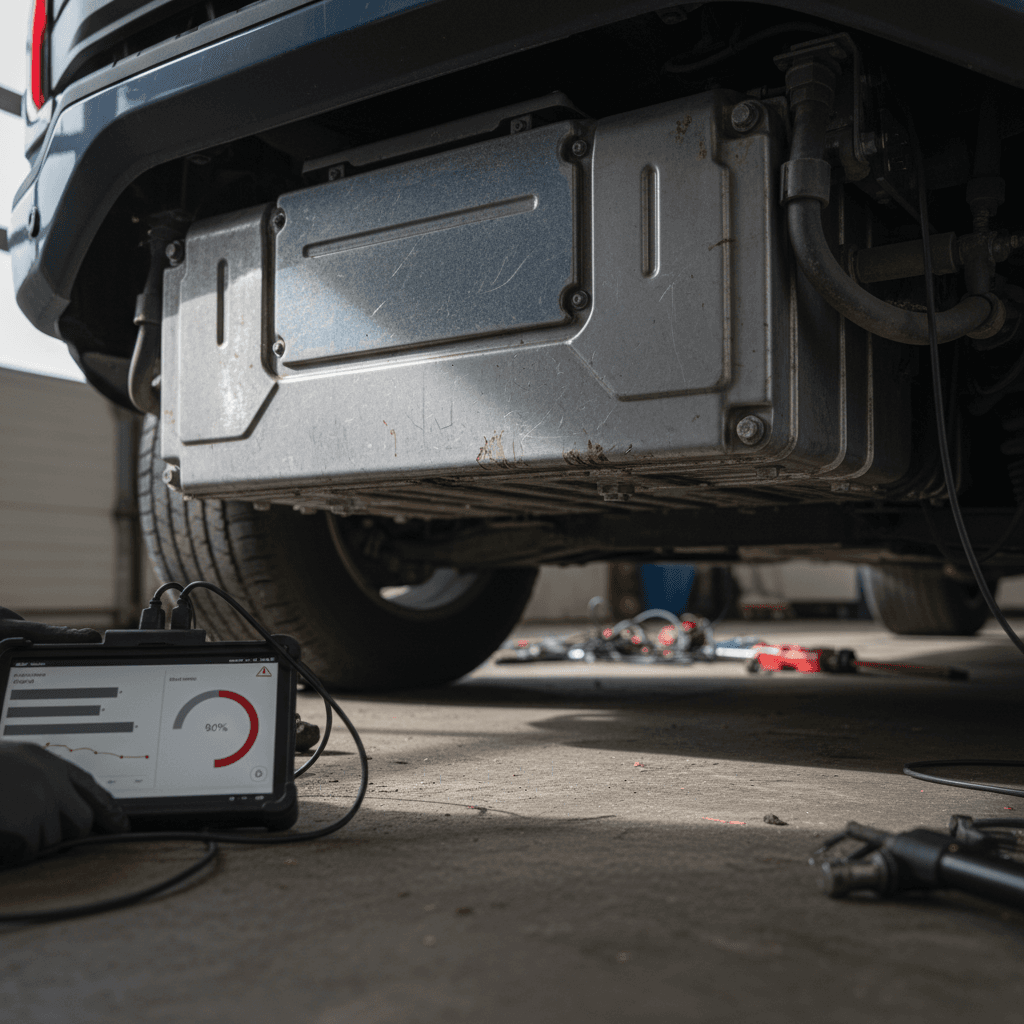
Because the battery is such a large fraction of the Lightning’s value, you should treat battery health as seriously as you’d treat an engine compression test on a diesel pickup. The difference is that with a modern EV, you can combine software‑level diagnostics with road‑test impressions to get a much clearer picture.
How to judge an F-150 Lightning’s battery when buying used
You don’t need to be an engineer, just systematic.
On‑screen clues
Professional diagnostics
Used Lightning battery health checklist
1. Ask for charging history
Did the previous owner primarily charge at home on Level 2, or did they rely on DC fast chargers? How often was the truck taken to 100%?
2. Look at where it lived
A truck that spent its life garaged in a mild climate will generally age better than one parked outside in Phoenix or Miami heat.
3. Verify software is up to date
Ask the seller when the last over‑the‑air or dealer software update was applied. Range and charging behavior can change subtly with updates.
4. Test drive in realistic conditions
Drive at the speeds you actually use, 65–70 mph highway, then compare energy use (mi/kWh) to what you’d expect from EPA numbers. Big outliers deserve questions.
5. Get a third‑party or Recharged report
A <strong>Recharged Score Report</strong> includes verified battery health, so you aren’t guessing. If you’re shopping elsewhere, see if the seller will provide a scan from a capable EV diagnostic tool.
How Recharged helps de‑risk used Lightnings
Cost, warranty and replacement considerations
The phrase “battery replacement” hangs over every EV conversation, especially for big‑pack trucks like the Lightning. In reality, very few owners will face a full pack replacement inside the warranty window, and most will sell or trade the truck before the pack gets anywhere near the end of its useful life. Still, it’s worth understanding the financial landscape.
F-150 Lightning battery: what to expect financially
These are directional, not official Ford quotes, always check current service pricing for your model year and region.
| Item | What it means for you | What to keep in mind |
|---|---|---|
| Battery warranty | Covers defects and excessive capacity loss for a set time/mileage window. | Know the exact terms on the truck you’re buying, model years can differ. |
| Out-of-warranty replacement | A full pack replacement, if ever needed, is a five‑figure repair. | By the time most trucks might need this, pack prices should be lower and remanufactured options more common. |
| Partial repairs | Module‑level fixes can address localized issues without replacing the whole pack. | Not every problem requires a full pack swap; a good service center can advise. |
| Resale value | Battery health is a major driver of used pricing. | Buying a truck with documented battery health (and good habits) protects your future resale too. |
Battery failures are rare; moderate degradation is normal and generally baked into used pricing.
Don’t buy blind
Ford F-150 Lightning battery degradation FAQ
Frequently asked questions about Lightning battery life
Bottom line: Should you worry about Lightning battery degradation?
If you’re shopping for or already own a Ford F-150 Lightning, it’s reasonable to keep an eye on battery degradation, but you don’t need to live in fear of it. The pack is big, well‑managed, and buffered, and real‑world experience so far points to gradual, predictable capacity loss, not sudden failure. Most of the range swings owners feel from day to day come from weather, speed, load and accessories, not a dying battery.
The smartest move is to control what you can: charge mainly on Level 2, avoid parking at 100% in summer heat, use DC fast charging strategically, and buy used trucks with clear, verified battery health data. That’s exactly what Recharged was built for. Every Lightning on our platform comes with a Recharged Score battery health diagnostic, fair‑market pricing, and EV‑specialist support, from first question to final click, so you can focus on finding the right truck, not guessing about the battery buried underneath it all.