If you’re considering a Mercedes EQE, or eyeing a used one, the big question isn’t just how far it drives when new. It’s how much Mercedes EQE battery degradation per year you should realistically expect, and what that means for range, warranty coverage, and resale value over time.
Key takeaway up front
Overview: How the Mercedes EQE Battery Degrades
All lithium-ion EV batteries lose capacity over time. The Mercedes EQE is no exception, but its large battery, modern chemistry, and active thermal management mean degradation is usually gradual, not catastrophic. Early data from EQE and similar Mercedes EQ models suggests that, under typical use, you’ll seeminor capacity loss in the first few years, then a slower decline as the pack ages.
Mercedes EQE Battery Degradation at a Glance (Typical Ranges)
Not a guarantee
EQE Battery Specs and Why They Matter for Degradation
Understanding the EQE’s battery hardware helps you interpret any degradation numbers you hear. It’s not just about kWh, it’s about how Mercedes manages that energy over a decade of use.
Mercedes EQE Battery Basics
Approximate specs for common EQE variants. Exact values vary by model and market.
| Model | Usable Battery (kWh, approx.) | EPA Range (mi, approx.) | Architecture | Thermal Management |
|---|---|---|---|---|
| EQE 350+ sedan | ~90 kWh | 300+ mi | 400V | Active liquid cooling and heating |
| EQE 500 4MATIC sedan | ~90 kWh | ~260–280 mi | 400V | Active liquid cooling and heating |
| EQE SUV variants | ~90 kWh | ~250–280 mi | 400V | Active liquid cooling and heating |
Larger, well‑managed packs usually degrade more slowly in day‑to‑day use than smaller, harder‑worked batteries.
Why pack size matters
Real-World Mercedes EQE Battery Degradation Per Year
Hard, model‑specific long‑term data for the EQE is still building because the model is relatively new. But we can triangulate from owner reports, Mercedes’ own warranty stance, and what we’ve seen from earlier EQ models and comparable luxury EVs.
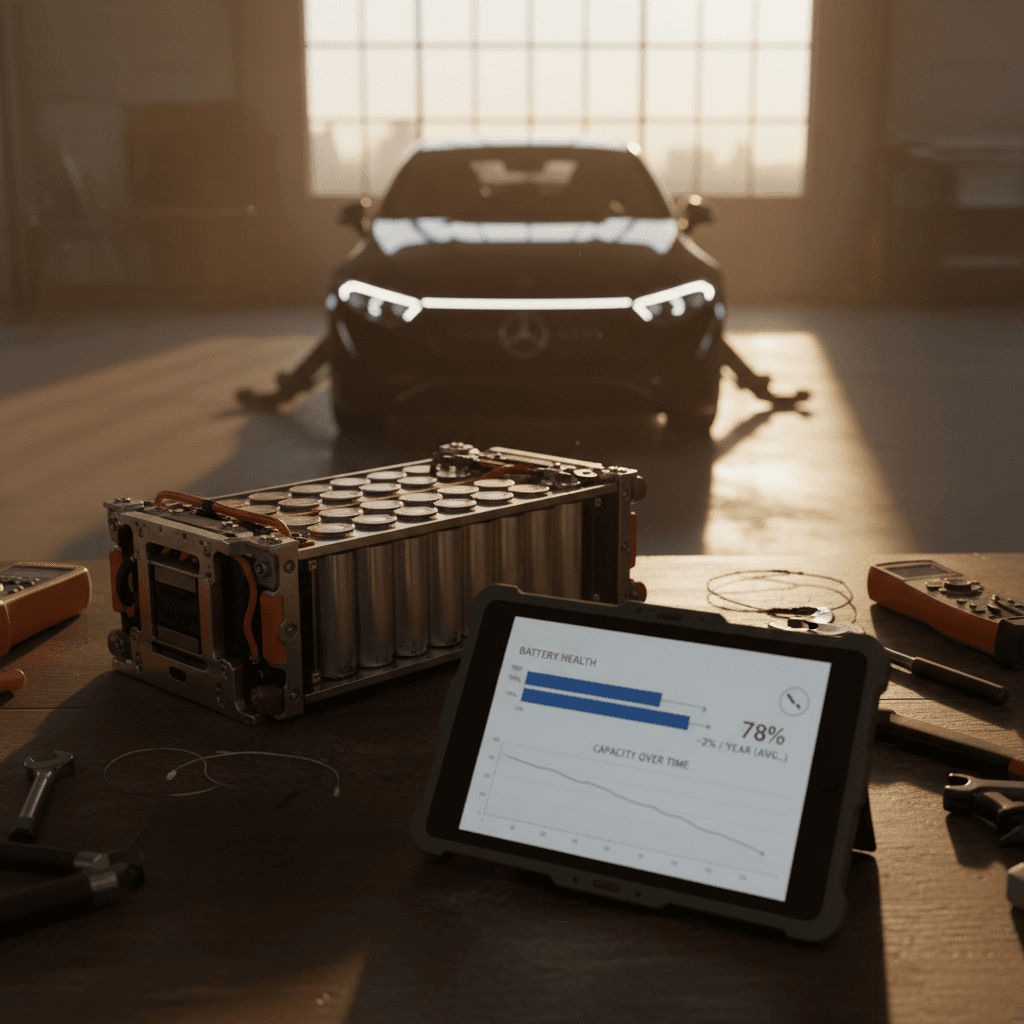
- Year 1–2: Many EVs, including the EQ family, see an initial capacity drop of roughly 2–4% as the pack “settles.” You might not notice this in daily driving unless you regularly push the full range.
- Years 3–5: If you mostly AC charge and avoid extreme heat, annual loss often settles in around 1–2% per year. By year 5, a typical EQE might be down roughly 8–10% from its original usable capacity.
- Years 6–10: Long‑term data on EQE is limited, but luxury EVs in this class commonly show around 10–15% loss by the 8–10‑year mark when reasonably cared for. Some owners will see better; hard‑driven cars in hot climates can do worse.
How to sanity‑check range loss
6 Factors That Speed Up (or Slow Down) EQE Battery Degradation
The Biggest Drivers of Mercedes EQE Battery Degradation
Battery age is only part of the story, how you use and charge the EQE matters just as much.
1. Climate and Temperature
High heat accelerates chemical aging in lithium‑ion packs. An EQE parked outdoors in a hot Southern summer will generally degrade faster than one garaged in a mild coastal climate.
Cold weather doesn’t permanently damage the pack the same way heat can, but it temporarily reduces available range until the battery warms up.
2. Fast Charging vs. AC Charging
DC fast charging is convenient on road trips, but frequent fast charging, especially at high state of charge, can increase wear.
For daily use, Mercedes (and most OEMs) expect you to rely on Level 2 AC charging at home or work. Occasional fast charging is fine; living on fast chargers can accelerate degradation.
3. State of Charge Habits
Keeping the battery near 100% or running it very low every day stresses the cells.
For slower Mercedes EQE battery degradation per year, aim to live in the middle: charging to 70–90% for daily use and avoiding frequent deep discharges below 10–15% when you can.
4. Mileage and Driving Style
Higher annual mileage means more charge cycles. Spirited driving, heavy loads, and high sustained speeds increase battery temperature and energy throughput, all of which nudge degradation upward.
5. Calendar Age
Even a low‑mileage EQE loses some capacity simply with time. A gently‑used 8‑year‑old EQE will typically show more loss than a 3‑year‑old high‑miler, but both mileage and calendar age matter.
6. Software and Thermal Management
Mercedes continually refines battery management software. Updates can adjust how the EQE charges and cools the pack, sometimes trading a bit of top‑end range for better long‑term health.
How Degradation Affects Range, and Used EQE Resale Value
A few percentage points of loss on a big battery is less dramatic than it sounds, but it matters for long trips and used‑car pricing. Here’s how Mercedes EQE battery degradation per year translates to the real world.
Range you’ll actually notice
On a 300‑mile EQE, a 10% capacity loss means roughly 270 miles under similar driving conditions. For commuting and local errands, that’s still more than enough for most owners.
Where it bites is on highway road trips. You may need to add an extra charging stop on long routes, or your comfort buffer between chargers shrinks slightly.
Impact on resale and trade‑in
Battery health is a major driver of used EV values. A car that shows unusually high degradation compared to its age and mileage will generally command less money at resale or trade‑in.
That’s why objective battery diagnostics, like the Recharged Score battery health report included with every vehicle on Recharged, are becoming central to pricing and buyer confidence.
Why a healthy EQE holds value well
Mercedes EQE Battery Warranty: What’s Actually Covered
Mercedes, like most legacy automakers, offers a high‑voltage battery warranty on the EQE that combines time, mileage, and a minimum capacity guarantee. Exact terms vary by market and model year, so you should always verify for your VIN, but the broad contours are similar.
- Duration: Often around 8–10 years from in‑service date.
- Mileage limit: Typically in the 100,000–155,000‑mile range, whichever comes first.
- Capacity floor: The pack is usually warranted not to fall below roughly 70% of its original usable capacity within the time/mileage window, provided the vehicle is used and maintained within Mercedes’ guidelines.
- What’s not covered: Normal, gradual range loss is expected and not considered a defect. The warranty is aimed at abnormal or premature failures.
Read the fine print
How to Slow Mercedes EQE Battery Degradation
You can’t stop chemistry, but you can stack the deck in your favor. A few simple habits can noticeably slow Mercedes EQE battery degradation per year and keep your usable range higher for longer.
Everyday Habits to Protect Your EQE Battery
1. Favor AC charging for daily use
Use Level 2 home or workplace charging for most top‑ups and reserve DC fast charging for road trips or genuine need. Slower, cooler charging is easier on the cells.
2. Avoid living at 100%
If your schedule allows, set the EQE’s charge limit to around 70–90% for daily driving. Save 100% charges for long trips where you’ll depart soon after charging completes.
3. Don’t regularly run it to empty
Occasional deep discharges won’t kill the pack, but routinely dropping below 5–10% adds stress. Try to plug in when you’re in the 15–25% range instead of waiting for single digits.
4. Protect the car from heat
Whenever possible, park in shade or a garage, especially in hot climates. The EQE has thermal management, but keeping cabin and pack temps reasonable reduces long‑term wear.
5. Keep software up to date
Battery management improvements are often delivered via software. Staying current ensures the EQE is using Mercedes’ latest strategies for balancing performance and longevity.
6. Drive smoothly when you can
Exploring torque is part of the fun, but constant full‑throttle launches and heavy braking increase heat and energy throughput. A smoother style is kinder to the battery (and your tires).
How to Check Battery Health on a Used Mercedes EQE
If you’re shopping the used market, battery health is where deals are made, or lost. Two EQEs with the same mileage can have very different remaining capacity depending on how they were driven and charged.
Checklist for Evaluating a Used EQE’s Battery
1. Review the service and charging history
Ask the seller how the car was charged (home AC vs. mostly DC fast) and where it lived. A car that’s lived its life on highway fast chargers in a hot climate will likely show more degradation.
2. Look for on‑screen range anomalies
With the battery at a known state of charge (for example 80%), compare the projected range to the original EPA rating. Large unexplained gaps can hint at higher‑than‑average degradation or other issues.
3. Use a professional battery health report
DIY impressions only go so far. A structured diagnostic, like the <strong>Recharged Score battery health report</strong> on every vehicle sold through Recharged, quantifies usable capacity and flags anomalies you can’t see from the driver’s seat.
4. Confirm remaining battery warranty
Have a Mercedes dealer or seller provide documentation of the in‑service date and remaining high‑voltage battery warranty. A car still under coverage is more insulated from worst‑case scenarios.
5. Test drive under your real conditions
Replicate how you’ll actually use the car. A 40‑mile mixed‑driving loop at highway speeds will tell you more about effective range than a short city hop around the block.
How Recharged derisks used EQE shopping
Ready to find your next EV?
Browse VehiclesHow EQE Battery Degradation Compares to Other Luxury EVs
If you’re cross‑shopping the Mercedes EQE with rivals from Tesla, BMW, Audi, or Lexus, degradation behavior is one more data point to weigh. No two cars age exactly alike, but several themes stand out.
EQE vs. Other Luxury EVs: Degradation Context
A high‑level look at how the EQE fits into the broader luxury EV landscape.
Pack size and buffer
The EQE’s large pack and conservative usable capacity percentage put it in line with other premium EVs. More energy in reserve usually means less stressful daily cycling.
Thermal management
Like its peers, the EQE relies on active liquid cooling and heating. This is a big advantage over early air‑cooled EVs that showed faster degradation in hot climates.
Real‑world expectations
Owners of the latest wave of luxury EVs typically report modest, single‑digit capacity loss over the first several years. The EQE is designed to compete in that same durability envelope.
Don’t over‑index on one number
Frequently Asked Questions About EQE Battery Degradation
Mercedes EQE Battery Degradation FAQs
Should You Worry About EQE Battery Degradation?
Taken in context, Mercedes EQE battery degradation per year is more of a background factor than a daily headache. With a large, well‑managed pack and a robust high‑voltage warranty, the EQE is engineered to remain useful for many years of commuting and road trips, even after you’ve lost a slice of the original capacity.
Where degradation really matters is when you’re moving into, or out of, the car. If you’re buying used, objective battery data and a clear picture of charging history help you separate strong candidates from problem children. If you’re selling or trading in, demonstrating healthy capacity can support a higher price.
That’s exactly where Recharged focuses. Every EV on our marketplace comes with a Recharged Score battery health report, transparent pricing tied to real pack condition, and EV‑specialist support from first question through financing, trade‑in, and nationwide delivery. If an EQE is on your shortlist, you can shop used examples with confidence instead of guessing what’s left in the battery.