If you’re coming from a gas SUV, the official Mercedes EQB maintenance schedule looks both familiar and confusing at the same time. You’ll see service codes, mileage intervals, and a few EV-only items, but what does your EQB actually need, and how often? Let’s walk through the schedule like an owner, not a service advisor with a sales quota.
Quick take
Mercedes EQB maintenance schedule at a glance
How often does a Mercedes EQB really need service?
Mercedes publishes a detailed service chart for the EQB, but as an owner you can think in three buckets: annual safety checks, multi‑year fluid and filter changes, and long-term battery and coolant care. Most of the big scary items you remember from gas cars, timing belts, spark plugs, transmission services, simply don’t exist here.
How the EQB’s EV platform changes maintenance
What’s gone for good
- No oil changes or oil filters, ever.
- No spark plugs, ignition coils, or exhaust system.
- No traditional multi-gear automatic transmission service.
- Far fewer engine gaskets, sensors, and belts to fail.
What still matters
- Brake fluid, coolant, cabin filters, and tires.
- Suspension, steering, and alignment checks.
- Software updates and recall campaigns.
- Battery health monitoring and thermal management.
The result is a car that still needs a relationship with a shop, but the tone changes. Instead of chasing misfires and oil leaks, you’re protecting battery health, ride comfort, and safety systems. For many EQB owners, the most noticeable recurring expense is actually tires, thanks to the instant torque and weight of the pack.
Tip for ex-gas drivers
Official Mercedes EQB service intervals
Exact details can vary slightly by model year and market, but in North America the Mercedes EQB generally follows a time‑and‑mileage cadence. Think of it like this: basic checks every year or so, brake fluid and cabin filters on a multi‑year rhythm, and a handful of long‑term coolant services for the battery and power electronics.
Typical Mercedes EQB maintenance intervals (high level)
Always confirm exact intervals in your EQB owner’s manual or Mercedes service booklet, this table is a simplified, owner-friendly view.
| Item | Approx. Interval | Trigger | Notes |
|---|---|---|---|
| General inspection & diagnostics | 12–24 months | Time / mileage | Multi-point check, software, visual inspections. |
| Cabin air filter | 2 years or 20k–25k miles | Time / mileage | More often if you drive in dusty or urban areas. |
| Brake fluid replacement | 2–3 years | Time | Critical for pedal feel and ABS performance. |
| High-voltage battery & charging system check | Every service visit | Time / mileage | Usually part of standard EV multi-point inspection. |
| Coolant for battery & power electronics | 8–10 years (typical) | Time | Long-life coolant; interval varies, check manual. |
| Wiper blades & washer fluid | As needed | Wear / usage | Fast, inexpensive DIY or shop item. |
| Tires (rotation / replacement) | 6k–10k miles / 25k–40k miles | Mileage / wear | Heavily depends on driving style and climate. |
Mileage and time estimates are approximate and may vary by model year and how your EQB is optioned.
Check your specific EQB
Year-by-year Mercedes EQB maintenance checklist
Let’s translate the factory chart into what you’re likely to see in the real world over the first decade of EQB ownership. This assumes average driving in the U.S. (about 10,000–12,000 miles per year) and no unusual damage.
EQB maintenance by ownership year
Year 1: Baseline inspection
Expect a general inspection, software check, tire rotation, and fluid top‑offs. You’re mainly confirming that everything is bedding in correctly, no unusual tire wear, no loose trim, no warning lights hiding in the dash menus.
Year 2: First real service visit
This is often the first time you’ll see items like a <strong>cabin air filter replacement</strong> and possibly a brake fluid change if your dealer follows a conservative interval. The tech should also review battery health trends and charging behavior.
Years 3–4: Brakes and fluids
Around this time, budget for a definite <strong>brake fluid change</strong>, alignment check, and another cabin filter. If you use your EQB for road trips, you may be on your first or second tire set by now.
Years 5–6: Suspension and wear items
Bumps and potholes start to tell their stories. Plan for more careful inspection of <strong>control arm bushings, shocks, and steering components</strong>. Some owners see their first minor suspension refresh in this window, especially in rough-road regions.
Years 7–8: Long-life coolant service
At this stage the long-life coolant for the <strong>high-voltage battery and power electronics</strong> may come due, depending on your model year’s schedule. It’s not a DIY job, but it’s critical for keeping the pack at the right temperature.
Years 9–10: Deep-dive checkup
Now you’re into mature-EV territory. A thorough inspection of battery health, charging hardware, seals, and corrosion points is smart, especially if you’re thinking about resale. Documentation here makes a used EQB far more attractive to the next owner.
Brakes, tires, coolant: what actually wears out on an EQB
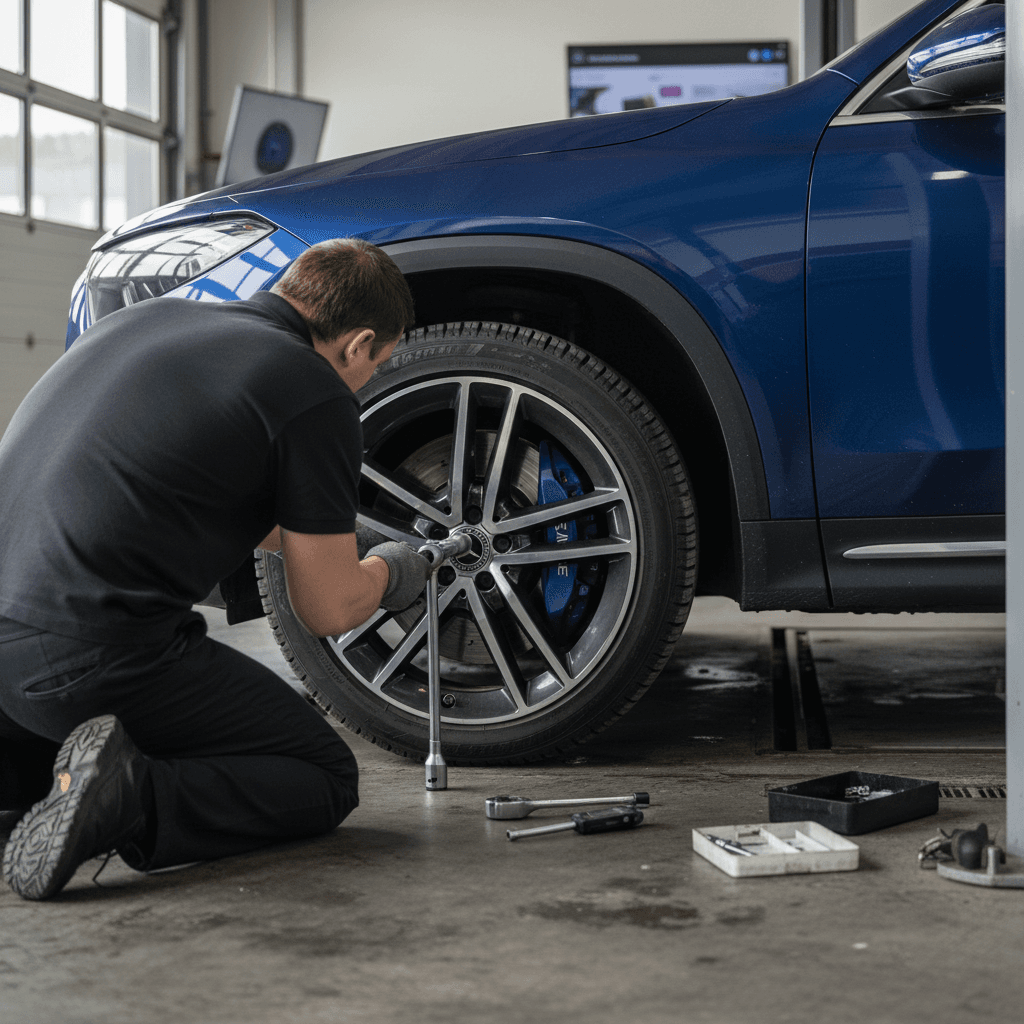
Electric Mercedes models like the EQB are gentle on some parts and hard on others. Regenerative braking means your traditional brakes get a break most of the time, but the weight and torque of the EV platform move that wear to other places.
Key EQB wear items to watch
Think of these as your usual suspects over 5–10 years of ownership.
Tires
The EQB is heavy and quick off the line, so front tires in particular can wear faster than on a comparable gas SUV. Rotate regularly and don’t ignore alignment, uneven wear can sneak up on you.
Suspension & alignment
All that battery weight rides on shocks, bushings, and ball joints. Hitting potholes or curbs can throw alignment off sooner than you’d expect, hurting range and comfort.
Brake fluid & coolant
Even if your brake pads last a long time, brake fluid ages with time, and the EQB’s complex cooling loop needs correct, uncontaminated coolant to protect the battery and inverter.
Good news on brake pads
Real-world Mercedes EQB maintenance costs (and how to save)
Service pricing varies wildly between metro dealers, independent shops, and regions, but we can sketch a ballpark picture. Compared with a gas Mercedes GLB, the EQB usually wins on long‑term maintenance dollars, even if hourly labor rates are the same.
Typical EQB maintenance cost ranges (U.S., non-warranty)
These are rough, owner-oriented ranges for planning and comparison. Always get an estimate from your service provider before work begins.
| Service | Approx. Cost Range (USD) | Notes |
|---|---|---|
| Basic inspection + diagnostics | $150–$300 | Includes multi-point check and plug-in scan; often bundled with other work. |
| Cabin air filter replacement | $80–$180 | DIY-friendly; dealer labor can double the cost vs buying the filter yourself. |
| Brake fluid flush | $150–$250 | Usually recommended every 2–3 years. |
| Tire rotation & balance | $50–$120 | Free at some tire shops if you bought tires there. |
| Set of tires (4), installed | $900–$1,400+ | Depends heavily on brand, size, and speed rating. |
| High-voltage coolant service | $400–$900+ | Infrequent but specialized; usually a dealer or EV-expert job. |
Dealer prices tend to sit at the upper end of these ranges; high-cost metro areas may be higher.
How to keep EQB maintenance costs down
Warranty, battery health, and what happens if you skip services
Mercedes, like other manufacturers, can require proof that you’ve followed the recommended service schedule when you make a warranty claim, especially on big-ticket items like the drive unit or high-voltage battery. That doesn’t mean you’re forced to use a dealer, but it does mean you should keep receipts and service records, wherever you go.
- Time-based items like brake fluid and coolant are often called out explicitly in warranty terms.
- If you skip them and later have a related failure, Mercedes could argue that neglect played a role.
- Digital service records (from a dealer) are convenient, but paper invoices from a qualified shop are also valid documentation.
- Battery warranty decisions can factor in your charging habits, software history, and whether thermal management has been properly maintained.
Don’t ignore EV coolant leaks
Buying a used Mercedes EQB: maintenance red flags
A used EQB can be a smart way to get into a premium electric SUV for less money, if you know how it’s been cared for. This is exactly the gap Recharged was built to close: every EV we list comes with a Recharged Score battery health report, verified service history when available, and expert guidance so you’re not reading tea leaves from a stack of invoices.
Used Mercedes EQB maintenance checks
Verify service records
Look for at least periodic visits showing inspections, brake fluid service, and cabin filters. A complete black hole in the first 4–5 years is a concern.
Ask about tire history
Multiple sets of tires in low mileage can hint at aggressive driving or alignment issues. One normal tire replacement around 30k–40k miles is a better story.
Check for coolant or oil-like stains
Walk around the parking spot area and look under the car. EVs still use coolant and gear oil; leaks shouldn’t be shrugged off.
Scan for warning lights or messages
Turn the EQB fully on, not just accessory mode. Watch for persistent alerts related to the drive system, charging, or battery management.
Test charging behavior
If possible, plug into both AC (Level 2) and DC fast charging. Listen for unusual noises, watch for error messages, and note whether charging starts smoothly.
Get a battery health assessment
Tools like the <strong>Recharged Score</strong> give you an objective read on pack health and usable capacity, crucial information when comparing two similar EQBs.
How Recharged helps
DIY vs dealer: what you can do yourself on an EQB
EVs lull some owners into thinking there’s nothing they can do themselves. That’s not true with the EQB. While anything high‑voltage belongs in professional hands, you can still knock out a few line‑items from the maintenance schedule at home and keep closer tabs on your SUV in the process.
Reasonable DIY jobs
- Cabin air filter: Usually accessible behind the glovebox or under the cowl. Follow a video specific to your year.
- Wiper blades & washer fluid: Classic driveway tasks; just match the blade length.
- Tire pressure and rotation (if you have equipment): Correct pressure helps range and tire life.
- Basic visual inspections: Look for leaks, uneven tire wear, damaged aero panels, or frayed seals.
Leave these to the pros
- High-voltage system work: Anything involving orange cables, battery pack, or inverter.
- Coolant services: Incorrect bleeding or filling can trap air and hurt cooling performance.
- Brake fluid flush: Not technically impossible DIY, but mistakes can compromise safety.
- Software flashes and TSBs: These live in Mercedes’ systems and require special tools.
Respect the orange cables
Mercedes EQB maintenance FAQ
Frequently asked questions about Mercedes EQB maintenance
Bottom line: building a simple EQB maintenance plan
You don’t need to memorize every line of the official Mercedes EQB maintenance schedule to be a good owner. Instead, think in rhythms: a visit every year or two for inspections and filters, a brake fluid change every few years, an occasional set of tires, and long-life coolant sometime down the road. Keep records, listen to odd noises early, and don’t ignore warning messages, especially anything tied to the high-voltage system.
If you’re weighing a used EQB, that same maintenance story becomes your negotiation tool. Solid records, calm battery health, and normal wear items point to a car that’s been treated well. That’s exactly what Recharged is set up to surface for you with transparent Recharged Score reports, fair pricing, and EV‑savvy support from your first question to delivery in your driveway.