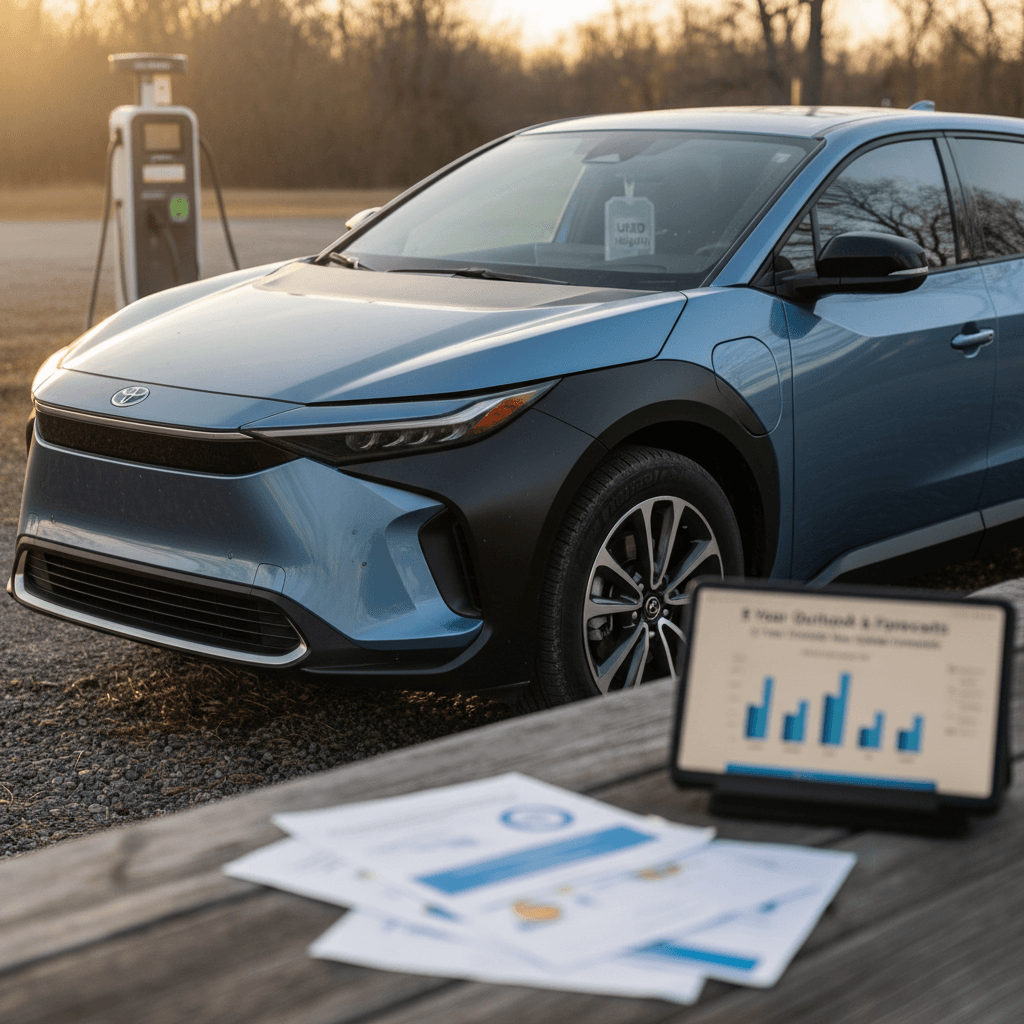
If you follow Toyota, you’re used to seeing its vehicles at the top of every resale ranking. The Toyota bZ4X resale value forecast tells a very different story. Early numbers show this electric SUV depreciating far faster than Toyota’s hybrids and gas crossovers, yet that may create opportunities if you’re shopping used.
Key takeaway
Why Toyota bZ4X resale value looks different from Toyota norms
Historically, Toyota products have been depreciation darlings. Hybrids like the RAV4 Hybrid, Prius, and Corolla Hybrid routinely post five‑year losses in the low‑30% range, with some trims holding nearly 70% of their original value after five years. The bZ4X breaks that pattern for a few reasons:
- It’s Toyota’s first mass‑market EV, so buyers are still testing the brand’s long‑term EV credentials.
- Early bZ4X range and charging specs trail key rivals, which matters a lot in today’s EV market.
- Aggressive lease deals and incentives on new EVs have pulled used values down faster than usual.
- The broader used‑EV market has reset as more inventory hits the lanes and buyers price in rapid tech change.
Toyota badge ≠ guaranteed high resale
Current data: what we know about bZ4X depreciation so far
What the numbers say today
Different data providers slice the numbers in different ways, but the pattern is consistent: the bZ4X is depreciating faster than Toyota’s hybrids and slightly faster than the brand’s overall average. Five‑year forecasts land in the mid‑40% depreciation range in aggregate, with some more pessimistic three‑year snapshots pushing closer to a 50% value drop for early model years.
Auction reality check
Five-year Toyota bZ4X resale value forecast
Looking ahead from early 2026, a reasonable Toyota bZ4X resale value forecast over five years has to blend hard data with a dose of market judgment. Below is a directional view for mainstream trims assuming typical mileage, clean history and no major economic shock.
Illustrative 5‑year Toyota bZ4X resale value forecast
Approximate retained value as a percentage of original MSRP, assuming 12,000 miles per year and average condition. These are directional ranges, not price guarantees.
| Model year at purchase | Age in 2026 | Forecast at 3 years | Forecast at 5 years | Comment |
|---|---|---|---|---|
| 2023 bZ4X (first owners) | 3 years now | 45–55% of MSRP | 35–45% of MSRP | First wave hit hardest by early EV price resets. |
| 2024 bZ4X | 2 years | 50–60% | 40–50% | Slightly better as incentives stabilize. |
| 2025–2026 bZ4X | 1 year or new | 60–70% | 45–55% | Benefit from refined product and more mature EV demand. |
Forecasted value retention is weaker than Toyota hybrids but broadly in line with many non‑Tesla EVs.
Forecast, not a promise
Factors that will shape future bZ4X resale values
Major drivers of Toyota bZ4X resale value
Some you can control, some you can’t, but all of them move prices.
Battery longevity
Charging speed & network
Technology pace
Incentives & interest rates
Supply vs. demand
Policy and fuel prices
bZ4X vs other Toyota models and rival EVs
Toyota vs Toyota
- RAV4 Hybrid / RAV4 Prime: Five‑year depreciation commonly in the low‑30% range. They’re near the top of the industry for value retention.
- bZ4X: Current projections point closer to mid‑40% five‑year depreciation, sometimes worse on early model years.
- Takeaway: If your goal is maximum resale value, Toyota’s hybrids still have a clear edge over the brand’s first mass‑market EV.
bZ4X vs other EVs
- Non‑Tesla EVs: Many mainstream EVs lose 45–55% of their value in five years, especially first‑gen products with modest range.
- Tesla models: Historically stronger resale, though even Teslas have seen volatility as prices and incentives move.
- Takeaway: The bZ4X is behaving more like the broader non‑Tesla EV pack than like a typical Toyota. It’s not an outlier, but it is a shift for the brand.
Good news for used‑EV shoppers
What this means if you’re buying a used bZ4X
If you’re coming to the bZ4X as a used‑EV shopper, today’s resale profile can actually work in your favor. Here’s how to use that to your advantage.
Used Toyota bZ4X buyer’s checklist
1. Target the value sweet spot
Three‑ to four‑year‑old bZ4X models often combine the steepest part of the depreciation curve with plenty of useful life. That’s where you’re most likely to see 40–50% discounts from original MSRP, depending on trim and miles.
2. Compare against new incentives
Before you commit to a used example, price it against current new‑car programs. Generous lease support on new EVs can occasionally compress the gap between new and used more than you’d expect.
3. Prioritize battery and charging history
Ask for documentation on charging habits and software updates. Favor vehicles that avoided frequent DC fast charging, were serviced on schedule and have no open recalls.
4. Look beyond odometer readings
Mileage matters, but so does <strong>use pattern</strong>. A low‑mile vehicle that sat for long stretches at high state‑of‑charge in hot climates may be worse for the battery than a higher‑mile commuter car charged conservatively.
5. Get independent battery health data
Whenever possible, use third‑party diagnostics or a service such as Recharged’s <strong>Recharged Score battery health report</strong> to see real‑world capacity and degradation trends before you buy.
6. Shop multiple trims and powertrains
AWD and Limited trims carry higher original MSRPs. Because depreciation is a percentage of price, they can sometimes be relative bargains used, if the extra equipment and performance matter to you.
How Recharged can help you shop smart
What this means if you own or lease a bZ4X today
Current depreciation trends are a mixed bag for existing owners. If you bought early at full sticker, the paper loss today may look steep. But if you’re in a favorable lease or you picked up the vehicle with strong incentives, you may still be in decent shape.
- If you’re leasing, check the residual value in your contract. In some cases, market values have dipped below preset residuals, making it smarter to walk away rather than buy out the lease.
- If you own, focus on total cost of ownership, not just resale. Low maintenance, no fuel and potential electricity savings still matter over the life of the vehicle.
- If you’re considering selling, get multiple offers, online instant offers, local dealers and EV‑focused marketplaces, to see who’s closest to true market money.
Timing a sale or trade
How battery health affects bZ4X resale value
In the EV market, battery health is the new mileage. For a bZ4X, two identical vehicles on paper, same year, trim and odometer, can be thousands of dollars apart in value if one shows stronger remaining battery capacity.
Ways battery health moves the value needle
These are the questions savvy buyers and dealers are asking.
Degradation so far
Charging behavior
Documentation & warranty
Why marketplace reports matter
Practical pricing benchmarks by model year
Exact pricing will always depend on spec, mileage and region, but it’s useful to know roughly where different model years sit relative to original MSRP. Use this as a starting point before you pull live comps.
Directional bZ4X value benchmarks vs. original MSRP
Very rough, national‑level guide to where typical transaction prices often land for clean examples as of early 2026. Always check real‑time local data before pricing a specific vehicle.
| Model year | Typical age in 2026 | Common market position | Approx. % of original MSRP |
|---|---|---|---|
| 2023 | ≈3 years | Often advertised in the high‑$20Ks to low‑$30Ks for mainstream trims, depending on miles. | ~45–55% |
| 2024 | ≈2 years | Generally listed mid‑$30Ks to low‑$40Ks, again with wide spread by trim and mileage. | ~55–65% |
| 2025 | ≈1 year | Many still near new‑car pricing, but discounts appear on higher‑trim or higher‑mile units. | ~65–75% |
Local market conditions, tax credits and trim differences can move any one vehicle well outside these bands.
Watch out for stale listings
FAQ: Toyota bZ4X resale value forecast
Frequently asked questions about Toyota bZ4X resale value
The Toyota bZ4X is writing a new chapter for a brand long associated with rock‑solid resale value. Early depreciation has been steeper than Toyota’s hybrids, but that’s more a reflection of the broader EV learning curve than a verdict on the nameplate’s future. For buyers, it creates chances to step into a modern electric Toyota at a meaningful discount; for owners, it’s a reminder to manage battery health, watch product updates and treat resale as one piece of a longer cost‑of‑ownership story. However you approach the bZ4X, bringing EV‑specific data, especially on the battery, into the conversation is the best way to protect your wallet when it’s time to sell or trade.