If you’re considering a Mercedes EQB, especially a used one, your monthly payment is only part of the story. Mercedes EQB insurance rates by age can swing by thousands of dollars a year between a 22‑year‑old and a 45‑year‑old with the same SUV, coverage limits, and ZIP code. Understanding how that curve looks before you buy can save you real money and a lot of surprise.
Quick context
Overview: How age affects Mercedes EQB insurance
Insurers don’t publish a public rate chart that says, “Here’s the official Mercedes EQB insurance rate by age.” Instead, they start from broad average car insurance rates by age and then adjust for the specific vehicle, your driving record, and dozens of other factors.
Typical full-coverage car insurance by age (all vehicles, U.S. averages)
Those numbers are for all cars combined. The Mercedes EQB is a luxury electric SUV, so expect your rate to sit above those general averages. National data puts a 2024 Mercedes‑Benz EQB’s average annual insurance cost around the high‑$2,000s for a typical adult driver. Younger drivers and high‑cost states can easily see figures north of $3,500 a year.
These are directional, not quotes
How much to budget for EQB insurance by age group
To make this practical, let’s translate the national averages and what we know about EV and luxury pricing into rough EQB insurance budgets by age group. We’ll assume full‑coverage policies (liability, comprehensive, and collision) with typical limits for a clean‑record driver in a moderate‑cost state.
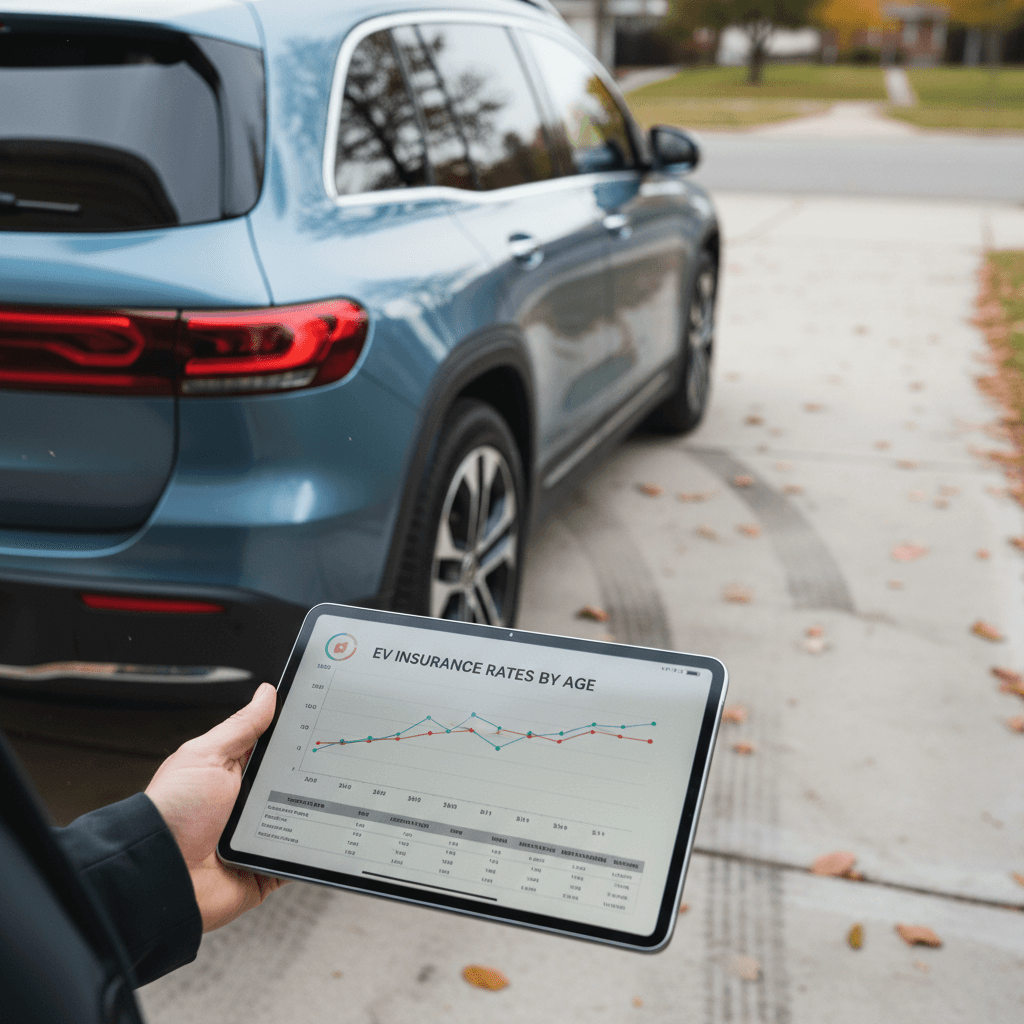
Estimated Mercedes EQB annual insurance cost by age
Rough planning ranges for a Mercedes EQB with full coverage. Real quotes will vary by state, credit, usage, and more.
| Driver age | How insurers view you | Typical full-coverage range for EQB | Monthly equivalent |
|---|---|---|---|
| 18–21 | Highest risk, very limited experience | $3,800 – $5,500+ | $315 – $460+ |
| 22–24 | Still young, but a bit more history | $3,200 – $4,500 | $265 – $375 |
| 25–29 | Risk starts to fall; many see first big drop | $2,700 – $3,800 | $225 – $320 |
| 30–39 | Prime years: good experience, still sharp | $2,400 – $3,400 | $200 – $285 |
| 40–54 | Often the most favorable pricing window | $2,200 – $3,200 | $185 – $265 |
| 55–64 | Still solid, but some carriers start inching up | $2,200 – $3,300 | $185 – $275 |
| 65–74 | More variability by state and insurer | $2,300 – $3,600 | $190 – $300 |
| 75+ | Higher claims frequency; rates can climb | $2,600 – $4,000+ | $215 – $335+ |
Use this as a budgeting tool before you shop for quotes or a used EQB.
How to read this table
Example: younger EQB driver
A 24‑year‑old with a clean record, 2024 EQB 250+, and full coverage might see quotes between $3,200 and $4,500 per year depending on location and credit tier. Add one at‑fault accident, and that could jump another $800–$1,200.
On Reddit, it’s not unusual to see early‑20s EQB drivers paying well over $500 a month when the policy also covers a second vehicle or sits in a high‑cost metro area.
Example: mid‑career EQB driver
A 45‑year‑old insuring a 2‑ to 3‑year‑old EQB with a clean record might be closer to $2,200–$2,900 per year, especially if they bundle home and auto and drive a moderate annual mileage.
That’s closer to $185–$240 a month, often less than some mainstream gas SUVs in the same driveway.
Why electric SUVs like the EQB cost what they do to insure
To understand your EQB quote, it helps to know how insurers see the vehicle itself. They aren’t just reacting to the Mercedes badge; they’re looking at what it costs to put the SUV back on the road after a loss and how often drivers of that model tend to file claims.
Key EQB traits that push premiums up or down
These are baked into the vehicle before your age and driving history even enter the picture.
High repair and battery costs
EV‑specific parts, high‑voltage batteries, and ADAS sensors in the bumpers and grille make collision repairs more expensive than a basic gas crossover.
Strong safety and crash tech
Advanced driver‑assistance systems (automatic emergency braking, lane keeping, blind‑spot assist) help reduce some types of crashes and can temper premiums.
Luxury positioning and value
The EQB’s MSRP and replacement cost are higher than many mainstream compact SUVs. That pushes comprehensive and collision premiums higher, especially when the vehicle is new.
On top of that, insurers are still digesting long‑term EV repair data. Some carriers assume worst‑case scenarios on battery or electronics damage, which is part of why EVs as a group often carry higher premiums than comparable internal‑combustion vehicles.
Used EQB advantage
Beyond age: The other levers that move your EQB premium
Age is one of the biggest predictors of claim frequency, but it’s far from the only variable. Two 35‑year‑old EQB drivers can see premiums that differ by $1,000 or more per year.
- ZIP code and garaging: Dense urban areas with higher theft and accident rates cost more than quiet suburbs. Street parking is usually pricier than a locked garage.
- Driving record: At‑fault accidents, speeding tickets, and DUIs all rack up surcharges. Clean records are rewarded most in your 30s, 40s, and 50s.
- Annual mileage and usage: A 6,000‑mile‑per‑year commuter may pay less than a 15,000‑mile road warrior in the same EQB.
- Credit‑based insurance score (where allowed): In many states, lower credit correlates with higher premiums, regardless of age.
- Coverage levels and deductibles: Higher liability limits and low deductibles increase premiums; stepping up deductibles can trim costs if you can afford out‑of‑pocket repairs.
- Policy structure: Multi‑car and home/auto bundles can knock 10–20% off, especially for established households. Telematics "usage‑based" programs can help responsible younger drivers prove their low‑risk habits.
Don’t copy someone else’s number
Strategies to lower EQB insurance rates at every age
You can’t change your date of birth, but you have more control than you might think over how insurers perceive your risk, especially if you’re moving from a higher‑risk age band into your 30s and 40s.
Age‑specific ways to tame your EQB premium
Tactics that tend to work best in each life stage.
Under 25: Prove you’re not a statistic
- Opt into telematics programs that score your real driving behavior.
- Take an approved defensive‑driving course for a discount where offered.
- Stay on a parent’s multi‑car policy if it’s cheaper than a solo policy.
- Avoid performance‑oriented trims; a front‑drive EQB 250+ is often cheaper to insure than higher‑output variants.
25–40: Leverage your clean history
- Ask your agent to re‑shop your policy after major life events, marriage, home purchase, or a move to a lower‑risk ZIP code.
- Bump deductibles slightly if you have an emergency fund.
- Bundle home or renters insurance with your EQB for multi‑policy discounts.
- Keep claims small and infrequent; sometimes it’s better to pay out of pocket than file a minor claim.
40–60: Maximize household discounts
- Consolidate all household vehicles with one carrier if the math works.
- Ask about low‑mileage or "pleasure use" classifications if you’ve cut back on commuting.
- Review coverage on older vehicles; you may not need full collision on every car.
- Maintain excellent credit, this is often when carriers reward top‑tier scores most.
60+: Protect discounts and watch for age creep
- Take a mature‑driver safety course if your state offers a mandated discount.
- Re‑shop your EQB policy every couple of years as some carriers quietly raise senior rates faster than others.
- Consider simplifying your fleet, dropping a rarely used second vehicle can lower overall premiums.
- Ensure your medical payments and uninsured/underinsured motorist coverage are strong; they matter more as healthcare costs rise.
Where Recharged fits in
Ready to find your next EV?
Browse VehiclesUsed Mercedes EQB buyers: Insurance and total cost of ownership
If you’re shopping used rather than new, you’re already thinking smartly about total cost of ownership. Insurance is a major line item in that calculation, especially for a premium EV.
How age of the EQB affects insurance
- Vehicle value falls over time, which typically lowers comprehensive and collision premiums for 2‑ to 5‑year‑old EQBs versus brand‑new ones.
- Some carriers begin offering more refined EV pricing as they see real‑world repair costs on earlier model years.
- Safety tech is still current on relatively young EQBs, which helps keep claim severity in check.
How your age interacts with vehicle age
- A 30‑year‑old in a 3‑year‑old EQB might pay similar insurance to a 25‑year‑old in a brand‑new one.
- Middle‑aged buyers often see the best blend: lower vehicle value plus their most favorable risk band.
- Seniors can use a slightly older EQB to soften the impact of age‑related surcharges.
At Recharged, every used EQB listing includes a Recharged Score battery‑health report and transparent pricing. That same discipline helps when you talk to your insurer; you can accurately represent the vehicle’s condition, mileage, and typical use, details that can support a lower‑risk profile if you drive modestly.
Checklist: What to do before you shop EQB insurance
Pre‑quote EQB insurance checklist
1. Decide on coverage limits and deductibles
Write down realistic liability limits (for example, 100/300/100), comprehensive and collision choices, and deductibles you could truly afford after a loss. This makes comparing quotes apples‑to‑apples.
2. Estimate your annual mileage
Insurers will ask how much you drive. If your used EQB will mainly handle local errands and school runs, be honest, low‑mileage use can qualify for lower rates.
3. Gather driver and vehicle details
Have driver’s license numbers, prior insurer information, VIN or at least year/trim of the EQB, garaging address, and any safety features handy so you’re not guessing mid‑quote.
4. Pull your recent driving record in mind
Know roughly when any tickets or accidents occurred. Many surcharges fall off after three to five years, and you’ll want to be sure your quotes reflect that.
5. Check your credit and fix easy issues
Where credit‑based scoring is legal, cleaning up small errors or paying down revolving balances can nudge you into a better tier before you ask for quotes.
6. Shortlist at least three insurers
Include a mix of big national brands and strong regional carriers. For EVs, ask specifically how they price electric vehicles and whether they offer EV‑friendly perks like OEM‑part guarantees.
Mercedes EQB insurance FAQ
Frequently asked questions about Mercedes EQB insurance by age
Key takeaways for EQB insurance by age
When you zoom out, Mercedes EQB insurance follows the same age curve as the broader market, very high in your teens and early 20s, improving through your 30s and 40s, then leveling off and inching up again later in life. The difference is that the EQB starts from a slightly higher base thanks to its status as a luxury EV. If you understand where you sit on that curve, shop multiple carriers, and choose the right used EQB with the help of tools like the Recharged Score, you can keep premiums in check and enjoy the benefits of electric driving without blowing up your total cost of ownership.
Whether you’re a 24‑year‑old moving into your first premium EV or a 55‑year‑old downsizing into an efficient electric SUV, the smartest move is to run the numbers before you sign. Recharged can help you compare used EQB options, estimate realistic insurance ranges for your age and profile, line up financing, and even deliver the car to your driveway, so the only surprise is how easy the transition to electric can be.