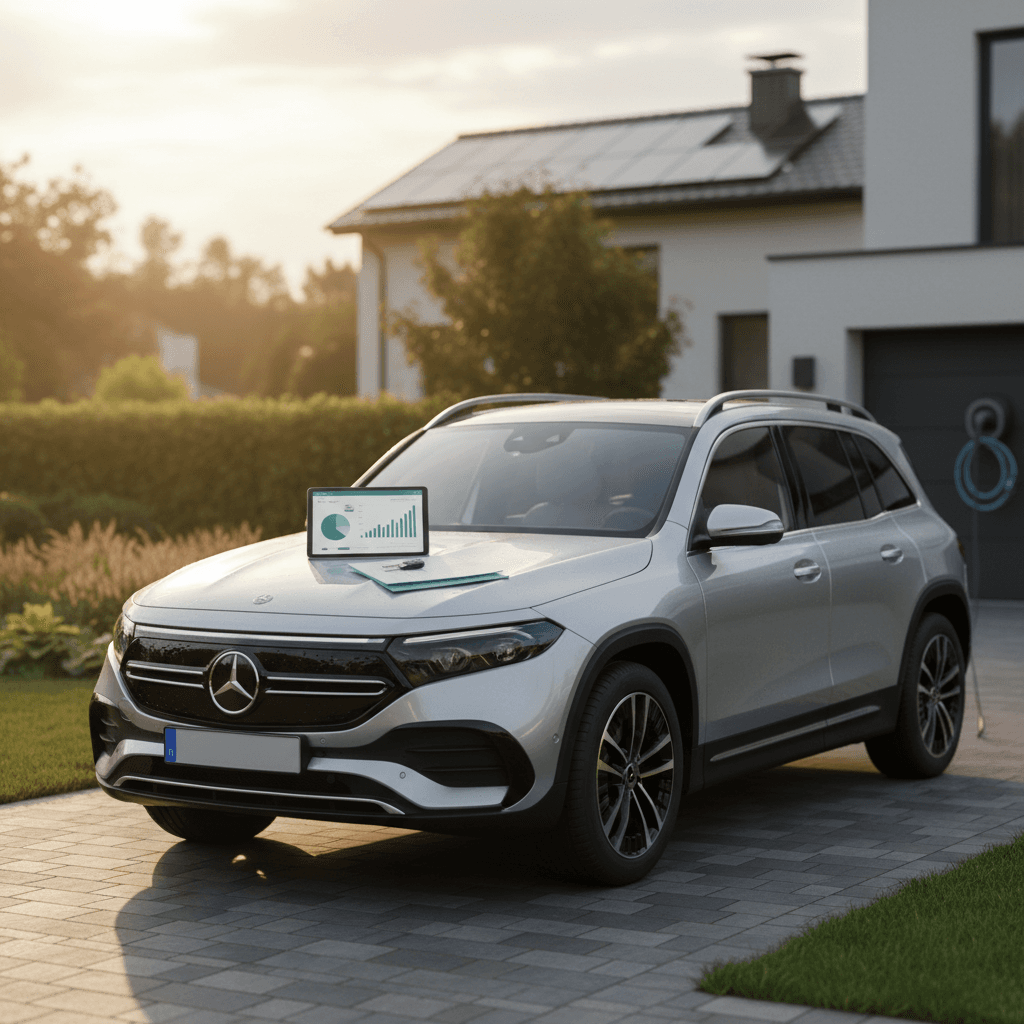
If you’re cross-shopping electric SUVs, you’ve probably noticed one number that jumps around more than any other: monthly insurance cost. The Mercedes EQB is no exception. Understanding the Mercedes EQB insurance cost per month, and what actually drives it, can be the difference between a comfortable payment and a budget surprise.
Quick answer
Average Mercedes EQB insurance cost per month
Let’s anchor the discussion with the best available national data. Insurance.com’s model-specific analysis pegs the average cost to insure a Mercedes-Benz EQB at about $2,900–$2,950 per year, or roughly $240–$245 per month for a full-coverage policy. That assumes a typical driver profile (clean record, average credit, standard limits).
Mercedes EQB insurance at a glance
Keep in mind: these are benchmarks, not promises. Actual EQB premiums vary widely. Insurers weigh everything from your ZIP code and annual mileage to whether your EQB is a 250+ or 350 4MATIC and how you use it (commuting vs. business, rideshare, etc.).

Why Mercedes EQB insurance is higher than average
Electric vehicles as a group still cost more to insure than comparable gas models. Recent industry studies show EV insurance averaging around 10–20% higher than similar gasoline cars, with some analyses finding gaps close to 49% in certain segments. The EQB sits in the middle of that pack: not the most expensive EV to insure, but firmly above the mainstream-compact-SUV average.
What pushes EQB insurance above a gas SUV
You’re paying to protect a luxury EV, not just a compact crossover
Expensive components
Specialized repairs
Luxury positioning
Sticker shock risk
What really moves your EQB insurance rate
Insurers don’t price your Mercedes EQB in a vacuum. They start with the vehicle’s risk profile, then adjust based on everything they know about you. Here are the levers that matter most if you’re trying to predict (or reduce) your Mercedes EQB insurance cost per month.
Key factors that shape EQB premiums
1. Where you live and park
Urban areas with more congestion, theft, and higher medical costs tend to have <strong>much higher EQB insurance rates</strong> than suburban or rural ZIPs. Street parking vs. a locked garage can also move the needle.
2. Driving history and mileage
A clean record with low annual mileage (e.g., 7,500–10,000 miles a year) can trim your premium substantially. A couple of at-fault accidents or speeding tickets can easily add <strong>$50+ per month</strong> to a luxury EV policy.
3. Coverage limits and deductibles
Full coverage with higher liability limits and low deductibles (e.g., $500) will cost more than state-minimum liability and $1,000–$2,000 deductibles. If your budget is tight, adjusting these numbers is the fastest way to alter the monthly bill, just don’t underinsure yourself.
4. EQB trim and value
An EQB 250+ with front-wheel drive and fewer options is typically cheaper to insure than a loaded EQB 350 4MATIC with AMG Line and big wheels. Higher replacement cost and more performance generally equal higher premiums.
5. Credit-based insurance score (in most states)
In many U.S. states, insurers legally use a credit-based score to predict claim risk. Strong credit can unlock better EQB rates; weak credit can push you toward the upper end of the monthly range, even with a clean driving record.
6. How you use the EQB
Personal commuting is standard. Add-ons like <strong>business use or rideshare</strong> can push your rate significantly higher because the EQB spends more time on the road in higher-risk scenarios.
Quote like-for-like coverage
Monthly cost examples for different EQB drivers
Because EQB insurance is so sensitive to personal details, it helps to think in scenarios instead of a single “average.” Below are hypothetical but realistic examples based on current market data and typical underwriting behavior. All assume a full-coverage policy on a relatively new EQB.
Sample monthly Mercedes EQB insurance scenarios
Illustrative ranges only, your quotes may differ by state and insurer.
| Driver profile | Location | EQB type | Driving record | Estimated monthly premium |
|---|---|---|---|---|
| “Ideal” driver | Suburban Ohio | 2024 EQB 250+ | Clean, 10k mi/yr | $170–$210 |
| Young urban professional | Los Angeles, CA | 2025 EQB 300 4MATIC | 1 minor speeding ticket | $260–$330 |
| Family driver | Dallas, TX | 2023 EQB 350 4MATIC | Clean, 12k mi/yr | $210–$260 |
| High-risk driver | Miami, FL | 2022 EQB 250+ | 2 at-fault accidents | $320–$450 |
| Retiree, low mileage | Raleigh, NC | 2023 EQB 250+ | Clean, 5k mi/yr | $150–$190 |
All examples assume full coverage with reasonable limits; liability-only policies will be cheaper but offer far less protection.
If your personal quotes are markedly higher than these bands with no obvious risk factors, it’s a sign to shop multiple carriers or work with a broker who understands EVs. Some mainstream insurers still price EVs conservatively because they lack enough long-term claims data.
How new vs. used EQB changes your insurance bill
A new EQB and a three-year-old EQB may look identical in your driveway, but they don’t look the same to an underwriter. As the vehicle’s market value drops, comprehensive and collision coverage get cheaper, which usually pulls your monthly premium down too.
New or nearly new EQB (0–2 years)
- Higher vehicle value means more expensive comprehensive and collision coverage.
- Lenders typically require full coverage, so you have less flexibility to reduce or drop coverage.
- Advanced options like large wheels, panoramic roof, and AMG Line can all nudge your premium up.
For many buyers, that means landing closer to $225–$275 per month for full coverage, especially in higher-cost states.
Used EQB (3–6 years)
- Lower market value can bring meaningful savings on physical-damage coverage.
- You can decide whether full coverage still makes sense vs. liability-only, based on replacement cost and risk tolerance.
- Some insurers also give small discounts for vehicles equipped with specific safety and ADAS features, regardless of age.
For a healthy used EQB, many drivers see premiums in the $170–$230 per month range, all else equal.
Where Recharged fits in
Ways to lower your Mercedes EQB insurance cost per month
You can’t change that the EQB is a luxury EV, but you have more control over your premium than you might think. Insurers reward low-risk behavior, clear documentation, and vehicles that are easier to repair and harder to steal.
Practical strategies to cut EQB insurance costs
Start with the levers that don’t require lifestyle changes
Fine-tune your coverage
Stack discounts
Improve where and how you park
Limit annual mileage
Clean up your record
Shop insurers that like EVs
Be careful dropping coverage
How EQB insurance compares to other EV SUVs
From an insurer’s standpoint, the EQB sits in a crowded class of compact and midsize luxury EV SUVs, think Tesla Model Y, Audi Q4 e‑tron, Volvo XC40 Recharge, Cadillac Lyriq. Across that group, premiums are consistently higher than for mainstream gas crossovers, but not all EVs are priced the same.
EQB insurance vs. other EV crossovers (ballpark averages)
Representative, not exhaustive; assumes broadly similar driver profiles and full-coverage policies.
| Model | Segment | Typical annual premium | Typical monthly premium |
|---|---|---|---|
| Mercedes-Benz EQB | Luxury compact EV SUV | $2,700–$3,100 | $225–$260 |
| Tesla Model Y | Luxury compact EV SUV | $2,900–$3,400 | $240–$285 |
| Audi Q4 e‑tron | Luxury compact EV SUV | $2,600–$3,000 | $215–$250 |
| Volvo XC40 Recharge | Premium compact EV SUV | $2,500–$2,900 | $210–$240 |
| Mainstream gas compact SUV | Non-luxury (RAV4/CR‑V class) | $1,900–$2,300 | $160–$195 |
These are generalized ranges; specific vehicles and states can land outside them.
The EQB isn’t the outlier
Fitting EQB insurance into total cost of ownership
Insurance is just one line on the EQB ownership spreadsheet. You’re also trading gasoline for electricity, reducing routine maintenance (no oil changes, fewer moving parts), and potentially qualifying for EV-related incentives depending on where you live.
Costs that go up with an EQB
- Insurance premiums: often 10–20% higher than a similar gas SUV, sometimes more.
- Collision and comprehensive: pricier components and repairs keep these line items elevated.
- Financing costs: if you’re buying new, higher sticker price can mean a bigger loan payment.
Costs that go down
- Fuel: electricity typically undercuts gasoline on a per‑mile basis, especially with off-peak home charging.
- Maintenance: no oil, fewer fluids, and fewer wear items can mean fewer shop visits.
- Depreciation on used EQBs: buying used shifts a chunk of depreciation to the first owner, smoothing your total cost of ownership.
This is where the used market starts to look interesting. A well-priced used EQB with strong battery health, confirmed by something like a Recharged Score report, can give you much of the new-EQB experience with a lower purchase price and slightly lower insurance bill. For many buyers, that combination pulls total monthly EV costs back in line with what they were paying to run a premium gas SUV.
Mercedes EQB insurance FAQ
Frequently asked questions about Mercedes EQB insurance
Key takeaways on EQB insurance costs
- Most drivers will see a Mercedes EQB insurance cost per month in the $200–$250 range for full coverage, with significant variation by state and driver profile.
- The EQB’s status as a luxury electric SUV means higher premiums than a typical gas compact SUV, but it’s broadly comparable to other luxury EV crossovers.
- Your biggest levers are location, driving record, coverage limits, and vehicle value. New, highly optioned EQBs will cost more to insure than older, simpler trims.
- Buying a used EQB with verified battery health can reduce both your payment and your insurance, smoothing out total cost of ownership.
- Shopping multiple insurers, ideally those comfortable with EVs, plus stacking discounts and right-sizing coverage is the most reliable way to pull your monthly EQB premium down without sacrificing protection.
If you’re weighing a Mercedes EQB against other EVs, or against your current gas SUV, build insurance into the math early. A realistic view of your monthly premium, paired with transparent information on vehicle condition and battery health, will tell you whether the EQB fits your budget today and five years from now. And if you’re exploring a used EQB, Recharged can help you compare vehicles, financing, and long-term ownership costs side by side so you’re not surprised when the first renewal notice hits your inbox.