If you own or are eyeing a used Mercedes EQB, depreciation is probably your biggest financial question. In 2026, the Mercedes EQB depreciation rate looks a lot like the rest of the luxury EV market: faster than comparable gas SUVs, but also packed with opportunity if you’re buying used at the right point in the curve.
Key context for 2026
Mercedes EQB depreciation in 2026: the short version
Where the Mercedes EQB sits in 2026
Because the EQB is a compact luxury electric SUV, it follows the broader luxury EV pattern rather than gas Mercedes GLB‑Class models. In practice, that means a steeper slide in the first 3–4 years, then a flatter curve once the first owner has absorbed most of the hit.
Not all EQBs depreciate the same
How fast does a Mercedes EQB depreciate?
To understand the Mercedes EQB depreciation rate in 2026, you need to look at two things: general EV trends and what the market is paying for actual 2022–2024 EQBs today. Industry data this year shows that electric SUVs in the EQB’s price class are typically losing around half their value in the first three years, with luxury-branded EVs at the higher end of that range.
- Many luxury EVs are showing roughly 50–60% depreciation by year 3.
- By year 5, total depreciation of 60–70% is now common for upscale EV crossovers.
- The EQB’s original transaction price (often in the mid‑$50,000s with options) means even a “normal” percentage loss translates into a big dollar number.
This lines up with early real‑world data for the EQB. Before incentives, a well‑equipped 2023 EQB could easily sticker in the low‑to‑mid $50,000s. By spring 2026, typical used values on mainstream trims are often landing in the mid‑$20,000s to low‑$30,000s range with average mileage, which implies roughly 45–55% depreciation in three years, depending on how the original deal was structured.
Look at transaction prices, not just MSRP
3-year and 5-year depreciation forecasts for the EQB
No one can quote a guaranteed future value, but 2026 data on electric SUVs and luxury EVs gives us a reasonable forecast band for the Mercedes EQB. Think in terms of *ranges* and scenarios, not single numbers.
Indicative Mercedes EQB depreciation scenarios
Illustrative 3‑ and 5‑year value paths for a Mercedes EQB that originally transacted around $55,000. These are directional examples, not appraisals.
| Scenario | Assumptions by Year 3 | Approx. 3‑yr Value | Approx. 5‑yr Value | Total 5‑yr Depreciation |
|---|---|---|---|---|
| Conservative (slower drop) | Healthy battery, below‑average miles, strong demand region, tech still competitive | $30,000–$32,000 (≈42–45% depreciation) | $22,000–$24,000 | ≈55–60% |
| Base case (most common) | Average miles, normal wear, solid battery report, mix of trims | $26,000–$30,000 (≈45–53% depreciation) | $18,000–$22,000 | ≈60–67% |
| Aggressive (faster drop) | High miles, weaker demand region, older tech vs new EVs, cosmetic issues | $22,000–$25,000 (≈55–60% depreciation) | $14,000–$17,000 | ≈70%+ |
Actual results will vary by trim, mileage, region, equipment, and battery health.
In other words, a typical 3‑year‑old EQB that cost around $55,000 new may realistically transact for something like $26,000–$30,000 in 2026 if it’s clean and reasonably equipped. By year five, many EQBs will likely live in the high‑teens to low‑$20,000s, especially as newer rivals bring more range and tech at similar prices.
How does that compare to gas SUVs?
Why luxury EVs like the EQB depreciate so quickly
Four forces pushing EQB values down faster
Most apply to other luxury EVs as well, but the EQB sits right in the crosshairs.
1. Fast‑moving battery and range tech
Each model year, newer EVs add range, faster charging, or better efficiency. When a new 2026–2027 compact EV SUV offers significantly more range or DC fast‑charging speed than an earlier EQB, used buyers expect a discount to compensate.
2. Big new‑car incentives and discounts
Factory incentives, dealer discounts, and federal/state EV credits can carve thousands off new‑car transaction prices. If a 2026 buyer can get a heavily incentivized new EV for not much more than a 2–3‑year‑old EQB, that caps what the market will pay for used.
3. Range anxiety and uncertainty
Some shoppers still worry about range, cold‑weather performance, and long‑term battery life. That perceived risk, fair or not, pushes values lower than they might be if buyers had full confidence in 8–10 years of trouble‑free battery life.
4. Rapid model and policy changes
Regulations, charging‑standard shifts, and new trim mixes can make last year’s tech feel dated quickly. When an updated EQB or rival offers better charging network access or software, the older version has to be priced aggressively to sell.
What this means for first owners
Real‑world price examples for 2022–2024 EQB models
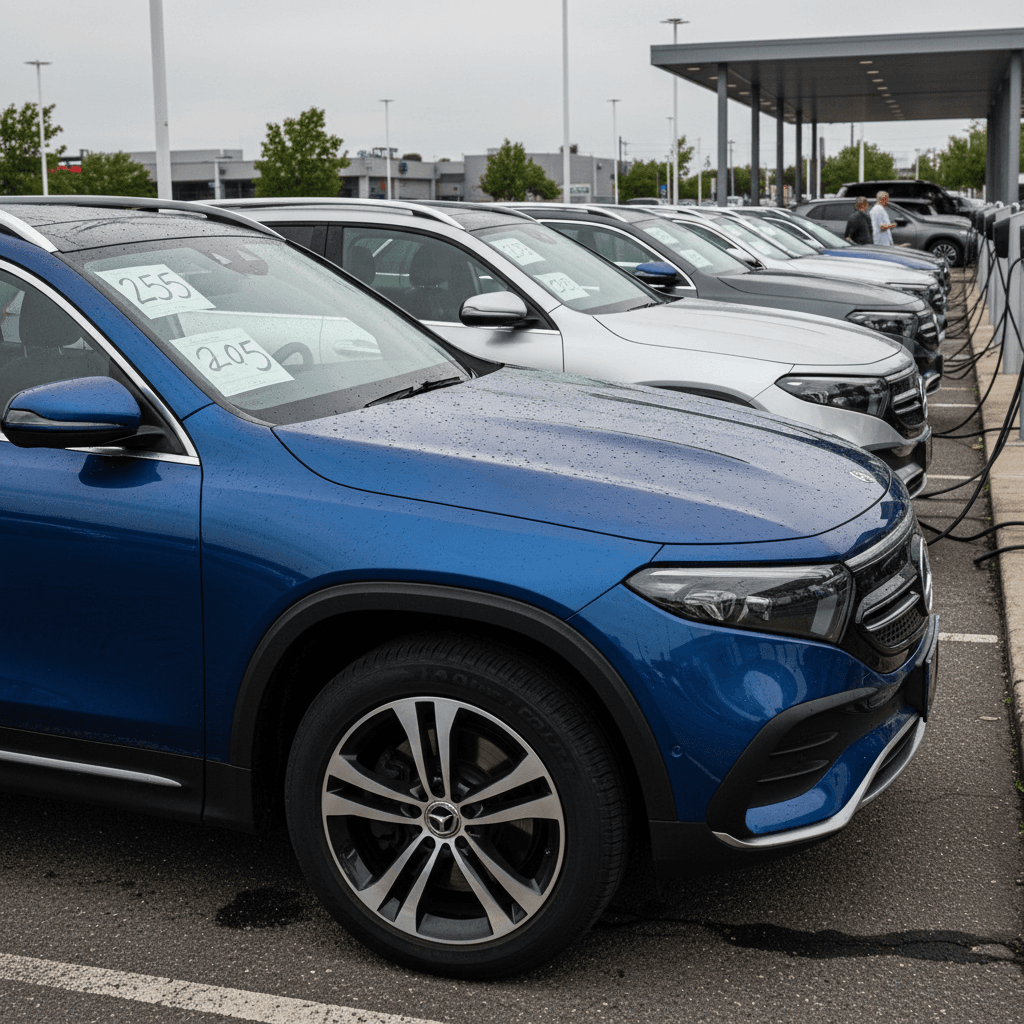
Retail listings, trade‑in tools and auction data all tell a similar story for early‑run EQBs in the U.S. market. While exact prices move month to month, patterns are emerging:
- Clean 2023 EQB 250+ and 300 models with average miles commonly list in the upper‑$20,000s to low‑$30,000s depending on options and region.
- Lower‑mileage, heavily optioned EQB 350 4MATIC examples can push higher, but face stiff competition from newer EVs with more range and updated tech.
- Trade‑in and auction values are often several thousand below retail asking prices, especially when dealers anticipate reconditioning costs or soft local demand.
The upshot: for a shopper in 2026, it’s increasingly normal to find 2‑ to 3‑year‑old EQBs advertised for roughly 45–55% below their original MSRP, sometimes even more if they were richly optioned when new or if the local market is saturated with luxury EV crossovers.
Why this is good news for used‑EV buyers
How battery health impacts EQB resale value
No single factor spooks or reassures used‑EV shoppers more than battery health. Two EQBs with the same model year and mileage can be worth very different amounts if one shows strong remaining capacity and the other looks tired or inconsistent.
What buyers look for
- State of health (SOH) score: Objective diagnostics showing how much capacity the pack still has compared with new.
- Charging history: Frequent DC fast‑charging and repeated 100% charges can accelerate degradation in some use patterns.
- Range consistency: Does the real‑world range still align reasonably with what the car reports?
- Warranty coverage: Remaining years and mileage on Mercedes’ high‑voltage battery warranty.
How it affects price
- A healthy‑battery EQB with documentation can command a meaningful premium over a similar car with unknown history.
- Noticeable degradation or inconsistent diagnostics can push a unit thousands of dollars lower, especially in a soft EV market.
- Verified battery condition usually matters **more** to serious buyers than cosmetic blemishes or minor convenience features.
How Recharged helps here
7 ways to reduce Mercedes EQB depreciation
Practical steps EQB owners can take in 2026
1. Keep mileage in check
Depreciation models assume about 10,000–12,000 miles per year. If you routinely drive far more, expect steeper depreciation. If you drive less, highlight that in your listing and service records.
2. Stay on top of software and recalls
Make sure your EQB has the latest software updates and any recall work documented. Buyers and lenders favor vehicles that are fully up to date, especially on safety and charging‑system updates.
3. Document charging habits and battery health
Hang onto DC fast‑charging receipts, home‑charging logs (if available), and any third‑party or dealer battery health reports. A clean paper trail that shows reasonable charging behavior reassures used buyers.
4. Protect the interior and high‑touch surfaces
Luxury EV buyers care about cabins, screens, upholstery, and trim. Use floor mats, fix small cosmetic issues early, and avoid aftermarket modifications that are hard to reverse.
5. Time your sale around model updates
Major EQB refreshes, longer‑range variants, or aggressive new‑EV incentives can drag used prices down. If you know a big update is coming, consider selling a bit earlier, before the new version hits showrooms in volume.
6. Price against incentives, not just used comps
If new EVs are heavily discounted in your region, your asking price has to reflect that reality. Shoppers will compare your used EQB to what they can lease or buy new after incentives and dealer cash.
7. Sell in the right channel
Some EQBs sell better via consignment or specialty EV outlets than at generalist dealers or quick online offers. Platforms like Recharged can help you compare an instant offer vs. a consignment approach designed to maximize your net.
Is a used Mercedes EQB a smart buy in 2026?
From a value perspective, 2026 is shaping up as a favorable year to buy a used Mercedes EQB, especially if you’re stepping in after the initial 2–3‑year drop. You’re effectively letting the first owner cover the expensive part of the curve and taking over once depreciation slows down.
Pros and cons of buying a used EQB in 2026
The equation looks attractive if you understand the trade‑offs.
Pros
- Big initial discount: Many 2–3‑year‑old EQBs sell at roughly half of their original MSRP or less.
- Luxury experience at mainstream pricing: You get Mercedes build quality, safety tech, and a premium interior at a price closer to a new mainstream crossover.
- Lower future depreciation: Going from year 3 to year 7 is usually much gentler than years 0–3.
- Lower running costs: Electricity and basic maintenance still undercut comparable gas luxury SUVs in most regions.
Cons
- Technology moves fast: Newer EVs may offer more range and features at similar prices in a few years.
- Charging ecosystem still evolving: Depending on your region, public charging convenience can vary widely.
- Resale still uncertain: Luxury EV depreciation trends are stabilizing, but they’re not as predictable as long‑running gas models yet.
How Recharged can help you shop
FAQ: Mercedes EQB depreciation and resale value
Frequently asked questions about Mercedes EQB depreciation in 2026
Bottom line for EQB owners and shoppers
In 2026, the Mercedes EQB depreciation rate reflects the reality of today’s luxury EV market: strong technology, compelling ownership costs, and a resale curve that’s steeper than most gas SUVs. If you bought new in 2022–2024, depreciation is likely your single biggest ownership expense. If you’re buying used now, that same curve works in your favor, especially when you focus on 3–4‑year‑old EQBs with clean histories and verified battery health.
Whether you’re looking to sell your EQB, trade it toward another EV, or buy a used EQB at the right point in its life cycle, the key is information: real transaction data, objective battery diagnostics, and a clear view of how incentives and new‑EV pricing shape the used market. That’s exactly the problem Recharged is built to solve, pairing transparent condition reports and fair market pricing with EV‑specialist guidance, so you can make depreciation work for you instead of against you.