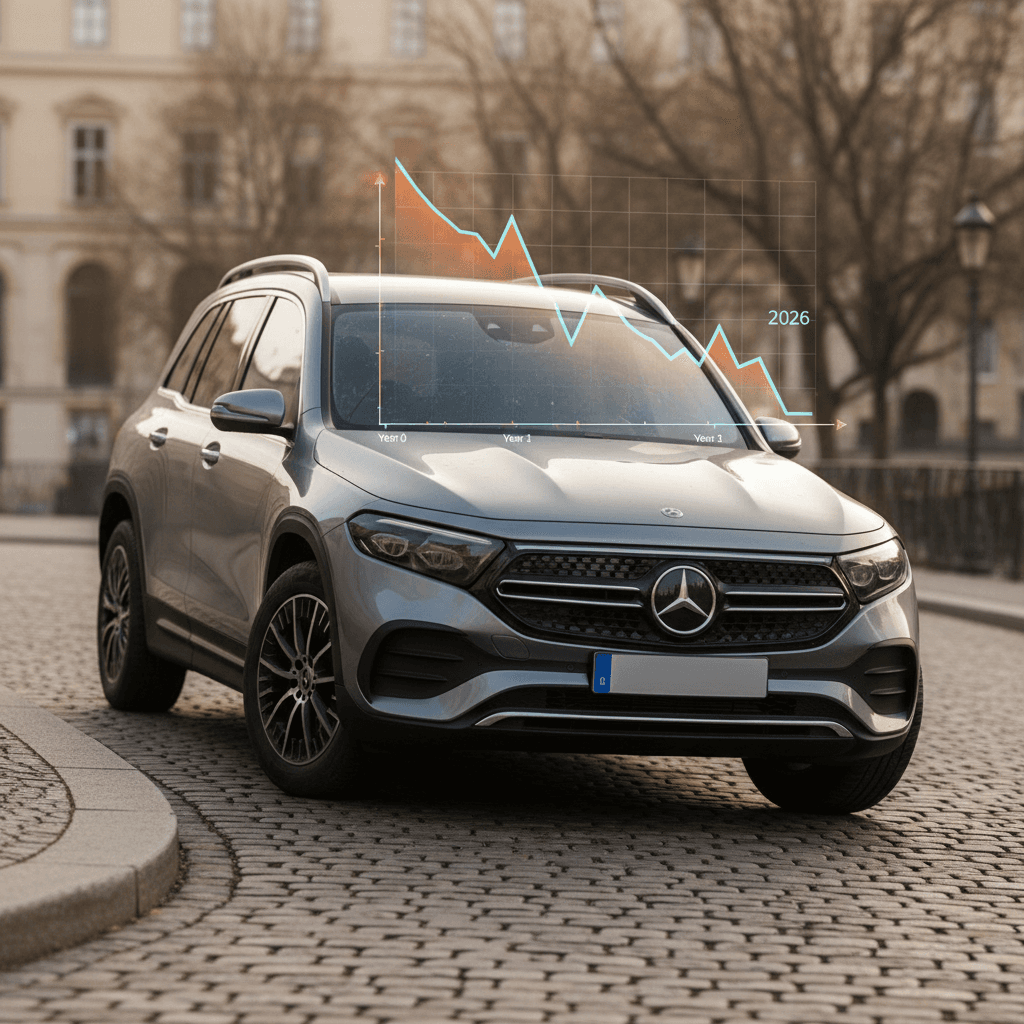
If you’re considering a Mercedes EQB, you’re probably wondering how fast it loses value. The Mercedes EQB depreciation curve over 5 years is steeper than many gas SUVs, but it’s also more predictable once you understand how incentives, battery tech, and luxury‑EV demand play together.
Key takeaway up front
Mercedes EQB depreciation at a glance
Mercedes EQB 5‑year value snapshot (directional)
Different analysts model the numbers slightly differently, but most agree the EQB lands near the middle of the luxury‑EV pack. Third‑party tools that track a Mercedes EQB 350 SUV, for example, estimate roughly 60% depreciation after 5 years, leaving a resale value around 40% of MSRP. Other market data and Recharged valuation work with KBB and listing data suggest slightly softer curves in the early years but a similar 5‑year landing zone.
Depreciation is not a guarantee
How the 5‑year EQB depreciation curve typically looks
To make the 5‑year Mercedes EQB depreciation curve practical, let’s use round numbers. Imagine a nicely equipped new EQB 350 4MATIC with an original MSRP of $60,000. Actual stickers run a little lower or higher, but this keeps the math clean.
Illustrative Mercedes EQB 5‑year depreciation curve
Approximate retained value for a $60,000 EQB. Numbers are directional, assuming normal mileage and typical incentives in today’s market.
| Vehicle age | Approx. value | % of original MSRP | What this stage feels like |
|---|---|---|---|
| 1 year | $45,000–$50,000 | 75–85% | Biggest hit is already taken, but values are still tied closely to new‑car discounts. |
| 2 years | $38,000–$44,000 | ≈65–75% | Sweet spot for shoppers who want newer tech and plenty of warranty. |
| 3 years | $32,000–$38,000 | ≈55–65% | Most of the front‑loaded luxury‑EV depreciation is behind you. |
| 4 years | $27,000–$33,000 | ≈45–55% | Battery health, range, and condition start to matter more than model‑year bragging rights. |
| 5 years | $22,000–$28,000 | ≈35–45% | The curve flattens; well‑cared‑for EQBs can still be very compelling value buys. |
These figures are estimates for planning, not appraisals. Always check live market data before buying or selling.
Think in bands, not single numbers
What really drives Mercedes EQB depreciation
6 big factors behind EQB resale value
You can’t control the market, but you can stack the odds in your favor.
1. Battery health & range
The EQB launched with competitive range, but shoppers are quickly learning to ask about real‑world battery health, not just EPA numbers. A pack that still delivers most of its original range will support stronger offers than one that’s been fast‑charged hard and driven hot miles.
2. New‑car discounts & leases
Mercedes has frequently used lease cash and dealer discounts to move EQB inventory. When a new EQB can be leased with stacked incentives or heavy discounts, used prices often move down to keep the value gap sensible.
3. Trim, options & seating
All‑wheel‑drive 300/350 models, AMG Line styling, and 3‑row seating can help resale. A base 250+ with unpopular colors or sparse options may lag a similar‑mileage EQB 350 in the used market.
4. Mileage & usage pattern
Luxury EV buyers are still mileage‑sensitive. A 3‑year‑old EQB with 18,000 miles will typically be worth significantly more than one with 45,000 miles, even if the equipment lists match.
5. Maintenance & warranty history
On‑time servicing, documented software updates, and remaining battery and high‑voltage warranty coverage make buyers more comfortable and support higher values.
6. EV market mood
Shifts in federal credits, local incentives, and competitors’ price cuts can move all EV values. If new luxury EVs suddenly get cheaper, used prices tend to follow.
Why generic "EV depreciation" charts can mislead you
Lease residuals vs real‑world EQB resale values
If you’ve shopped EQB lease deals, you’ve probably seen residuals in the mid‑40s to mid‑50s percent range for 36‑month terms, depending on miles and incentives at the time. That means Mercedes Financial is guessing an EQB will be worth around 45–55% of MSRP at lease‑end, before any market surprises.
How residuals are set
- They’re based on historical Mercedes data, segment trends, and auction results.
- They don’t fully account for sudden changes in incentives or tech leaps.
- They’re intentionally conservative to protect the lender.
What we see in the market
- Some off‑lease luxury EVs are worth less than their residuals, giving lessees an easy walk‑away.
- Others track close to residuals when production slows and demand firms.
- The EQB has generally trended closer to lease expectations than high‑dollar EQ sedans and SUVs.
Where Recharged fits in
Ready to find your next EV?
Browse VehiclesBuying a used Mercedes EQB (1–5 years old)
From a consumer‑advice standpoint, the EQB really starts to shine as a used buy between about year two and year five. By then, the first owner has shouldered the steepest portion of the depreciation curve, but the vehicle is still young enough that the battery, interior, and tech haven’t aged out of the market.
Used Mercedes EQB buying checklist
1. Start with a depreciation‑aware budget
Instead of shopping payment first, decide how much value you’re comfortable losing over your planned ownership period. A 3‑year‑old EQB you keep another 4 years might lose much less in dollar terms than a brand‑new one you keep for the same time.
2. Focus on 2–4‑year‑old examples
At this age, an EQB often retains about 55–70% of its original MSRP, which means you’re getting a meaningful discount while still enjoying current‑enough tech and active warranty coverage.
3. Pull real battery and range data
Ask for a <strong>battery health report</strong>, not just a full‑charge guess‑o‑meter screenshot. On Recharged, that’s baked into the Recharged Score so you can compare one EQB’s pack health against others.
4. Compare trims and seating layouts
An EQB 250+ might look like the bargain on paper, but if you need AWD or the optional third row, the market often rewards those features at resale time.
5. Cross‑check value guides with listings
Use tools like KBB, plus live listings from Recharged and other marketplaces, to confirm that the asking price lines up with mileage, options, and condition.
6. Think about your exit strategy
Aim to buy at a point on the curve where you can sell or trade with reasonable equity in 3–5 years. That often means <strong>buying used, not new</strong>, for a luxury EV like the EQB.
Where to find depreciation‑friendly EQBs
How to protect your EQB’s resale value
- Keep annual mileage reasonable; big outliers in either direction (very high or suspiciously low) can raise questions.
- Follow the maintenance schedule and save every service document, even tire rotations and software updates.
- Avoid aftermarket modifications that can scare off mainstream luxury buyers (wrapped trim, aggressive wheels, etc.).
- Mind the interior, three‑row EVs often serve kid duty, and heavy wear shows up quickly in photos and at appraisal time.
- Stay on top of recalls and software campaigns so your EQB looks fully up to date at sale time.
Fast‑charging habits matter
Example scenarios: new vs 3‑year‑old vs 5‑year‑old EQB
Let’s put the EQB depreciation curve into everyday language. Assume you drive about 10,000 miles per year and plan to hold the car for 5 years, starting in 2026.
Scenario A: Buy new in 2026
• Purchase a 2026 EQB for $60,000.
• In 2031 (year 5), it may be worth roughly $24,000–$28,000.
• You’ve absorbed around $32,000–$36,000 of depreciation.
Upside: You enjoy the full warranty and latest tech from day one.
Scenario B: Buy 3‑year‑old in 2026
• Buy a 2023 EQB for roughly $34,000–$38,000.
• In 2031, it might be worth $22,000–$26,000.
• You’ve taken about $10,000–$14,000 of additional depreciation.
Upside: You skip the brutal first owner hit but still own it during its “prime” years.
Scenario C: Buy 5‑year‑old in 2026
• Buy a 2021 EQB (or early build) for, say, $24,000–$26,000.
• In 2031 it might be worth $14,000–$17,000.
• Depreciation over your 5 years is roughly $8,000–$11,000.
Upside: Lowest depreciation per year, but you’re relying more heavily on how that specific car was treated.
Which scenario usually makes the most sense?
FAQ: Mercedes EQB depreciation & resale
Frequently asked questions about Mercedes EQB depreciation
Bottom line: Is the Mercedes EQB a good long‑term bet?
Viewed strictly through the lens of depreciation, the Mercedes EQB looks a lot like its luxury‑EV peers: a steep drop in the early years, then a more predictable glide path. The 5‑year EQB depreciation curve won’t thrill bargain‑hunters who insist on buying new, but it creates real opportunity for used‑EV shoppers willing to let someone else take the initial hit.
If you buy thoughtfully, aiming for an EQB that’s 2–4 years old, with strong battery health, reasonable miles, and the right equipment, you can enjoy a premium electric family SUV without signing up for the worst of the value loss. And if you want help quantifying that trade‑off, Recharged gives every EQB a Recharged Score Report with verified battery diagnostics and fair‑market pricing, plus digital‑first buying, financing, and trade‑in support to make the numbers and the process as transparent as possible.