If you’re looking at a Mercedes EQB or already own one, you’re probably wondering how fast it really charges, not just on a spec sheet, but at an actual public fast charger or your home wall box. This guide walks through a practical Mercedes EQB charging speed test, explains what you should see from 10–80% on DC fast charging, and what to expect from Level 2 home charging in everyday use.
Quick answer
Mercedes EQB charging speed at a glance
EQB charging speed snapshot (all trims)
On paper, the EQB doesn’t chase headline-grabbing numbers like some newer 800-volt EVs, but its charging profile is competitive in the compact luxury SUV class. The key is understanding what those numbers look like in the real world, and how much control you actually have over them.
EQB battery and charging specs that matter
Before we talk about charging speed tests, it helps to know what’s under the skin. Regardless of trim, recent U.S.-market EQB models share a very similar battery and charging setup.
Mercedes EQB battery & charging specs by trim (U.S.)
Key charging-related specs for popular EQB variants. Exact numbers can vary slightly by model year and wheel/tire choice, but the charging behavior is broadly similar.
| Model | Usable battery (kWh)* | EPA range (mi, approx.) | Max AC Level 2 | Max DC fast charge | 10–80% DC claim |
|---|---|---|---|---|---|
| EQB 250+ | ≈70.5 | ~250 | Up to 9.6 kW | Up to 100 kW | ~32 minutes |
| EQB 300 4MATIC | ≈70.5 | ~205 | Up to 9.6 kW | Up to 100 kW | ~32 minutes |
| EQB 350 4MATIC | ≈70.5 | ~207 | Up to 9.6 kW | Up to 100 kW | ~32 minutes |
All recent EQB trims use a ~70.5 kWh battery and support up to ~100 kW DC fast charging under ideal conditions.
About battery size
- Connector types (North America): J1772 for AC Level 1/2, CCS1 for DC fast charging.
- Onboard charger: Up to 9.6 kW AC on newer EQB models, which pairs well with a 40-amp (or higher) Level 2 home charger on a 240V circuit.
- DC fast charging: CCS1 inlet supports up to about 100 kW peak, with a roughly 30–35 minute window from 10–80% when everything is in your favor.
DC fast charging speed test: 10–80% in the real world
Spec sheets love to quote a single number, “10–80% in 32 minutes”, but that’s an average under ideal lab-style conditions. Here’s what a realistic Mercedes EQB charging speed test at a DC fast charger looks like, and what numbers you should look for on the screen.
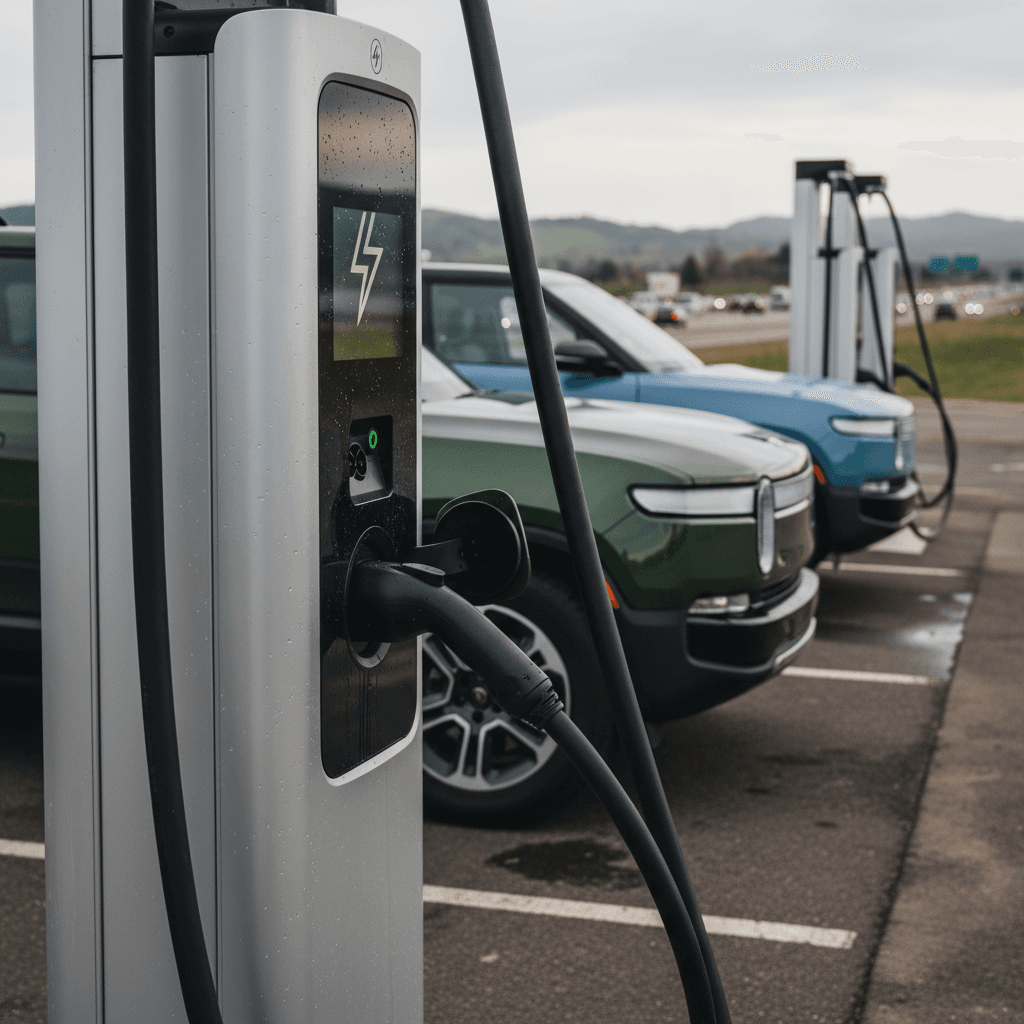
How to run your own EQB DC fast charging speed test
1. Start around 10–15% state of charge
Plan your arrival so the battery is at roughly 10–15% when you plug in. This is where the EQB can pull close to its maximum DC power without being limited by a high state of charge.
2. Use at least a 150 kW-capable charger
Look for a CCS fast charger rated 150 kW or higher. On a 50 kW unit, the EQB will simply be capped by the station and you’ll never see its full potential.
3. Precondition the battery if possible
Entering the fast charger as a destination in the built-in navigation gives the EQB a chance to warm or cool the pack. A properly conditioned battery can be the difference between seeing 40 kW and seeing close to 100 kW.
4. Record the peak kW you see
Within the first few minutes, you should see the charger ramp quickly. In good conditions, many owners report peaks close to <strong>90–100 kW</strong> before the curve begins to taper.
5. Time 10–80% with a stopwatch
Use your phone to time how long it takes to go from 10% to 80%. Under typical conditions, expect roughly <strong>30–35 minutes</strong>; cold weather or a weak charger can push that longer.
6. Note the average speed, not just the peak
Most charger screens show how many kWh have been delivered. Divide kWh added by minutes/60 to estimate your average charging power over the session. For example, 50 kWh in 0.5 hours is 100 kW average. That’s a strong result for an EQB.
What a healthy EQB fast charge looks like
In independent tests and owner reports, EQB 250, 300, and 350 models all behave broadly the same at DC stations because they share the same battery and DC hardware. What changes more dramatically is the impact of weather, software updates, and pack temperature, especially in colder climates or after the vehicle has sat.
Cold battery = slow EQB
Level 2 home charging: overnight speed test
Most EQB owners will do the bulk of their charging at home. Here’s what a realistic Level 2 home charging speed test looks like when your wall box is sized to match the car’s onboard charger.
EQB home charging: what to expect by outlet and charger size
Use these ballpark numbers to decide whether your setup is holding the EQB back.
Standard 120V outlet (Level 1)
Best for emergencies only.
- Power: roughly 1.4–1.9 kW
- Speed: about 3–5 miles of range per hour
- 10–80%: well over a day of charging
Fine for topping up a few miles, but not a long-term solution for most EQB owners.
240V, 32A Level 2
Workable daily solution.
- Power: ~7.7 kW
- Speed: around 18–23 miles of range per hour
- 10–100%: roughly 9–10 hours from near empty
Good for overnight charging if you plug in every evening.
240V, 40A Level 2 (recommended)
Matches the EQB’s capability.
- Power: up to 9.6 kW, depending on model year
- Speed: roughly 23–29 miles of range per hour
- 10–100%: about 7–8 hours in typical conditions
This is the sweet spot for most EQB drivers with home charging.
In other words, if you install a 40-amp Level 2 charger on a dedicated 240V circuit, you should be able to comfortably refill from low state of charge overnight, even after a longer commute. That’s true whether you drive a 250+, 300, or 350.
Pair the right wall box with your EQB
6 things that slow your EQB charging (and how to fix them)
- Cold battery – The number-one enemy of fast charging. Use navigation-based preconditioning when possible and, in winter, arrive at the charger after at least 20–30 minutes of driving.
- High state of charge on arrival – Plugging in at 50–60% instead of 10–20% means the car will taper much sooner, and your average power will be lower.
- Weak station or shared power – Many public chargers are limited to 50 kW, and some sites share one cabinet across multiple plugs. If someone else is charging next to you, your EQB might get throttled.
- Battery management software updates – Over time, Mercedes may adjust charge curves via software for longevity or safety. That can slightly reduce peak or average power on older vehicles, especially if an update tames an aggressive curve.
- Battery health and age – A pack that’s been constantly fast-charged to 100% and overheated may not perform like a gently used one. This is especially important when evaluating a used EQB.
- Charging settings in the car – Double-check that you haven’t set a very low maximum state of charge or limited DC power in the vehicle’s charging menu. It’s surprisingly easy to forget you changed a setting for a one-off trip.
Watch out for repeat slow sessions
How EQB charging speed compares to rivals
On a road trip, you don’t drive a spec sheet, you drive the charging curve. The EQB’s 100 kW peak may look modest next to some newer 800-volt EVs that can briefly spike above 200 or even 300 kW, but that’s only half the story.
EQB vs typical compact luxury EV rivals (charging-focused snapshot)
Approximate numbers for context only; individual trims and wheel choices vary, but the charging behavior patterns are what matter for trip planning.
| Model (example) | Battery (usable, approx.) | Max DC power | 10–80% DC (claimed) | Notable trait |
|---|---|---|---|---|
| Mercedes EQB (all trims) | ~70.5 kWh | ~100 kW | ~32 minutes | Steady, conservative curve; modest range vs rivals. |
| Audi Q4 e-tron | ~77 kWh | ~175 kW | ~28–30 minutes | Higher peak power, slightly longer time due to larger battery. |
| Volvo XC40 / C40 Recharge (updated) | ~79 kWh | ~200 kW | ~27–30 minutes | Very strong peaks; benefits from bigger pack and improved curve. |
| Tesla Model Y Long Range | ~75–80 kWh | >200 kW on V3 | ~25 minutes | Excellent network and very strong DC performance. |
The EQB’s DC performance is competitive but not class-leading; its main weakness is range, not charging speed per se.
Where the EQB keeps up
- Its 10–80% times are in the same ballpark as most peers once you account for battery size.
- The charging curve is conservative but predictable, which is nice on longer trips.
- If you plan smart stops, you won’t feel dramatically slower than most other CCS-based luxury EVs.
Where the EQB falls behind
- Its range is lower than many competitors, so you stop a bit more often.
- It lacks the cutting-edge 800-volt system and ultra-fast peaks of newer designs.
- Tight charging spacing matters more, picking the right station can make or break a road trip day.
Best charging strategy to protect your EQB battery
Charging speed is only half the story. How you charge over years of ownership affects both how fast your EQB charges and how much range you keep. A balanced routine will keep your pack healthy and your trip times reasonable.
EQB-friendly charging habits
Live between ~20–80% for daily driving
For day-to-day use, try to float the battery between about 20% and 80% state of charge. Save 100% charges for rare early-morning road trips when you’ll immediately hit the highway.
Use DC fast charging for trips, not every day
The EQB can handle DC fast charging, but frequent 0–100% blasts on DC are hard on any lithium-ion pack. Use <strong>Level 2 at home</strong> for routine charging, and save DC for when you really need it.
Precondition in extreme weather
When it’s very hot or cold, give the car time to stabilize pack temperature before a fast-charging session. Using the built-in navigation to route to a charger helps the EQB arrive in its comfort zone.
Avoid sitting at 100%
If you do a full charge overnight for a trip, aim to finish close to departure time. Letting the EQB sit full in the driveway for hours in summer heat isn’t doing the battery any favors.
Monitor long-term behavior
You don’t need to obsess over every kilowatt, but paying attention to how your EQB charges over the years can help you spot changes early and adjust your routine.
Good news for road trips
Buying a used EQB? Charging tests to run first
Because the EQB has been on sale for a few years now, and a major refresh is on the horizon, more examples are landing in the used market. Charging behavior is one of the smartest ways to gauge how a particular car has lived.
Simple charging checks for a used Mercedes EQB
You don’t need lab equipment, just a charger, a watch, and a little curiosity.
Quick DC fast-charging check
- Arrange a test at a 150 kW+ CCS charger.
- Start around 15% SoC and plug in.
- Watch for a peak near 80–100 kW in mild weather.
- Time how long it takes to reach 60–70%.
You’re looking for behavior that broadly matches Mercedes’ 10–80% in ~32 minutes claim, allowing for temperature and station quality.
Level 2 sanity check
- Plug into a known 40-amp (or similar) Level 2 charger.
- Check the indicated kW (around 7.7–9.6 kW is normal).
- Confirm the expected time-to-full matches seller’s claims.
A big mismatch between indicated power and charger rating could point to wiring issues or onboard charger problems.
Leaning on third-party battery reports
That combination, a documented battery health score plus a quick fast-charging spot check, gives you a far clearer picture than a standard test drive ever will. It’s the difference between buying an EQB you’ll grow into, and one you’ll grow impatient with.
Mercedes EQB charging speed FAQ
Frequently asked questions about EQB charging speed
Bottom line: Is the Mercedes EQB fast enough to live with?
If you’re expecting fireworks, the Mercedes EQB’s numbers, about 100 kW peak on DC and 7–8 hours at home on Level 2, may not sound dramatic. Live with the car, though, and the story changes. The EQB’s charging is steady, predictable, and perfectly adequate for daily life, provided you have a decent home setup and understand how to plan your fast-charging stops.
For shoppers, especially in the growing used market, the real trick is separating a healthy EQB with normal charging behavior from one that’s been ridden hard and charged carelessly. That’s where structured tests and verified battery health reports matter. At Recharged, every used EV comes with a Recharged Score that looks beyond the odometer and into the battery and charging history, so you can buy an EQB that will charge as quickly, and confidently, as it did when it was new.