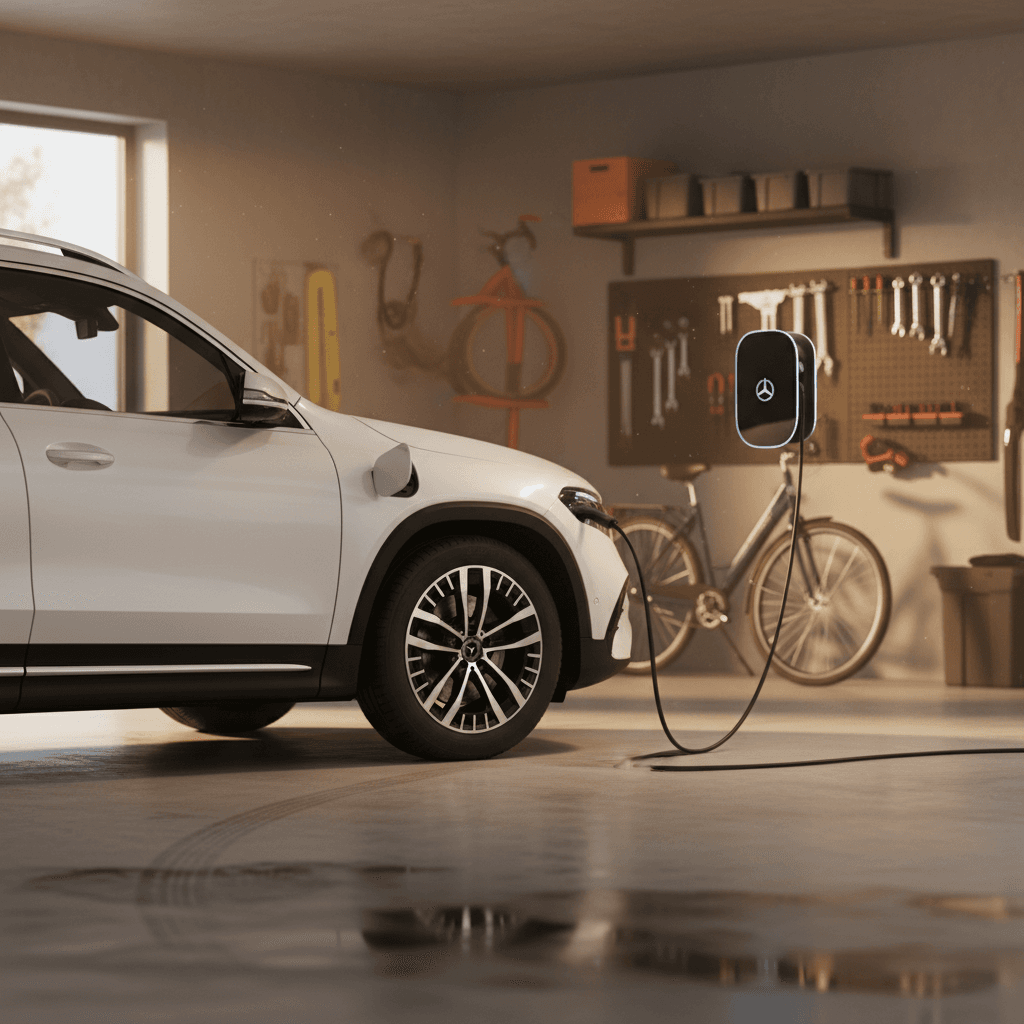
If you’re hunting for the best home charger for your Mercedes EQB, you’ve probably discovered two things already: there are far too many wallboxes to choose from, and the marketing promises don’t always line up with what your EQB can actually use. The good news is that the EQB is easy to satisfy at home, as long as you match the charger to the car’s onboard hardware and your home’s electrical panel.
Quick answer
Why home charging matters so much for the Mercedes EQB
The EQB is a compact luxury SUV with a usable battery around the low‑70 kWh range, depending on trim and market. It will happily fast charge on road trips at roughly 100–110 kW DC, but the car is designed around the idea that most charging happens at home. That’s where you save money, save time, and protect the battery from constant high‑power DC abuse.
Mercedes EQB home charging at a glance
If you only ever trickle charge on 120V, your EQB will recover just a handful of miles per hour. Step up to a properly installed Level 2 home charger and suddenly an empty‑to‑full charge fits comfortably into a normal weeknight. That’s why choosing the right unit, and avoiding expensive overkill, matters.
How fast can a Mercedes EQB actually charge at home?
Before you pick a wallbox, you need to know what your EQB can accept. All EQB variants use J1772 for AC Level 1 and Level 2 in North America and a CCS1 combo inlet for DC fast charging. The limiting factor at home isn’t the wallbox’s sticker number; it’s the car’s onboard AC charger.
Mercedes EQB typical home charging speeds
Approximate EQB charging performance at common home setups in North America.
| Charging setup | Power delivered to EQB | Approx. miles of range gained per hour | Time 10–100% (from low SOC) |
|---|---|---|---|
| Level 1 – 120V, 12A | ~1.4 kW | 3–4 mi/hr | 30–40 hours |
| Level 2 – 240V, 16A | ~3.8 kW | 9–12 mi/hr | 18–20 hours |
| Level 2 – 240V, 32A | ~7.7 kW | 18–23 mi/hr | 9–11 hours |
| Level 2 – 240V, 40A | ~9.6 kW | 23–29 mi/hr | ~7–8 hours |
| Level 2 – 240V, 48A* | ~9.6–11 kW (car‑limited) | Similar to 40A in practice | No meaningful time savings vs 40A |
Real‑world times vary with temperature and state of charge, but these numbers are a solid planning baseline for EQB owners.
Don’t chase numbers you can’t use
The key takeaway: if your EQB is your main EV and you have typical U.S. electricity rates, a 40A Level 2 charger offers the best balance of cost, speed, and installation difficulty. Anything less will work, but you’re stretching charge times. Anything wildly bigger is mostly marketing fluff for this particular car.
Mercedes EQB best home charger: ideal amps and circuit size
Picking the right amperage for your EQB
Match the charger to your driving, not just the spec sheet.
Option 1: 32A charger
Best for: Light‑to‑moderate daily driving, limited panel capacity.
- Needs a 40A breaker.
- Delivers ~7.7 kW.
- Good if you drive 20–40 miles per day.
Option 2: 40A charger (recommended)
Best for: Most EQB owners with home parking.
- Needs a 50A breaker.
- Delivers ~9.6 kW (max for many EQBs).
- Comfortable overnight full charge from low SOC.
Option 3: 48A charger
Best for: Future‑proofing for a second EV that can use 48A.
- Needs a 60A breaker.
- EQB is usually the bottleneck, not the charger.
- Useful only if a future vehicle can draw more than 40A.
Think in miles, not kilowatts
Electrical code in the U.S. requires continuous loads like EV charging to stay at or below 80% of a circuit’s rating. So a 50A breaker supports a 40A charger, and a 60A breaker supports 48A. If you’re not sure what your panel can handle, this is where a qualified electrician, and in many cases, an EV‑savvy partner like Recharged, can keep you from overspending on panel upgrades you don’t really need.
Best home chargers for Mercedes EQB: top picks
The “best” home charger for a Mercedes EQB is less about brand loyalty and more about delivering 32–40 amps reliably, working well in your space, and playing nicely with your utility rates. Below are representative examples of what to look for, specific models change from year to year, but the feature sets stay similar.
Recommended home charger profiles for EQB owners
Use these archetypes to shop smarter, not harder.
Value 40A wallbox
Who it’s for: EQB owners who want fast overnight charging without fancy apps.
- 40A / 9.6 kW output on a 50A circuit.
- Hardwired for reliability.
- Basic delay timer or simple schedule.
- Weather‑resistant housing for indoor/outdoor use.
Look for UL listing, a sturdy cable, and a 3‑year or better warranty.
Smart 40–48A charger
Who it’s for: Households with time‑of‑use rates or rooftop solar.
- App‑based scheduling and usage history.
- Wi‑Fi or Ethernet connectivity.
- Integration with some utilities for rebates.
- Often adjustable from 16A up to 40–48A.
Great match if you like to track costs and charge when power is cheapest.
Portable 32A plug‑in unit
Who it’s for: Renters or anyone who might move soon.
- Plugs into NEMA 14‑50 or 6‑50 outlet.
- Typically 32A (about 7.7 kW) max.
- Can travel with the car for RV parks or relatives’ homes.
- Often comes with a carry case.
A little slower than a 40A hardwired unit, but far more flexible.
What “good” looks like for an EQB charger
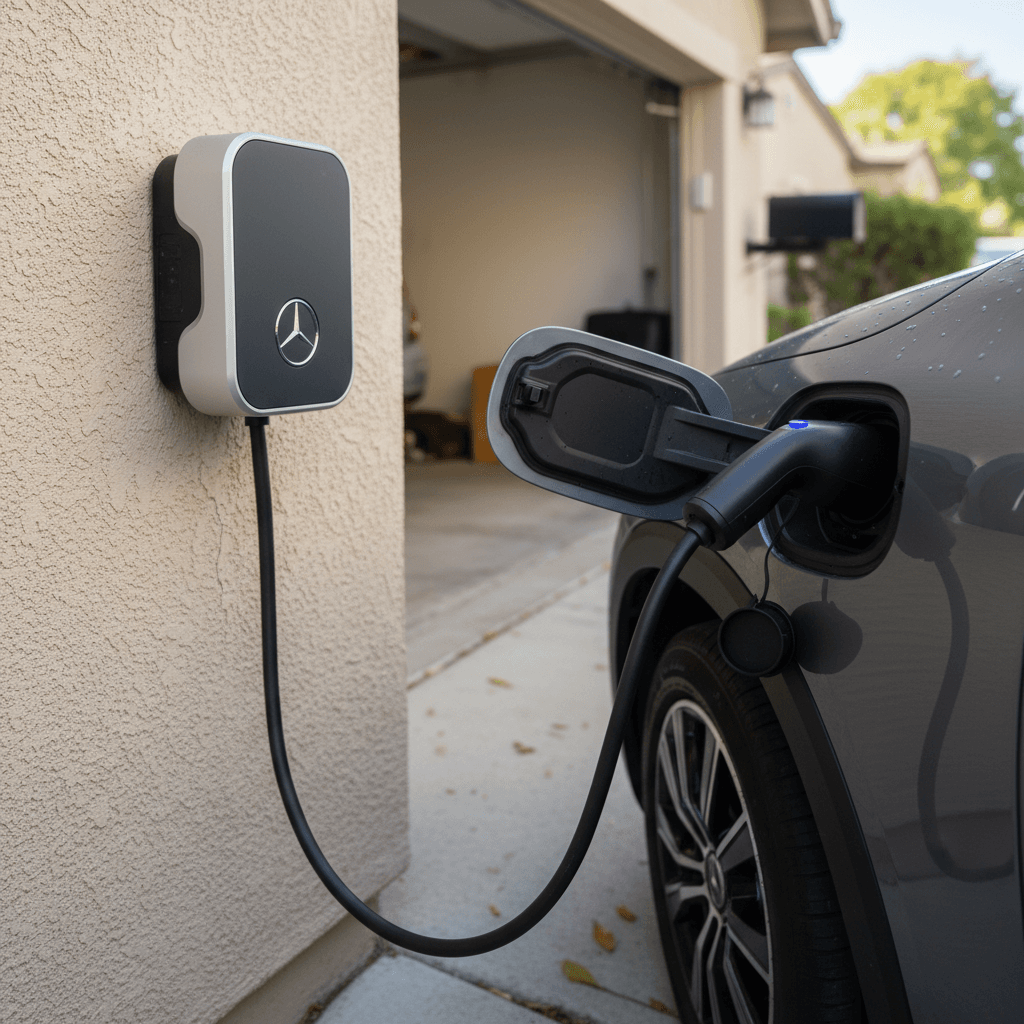
Mercedes Wallbox vs. universal home chargers
Mercedes-branded Wallbox
- Pros: Matches the brand, often integrates cleanly with Mercedes apps, sometimes eligible for dealer bundle deals or financing.
- Cons: Usually costs more than comparable third‑party units, and doesn’t charge your EQB any faster than a well‑chosen universal charger.
- Good fit if: You really value the matched look and are comfortable paying a premium for it.
Universal Level 2 charger
- Pros: Works with essentially any J1772‑equipped EV, typically lower price for the same or better hardware, wide range of smart features.
- Cons: App experience and support quality can vary; you’ll want to stick to reputable brands.
- Good fit if: You might add a second EV later or replace the EQB with another brand.
Think beyond your first EV
Installation and safety basics for EQB home charging
A home charger is an appliance that can quietly run at high power for hours at a time. That makes professional installation and basic safety practices non‑negotiable. The EQB doesn’t need anything exotic, but you do want the work done correctly.
Safe home charging setup for your Mercedes EQB
1. Get your electrical panel evaluated
Have a licensed electrician confirm how much spare capacity you have and which breaker sizes are realistic. This determines whether a 32A, 40A, or 48A charger makes sense without an expensive panel upgrade.
2. Choose hardwired vs. plug-in
Hardwiring is usually preferred for 40A and above. A 32A plug‑in unit on a NEMA 14‑50 outlet can work well if you want something semi‑portable, just make sure the outlet is dedicated to EV charging.
3. Plan the charger location
Mount the charger where the cable easily reaches your EQB’s charge port without stretching across walkways. Measure with the car parked the way you actually use the space.
4. Use proper wiring and breaker sizing
Your electrician should follow the 80% rule for continuous loads. That means, for example, a 40A charger on a 50A breaker with appropriately sized wire and conduit for the run length.
5. Consider weather and enclosure rating
If the charger will live outdoors, insist on a unit rated for outdoor use with a sealed enclosure and a sturdy connector holster. Snow, sprinklers, and sun are all long‑term stress tests.
6. Set safe charge limits in the car
In your EQB’s settings, set a reasonable daily charge limit (often 80–90%) and a maximum current that matches your circuit if your charger is adjustable. This protects both the battery and your wiring.
Don’t DIY high-voltage work
Smart charger features that are actually worth it
Modern home chargers come loaded with apps, graphs, and buzzwords. For an EQB owner, only a few smart features truly change the ownership experience; the rest are nice‑to‑have at best.
High‑value vs. low‑value smart features
Spend where it saves you time or money.
Worth paying for
- Scheduled charging: Lets you automatically charge in off‑peak hours if your utility offers cheaper nighttime rates.
- Adjustable amperage: Handy if you move or repurpose the circuit later.
- Energy tracking: Shows how many kWh and dollars you’ve put into the EQB each month.
- Load sharing: If you plan to run two chargers on one circuit in the future.
Usually optional
- Color‑changing light shows.
- Voice‑assistant integrations you’ll use twice and forget.
- Overcomplicated apps that require an account just to start charging.
- Brand‑specific gimmicks that don’t add speed or savings.
Use the car and the charger together
What it really costs to charge a Mercedes EQB at home
While public DC fast charging prices bounce around, home electricity is boring in the best way. That makes your energy bills predictable, and usually much cheaper per mile than gasoline.
Back‑of‑napkin math
Assume your EQB’s usable battery is about 70 kWh and your electricity is $0.15 per kWh, a common U.S. residential rate:
- 70 kWh × $0.15 = $10.50 for a full 0–100% charge.
- If that full battery yields ~220 real‑world miles, you’re around 4.8 cents per mile.
Even at higher coastal rates, you’re usually well ahead of gasoline on a per‑mile basis.
Home vs. public fast charging
Public DC fast chargers often run effectively $0.35–$0.50 per kWh before idle fees or memberships. That turns the same 70 kWh into $24.50–$35.00.
The takeaway: use DC fast chargers as road‑trip tools, not daily life support. A properly sized home charger lets your EQB sip cheap power most of the time.
Stack the savings
Checklist: choosing the right home charger for your EQB
EQB home charger buying checklist
Confirm your EQB’s onboard AC limit
Most EQBs top out around 9.6–11 kW AC. There’s no benefit to installing a 19.2 kW (80A) home charger for this car alone.
Measure your daily driving
If you regularly drive more than 60–70 miles per day, aim for at least a 32A charger. For typical commuting and errands, 32–40A is ideal.
Check your electrical panel capacity
Have an electrician verify whether you have room for a new 40A or 50A breaker without a pricey service upgrade.
Decide on hardwired vs. plug-in
Hardwired is best for permanent 40A setups; plug‑in is great for renters or anyone who might relocate the charger.
Prioritize safety certifications
Look for UL or ETL listing, a robust enclosure, and a cable that stays flexible in your local climate.
Choose only the smart features you’ll use
Scheduling and energy tracking are genuinely helpful; light shows and voice commands, not so much.
Think about your next EV
If a future second EV might draw more than 40A, consider a 48A adjustable charger now, installed on an appropriately sized circuit.
Mercedes EQB home charging FAQ
Frequently asked questions: Mercedes EQB home charging
How Recharged can help with your EQB and home charging
The right home charger turns the Mercedes EQB into exactly what it was meant to be: an easy, predictable electric family hauler that’s always ready when you are. You don’t need the priciest wallbox on the market, you need one that matches the EQB’s 9.6–11 kW AC capability, fits your panel, and suits the way you live.
If you’re considering a used EQB, Recharged can help you connect the dots between the car, its real‑world charging behavior, and your home. Every EV we sell includes a Recharged Score Report with verified battery health and fair‑market pricing, plus expert guidance on home charging options and, if needed, referrals to trusted installers. That way you’re not just buying an EQB, you’re setting yourself up with a charging setup that actually works for your life.