If you’re serious about living with an electric vehicle day to day, you’ll eventually ask the same question many EV shoppers do: **what does a 240V outlet installation for EV charging actually cost?** The short version: it’s usually a four-figure project if you include the charger, but a simple 240V outlet alone can be surprisingly affordable, and the savings on fuel add up fast.
The role of a 240V outlet
Why a 240V outlet matters for everyday EV charging
Most EVs ship with a basic Level 1 charger that plugs into a standard **120V household outlet**. That works in a pinch, but it typically adds only 3–5 miles of range per hour. A dedicated **240V outlet** turns that into Level 2 charging, which for many EVs means roughly 20–40 miles of range per hour, enough to refill an empty battery overnight, or top off after a long commute.
- Level 1 (120V): often 20–40 hours for a full charge from low state of charge
- Level 2 (240V): often 6–12 hours for a similar charge, depending on vehicle and charger
- Public DC fast charging: great for road trips, overkill (and more expensive) for daily use
If you own, or are considering, a **used EV**, getting into that Level 2 sweet spot is what makes the car feel normal to live with. You plug in at night, wake up with a “full tank,” and the car behaves a lot more like a gas vehicle in day‑to‑day convenience.
Quick answer: what most people pay for a 240V EV outlet
Typical 240V outlet and Level 2 costs (U.S., 2025–2026)
Those numbers are ballpark ranges from recent installation data and electrician quotes across the U.S. They’re not bids, but they’re a useful lens when you’re staring at a $1,900 quote and wondering whether it’s reasonable or you should keep shopping.
Cost breakdown: 240V outlet installation for EV charging
When you ask for a price on a **240V outlet installation for EV charging**, you’re really paying for several pieces at once: the outlet itself, new wiring, the breaker, the electrician’s labor, and sometimes permits or panel work. Here’s how those pieces typically shake out in 2025–2026.
Typical 240V EV outlet installation cost breakdown (U.S.)
Planning numbers for a standard single‑family home. These ranges assume no major service upgrade; your local electrician and code requirements will set the real price.
| Line item | Low | High | What it covers |
|---|---|---|---|
| Outlet hardware (NEMA 14‑50, 6‑50, etc.) | $10 | $40 | Receptacle and wall box, usually the smallest part of the bill. |
| Breaker + small parts | $30 | $120 | New double‑pole breaker, wire staples, junction boxes, covers. |
| Install simple 240V circuit + outlet | $250 | $1,000 | Electrician labor and materials when panel is close and capacity is OK. |
| Permits & inspection | $50 | $300+ | Varies by city; some utilities require separate EV paperwork. |
| Panel or service upgrade (if needed) | $800 | $2,500+ | New panel, subpanel, or service upgrade when you’re out of capacity. |
| Total: outlet‑only job (no upgrades) | $300 | $800 | What many homeowners pay just to add a 240V outlet near the garage panel. |
| Total: outlet + wall‑mount Level 2 charger | $900 | $2,500+ | Adds $400–$1,200 for the charger hardware itself. |
Expect to pay more at the upper end of these ranges in high‑cost metro areas or when routing is long and walls are finished.
Think in “project scenarios,” not just outlet price
7 factors that drive your 240V outlet quote up or down
What actually drives 240V EV outlet cost?
Why your neighbor paid $350 and you’re looking at $1,500.
1. Distance from panel
2. Amperage you need
3. Panel capacity
4. Age of the home
5. Local code & permits
6. Labor market
More subtle cost drivers
Often overlooked details that sneak into bids.
7. Indoor vs. outdoor location
8. Wall condition
9. Bundled work
240V outlet vs. hardwired charger: which is cheaper?
Option 1: 240V outlet + plug-in charger
This is the most flexible setup. The electrician installs a **240V receptacle** (often a NEMA 14‑50 or 6‑50), and you plug in a portable or wall‑mount Level 2 charger.
- Pros: Easy to replace or upgrade the charger, can unplug and take it with you, sometimes cheaper to permit as an outlet.
- Cons: Slightly more hardware cost (outlet + plug), cord can be easier to unplug accidentally if not well‑managed.
- Typical cost: About $300–$800 for the outlet install, plus $300–$900 for a charger.
Option 2: Hardwired Level 2 charger
Here the electrician runs a dedicated 240V circuit directly into the charger’s junction box, no outlet, no plug.
- Pros: Clean install, fewer exposed connections, easier to hit higher amp ratings (48A+) on some units.
- Cons: Swapping the charger later is a bit more involved, not portable, and sometimes slightly higher labor cost.
- Typical cost: Similar labor to an outlet, but the quote may look higher if the electrician is also supplying the wall unit.
A good rule of thumb
Permits, safety, and DIY: what you can and can’t do
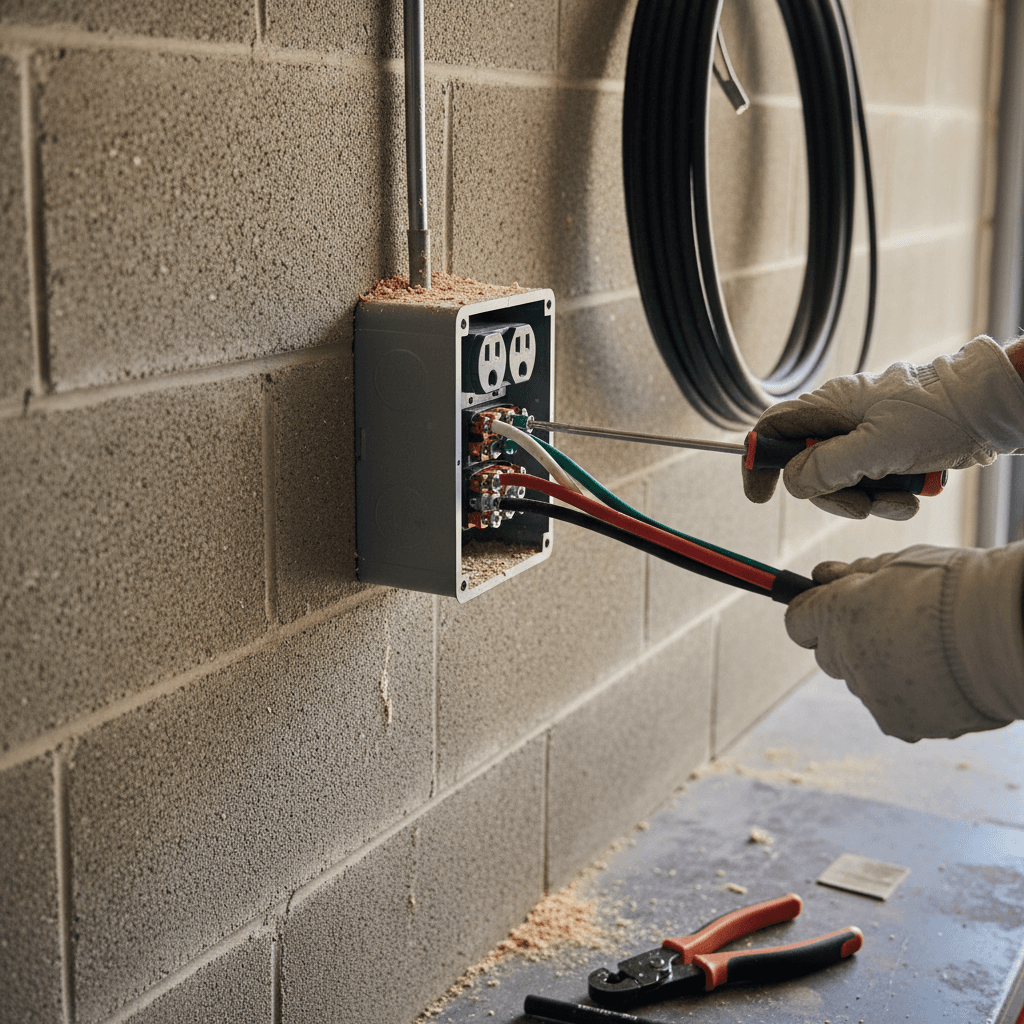
A 240V circuit can deliver serious power, great for EV charging, but not something to treat like hanging a shelf. Most cities treat a new 240V EV circuit as permitted electrical work, and many utilities now ask for basic EV charging information as well.
Before anyone pulls wire for your 240V EV outlet
Confirm you actually need a new circuit
If you already have a suitable 240V outlet in the right spot (for a dryer or RV, for example) and your electrician confirms it’s safe to share or repurpose, you may not need new wiring at all.
Check local permit rules
Call your city or browse its website for "residential EV charger" or "240V circuit" requirements. Some areas allow minor work under a homeowner’s permit; others require a licensed electrician for everything over 120V.
Use a licensed electrician for new circuits
Even if you’re handy, a licensed pro will size the breaker and wire correctly, perform a load calculation if needed, and make sure the installation passes inspection.
Avoid improvising with adapters
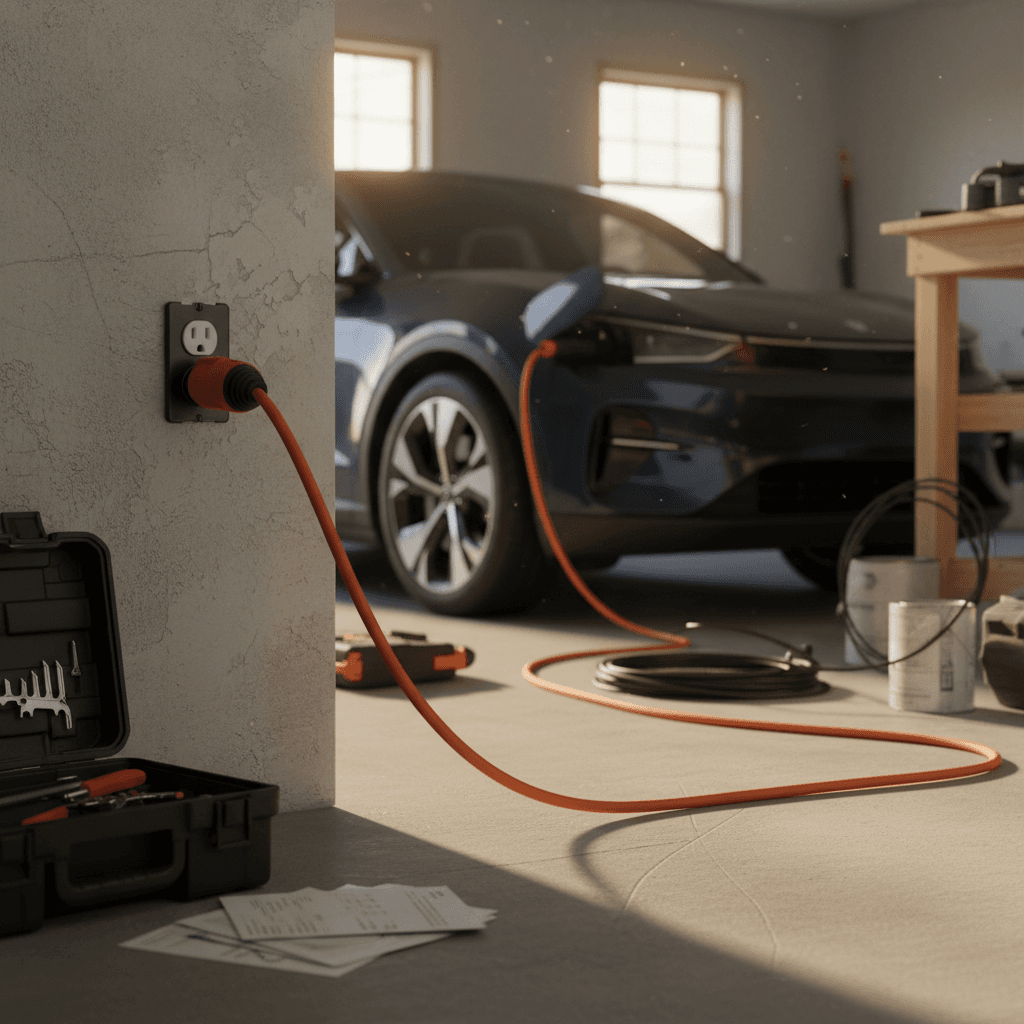
Don’t mix and match dryer adapters, extension cords, or non‑EV‑rated gear to “hack” a 240V charging solution. It’s not worth the fire risk, or your insurer’s reaction if something goes wrong.
Safety first
7 ways to lower your 240V outlet installation cost
- Get at least two or three quotes, ideally from electricians with EV experience. Ask each to price a short‑run 40A or 50A circuit if possible, not just a “future‑proof 100A” upsell.
- Choose the right amperage for your car. If your EV only pulls 32A, a 40A circuit is enough; you don’t need to pay for heavier wire and a larger breaker.
- Place the outlet near the panel if you can. Parking close to your electrical panel, or mounting the charger on the same wall, can shave hundreds of dollars off labor and materials.
- Keep the route simple and exposed. If your basement or garage is unfinished, ask whether the electrician can run conduit on the surface instead of fishing wires through finished walls.
- Bundle projects. If you already need panel work, an additional outlet, or exterior lighting, getting it done in the same visit is almost always cheaper than paying for separate trips.
- Check utility and state rebates before you schedule. Some programs require using an approved contractor or filing pre‑approval paperwork before work starts.
- Use a plug‑in charger on a 240V outlet. In many cases, this is cheaper and more flexible than hardwiring a unit, especially if you ever move or upgrade vehicles.
How tax credits and rebates change the real price
On paper, the cost of a 240V outlet installation for EV charging might look intimidating. Once you factor in incentives, the **real number** gets more interesting, especially if you’re already saving money by choosing a used EV.
Federal EV charger tax credit
How incentives stack up
- Federal tax credit: Typically 30% of qualifying costs, up to $1,000 for residential installs in eligible areas.
- Utility rebates: Some utilities offer $200–$500 rebates for installing a Level 2 charger, or discounted smart chargers.
- Time‑of‑use rates: Even if you don’t get cash back, off‑peak pricing can cut your fueling bill dramatically once your 240V outlet is in place.
What this means in practice
Say your all‑in project (240V outlet + charger + permits) comes to $1,600. A 30% federal credit knocks that down to $1,120 if you qualify. Add a $300 utility rebate and you’re effectively paying **$820** for something you’ll use every day for years.
Realistic budget examples by home type
It’s one thing to see a cost table; it’s another to picture how this plays out for real homes. Here are three common scenarios that mirror what EV owners report and what installers quote in 2025–2026.
Sample 240V EV outlet project scenarios
Numbers here are illustrative, not quotes, but they reflect typical ranges from real‑world installations.
Attached garage, panel nearby
Home: 1990s–2020s single‑family, 200A panel on garage wall.
Work: 40A or 50A circuit, 10–15 feet of wire, NEMA 14‑50 outlet.
Typical cost: $350–$700 for outlet install, plus your choice of charger.
Older home, panel upgrade
Home: 1960s house with 100A panel nearly full.
Work: Panel upgrade to 200A, new 50A EV circuit, outlet in garage.
Typical cost: $1,500–$3,000+ all‑in, depending on service upgrade complexity.
Detached garage or carport
Home: House with parking 40–80 feet from panel.
Work: Trenching or long conduit run, outdoor‑rated 240V outlet.
Typical cost: $800–$2,000+ for the electrical work alone, plus charger hardware.
Sticker shock doesn’t always tell the whole story
What a 240V outlet means for used EV ownership
If you’re shopping the used market, a 240V outlet isn’t just a line item, it’s part of the total cost of owning that car. You’re weighing three moving pieces at once: the price of the used EV, what it will cost to charge at home, and what you’ll save on fuel compared with a gas car.
How the math can still favor a used EV
Imagine you buy a used EV for less than a comparable new model, then spend **$800** net of incentives on a 240V outlet and Level 2 charger. If home charging cuts your monthly fuel spending from, say, $180 in gas to $50 in electricity, the install starts to pay for itself within a year or two.
Over a five‑year ownership window, those fuel savings can quietly dwarf the one‑time cost of the outlet, even if your installation wasn’t the cheapest scenario.
What Recharged brings to the table
Every EV sold through Recharged includes a Recharged Score Report with verified battery health, pricing transparency, and guidance on real‑world range. That makes it easier to decide whether a 240V outlet install plus a used EV actually beats your current gas car.
Our specialists also talk through home charging plans during the buying process, so you’re not discovering a $2,000 electrical surprise after you’ve fallen in love with a car.
Financing the whole package
240V outlet installation for EV charging: FAQ
Common questions about 240V outlets for EV charging
Bottom line: how to plan your 240V EV outlet project
A **240V outlet installation for EV charging** is one of those projects that looks more complicated on paper than it usually feels once it’s done. For many homeowners, the real‑world cost falls in the mid‑hundreds of dollars for the outlet work alone, or the low‑to‑mid thousands when you include a quality Level 2 charger and any panel tweaks.
The key is to treat it like any other serious home upgrade: get multiple quotes, insist on a clear scope of work, check incentives, and size the circuit for how you actually drive, not just the biggest number on a box. Do that, and your garage quietly turns into the most convenient “fuel station” you’ve ever used.
If you’re weighing whether home charging plus a used EV makes sense, Recharged can help you line up the numbers. Every vehicle we list comes with transparent battery‑health and pricing data, so you can plan the **total cost of ownership**, 240V outlet and all, before you ever plug in.