If you’re looking at a three-row plug‑in SUV, the Mazda CX-90 PHEV makes a seductive pitch: handsome design, luxury‑leaning cabin, 26-ish electric miles, and proper Mazda steering. Then you Google “Mazda CX-90 PHEV problems and issues” and fall into a rabbit hole of recalls, horror stories, and equally loud owners saying, “Mine’s perfect.” This guide is here to separate signal from noise, so you can decide, eyes wide open, whether the CX-90 PHEV belongs in your driveway or on your do‑not‑buy list.
Model years covered
Overview: Is the Mazda CX-90 PHEV Problematic?
Short answer: the CX-90 PHEV is not a hopeless basket case, but it has had more than its share of early teething issues compared with Mazda’s usual “set it and forget it” reputation. The first 2024 models were hit with multiple recalls for software and hybrid‑system faults, plus a swirl of owner complaints about warning lights, drivability glitches, and build‑quality quirks. Later 2024 builds and 2025–2026 models appear calmer, but this is still a complex first‑generation PHEV from a brand new longitudinal platform, not a Camry Hybrid with 20 years of debugging baked in.
Where the CX-90 PHEV shines
- Genuinely fun‑to‑drive chassis for a 3‑row SUV
- Respectable EV range (around 25–30 miles in real use)
- Upscale cabin design and materials, especially in higher trims
- Standard all‑wheel drive and strong crash‑test performance
Where the headaches live
- Early recalls for loss of drive power and electrical faults
- Scattered reports of hybrid system failure and no‑start conditions
- Brake squeal, suspension squeaks and rapid tire wear
- Software quirks (app functions, alerts, odd PHEV logic)
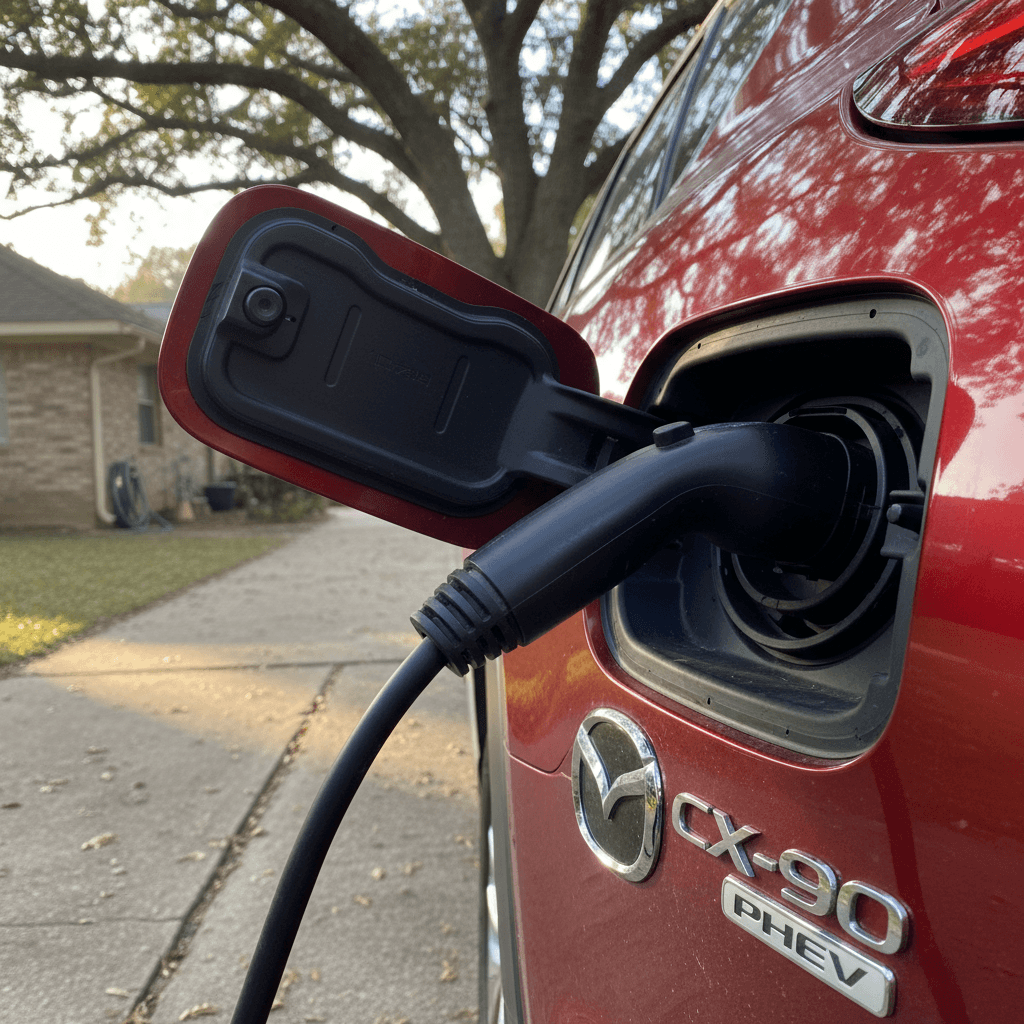
Quick Specs: What Mazda Is Trying to Do Here
Mazda CX-90 PHEV At a Glance
The CX-90 PHEV uses Mazda’s e‑Skyactiv PHEV system: a 2.5‑liter four‑cylinder paired with a sizable battery and electric motor on a rear‑drive‑biased platform. Translation: you get proper driving dynamics and a plug, but also multiple layers of software, cooling, and high‑voltage hardware. When things go wrong, they often do so electronically before anything actually breaks.
Major Mazda CX-90 PHEV Recalls and Campaigns
Before we get into everyday annoyances, it’s worth zooming in on the big-ticket items: the recalls and technical campaigns that define the CX-90 PHEV’s reputation. If you’re shopping new, most of these should be addressed before delivery. If you’re shopping used CX-90 PHEVs, you want to verify every last one has been completed.
Key CX-90 PHEV Recalls to Know About
This is a simplified, shopper‑friendly view of the most talked‑about CX-90 PHEV recalls. Exact campaign numbers and scope can vary; always run the VIN through an official recall checker.
| Issue | Typical Model Years | What Happens | Fix |
|---|---|---|---|
| Hybrid failsafe / loss of drive power | 2024 | PHEV system overheats or glitches, engine and motor can shut down and the car loses drive power. | Dealer reprograms powertrain and hybrid control modules with updated logic. |
| Electrical leakage / hybrid system fault warnings | 2024–2025 | Cluster lights up with "Hybrid system malfunction" or "Electric leakage" warnings; vehicle may not go into gear or may enter limp mode. | Software update and, in some cases, inspection or replacement of high‑voltage components. |
| Battery cooling / high‑voltage battery concerns | 2024 | Improper battery cooling control can trigger warnings, reduce performance, or increase degradation risk. | Updated software and inspection of cooling hardware; parts replaced if needed. |
| Misc. electrical (defroster, fuel gauge, etc.) | 2025 | Comfort and convenience features misbehave or display incorrect information. | Control unit updates or component replacement depending on system. |
Always confirm recall status by VIN on official government or Mazda sites before you buy.
Don’t rely on the glovebox
Engine Shutoff & Loss of Power: The Big Scare
The headline‑grabbing problem on early CX-90 PHEVs was a scenario where the vehicle’s failsafe logic could shut down both the engine and electric motor. In plain English: the car could lose drive power with little or no warning. This was tied to how the powertrain control module reacted when the PHEV inverter temperature climbed past a certain threshold, essentially an overcautious safety routine with bad bedside manner.
- Warning lights often appeared only after the failsafe kicked in, not before.
- Drivers reported sudden loss of propulsion and an inability to restart normally.
- Mazda’s recall fix reprograms the control software to manage high temperatures without killing the entire drivetrain.
How worried should you be now?
Battery & Electrical Issues Owners Report
Hybrid systems live and die by their software. On the CX-90 PHEV, a lot of the drama owners describe falls into the bucket of "the computer got mad" rather than something physically snapping in half. That’s not necessarily better, an SUV that strands you in a parking lot because it thinks there’s electrical leakage feels just as broken as one with a dead transmission.
Common CX-90 PHEV Battery & Electrical Complaints
Not every car shows these, but these are the patterns that show up in owner reports and service bulletins.
Hybrid system failure warnings
HV battery or cooling concerns
Charging oddities
Smart move for used buyers
Drivetrain, Brakes & Suspension Problems
Beyond the hybrid hardware, the CX-90 PHEV also shares some garden‑variety SUV problems: leaks, squeaks, and consumables wearing out faster than you’d like on a $60,000 family hauler.
- Transmission / driveline leaks: A small but real number of owners report transmission‑fluid or axle‑seal leaks on low‑mileage CX-90s, sometimes serious enough to trigger buybacks. Always inspect the underbody and look for fresh wetness around the transmission and axle seals.
- Brake squeal at low speeds: Chronic low‑speed brake squeal shows up in multiple owner reviews. It’s not dangerous, but it’s embarrassing in the school pickup line. Dealers may clean or chamfer pads; expect mixed success.
- Suspension squeaks and clunks: There are repeated reports of front‑end squeaks over low‑speed bumps or during tight turns, often traced to bushings that need lubrication or replacement. It’s more annoying than catastrophic, but on a near‑luxury SUV, it feels off‑brand.
- Rapid tire wear: Some CX-90 owners, PHEV and otherwise, complain of OEM tires hitting the wear bars surprisingly early. Part of that is weight and torque, part is alignment and tire choice. Budget for a fresh set sooner than you might on a smaller crossover.
Walk‑away signs on a test drive
Software Quirks and Everyday Annoyances
Not every CX-90 PHEV “issue” is the sort of thing NHTSA cares about. A lot of what frustrates owners day‑to‑day are rough edges in the software experience, how the car decides when to run the engine, what the MyMazda app can or can’t do, and small glitches that make a supposedly premium SUV feel oddly unfinished.
CX-90 PHEV Quirks Owners Talk About
Death by a thousand software papercuts.
App limitations & remote features
Aggressive alerts & nannying
The flip side
Cold-Weather Behavior: When the PHEV Gets Grumpy
Like every plug‑in hybrid, the CX-90 PHEV gets weird when the mercury drops. Some of this is by design, and clearly flagged in the owner’s manual. Some of it is owners discovering that reality doesn’t quite match the marketing brochure’s pretty blue EV‑mode icons.
- Engine starts even with a full battery: In cold temperatures, the CX-90 PHEV will fire the gasoline engine to generate cabin heat and keep the battery in its comfort zone, even if the battery is fully charged and you’ve selected EV mode.
- Reduced EV range in winter: That advertised ~25–30 miles of EV range can shrink dramatically in sub‑freezing weather, especially with highway speeds and a warm cabin. This is normal behavior for lithium‑ion batteries, not a Mazda‑specific sin.
- Cold‑weather owner complaints: A few owners describe particularly poor winter performance, rough transitions, extra noise, sluggish power delivery. Often, these experiences get better after software updates, but if you live in a cold climate, your test drive should absolutely happen on a cold day, not a sunny Saturday in April.
Winter‑testing tip
Reliability by Model Year: 2024 vs 2025–2026
The most honest way to think about CX-90 PHEV reliability is by model year and build timing. The 2024 launch batch took the slings and arrows; later production looks a bit more sorted.
2024 CX-90 PHEV
- First model year, heaviest concentration of recalls.
- More reports of hybrid‑system faults, electrical warnings, and early build defects.
- Plenty of trouble‑free examples, but the variance between good and bad cars is wide.
2025 CX-90 PHEV
- Software much improved; some campaigns baked in at the factory.
- Fewer catastrophic complaints, more “normal new‑car” issues.
- Still some owners citing no‑start or warning‑light events, but less noise overall.
2026 CX-90 PHEV
- Too new for a full statistical verdict, but early impressions suggest Mazda has sanded off many sharp edges.
- If you want a CX-90 PHEV and value peace of mind, a later‑build 2025 or 2026 is the smart money.
Why early builds matter
What to Check Before You Buy a CX-90 PHEV
If the CX-90 PHEV still speaks to you, and for many families it will, your job is to separate the good examples from the science experiments. Here’s how to do that whether you’re at a Mazda store or eyeing a used example on a lot or marketplace.
CX-90 PHEV Pre‑Purchase Checklist
1. Run a full recall & campaign check
Use the VIN on an official recall checker and ask for a Mazda dealer printout. Confirm all hybrid‑system, battery‑cooling, and electrical campaigns are completed, not just “scheduled.”
2. Scan for warning lights or stored faults
On the test drive, the dash should be clean, no CEL, no hybrid‑system warnings. If possible, have a shop or specialist scan the car for stored hybrid or battery‑related codes before you commit.
3. Test EV and hybrid modes thoroughly
Drive in EV mode around town, then do highway speeds, hills, and hard acceleration. The transition between electric and gas power should be smooth, with no abrupt surges or cutouts.
4. Inspect underbody and for leaks
Look under the front half of the vehicle for any fresh oil or fluid. Pay particular attention to the transmission and axle‑seal areas; seepage on a nearly new car is a red flag.
5. Listen for suspension and brake noise
On a low‑speed drive over rough pavement, listen for squeaks from the front suspension and squeal from the brakes. Some noise is fixable; persistent or loud sounds suggest future service visits.
6. Verify charging behavior at Level 2
If possible, plug into a Level 2 charger and confirm the car charges normally and at expected speed. Public chargers add an extra compatibility test; watch for repeated charging failures.
7. Confirm app features you care about
If remote start or pre‑conditioning matters to you, pair the MyMazda app at the dealer and confirm those features work on that exact car, not just on a brochure.
8. Get an independent EV‑savvy inspection
For a used CX-90 PHEV, consider a third‑party inspection that understands high‑voltage systems. At Recharged, every used EV gets a <strong>Recharged Score</strong> with battery health diagnostics and a deep mechanical review.
How Recharged can help
Ready to find your next EV?
Browse VehiclesWho the Mazda CX-90 PHEV Actually Suits Best
The CX-90 PHEV is not the default answer for everyone. It’s a sweet‑handling three‑row with a genuinely premium vibe, but it carries the usual first‑gen plug‑in hybrid asterisk: you’re trading some reliability predictability for performance and efficiency theater.
Good fit
- Drivers who can charge at home and do most daily miles electrically.
- Families who value driving dynamics and interior ambiance over max cargo volume.
- Shoppers willing to pay attention to service campaigns and keep software updated.
Maybe skip it
- Long‑distance road‑warriors who rarely plug in and just want an unburstable appliance.
- Buyers in remote areas without strong Mazda dealer support.
- Anyone allergic to warning lights, recalls, or the occasional software‑drama service visit.
Mazda CX-90 PHEV Problems: FAQ
Frequently Asked Questions About CX-90 PHEV Problems
Bottom Line: Buy, Wait, or Walk?
If you like your three‑row SUV with a side of driver’s car and guilt‑reduced commuting, the Mazda CX-90 PHEV is enormously appealing. It steers and rides with a sophistication most family crossovers can’t touch, and when it’s working as designed, you glide through town on electricity and hit the highway with a smooth, muscular hybrid powertrain.
The catch is that the CX-90 PHEV is not yet a “buy it and forget it” appliance. Early 2024s, in particular, carried a heavier burden of recalls and hybrid‑system quirks than most Mazda loyalists expected. Later builds are better, but this is still a first‑generation plug‑in on a brand‑new platform.
If you’re risk‑averse and just want something that will quietly churn through 200,000 miles, there are less dramatic choices. If you’re willing to trade a bit of reliability certainty for a more engaging drive and electric commuting, a carefully vetted CX-90 PHEV, ideally a 2025 or newer, with complete records, can make sense, especially at a used‑market discount.
Either way, don’t go in blind. Use the checklists above, lean on EV‑savvy inspections, and, if you’re shopping used, consider a platform like Recharged that bakes battery health diagnostics and transparent history into every purchase. The CX-90 PHEV can be a wonderful family car; the trick is making sure you pick one that’s already had its drama phase.