If you’re trying to make sense of the **Maryland electric car rebate in 2026**, you’re not alone. The popular state excise tax credit has blown through its funding more than once, the federal EV credit is being phased out, and new rebate programs are arriving with different rules. Let’s untangle what’s gone, what’s new, and how you can still stack meaningful savings on a new or used electric car this year.
Quick 2026 snapshot
Overview: Maryland electric car rebates in 2026
Maryland EV savings snapshot for 2026
Here’s the big picture for 2026: - The **old Maryland EV excise tax credit** (up to $3,000) is still on the books in law, but funding has been **exhausted for the current fiscal year**, and applicants are being put on a waiting list. - The state is rolling out a **new Maryland Clean Vehicle Rebate** designed to work at the **dealership, at the time of purchase**, mirroring how the federal credit worked before it was cut back. - Maryland’s **EVSE Rebate Program** continues to help with the cost of installing a home charger. - Local players, especially utilities and some counties, layer on smaller incentives and off‑peak rates. So while the easy, headline‑grabbing “$3,000 Maryland EV tax credit” isn’t something you can count on in 2026, there are still smart ways to lower the cost of going electric, especially if you’re open to a used EV.
Maryland EV excise tax credit: where it stands now
For years, Maryland’s star incentive was a **one‑time excise tax credit** of up to **$3,000** on qualifying new battery‑electric or plug‑in hybrid vehicles, as long as the base MSRP stayed under a set price cap. The credit applied to vehicles titled after July 1, 2023 and before July 1, 2027, subject to annual funding caps.
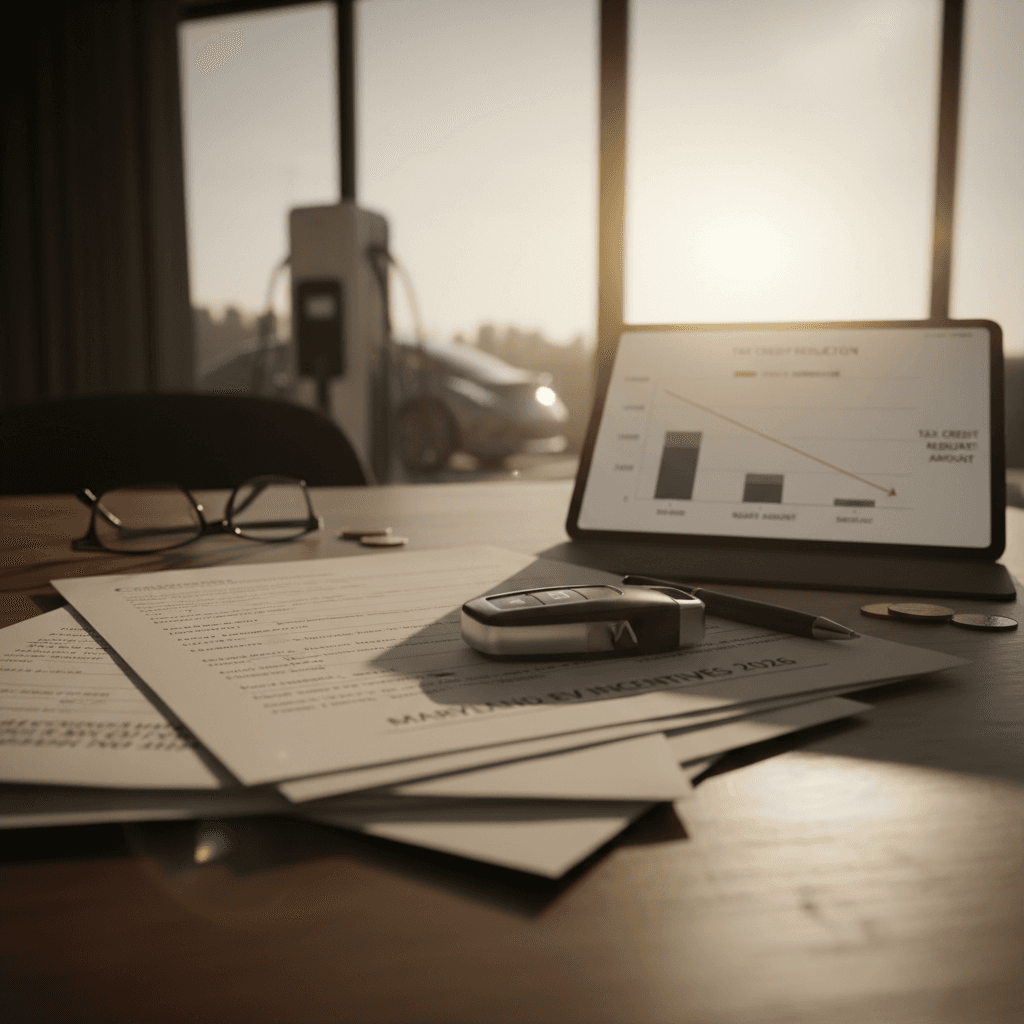
Funding is currently out
- If you **bought or leased a new EV earlier in the program** and your dealer or you submitted paperwork while funds were available, you may still be in the queue waiting for a check.
- If you **buy or lease a new EV in 2026**, the MVA may accept your application and place it on a **waiting list for a future fiscal year**, with no guarantee the legislature will add money.
- Maryland’s excise tax credit is administered by the **MVA and the State Comptroller’s Office**, and timing of payment can lag months or longer behind your purchase date.
Bottom line: in a 2026 shopping decision, you should treat the legacy excise tax credit as a **nice surprise if it arrives one day**, not as money you can safely count on. If a salesperson bases your monthly payment math on that credit, ask them to run the numbers again **without it**.
New Clean Vehicle Rebate: point-of-sale savings
Recognizing that back‑logged checks weren’t working for ordinary drivers, Maryland has begun building a new **Maryland Clean Vehicle Rebate** program. The goal is simple: move from slow, after‑the‑fact refunds to **instant, point‑of‑sale rebates** at the dealership.
How the Maryland Clean Vehicle Rebate is expected to work
Modeled to align with (and layer on top of) federal rules while they last
Rebate amounts
The framework calls for a **state rebate around $2,500 on a new EV** and **about $1,000 on a used EV** for buyers who meet income and vehicle‑price limits. Exact amounts, caps, and start dates can shift with each budget year, so always verify the current-year numbers before you sign.
Who qualifies
Maryland intends to tie eligibility to the same income and vehicle requirements used for the federal Clean Vehicle Credit (while that federal program still exists). That means you’ll likely need to:
- Stay under certain **modified adjusted gross income** limits;
- Keep your purchase under a **price cap**; and
- Buy from a **participating dealer** who can apply the rebate at checkout.
Timing matters
Because the Clean Vehicle Rebate is still maturing, think of it this way: **it may sweeten the deal, but it shouldn’t be the only reason you buy in 2026**. Focus on vehicles that make financial sense on their own, then treat any state rebate as a bonus you confirm in writing before you drive away.
Maryland EV charger rebate (EVSE) in 2026
Even as vehicle incentives wobble, Maryland’s **Electric Vehicle Supply Equipment (EVSE) Rebate Program** keeps quietly doing a lot of heavy lifting. If you’re installing a Level 2 charger at home, this is one of the most reliable state benefits left in 2026.
Maryland EVSE Rebate basics for residential drivers
Exact caps and dates can change each fiscal year, but the program structure has stayed fairly consistent.
| Feature | Typical Residential Benefit (FY 2026) | What It Means |
|---|---|---|
| Rebate type | Post-purchase rebate | You submit an application after your charger is installed and paid for. |
| Coverage | 50% of eligible costs | The program usually pays about half of your equipment + installation cost, up to a dollar cap. |
| What qualifies | Level 2 charger + permitted electrical work | You’ll need a 240V circuit, appropriate breaker, and any necessary permits/inspections. |
| Deadline | Application within set window | Missing the filing window is a common reason people lose out on this rebate. |
| Who runs it | Maryland Energy Administration | Program rules and forms live on the MEA website under transportation incentives. |
Always confirm current-year caps and deadlines on the Maryland Energy Administration site before you schedule an installation.
Cheat code for home charging
Many Maryland EV owners report getting **hundreds of dollars back** on EVSE rebates alone, often half the cost of adding a NEMA 14‑50 outlet or hard‑wiring a wallbox in the garage. Combined with off‑peak electric rates, that can turn your monthly “fuel” bill into something that looks like a rounding error.
Local, utility, and county incentives to stack
Utility incentives
Most major Maryland utilities now offer some mix of:
- Time-of-use (TOU) rates – cheaper electricity at night if you charge off‑peak.
- Small charger rebates – sometimes $100–$500 for enrolling a smart charger or EV in a managed charging program.
- Bill credits – for allowing the utility to occasionally throttle charging during grid peaks.
These incentives change often, so check your utility’s EV page before or right after your purchase.
County and city programs
Some counties and local governments add their own sweeteners: parking perks, public charging discounts, or limited-time grants tied to climate action plans. Montgomery, Prince George’s, and Baltimore regions are particularly active.
They’re usually smaller dollars than state or federal programs, but combined with **lower operating costs**, they can tip a borderline budget into the comfortable zone.
Stackable savings
Federal EV tax credit changes and what they mean for Maryland
On top of Maryland’s shifting landscape, the **federal Clean Vehicle Credit** has gone through its own political storm. A 2025 federal law rolled back or eliminated several clean‑energy credits, including the EV credit, on an accelerated timeline. Many new and used EV purchases after **September 30, 2025** no longer qualify for a federal tax break at all.
What this federal shakeup means if you live in Maryland
1. Don’t assume a $7,500 windfall
Most 2026 purchases no longer qualify for the old federal Clean Vehicle Credit. Any remaining benefits are narrower and subject to fast-changing rules.
2. Used EVs stand on their own economics
Without a reliable federal credit, **depreciation** becomes your new best friend. A 2–4 year-old EV can deliver huge fuel and maintenance savings without the drama of chasing tax forms.
3. State and local programs matter more
With the federal backstop weakened, Maryland’s own rebates, and your utility’s discounts, carry more weight in closing the affordability gap versus gas vehicles.
4. Financing becomes a key lever
If the credits are smaller, **financing terms** do more of the work. Spreading the cost of an EV over a longer term while you save at the pump can still leave you ahead each month.
In other words, the **EV deal in 2026 looks different from the glossy ads you saw in 2023–2024**, but it can still make financial sense, especially if you’re flexible about buying used and you take full advantage of Maryland’s home‑charging support.
Used EVs: how Marylanders can still win big
Here’s where the story gets good again. Even as tax credits fade, **used EV prices have come down sharply** compared with a few years ago. Many Maryland buyers are discovering that a 2–5 year‑old EV pencils out better than a new gas car ever did, without relying on a state check that may or may not show up.
Why used EVs shine in Maryland’s 2026 incentive world
Lower purchase price plus ongoing savings beat chasing uncertain credits
Depreciation does the heavy lifting
Early EV owners already took the steepest depreciation hit. You step in when the curve flattens, often saving **thousands off original MSRP**, more than the old $3,000 state credit was ever worth.
Battery health you can verify
With tools like the Recharged Score Report, you can see **independently verified battery health data** before you buy, not just a guess based on mileage.
Cleaner monthly cash flow
Pair a lower used‑EV payment with **Maryland’s EVSE rebate** and off‑peak electric rates, and your all‑in monthly cost (payment + energy + maintenance) can undercut a comparable gas car.
At Recharged, every used EV comes with a **Recharged Score battery health report**, fair‑market pricing, and expert help comparing models. That means you’re not gambling on a mystery battery just to save a few dollars, you’re buying with eyes wide open.
Eligibility rules and application checklist
Because Maryland’s programs each live in their own bureaucratic lane, it helps to think in **three buckets**: vehicle, charger, and local/utility. Here’s how to stay organized.
Maryland EV incentive checklist for 2026
1. Confirm vehicle eligibility
Check that your EV meets any **price caps, battery size, and emissions requirements** for state and local programs. For the legacy excise tax credit, the Monroney sticker base price had to fall under a set limit; future rebate programs will likely use similar caps.
2. Gather purchase documents
Keep copies of your **buyer’s order, bill of sale, registration, and window sticker (Monroney label)**. Maryland often asks for these with applications or dealer submissions.
3. Track your purchase date
Almost every incentive is tied to a specific **purchase or installation window** (for example, July 1, 2025–June 30, 2026). Note your dates and match them against each program’s rules.
4. Line up your installer
For the EVSE rebate, use a **licensed electrician**, pull any required permits, and keep detailed invoices that separate hardware and labor. Sloppy paperwork is the easiest way to lose a rebate.
5. File applications promptly
Maryland programs are famous for **running out of money mid‑year**. Submit your EVSE application and any required vehicle forms as soon as you’re eligible, and hang on to confirmation emails.
6. Ask your dealer to help
For point‑of‑sale rebates and the legacy excise credit waitlist, **dealers can usually submit documents electronically**. Ask them to show you exactly what they’re filing and get copies for your records.
Common pitfalls with Maryland EV rebates
Frequent Maryland gotchas
- **Assuming funding will be there later.** Maryland’s EV credits have a long history of **running out of money before the fiscal year ends**. If a program is “subject to funding,” never bank on it until you see a confirmation.
- **Not reading the fine print on price caps.** A trim level or option package that nudges the **base MSRP over the cap** can quietly make your car ineligible for a vehicle rebate, even if the final transaction price looks lower after discounts.
- **Waiting too long to install your charger.** The EVSE program is generous but finite. If you delay installation for months after your purchase, you risk landing in the next fiscal year, where rules or funding may change.
- **Ignoring income limits.** For any program tied to federal Clean Vehicle Credit rules, exceeding the **income thresholds** means no rebate, no matter how efficient or affordable the car is.
- **Losing documents.** Maryland loves documentation. Tossing the window sticker or not keeping digital copies of invoices can add weeks of delay or sink your application entirely.
If a deal sounds too good to be true, “You’ll get the state check in the mail, don’t worry about it”, slow the conversation down. Ask the salesperson to show you **current program language** and to put in writing whether your finance terms depend on a rebate that hasn’t been paid yet.
FAQ: Maryland electric car rebate 2026
Frequently asked questions about Maryland’s 2026 EV rebates
So, should you buy an EV in Maryland in 2026?
If you were picturing 2020‑style headlines, **"$10,000 off your new EV with stacked credits"**, then yes, 2026 can feel like a letdown. The big, simple Maryland electric car rebate has fractured into waitlists, point‑of‑sale pilots, and a patchwork of local offers. But that doesn’t mean the EV moment has passed you by.
The real opportunity for Maryland drivers in 2026 is to **let the incentives support a smart decision, not drive it**. A well‑priced used EV, backed by verified battery health and a solid home‑charging setup, can quietly undercut a comparable gas car on total cost, even without a federal credit or a sure‑thing state rebate. Then, if a Maryland Clean Vehicle Rebate or legacy excise check shows up down the road, that’s icing, not the cake.
If you’re ready to explore that path, Recharged can help you compare used EVs that fit Maryland’s evolving rules, estimate your charging costs, and lay out which **state, local, and utility incentives** you can realistically claim. With the right car and a little paperwork discipline, 2026 can still be the year you trade gas stations for a charging cable in your own driveway.