
If you’re driving a Kia Telluride and eyeing the all‑electric Kia EV9, you’re probably wondering one thing: how much will you actually save by switching? This guide walks through real‑world numbers so you can see the cost savings of switching from a Kia Telluride to a Kia EV9, from fuel and electricity all the way to maintenance and 5‑year ownership costs.
Quick takeaway
Why consider switching from a Kia Telluride to a Kia EV9?
The Telluride has earned its reputation: comfortable, roomy, and one of the better values in three‑row SUVs. The EV9 aims at the same buyer, but replaces the 3.8‑liter V6 and fuel tank with a large battery, dual‑ or single‑motor setup, and the ability to charge at home. That combination changes how you pay to drive in three big ways:
- You swap gasoline fill‑ups at $3–$4+ per gallon for electricity bought in kWh.
- Routine maintenance (oil changes, transmission service, exhaust, etc.) largely disappears with the EV9.
- Some states and utilities layer on rebates, tax credits, and cheaper overnight electricity for EVs.
EVs shine with higher mileage
Key specs that drive cost: Telluride vs EV9
Telluride vs EV9: the cost drivers
To get a fair cost comparison, you need a few anchor numbers. We’ll use reasonable, real‑world figures that line up with EPA data and owner reports:
Baseline assumptions for this cost comparison
You can adjust these later to match your own driving and local prices.
Kia Telluride fuel economy
Most AWD Telluride trims return about 21–23 mpg combined in real‑world driving. We’ll use 22 mpg as a reasonable average.
Kia EV9 efficiency
EPA efficiency for the EV9 generally sits around 38–41 kWh/100 miles depending on battery and drivetrain. We’ll use 40 kWh/100 miles (0.40 kWh per mile).
Energy prices (national averages)
- Gasoline: We’ll use $3.30 per gallon as a conservative long‑term average, slightly above the 2024–2025 U.S. norm and below current $4+ spikes.
- Electricity: Recent EIA data puts average U.S. residential rates in the $0.17–$0.18 per kWh range. We’ll use $0.18/kWh for at‑home charging.
Annual mileage
The typical American driver logs about 12,000 miles per year. We’ll use that as our base case, then look at heavier‑use scenarios like 15,000 and 20,000 miles.
If you drive significantly more or less, you can scale the numbers linearly.
Your numbers may differ
Fuel vs electricity: cost per mile explained
Once you know the Telluride’s mpg and the EV9’s kWh/100 miles, the rest is simple math. Let’s break down what you pay for each mile you drive.
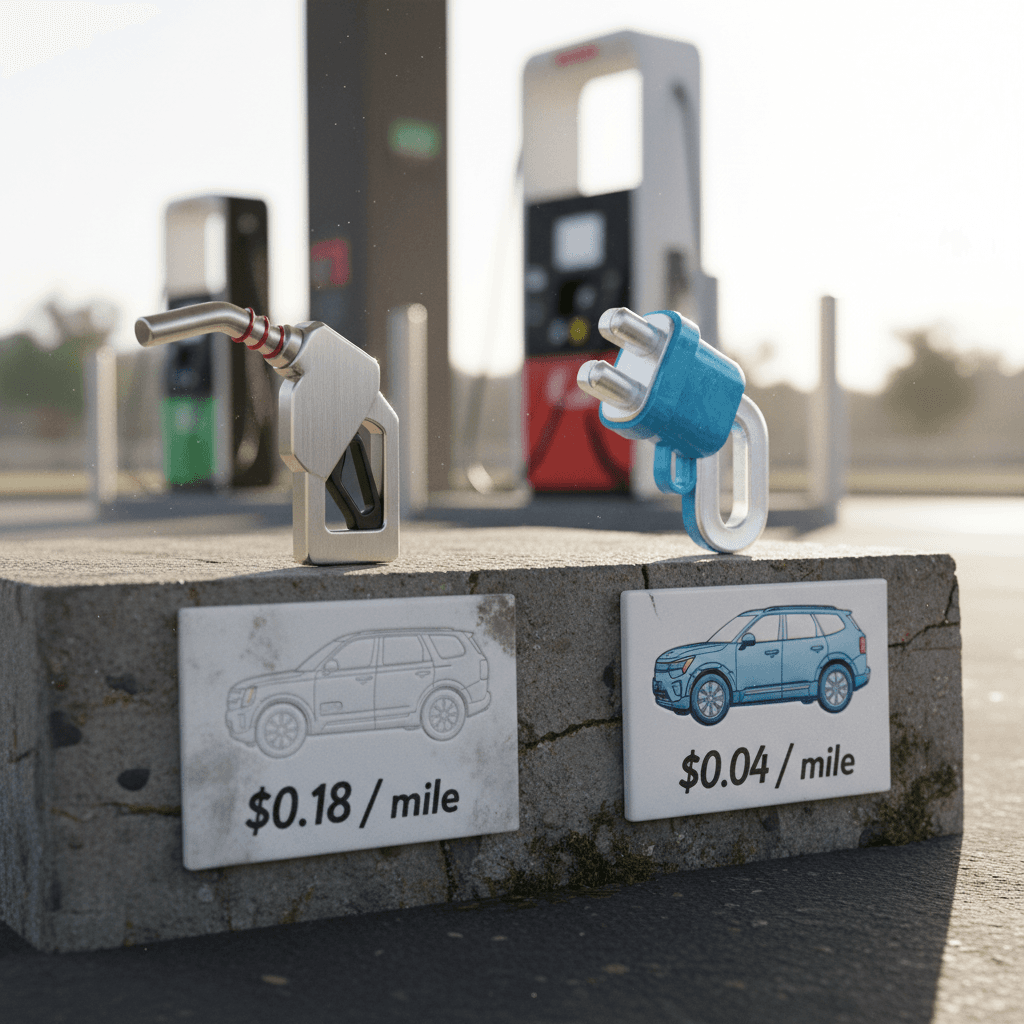
Energy cost per mile: Kia Telluride vs Kia EV9
Based on 22 mpg for the Telluride, 40 kWh/100 miles for the EV9, $3.30/gallon gasoline, and $0.18/kWh home electricity.
| Vehicle | Key assumption | Energy cost formula | Cost per mile (approx.) |
|---|---|---|---|
| Kia Telluride (gas) | 22 mpg, $3.30/gal | $3.30 ÷ 22 mpg | ≈ $0.15 per mile |
| Kia EV9 (home charging) | 40 kWh/100 mi, $0.18/kWh | (40 × $0.18) ÷ 100 | ≈ $0.07 per mile |
| Kia EV9 (public fast charge)** | 40 kWh/100 mi, $0.40/kWh | (40 × $0.40) ÷ 100 | ≈ $0.16 per mile |
Your local gas and power prices will move these figures up or down, but the relative gap tends to hold.
Public charging caveat
Look at that second row: at typical U.S. electricity prices, an EV9 charged mostly at home cuts your energy cost per mile by roughly half compared with a Telluride. Over thousands of miles, that adds up quickly.
5‑year total cost of ownership: Telluride vs EV9
Let’s turn per‑mile numbers into something more tangible: 5‑year fuel/electricity and maintenance costs. We’ll stay focused on running costs and ignore purchase price differences for the moment, because many shoppers are comparing selling or trading their Telluride for a used EV9, not paying MSRP for both.
Five‑year ownership cost snapshot (12,000 mi/year)
Estimated 5‑year operating costs: Kia Telluride vs Kia EV9
Assumes 12,000 miles/year, gasoline $3.30/gallon, home electricity $0.18/kWh, 80% of EV9 miles charged at home and 20% on public fast chargers at $0.40/kWh.
| Cost category (5 years) | Kia Telluride (gas) | Kia EV9 (electric) |
|---|---|---|
| Fuel / electricity | ≈ $9,000 | ≈ $5,040 home + $1,920 public ≈ $6,960 |
| Routine maintenance & wear* | ≈ $3,000 | ≈ $1,250 |
| Total operating costs | ≈ $12,000 | ≈ $8,200 |
| Approx. savings vs Telluride | , | ≈ $3,800 over 5 years |
Numbers are approximate but directionally reliable for many U.S. drivers.
Bigger savings with more home charging
This table deliberately uses conservative assumptions. In years when gasoline jumps above $4 per gallon, or in households driving 15,000–20,000 miles per year, the EV9’s advantage widens substantially.
Maintenance and repairs: where EV9 pulls ahead
The Telluride is a well‑engineered SUV, but it’s still a traditional internal‑combustion vehicle with hundreds of moving parts in the engine and transmission. The EV9 eliminates many of those systems outright, which is where long‑term savings quietly stack up.
Gasoline SUV vs EV maintenance: what disappears and what remains
Both vehicles still need tires and basic inspections, everything else starts to diverge.
Telluride: typical 5‑year items
- Oil and filter changes every ~7,500 miles
- Engine air filter, cabin air filter
- Transmission fluid service (depending on schedule)
- Spark plugs and ignition components (longer term)
- Exhaust system components
Conservatively, budgeting $500–$600 per year for routine service and wear items is sensible if you use a dealer or reputable shop.
EV9: typical 5‑year items
- Tire rotations and replacement
- Cabin air filter changes
- Brake fluid replacement per schedule
- Occasional software updates (often over‑the‑air)
No engine, transmission, or exhaust means EVs generally run 30–50% cheaper to maintain over the same period.
Battery health and used EV9s
Insurance, taxes, and incentives to factor in
Operating costs don’t stop at fuel and maintenance. When you move from a Telluride to an EV9, a few other line items can change as well.
- Insurance: Some carriers currently rate EVs slightly higher than comparable gas SUVs because of repair costs, while others offer green‑vehicle discounts. It’s smart to get quotes on both vehicles with the same coverage before you switch.
- Registration and taxes: A few states charge modest annual EV fees in place of lost gas‑tax revenue. Others offer reduced registration for EVs. This usually moves the needle by low hundreds of dollars over several years, not thousands.
- Tax credits and rebates: Depending on when and how you buy, a new or used EV9 may qualify for federal or state‑level incentives, or for utility rebates for home charger installation. These can offset part of the purchase or charging‑setup cost and effectively improve your payback period.
Don’t assume incentives automatically apply
Real-world examples for different driving profiles
To make the savings easier to visualize, here are three common driving profiles. In each case we’ll compare approximate annual fuel/electricity and maintenance spending for a Telluride vs an EV9, using the same assumptions as before.
How much can you save each year?
1. Suburban family: 10,000 miles/year
• Telluride: ≈ $1,500 in fuel + ≈ $500 in maintenance ≈ <strong>$2,000/year</strong><br>• EV9: ≈ $1,160 in electricity (mostly home) + ≈ $250 in maintenance ≈ <strong>$1,410/year</strong><br><br><strong>Approximate savings:</strong> ~$600/year
2. Typical driver: 12,000 miles/year
• Telluride: ≈ $1,800 in fuel + ≈ $600 in maintenance ≈ <strong>$2,400/year</strong><br>• EV9: ≈ $1,392 in electricity + ≈ $250 in maintenance ≈ <strong>$1,640/year</strong><br><br><strong>Approximate savings:</strong> ~$750/year
3. Road‑trip family: 20,000 miles/year
• Telluride: ≈ $3,000 in fuel + ≈ $800 in maintenance ≈ <strong>$3,800/year</strong><br>• EV9: ≈ $2,320 in electricity (more public DC fast charging) + ≈ $300 in maintenance ≈ <strong>$2,620/year</strong><br><br><strong>Approximate savings:</strong> ~$1,200/year
Savings scale with miles driven
How charging habits change your savings
The biggest swing factor in EV operating cost is where and when you charge. A Telluride’s fuel price is set at the station marquee. An EV9 gives you more knobs to turn.
Mostly home charging (best case)
- 80–90% of miles charged in your driveway or garage.
- Electricity at ~18¢/kWh or less.
- Cost per mile: around 7–8 cents.
This is where the EV9 really shines for families replacing a Telluride.
Mix of home and workplace
- Some employers or apartments offer low‑cost or free Level 2 charging.
- Blended average kWh price drops even below your home rate.
- Cost per mile can dip into the 5–7 cent range.
Heavy DC fast‑charging (least savings)
- Frequent road trips or no home charging option.
- Fast‑charge rates often hover around 35–45¢/kWh.
- Cost per mile looks similar to, or slightly cheaper than, gasoline.
In this case, the EV9 still wins on maintenance, but fuel savings are modest.
Plan your home setup
How to switch using a used Kia EV9
You don’t have to walk into a new‑car showroom and pay top dollar to move from a Telluride to an EV9. The early wave of Kia EV9s is already entering the used market, which is where platforms like Recharged are designed to help.
A simple path from Telluride to EV9 with Recharged
Minimize guesswork on pricing, battery health, and logistics.
1. Get a value for your Telluride
Start by getting an instant offer or trade‑in estimate for your Kia Telluride. Recharged can help you compare selling, trading in, or consigning your SUV so you understand your equity before you shop.
2. Shop used EV9s with verified battery health
Browse used Kia EV9s on Recharged, each with a Recharged Score battery health diagnostic, fair‑market pricing analysis, and detailed history. That helps you compare options the same way you might compare mpg and equipment on different Tellurides.
3. Line up EV‑friendly financing
Our EV‑savvy financing partners understand how lower operating costs and strong residual values affect an electric SUV. You can pre‑qualify online with no impact to your credit to see payment options before you commit.
4. Close the gap with delivery and support
Once you’ve chosen an EV9, Recharged can coordinate nationwide delivery and walk you through home‑charging setup, incentives, and what to expect on day one of EV ownership.
Ready to find your next EV?
Browse VehiclesWhy a used EV9 often pencils out
FAQ: Switching from Kia Telluride to Kia EV9
Frequently asked questions
Is switching from a Telluride to an EV9 worth it?
For many Telluride owners, the Kia EV9 is a natural next step: it keeps the three‑row practicality and comfort, adds quiet electric torque, and meaningfully reshapes your running costs. If you drive a typical or higher‑than‑average number of miles, charge mostly at home, and plan to keep the vehicle for several years, the cost savings of switching from a Kia Telluride to a Kia EV9 are real, often several thousand dollars over a 5‑year window.
The right answer for you comes down to how you drive, what energy costs look like in your area, and how you value the other benefits of going electric, quieter rides, instant torque, and fewer stops at gas stations. If you’re ready to run the numbers on an actual vehicle, browsing used Kia EV9 listings on Recharged, comparing them to your Telluride’s trade‑in value, and reviewing each EV9’s Recharged Score is a smart way to see how the math works out in your driveway, not just on paper.