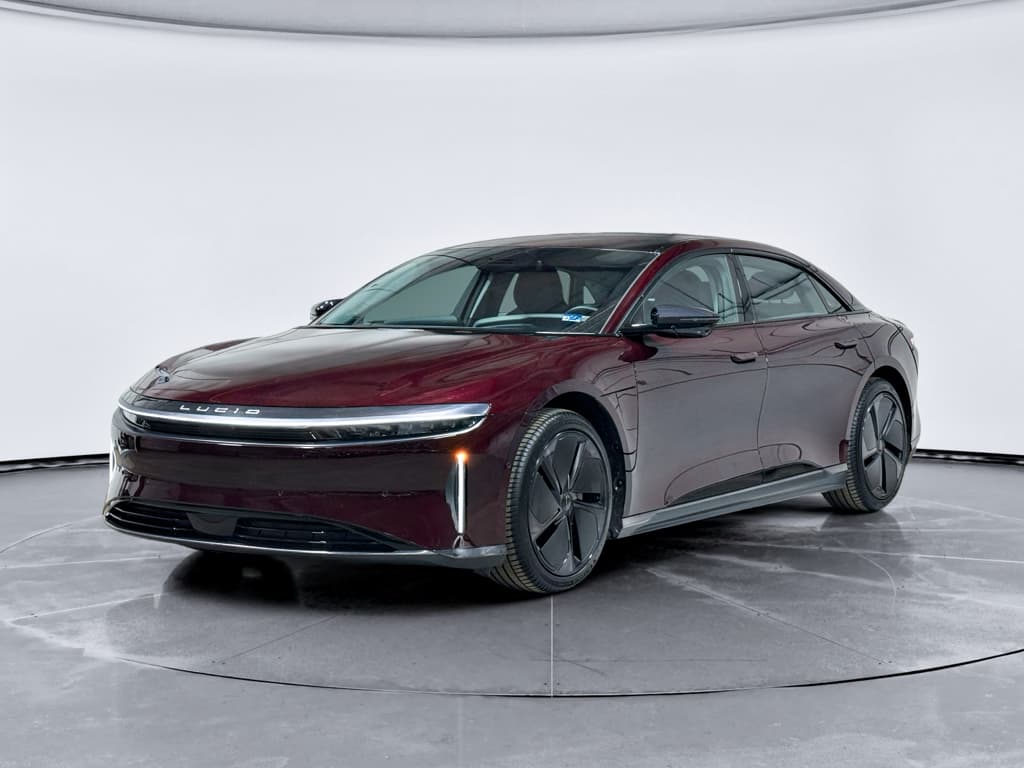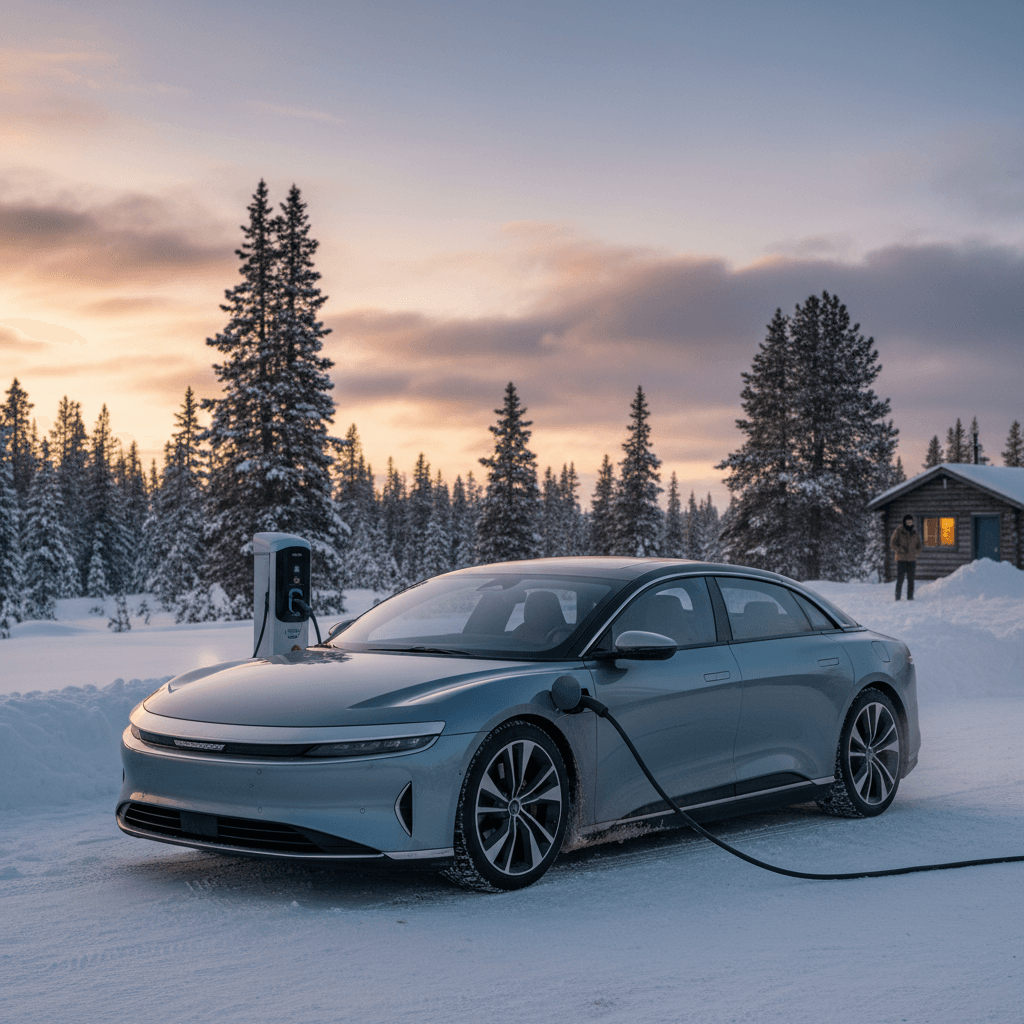
If you live where winter really means winter, you’re right to ask how a Lucid Air’s range changes in cold weather. The Air tops the charts for EPA range in mild conditions, but freezing temperatures, snow, and heater use all chip away at that headline number. The good news: with some planning, you can keep winter range predictable, and your trips drama‑free.
Lucid Air winter range at a glance
Lucid Air winter range: quick overview
Lucid Air winter range in one chart
Lucid engineered the Air to be one of the most efficient EVs on the road, with several trims rated above 500 miles of EPA range on 19‑inch wheels. That efficiency doesn’t disappear in winter, but physics still wins. Energy that would normally go to the motors is diverted into heating the cabin and the battery pack, and cold air increases aerodynamic drag. Understanding this tradeoff is the first step to planning your winter drives.
EPA range vs. Lucid Air range in cold weather
Start with the basics: EPA ratings are measured in controlled lab tests at moderate temperatures. They’re a solid benchmark for comparing vehicles, but they’re not a promise of what you’ll see at 10°F with snow on the road and the heat cranked. For a Lucid Air, winter typically turns those giant EPA numbers into still‑impressive, but smaller, real‑world figures.
EPA range vs. realistic Lucid Air winter planning
Approximate planning numbers for long highway drives, assuming steady speeds, climate control on, and mostly dry roads. Always leave yourself a buffer and watch your real‑time consumption.
| Condition | Typical Range vs. EPA | What to Plan For |
|---|---|---|
| Mild/cool (45–60°F) | 0–10% loss | Many owners report meeting or slightly beating EPA on longer drives. |
| Cold (25–35°F) | 15–25% loss | Plan for ~3⁄4 of EPA range on steady highway trips. |
| Deep cold (0–20°F) | 25–35% loss | Plan for ~2⁄3 of EPA range; more if it’s windy or icy. |
| Short, stop‑and‑go winter trips | Up to 35–40% loss | Heater and repeated warm‑ups dominate; plan extra margin. |
These are conservative planning targets, not guarantees. Your results will vary with speed, elevation, wind, and how warm you like your cabin.
Don’t use EPA as your winter trip plan
How cold weather actually affects your Lucid Air battery
1. Battery chemistry slows down
All lithium‑ion packs dislike cold. At low temperatures, the chemical reactions inside the cells slow, which:
- Reduces how efficiently energy flows in and out of the pack
- Limits peak power until the pack warms up
- Increases energy lost as heat in the battery itself
Lucid’s thermal management system fights this by actively warming the pack, but that takes energy too.
2. Heat is a range hog
Unlike a gas car that repurposes waste heat from the engine, an EV has to create cabin heat from the battery. Your Lucid Air uses a heat pump and resistive elements to keep you comfortable, especially at low temps.
- Cranking the heat on a cold start can add several kW of load
- Seat and steering‑wheel heaters use far less energy than blasting hot air
- Short trips where the car never fully warms up are the worst for efficiency
On top of that, cold, dense air increases aerodynamic drag and winter tires add a bit of rolling resistance. Taken together, it’s not surprising to see your miles per kWh fall in winter even if your driving style doesn’t change.
Use Lucid’s efficiency tools
Real-world Lucid Air winter range examples
Owner reports and third‑party tests paint a fairly consistent picture: even when temperatures plunge, the Lucid Air remains one of the most efficient long‑range EVs on the road. It may not hit the marketing‑sheet number on a snowy February afternoon, but it often goes farther than rivals given the same conditions.
What Lucid Air drivers often see in winter
These are illustrative scenarios based on common owner experiences and independent tests, not guarantees.
Highway road trip, around freezing
Scenario: Air Grand Touring on 19" wheels, 70 mph, temps in the low 30s°F, light heat.
Typical result: Consumption in the high 3s mi/kWh, roughly 15–25% below EPA, still leaving 250–350 miles of usable range per charge.
Deep-cold commute
Scenario: Air Pure or Touring, 10–20°F, multiple short trips with pre‑heating and heavy cabin heat.
Typical result: Efficiency drops into the 2s to low 3s mi/kWh. Effective range on a full charge might be 25–35% below EPA, more if all trips are under 10–15 miles.
Mountain or ski‑trip driving
Scenario: Climbing to a ski resort then descending, temps in the teens, mixed speeds.
Typical result: Range drops on the uphill leg, then your Air’s strong regenerative braking pays you back on the way down, often offsetting a chunk of the loss.
Lucid’s efficiency advantage still shows up
Planning winter range by Lucid Air trim & wheel choice
Not every Lucid Air is a 500‑plus‑mile monster. Battery size, motor count, and especially wheel choice all influence your starting point before winter takes its cut. Here’s how to think about range by trim when temperatures drop.
Sample winter planning targets by Lucid Air trim
Approximate long‑trip planning numbers for U.S. models on 19‑inch wheels. Figures are rough, conservative estimates based on typical winter losses, not official ratings.
| Lucid Air Trim (19" wheels) | EPA Range (approx.) | Cold (25–35°F) Planning | Deep Cold (0–20°F) Planning |
|---|---|---|---|
| Pure | ~410–430 mi | Plan ~300–340 mi | Plan ~260–290 mi |
| Touring | ~420–440 mi | Plan ~310–350 mi | Plan ~270–300 mi |
| Grand Touring | ~510–520+ mi | Plan ~380–430 mi | Plan ~330–370 mi |
| High‑performance / 21" wheels | EPA varies; usually 450–500 mi | Plan ~330–380 mi | Plan ~290–330 mi |
If you run 21‑inch wheels, subtract another ~5–10% from both EPA and winter planning numbers.
Why wheels matter so much
7 ways to reduce Lucid Air range loss in winter
Practical steps to protect your Lucid Air’s winter range
1. Precondition while plugged in
Use the Lucid app or in‑car scheduling to warm the cabin and battery <strong>before</strong> you leave, while you’re still connected to home or workplace charging. That way, a lot of the heavy lifting comes from the grid, not your battery.
2. Use seat and wheel heaters first
Seat and steering‑wheel heaters use far less power than blowing really hot air. Set the cabin temperature a bit lower, rely on the seat heaters, and you’ll feel just as warm with less range impact.
3. Build extra buffer into trip plans
On a 70°F day you might be comfortable arriving at a charger with 5–10% battery. In winter, give yourself a <strong>larger buffer</strong>, 15–20% is more comfortable when wind, detours, or unexpected delays can push consumption up.
4. Moderate your highway speeds
Cold, dense air already increases drag; 5–10 mph faster on the highway adds even more. Dropping from 78 mph to 68–70 mph can claw back a surprising amount of range, especially over a 200‑mile leg.
5. Avoid lots of short, cold starts
If possible, combine errands into a single, longer outing. A warm battery and cabin are much more efficient than repeatedly heating a stone‑cold car for 5–10 minute drives.
6. Keep tires properly inflated
Tire pressure drops in cold weather, increasing rolling resistance and hurting range. Check pressures regularly and keep them at the recommended spec for your wheel/tire setup.
7. Use Eco/efficient drive modes when it’s slick
On snow or ice, the efficient drive modes that soften throttle response can actually help you drive more smoothly and conserve energy while also improving traction.
Charging your Lucid Air in cold weather
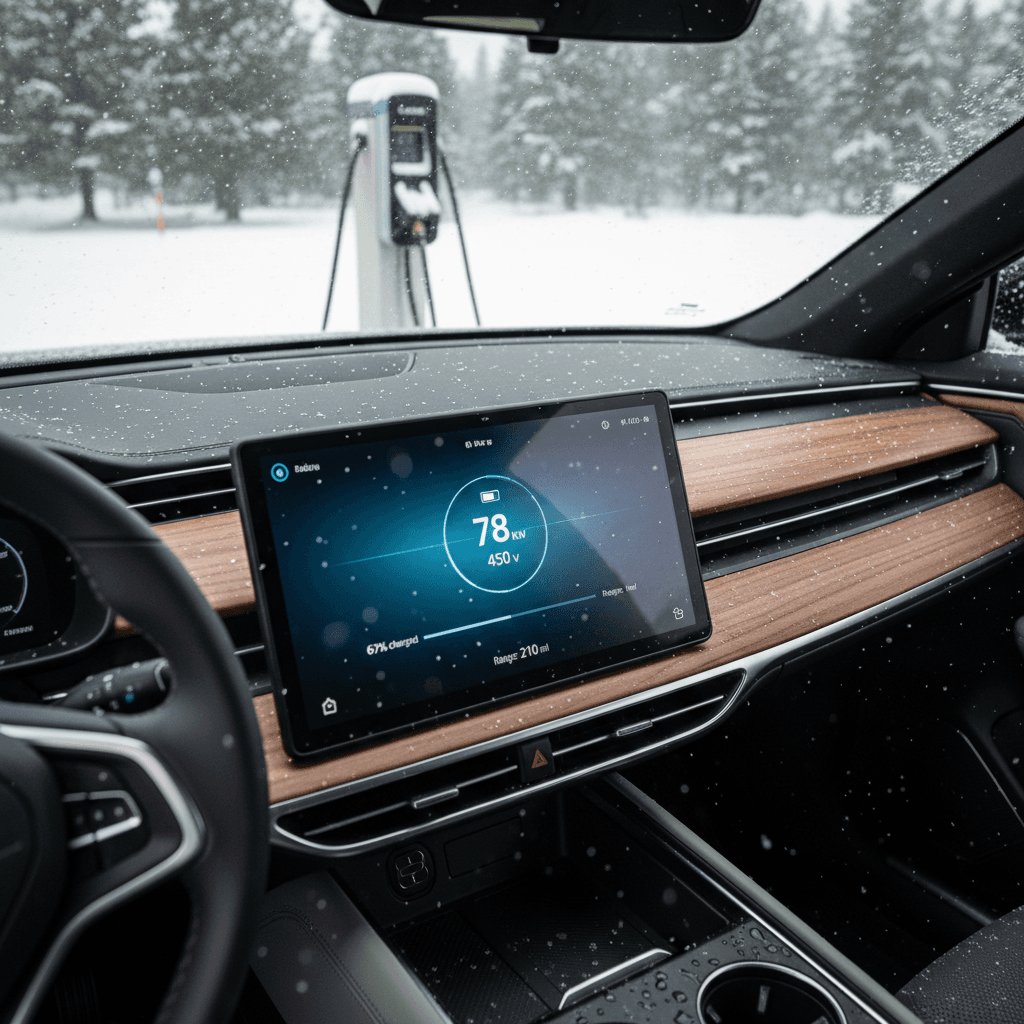
Range is only half the winter story. The other half is how quickly you can put energy back in. Cold batteries charge more slowly, especially on DC fast chargers. Lucid’s thermal management helps, but if you arrive at a fast charger with a pack that’s well below freezing, don’t expect headline charging speeds immediately.
Arrive with a warm battery
Fast charging works best when the pack is warm. In a Lucid Air, you can:
- Drive for at least 20–30 minutes before your DC fast‑charge stop
- Use built‑in navigation to the fast charger so the car can pre‑condition the pack where available
- Avoid letting the car sit unplugged for many hours in sub‑freezing temps right before a fast‑charge session
Adjust expectations on the first few minutes
On very cold days, you may see:
- Lower initial kW than you’re used to
- A gentle ramp‑up in charging speed as the pack warms
- More time spent in the mid‑SOC range (say 20–60%) before tapering
Plan a slightly longer stop and use the time for food, restrooms, or trip‑planning instead of hovering over the kW number.
Home charging is where winter range anxiety goes to die
Winter range vs. long-term battery health
The Lucid Air’s battery management system is designed to protect the pack in both heat and cold. While winter reduces your *temporary* usable range, it isn’t inherently bad for long‑term battery life, in some ways, it’s gentler than very high ambient temperatures.
- Cold slows down the chemical reactions that age the cells, as long as you’re not trying to fast‑charge a rock‑cold pack at very high power.
- The car’s software will limit charging and power if pack temperatures could cause damage, even if that means slower performance or charging.
- Keeping your Air plugged in during extreme cold lets the car maintain the pack in a healthy temperature window without major range loss while parked.
- Seasonal swings in range (more in summer, less in winter) are normal and not a sign that the battery is rapidly degrading.
What a good used‑EV report should show
Is a used Lucid Air a good choice for cold climates?
If you’re shopping the used market in places like the Midwest, Northeast, or Mountain West, the Lucid Air can be a smart cold‑climate pick, as long as you understand how winter affects range and charging. Its high baseline efficiency, large battery options, and sophisticated thermal management give you more headroom than many rivals once the temperature drops.
Pros and cons of Lucid Air in winter
Thinking about buying used for a snowy climate? Weigh these factors.
Winter-friendly strengths
- Huge EPA range gives a comfortable buffer even after 20–30% winter loss.
- Advanced thermal management helps the pack handle cold better than early‑generation EVs.
- Strong regenerative braking recovers energy on descents, especially relevant for mountain regions.
- Available all‑wheel drive on many trims for snow traction.
Winter caveats to plan around
- Long‑range doesn’t mean you’re immune to planning, you still need to think about charging spacing on rural routes.
- High‑performance trims on 21" wheels can give up more range in bad conditions.
- Public DC fast‑charging can be slower than you expect if both the pack and charger are cold.
How Recharged can help with winter readiness
Ready to find your next EV?
Browse VehiclesLucid Air winter range FAQ
Frequently asked questions about Lucid Air range in cold weather
Key takeaways for Lucid Air range in cold weather
Cold weather will absolutely trim your Lucid Air’s range, but it doesn’t erase its core advantage: exceptional efficiency and unusually large batteries. If you assume roughly 15–30% loss around freezing and up to about 35–40% in deep cold, adjust your highway speeds, and lean on preconditioning, you’ll find that the Air remains one of the most confidence‑inspiring EVs for winter driving.
If you’re considering a used Lucid Air and wondering how it will handle your specific winters, it pays to get model‑by‑model clarity instead of guessing. That’s where Recharged comes in: every vehicle includes a Recharged Score battery health report, transparent pricing, and EV‑savvy advisors who can help you understand winter range, home charging, and long‑term costs before you buy. That way, when the temperature drops, your only real decision is which road to take, not whether you’ll make it there.