If you own or are shopping for an electric car, the li‑ion battery for that electric car is the whole ballgame. It dictates range, performance, longevity, and even the resale value of the vehicle. The good news: modern EV lithium‑ion packs are proving far tougher and longer‑lived than most people imagined when plug‑ins first showed up.
Today’s EV batteries are outlasting the hype
Why the li‑ion battery in your electric car matters
In a gasoline car, the engine is the beating heart. In an EV, the lithium‑ion traction battery plays that role. It’s also the single most expensive component in the vehicle, and it quietly controls how stress‑free (or stressful) your EV ownership experience will be.
- It determines your real‑world driving range and how often you need to charge.
- It affects how quickly your car can accelerate and accept fast charging.
- It sets a large chunk of the car’s price; the pack can be 30–40% of total cost.
- It heavily influences resale value, especially once the car is out of warranty.
Think of the battery as a long‑term asset
How a li‑ion battery for an electric car actually works
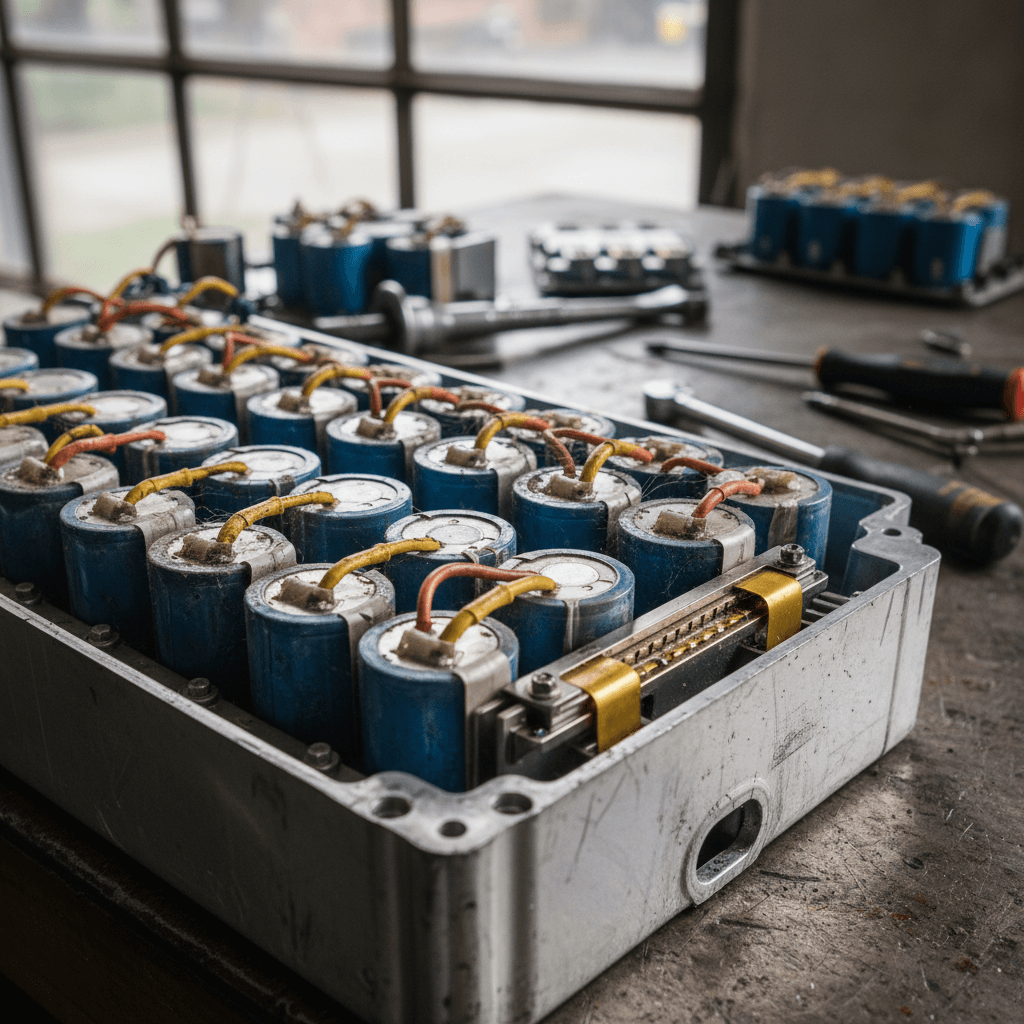
Despite the sci‑fi aura around EVs, the basic idea is straightforward. A lithium‑ion EV battery is a big collection of small cells, each a chemical sandwich of anode, cathode and electrolyte. When you drive, lithium ions move from anode to cathode, releasing electrical energy. When you charge, the process runs in reverse.
From tiny cells to a full EV pack
What’s actually under the floor of your electric car
Cells
Modules
Pack
The unsung hero here is the Battery Management System (BMS). It’s constantly measuring voltage, temperature and current in different parts of the pack, deciding how much power you can safely pull for acceleration, and how much charge it will accept from a DC fast charger without cooking itself.
Heat is the enemy
The main lithium‑ion chemistries in today’s EVs
Not all li‑ion batteries are the same. Carmakers choose different chemistries depending on whether they’re chasing maximum range, minimum cost, or long‑term durability. Three families dominate modern EVs: LFP, NMC and NCA.
Common EV lithium‑ion chemistries at a glance
How LFP, NMC and NCA differ in practice for EV drivers.
| Chemistry | Typical Use in EVs | Pros for Drivers | Trade‑offs |
|---|---|---|---|
| LFP (Lithium Iron Phosphate) | Many entry‑level and mid‑range EVs, standard‑range packs, some Teslas | Excellent safety, long cycle life, lower cost, happy to sit at 100% charge | Lower energy density means heavier packs for the same range; a bit weaker in cold weather |
| NMC (Nickel Manganese Cobalt) | Most mainstream and long‑range EVs in North America | High energy density for strong range, solid fast‑charge performance | Uses nickel and cobalt (more expensive, ethical supply concerns), prefers partial charges day‑to‑day |
| NCA (Nickel Cobalt Aluminum) | Performance‑oriented EVs, many Tesla long‑range packs | Very high energy density and power output, great for long‑range and performance models | Also uses cobalt and nickel, somewhat more sensitive to heat and fast‑charge abuse |
LFP trades energy density for cost and longevity; NMC and NCA prioritize range and power.
LFP vs NMC: which is “better”?
How long EV lithium‑ion batteries really last
What real‑world data says about EV battery life
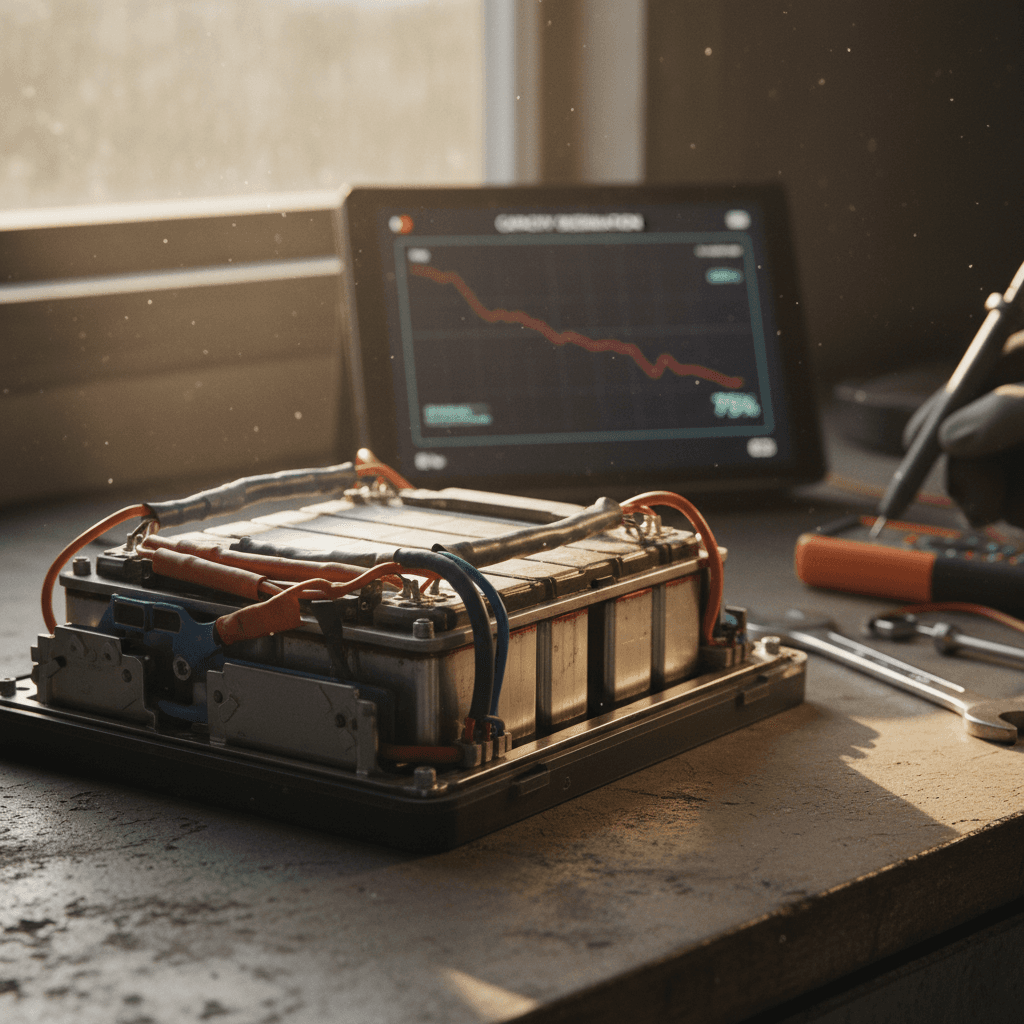
Every li‑ion battery slowly loses capacity as side reactions inside the cells build up over time. The pattern is usually an early dip in the first couple of years, then a very gentle decline. Large fleet studies of thousands of EVs now converge around an average 1.5–2% capacity loss per year in modern, liquid‑cooled packs.
- After 5 years, many EVs still retain roughly 85–90% of original capacity.
- After 8 years, most sit somewhere around 75–85%, still within typical warranty targets.
- High‑mileage cars, taxis, ride‑hail, delivery, often show 80%+ capacity even past 150,000 miles when cooled and managed well.
Warranties are conservative by design
How to treat your li‑ion battery so it lasts longer
You don’t need to baby a modern EV, but a few simple habits can dramatically extend the life of the li‑ion battery in your electric car. Think of it as changing the oil on a gas vehicle, low effort, big payoff.
Everyday habits that are kind to your EV battery
1. Avoid living at 100%
For NMC and NCA packs, use 70–90% as your everyday “full” and save 100% charges for road trips. LFP packs are more relaxed about 100%, but there’s still no need to leave them maxed out all week.
2. Don’t fear fast charging, just be smart
Occasional DC fast charging is fine. If you’re doing it several times a week, try to unplug around 80% and let the pack cool a bit before hammering down the highway.
3. Watch the heat
On very hot days, park in the shade, use the car’s scheduled pre‑conditioning, and don’t let it sit at 100% in the sun. High temperature plus high state of charge is hard on any li‑ion chemistry.
4. Let the BMS do its job
Keep your software up to date and occasionally charge to a higher level so the BMS can recalibrate its state‑of‑charge estimate. That makes your range prediction more honest.
5. Store it sensibly
If you’re parking the car for weeks, aim to leave the battery around 40–60% and enable any long‑term storage or “battery saver” mode in the settings.
6. Use Level 2 at home when you can
A well‑installed Level 2 charger gives you overnight refills at gentle power levels. It’s easier on the pack and far more convenient than living on public DC fast chargers.
Two things that really do hurt
Battery size, range and performance: what the numbers mean
When you read spec sheets, the li‑ion battery in an electric car is usually described in kilowatt‑hours (kWh): 60 kWh, 77 kWh, 100 kWh and so on. Bigger numbers generally mean more range, but it’s not the whole story.
1. Battery capacity (kWh)
Think of kWh like the size of the fuel tank. A 75 kWh pack stores more energy than a 50 kWh pack. However, not all of it is usable, most EVs keep a buffer at top and bottom to extend life.
A typical modern EV lands somewhere between 55 and 85 kWh usable capacity.
2. Efficiency (mi/kWh)
Efficiency tells you how far the car goes on each kWh, similar to mpg. Two cars with the same battery size can have very different ranges if one is heavy or shaped like a brick and the other slices the air.
Multiply usable kWh by mi/kWh to estimate realistic range in your climate and driving style.
- City‑heavy driving and milder weather usually yield more miles per kWh than cold‑weather highway blasts.
- Performance models with big wheels and sticky tires will consume more energy than eco‑spec trims with skinny tires.
- Software updates can improve both efficiency and charging speed over time, another reason to keep your car updated.
A quick rule of thumb for range
EV battery replacement costs and warranties
People fixate on the nightmare scenario: "What if the li‑ion battery for my electric car dies and I have to replace it?" For a modern EV that’s been reasonably cared for, outright pack failure is rare. When replacements do happen, they’re usually due to isolated defects or accident damage, not gentle degradation.
Typical EV battery warranty terms
These are broad patterns; always check the fine print for a specific model year.
| Coverage type | Typical duration | Common capacity guarantee |
|---|---|---|
| Basic battery warranty | 8 years | Around 70% state of health (SoH) |
| Mileage cap | 100,000–150,000 miles | Varies by brand and pack size |
| What’s covered | Manufacturing defects + excessive capacity loss | Abuse, tuning and collision damage are excluded |
Most EV battery warranties are kinder than the internet rumor mill suggests.
As for replacement cost, full pack swaps on older EVs have historically ranged from the high four figures into the teens, depending on pack size and labor. As volumes rise, pack prices are trending down, and partial repairs or module replacements are becoming more common options.
For many owners, replacement never comes
Buying a used EV? How to judge battery health
In the used market, the state of the lithium‑ion battery is the single most important thing you’re buying, far more important than the odometer alone. Two identical cars with the same mileage can have very different battery health depending on climate, use and charging history.
Key battery questions for a used electric car
Ask these before you fall for the paint color
What’s the SoH?
Where did it live?
How was it charged?
Where Recharged comes in
Ready to find your next EV?
Browse VehiclesQuick checklist for assessing a used EV’s battery
1. Review the battery report, not just Carfax
Look for a documented state of health and any history of pack repairs or replacements. Recharged’s reports put this front and center so you’re not buying blind.
2. Compare range to original spec
On a test drive, note the estimated range at a known state of charge and compare it to the original EPA rating. A 10–15% difference on an older car is normal; much more deserves questions.
3. Check for software updates and recalls
Battery‑related recalls, BMS updates or charging‑curve fixes should all be completed. A car that’s up to date is usually one that’s been looked after.
4. Understand remaining warranty
Is the high‑voltage pack still under the original battery warranty? That can meaningfully change the risk profile and price you’re willing to pay.
What’s next after lithium‑ion for electric cars?
The li‑ion battery for electric cars isn’t standing still. While today’s road cars overwhelmingly use LFP, NMC and NCA, the industry is furiously experimenting with what comes next, mostly aiming for more range, lower cost, and fewer supply‑chain headaches.
- Improved li‑ion chemistries like LMFP (manganese‑doped LFP) and “manganese‑rich” cathodes that promise better energy density without cobalt.
- Sodium‑ion batteries targeting affordable, short‑range vehicles where rock‑bottom cost and safety matter more than maximum range.
- Solid‑state cells that swap flammable liquid electrolytes for solid materials, theoretically offering big jumps in range and safety, but still working through manufacturing and longevity challenges.
- Smarter packs that can be monitored and repaired at the module level instead of swapping the whole battery, especially important for second‑life and used‑EV markets.
Future‑proofing your purchase
Li‑ion battery for electric car: FAQ
Frequently asked questions about EV lithium‑ion batteries
The bottom line on li‑ion batteries in electric cars
Strip away the hype, the rumors, and the comment‑section doomsaying, and the picture is actually reassuring: the li‑ion battery for an electric car built in the 2020s is a robust, long‑lived component. Treat it sensibly, and it will almost certainly outlast your appetite for that particular vehicle. The real art is choosing the right chemistry, capacity and health profile for your life.
If you’re comparing used EVs, this is where Recharged earns its keep. Every vehicle comes with a Recharged Score Report that pulls back the curtain on battery health, pricing and overall condition, so you’re not gambling on the single most important piece of technology in the car. Understand the battery, buy the car: that’s the modern EV equation.