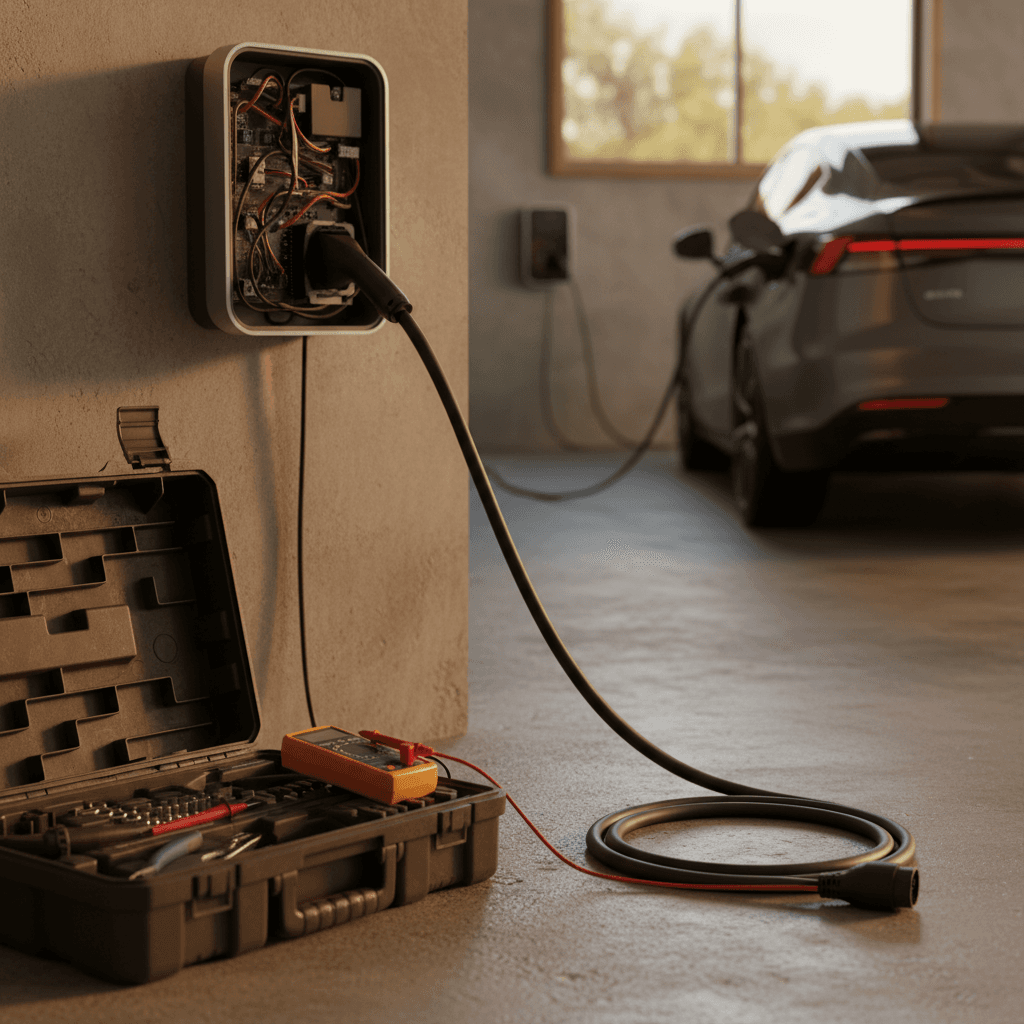
If you’ve ever watched your EV sip slowly from a wall outlet, you’ve probably wondered: why not put a Level 3 charger at home and be done with it? After all, pulling into a public DC fast charger and adding hundreds of miles in under an hour feels like magic compared to overnight charging. The catch is that what we casually call “Level 3” is industrial‑grade equipment, and almost everything about it fights against residential use. Let’s unpack what’s actually possible in 2025 and what setup makes the most sense for you.
Quick answer
What a “Level 3” Charger Really Is
First, some clarity on terminology. In everyday conversation, people call DC fast chargers “Level 3 chargers,” but technically the standards define three levels of AC charging (Level 1 and 2 for home, Level 2 for some public sites) and then separate DC fast charging categories. For practical purposes though, when people say “Level 3,” they mean DC fast charging (DCFC) in the 50–350 kW range, the kind you see at highway stations.
- Level 1: 120 V household outlet, ~3–5 miles of range per hour
- Level 2: 240 V circuit (like a dryer), ~20–45 miles of range per hour depending on amperage and vehicle
- “Level 3” / DC fast charging: 400–800 V DC, typically 50–350 kW, often 150+ miles of range in 30–40 minutes on compatible EVs
The leap from Level 2 to DC fast charging isn’t just “a bit faster.” It’s an order‑of‑magnitude step up in power, infrastructure, and cost. That’s why you mostly see DC fast chargers along highways, at commercial sites, and in fleet depots, not in residential garages.
Can You Install a Level 3 Charger at Home?
In theory, yes: there is no code book that says “absolutely not.” In practice, for a typical U.S. home, the answer is effectively no. The barriers aren’t about the wall space in your garage; they’re about grid connection, service size, and cost.
Why Home Level 3 Charging Is So Rare
The bottlenecks aren’t in your EV, they’re in your house and the grid feeding it.
Massive power draw
Service limitations
Huge installed cost
Check your utility first
Power and Electrical Requirements for Home DC Fast Charging
To understand why a Level 3 charger at home is so difficult, it helps to compare it to what you already have. A typical U.S. home service is 100–200 amps at 240 V single phase, supporting maybe 24–48 kW of total load across your entire panel. A single 7.7 kW Level 2 EVSE (32 amps at 240 V) is already a meaningful fraction of that.
Home Power vs DC Fast Charging Power
How typical home electrical service compares with common EV charging power levels.
| Scenario | Voltage / Phases | Approx. Power | Typical Use |
|---|---|---|---|
| Standard U.S. home | 240 V, single‑phase | 24–48 kW total | Whole house |
| Level 2 home EVSE | 240 V, single‑phase | 7–11 kW | Overnight home charging |
| Small DC fast charger | 400–800 V DC, 3‑phase AC feed | 50 kW | Urban or fleet fast charging |
| Highway DCFC site (per stall) | 400–800 V DC, 3‑phase | 150–350 kW | Long‑distance fast charging |
Even a "small" DC fast charger uses utility‑scale power compared to household loads.
To feed even a 50 kW DC fast charger, you’re now in the realm of dedicated commercial service, larger transformers, and likely three‑phase power. That’s not a matter of adding one more breaker to your panel; it’s an entirely different class of infrastructure.
DIY is absolutely off the table
How Much Would a Level 3 Charger at Home Cost?
Costs vary widely by region and utility, but the scale is consistent: a home Level 3 setup, if it’s even permitted, quickly runs into five‑figure or low six‑figure territory. By contrast, a robust Level 2 home installation usually stays in the low four figures.
Typical Cost Ranges (U.S., 2025 ballpark)
Even if you have the budget, you still face soft costs: utility engineering studies, permitting, construction delays, and demand charges on your electric bill. For most private owners, it’s hard to make any of this pencil out.
Rare Cases Where Home DC Fast Charging Might Make Sense
There are edge cases where something like a Level 3 charger at home can be justified, but at that point you’re mostly not a typical homeowner anymore. You’re effectively a small commercial site that happens to sit on residential‑zoned land.
1. Home-based commercial fleets
If you operate a fleet of EVs, delivery vans, ride‑hail vehicles, or service trucks, based at your property, the economics change. High utilization can justify the cost of DC fast charging, especially if it keeps vehicles in service more hours per day.
2. Rural properties with unique utility deals
Very large rural properties that already have high‑capacity service for irrigation, light industrial use, or agriculture sometimes explore DC fast charging as an add‑on. Even then, it competes with the much simpler option of multiple Level 2 ports.
For almost everyone else…
The Realistic Alternative: Level 2 Charging at Home
Here’s the key insight: for daily driving, a properly sized Level 2 charger at home already feels like having a gas pump in your garage. You plug in when you get home, wake up to a full battery, and rarely think about public charging except on longer trips.
Why Level 2 Home Charging Works So Well
For most households, smarter overnight charging beats raw speed.
Matches your parking time
Lower install & energy costs
Gentler on your battery
Think in miles per night, not kW
Choosing the Right Home Charging Setup
If you’ve let go of the Level 3 idea, the real question becomes: what Level 2 setup is right for you? That depends on your driving, your panel capacity, and whether you own or rent.
Step-by-Step: Designing Your Home Charging
1. Measure your real driving needs
Look at your last month of driving. If you average 30–60 miles per day, even a 7 kW (32 A) Level 2 charger gives you plenty of buffer overnight.
2. Check your electrical panel capacity
See how many amps your main panel is rated for (often 100 or 200 A) and what’s already in use. An electrician can confirm if there’s room for a 40–60 A EV circuit.
3. Pick an EVSE that matches your car
There’s no benefit to a 48 A wallbox if your EV only accepts 32 A AC charging. Match the charger’s maximum amperage to your vehicle’s onboard charger rating.
4. Choose location & cable length
Plan the mounting spot so the cable reaches your charge port easily without running across walkways. Longer cables are convenient but slightly heavier and costlier.
5. Decide on hardwired vs plug‑in
Hardwired units are cleaner and can support higher currents. Plug‑in units (NEMA 14‑50) are flexible and easier to swap if you move.
6. Get a professional installation quote
Always use a licensed electrician. Ask about permit requirements, available rebates, and whether your utility offers time‑of‑use rates for EV charging.
Fast Charging vs Battery Health
Beyond cost and complexity, there’s a battery‑health angle to the Level 3 at home question. DC fast charging pumps energy into your pack much more quickly, which increases heat and chemical stress. Manufacturers design for this, but they also quietly assume you’ll use DC fast charging occasionally, not every single day.
What the chemistry prefers
Lithium‑ion cells generally age more gracefully with slower, cooler charging. That’s what you get from overnight Level 2 charging, longer periods at moderate power, giving the pack time to balance and cool.
What daily DC fast charging does
Frequent DC fast charging tends to increase long‑term degradation, especially if you also keep the battery at high state of charge. That doesn’t mean "never fast charge," but it does mean you shouldn’t design your routine around it if you care about long‑term range.
Buying used? Ask about charging history
How Recharged Helps You Charge Smarter
If this all feels like a lot to weigh, service sizes, battery chemistry, real‑world range, you’re not alone. The EV market has moved faster than the education around it. That’s why Recharged builds more than just listings; we build tools and guidance for EV ownership.
Where Recharged Fits Into Your Charging Decisions
From picking the right used EV to planning your home setup, you don’t have to guess.
Recharged Score battery report
EV‑specialist support
Buy, sell, or trade seamlessly
Ready to find your next EV?
Browse VehiclesOnce you’ve picked the right EV, we encourage you to talk with a qualified electrician and your utility about home charging. The answer usually isn’t a Level 3 charger at home, it’s a well‑matched Level 2 setup paired with occasional public fast charging when you really need it.
FAQ: Level 3 Charger at Home
Frequently Asked Questions About Level 3 Home Charging
Bottom Line: What Most Drivers Should Do
Wanting a Level 3 charger at home is really about wanting freedom from range anxiety and downtime. The irony is that the best way to get that freedom isn’t by turning your garage into a mini substation, it’s by combining a healthy battery, a well‑matched Level 2 home charger, and smart use of public fast charging when you truly need it.
If you’re considering a used EV, start with the car itself. Use tools like the Recharged Score to understand battery health and real‑world charging capability, then design a home charging setup that fits your driving and electrical panel rather than chasing Level 3 speeds. That approach keeps your costs sane, your battery happier, and your daily life simpler, exactly what good EV ownership should feel like.