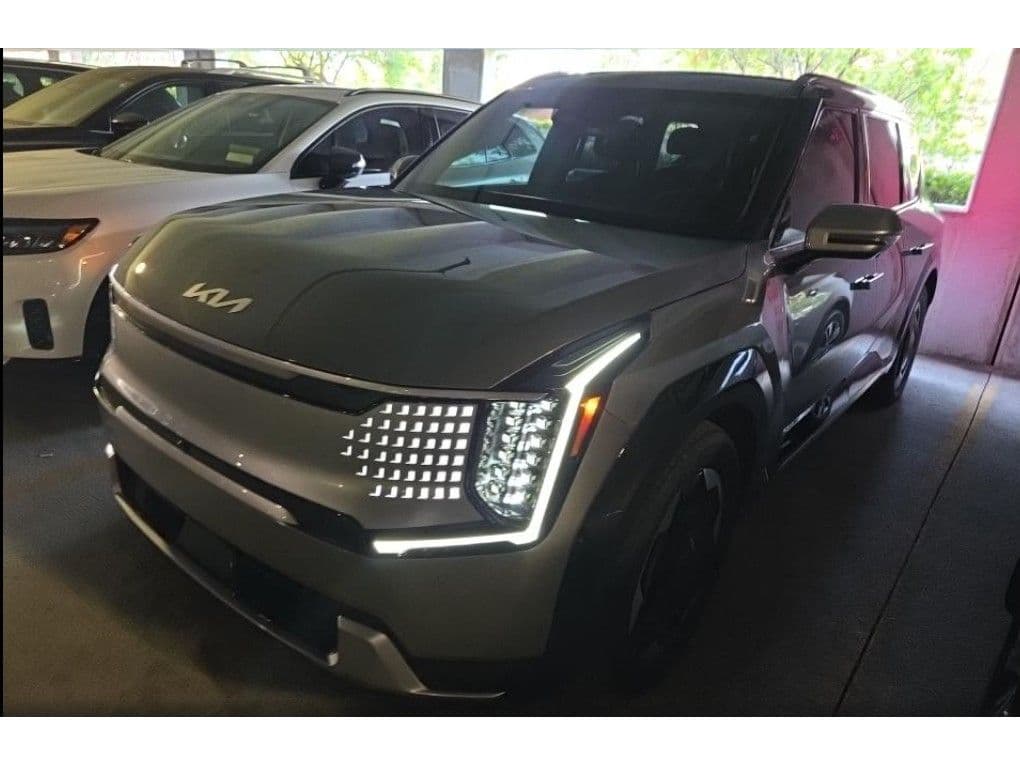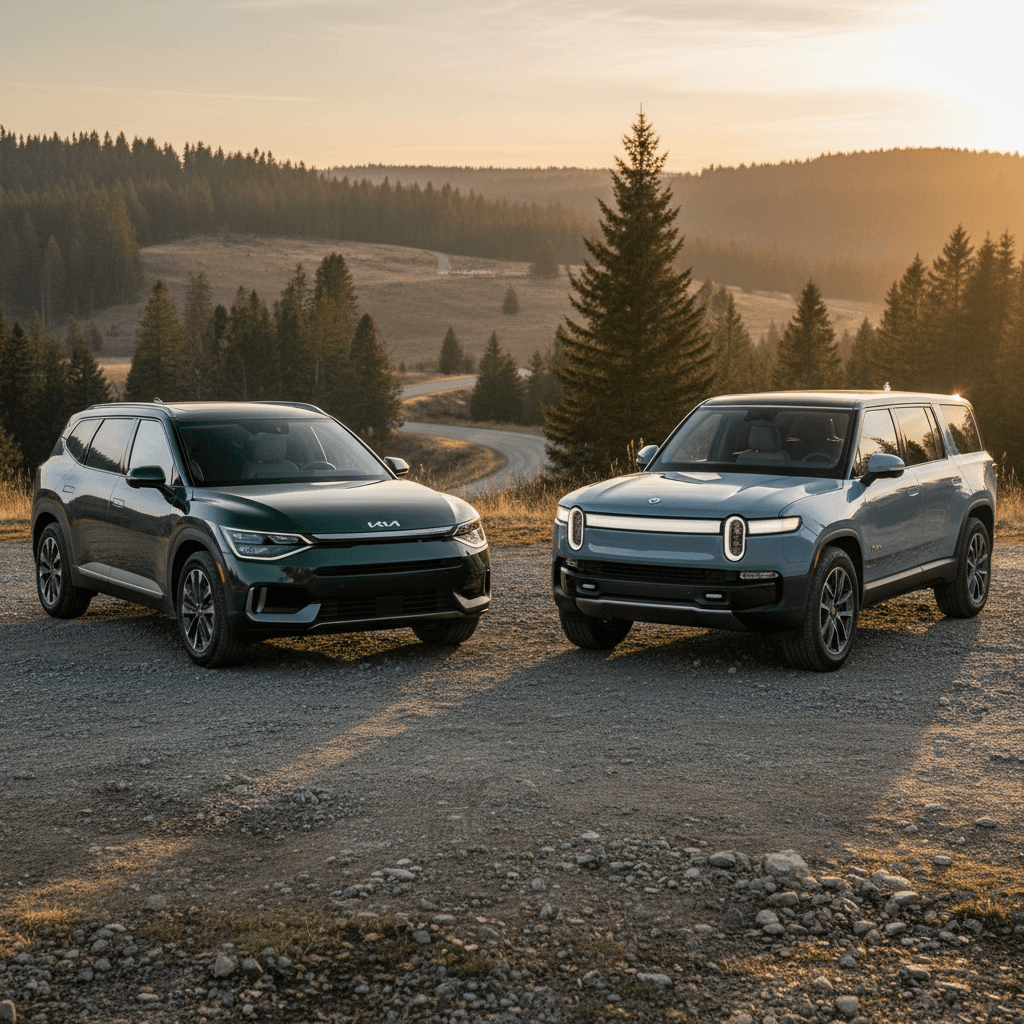
If you want a three-row electric SUV, your short list almost always ends up with the Kia EV9 and the Rivian R1S at the top. Both seat up to seven, both promise SUV capability with zero tailpipe emissions, and both can handle real family duty. But they deliver that experience in very different ways, and at very different prices.
Two very different personalities
Kia EV9 vs Rivian R1S: quick overview
EV9 vs R1S: core numbers at a glance
Approximate specs for popular configurations as of the 2025–2026 model years. Exact figures vary by trim and options.
| Kia EV9 | Rivian R1S | |
|---|---|---|
| Starting MSRP (new) | ~$56,400 | ~$77,700 |
| Common transaction price (new) | Often mid–$50Ks, depending on trim and incentives | High‑$70Ks and up |
| Max seating | 7 | 7 |
| Max EPA range (select trims) | Up to ~304 miles | Up to ~390+ miles depending on battery/motors |
| Typical city/highway efficiency | Around 101/76 MPGe | Around 73/65 MPGe |
| Drive layout | RWD or AWD | Standard AWD |
| 0–60 mph range | ~7.7 sec (base) to mid‑4s (GT‑Line, upcoming GT quicker) | Mid‑4s (Dual Motor) down to sub‑3‑sec Tri/Quad |
| Max towing capacity | Up to ~5,000 lbs | Up to ~7,700 lbs |
| Ground clearance | More crossover‑like | Up to ~14+ inches with air suspension |
| Charging standard (North America) | NACS with adapter support | NACS with CCS adapter support |
Headline differences: price gap, efficiency, and performance.
Specs move fast
Pricing and value: how much are you really spending?
This is where the Kia EV9 vs Rivian R1S comparison stops being theoretical and starts hitting your wallet. Kia came to this fight with a strategy: undercut premium EV rivals by a big margin, while Rivian leans hard into premium pricing to match its luxury and off‑road mission.
New pricing snapshot
Approximate 2025–2026 MSRPs before incentives or dealer discounts.
Kia EV9 pricing
- Light (base): around $56,400
- Light Long Range: low $60Ks
- Wind / Land AWD: mid–$60Ks to low $70Ks
- GT‑Line: mid–$70Ks
In practice, many buyers see discounts or incentives that nudge real‑world prices a bit lower.
Rivian R1S pricing
- Dual Motor Standard battery: high‑$70Ks
- Dual Motor Large/Max battery: mid‑$80Ks to low‑$90Ks
- Tri‑Motor: around $105K–$108K
- Quad‑Motor (second‑gen): well into six‑figure territory
Rivian sells direct, so haggling is off the table; what you see is close to what you pay.
Value difference in simple terms
If you’re payment‑sensitive, the EV9 is the obvious starting point. For the price of an entry‑level Rivian R1S Dual Motor, you can be in a well‑equipped EV9 Land or GT‑Line, with money left over for a home Level 2 charger, winter tires, or that summer road trip.
Used market angle
Range, efficiency, and battery tech
On paper, the Rivian R1S can be a range monster, especially with larger battery packs and efficient Dual Motor setups. But the Kia EV9 fights back with better efficiency and very fast DC charging, thanks in part to its 800‑volt architecture.
How far can they go?
- Kia EV9
- EPA ranges span roughly the mid‑200s to just over 300 miles, depending on trim.
- Single‑motor, rear‑drive trims do best on efficiency.
- Real‑world highway range is often a bit lower than the sticker, true of any EV.
- Rivian R1S
- Multiple battery sizes, with some Dual Motor trims rated well into the 300‑mile zone and strong highway legs.
- Tri/Quad Motor models trade some efficiency for huge power.
- Real‑world range can shrink quickly with big wheels, off‑road tires, or winter temps.
Efficiency and charging
- Efficiency
- EV9: roughly low‑100s MPGe city, mid‑70s highway in popular trims.
- R1S: often in the 60s–70s MPGe range, especially on highway.
- Fast charging
- EV9: 800‑V system can add about 150 miles in roughly 15–20 minutes on a strong DC fast charger.
- R1S: very solid DC rates as well, but its advantage is more about battery size than charging speed alone.
Battery warranties
Space, comfort, and everyday utility
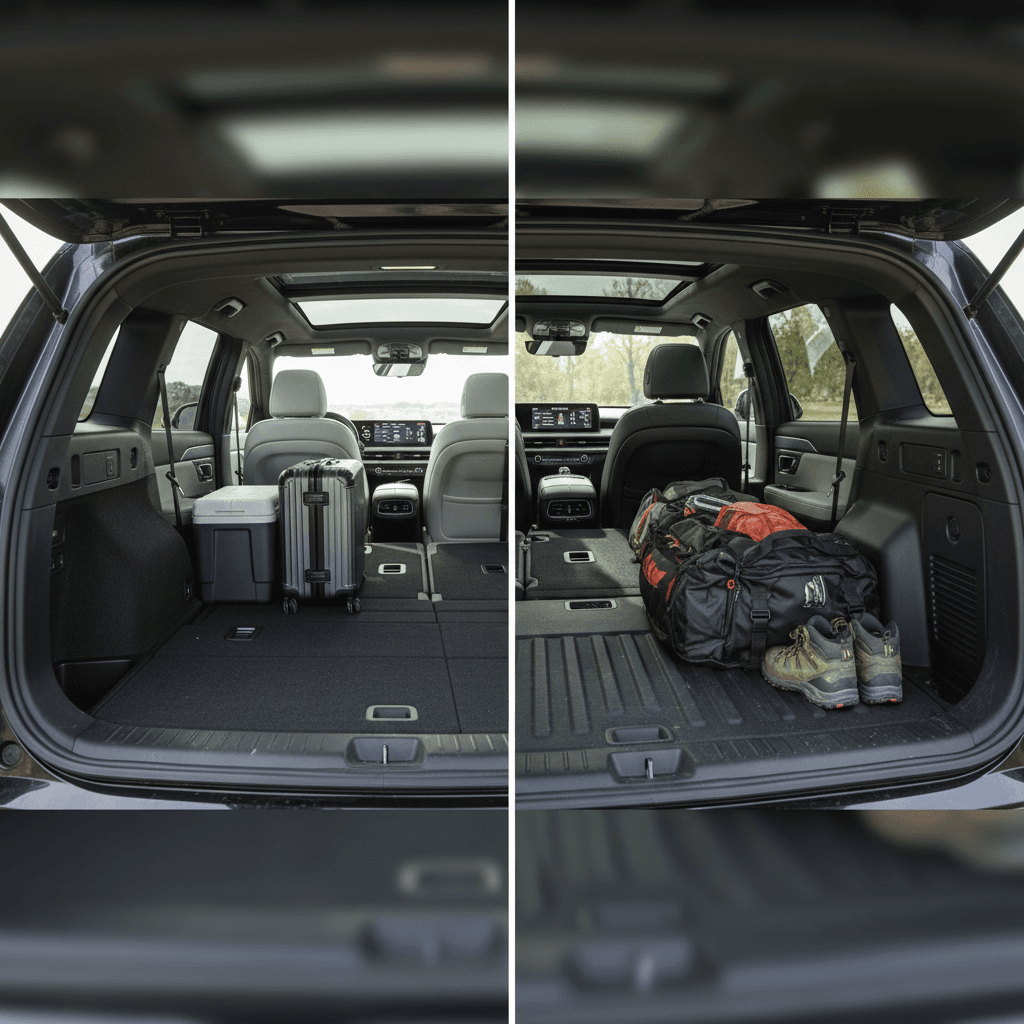
The promise of a three‑row EV is simple: carry people and stuff without burning a drop of gasoline. The EV9 and R1S both deliver on that, but they carve up their interiors a little differently.
Interior and cargo space comparison
Key seating and cargo figures for popular three‑row configurations.
| Kia EV9 | Rivian R1S | |
|---|---|---|
| Max seating | Up to 7 (bench) or 6 (captain’s chairs) | Up to 7 |
| 2nd‑row legroom | Approx. 42.8 in | Approx. 36.6 in |
| 3rd‑row legroom | Adult‑usable but tighter; best for kids/teens on long trips | Similar story: usable, but more occasional for adults |
| Cargo behind 3rd row | Around 20 cu ft | Around 17–18 cu ft |
| Cargo behind 1st row (all seats folded) | Low‑80s cu ft | Over 100 cu ft |
| Front trunk (frunk) | Small to modest | Very large, especially useful when fully loaded with passengers |
EV9 edges the R1S in second‑row room and behind‑third‑row cargo; R1S fights back with a huge frunk and more off‑road‑friendly dimensions.
Family friendliness
Performance, towing, and driving character
Here’s where these two SUVs feel like they were engineered on different planets. The Kia EV9 is very much tuned like a modern family crossover: quick when you want it to be, quiet, and composed. The Rivian R1S can be anything from brisk to supercar‑quick, with serious off‑road chops baked in.
Powertrain personalities
From sensible to slightly unhinged.
Kia EV9: relaxed but quick
- Base single‑motor EV9 makes around 215 hp and does 0–60 mph in roughly 7.5–8.0 seconds.
- Dual‑motor AWD trims jump to around 379 hp; GT‑Line models dip into the mid‑4‑second 0–60 range.
- Upcoming GT variants promise even more punch.
The EV9 feels confident merging and passing, but its mission is comfort, not drag‑strip runs.
Rivian R1S: wild card
- Dual Motor trims already feel strong, with 0–60 mph in the 4‑second range.
- Tri‑Motor: roughly 850 hp with 0–60 mph around 2.8 seconds.
- Quad‑Motor: over 1,000 hp and a 0–60 time around 2.5–2.6 seconds in recent tests.
It’s not an exaggeration: high‑spec R1S models are among the quickest SUVs on sale.
Towing and payload
- EV9: Up to about 5,000 lbs when properly equipped, plenty for small campers and boats.
- R1S: Up to about 7,700 lbs of towing; more headroom for heavier campers or trailers.
Remember, towing any EV cuts range dramatically; the bigger Rivian battery helps compensate.
Performance vs. practicality
Off-road cred vs. family comfort
Every EV SUV press release likes to show a truck flexed on a rock, but Rivian actually means it. The R1S was designed from day one to wheel, ford, and climb. The EV9 can handle dirt roads and mild trails, but it’s no rock crawler.
Rivian R1S off‑road strengths
- Available air suspension with very generous ground clearance, into the mid‑teens in inches.
- Advanced traction modes, plenty of underbody protection, and strong approach/departure angles.
- Tri/Quad Motor torque vectoring gives you precise wheel control on loose surfaces.
- Rivian’s own charging network often targets trailheads and adventure routes, not just interstates.
Kia EV9 everyday comfort
- Softer, quieter ride tuned for pavement and broken city streets.
- All‑wheel drive is available and fully capable in snow and rain.
- Lower overall height and step‑in make loading kids and car seats easier.
- Controls and sightlines feel more familiar if you’re coming out of a mainstream crossover or minivan.
Be honest about your adventures
Tech, safety, and driver-assistance
Both SUVs feel properly modern inside: big screens, over‑the‑air updates, and robust driver‑assistance suites. They just interpret "tech" differently.
Cabin tech and safety highlights
Screens, sensors, and software that actually matter day‑to‑day.
Screen setups
- EV9: Dual 12.3‑inch displays handle instruments and infotainment, with a clean, horizontal layout.
- R1S: Large central touchscreen plus digital cluster; UI leans toward minimalist, adventure‑themed graphics.
Driver assistance
- EV9: Highway‑assist systems, lane‑centering, adaptive cruise, and surround‑view cameras available.
- R1S: Rivian Autonomy Platform with an array of cameras, radar, and advanced highway features, with more capability arriving via OTA updates.
Software feel
- Kia’s system feels more like a polished mainstream infotainment stack.
- Rivian’s UI feels closer to a clean, tablet‑style interface, emphasizing maps and adventure‑focused tools.
Safety ratings
Charging experience and road‑trip usability
For years, the elephant in the garage was charging access. Today, both the Kia EV9 and Rivian R1S are adopting the North American Charging Standard (NACS) and gaining access to more high‑speed DC networks, including Tesla’s Superchargers via adapters or native ports.
What your charging life looks like with each
Home charging with EV9
The EV9 is a natural fit for Level 2 home charging. With a 240‑V outlet and a 40–48‑amp charger, overnight fills are easy even after long days. Kia’s bidirectional capability (V2L) can power tools or camping gear from the vehicle.
Home charging with R1S
Same basic routine: install a solid Level 2 charger and you’re set. The R1S’s larger battery packs take longer to fill from empty, but you also start with more miles in the tank.
Public fast charging
Both EVs can now tap into more high‑power DC fast chargers, including many Tesla Superchargers, using NACS ports or adapters. The EV9’s 800‑V architecture makes it one of the quickest‑charging three‑row SUVs available when you find a strong charger.
Road‑trip strategy
In an EV9, you’ll plan stops a bit more often than in a big‑battery R1S, but your sessions may be shorter. In an R1S, you can sometimes stretch farther between stops, but expect longer sessions to refill the larger pack.
Reality check on charging speeds
Ownership costs, warranty, and long-term confidence
Sticker price is just one chapter. Electricity vs. fuel savings help both SUVs, but warranty coverage, service access, and depreciation matter just as much, especially if you’re shopping the used market or planning to keep the vehicle for a long time.
Kia EV9 ownership picture
- Warranty: Kia is known for strong coverage, including long basic and battery warranties for the EV9.
- Service network: You can service an EV9 at many Kia dealers; that’s a big plus if you live far from major cities.
- Depreciation: Brand‑new EVs tend to drop quickly in the first few years. Kia’s lower starting price softens that blow and may make used EV9s particularly attractive value plays.
Rivian R1S ownership picture
- Warranty: Rivian backs its vehicle and battery with robust terms, including high mileage caps on certain packs.
- Service model: Rivian leans on mobile technicians and service centers in select regions, with scheduling through the app.
- Depreciation: High initial MSRPs mean bigger dollar drops early on; for used buyers, that can turn into opportunity, if you’re comfortable with a younger brand and a smaller service footprint.
Where Recharged fits in
How to choose: Kia EV9 vs Rivian R1S
By now you’ve probably got a hunch which SUV fits your life better. To firm that up, it helps to boil this comparison down to use‑cases instead of spec sheets.
Which three-row EV is right for you?
Choose the Kia EV9 if…
<ul><li>You want three rows and real family space without a six‑figure budget.</li><li>You prioritize comfort, quiet, and mainstream usability over hardcore off‑road tricks.</li><li>You live far from a Rivian service center and prefer a traditional dealer network.</li><li>You like the idea of fast charging and strong efficiency over raw horsepower.</li></ul>
Choose the Rivian R1S if…
<ul><li>Adventure and performance are central to your life, not just weekend maybes.</li><li>You’ll use the extra towing capacity, ground clearance, and off‑road modes.</li><li>You’re comfortable paying more up front for a premium, boutique‑brand experience.</li><li>You love the idea of an SUV that can outrun a sports car and still carry your family and gear.</li></ul>
You’re shopping used and value matters most
<ul><li>Look closely at lightly used EV9s and R1S Dual Motor trims; early depreciation can turn them into strong buys.</li><li>Compare warranties and service access in your area.</li><li>Make battery health your first question, not an afterthought, especially for higher‑mileage adventure‑used R1S models.</li></ul>
Bottom line
Kia EV9 vs Rivian R1S: FAQ
Frequently asked questions
The good news is that there’s no wrong answer here, just a better answer for you. The Kia EV9 proves a three‑row EV can be practical, comfortable, and relatively attainable, while the Rivian R1S shows just how far electric performance and capability can go in SUV form. Decide how often you’ll really use the extra capability, how far your budget stretches, and how long you plan to keep the vehicle. Then drive both if you can; the one that makes you smile on your daily routes is the one that belongs in your driveway.