If you’re searching for a Kia EV6 50,000 mile review, you’re likely wondering how this sharp-looking crossover holds up once the new‑car glow wears off. Does the battery still charge fast? Has range taken a big hit? And what about the reliability stories you may have seen online?
Scope of this long-term look
Quick Take: Is the Kia EV6 Still Good at 50,000 Miles?
Kia EV6 at 50,000 Miles: Snapshot
Where it shines, and where to be cautious
Battery & Range
Degradation stays modest for most owners, often in the low single digits by 50,000–60,000 miles, thanks to Kia’s liquid‑cooled, NCM battery.
Real‑world range typically drops by a few percent, not tens of percent, if the car hasn’t been abused.
Charging Experience
The 800V E‑GMP platform still delivers excellent fast‑charge speeds years in, 10–80% in ~18 minutes when everything lines up.
Charging curves remain strong; most slowdown comes from station quality, not the car.
Reliability Watchouts
Day‑to‑day reliability is generally solid, but there are two hot spots: ICCU failures and 12V battery issues. Both can immobilize the car and may require recall work or parts replacement.
In other words, the EV6’s fundamentals, battery, range, and fast‑charging, age well. Where you need to be selective, especially when buying used, is around charging‑system recalls, 12V battery history, and how the previous owner used the car.
Why a 50,000‑Mile Kia EV6 Review Matters
The first U.S. Kia EV6 models landed in 2022, which means many are now rolling past 50,000 miles. For shoppers, that’s a sweet spot: big depreciation already baked in, but plenty of life left, especially with Kia’s long EV warranty. For current owners, this is around the time you start asking whether any early wear patterns are emerging.
- Most 2022–2023 EV6s at 50,000 miles are coming off or nearing the end of basic bumper‑to‑bumper coverage, but high‑voltage components are still under warranty in the U.S.
- Battery health and ICCU behavior at this mileage are better predictors of long‑term costs than paint, tires, or interior wear.
- Used‑EV buyers increasingly cross‑shop the EV6 against Tesla Model Y, Hyundai Ioniq 5, and Mustang Mach‑E, so understanding real‑world durability matters for pricing.
How Recharged fits in
Battery Health and Degradation at 50,000 Miles
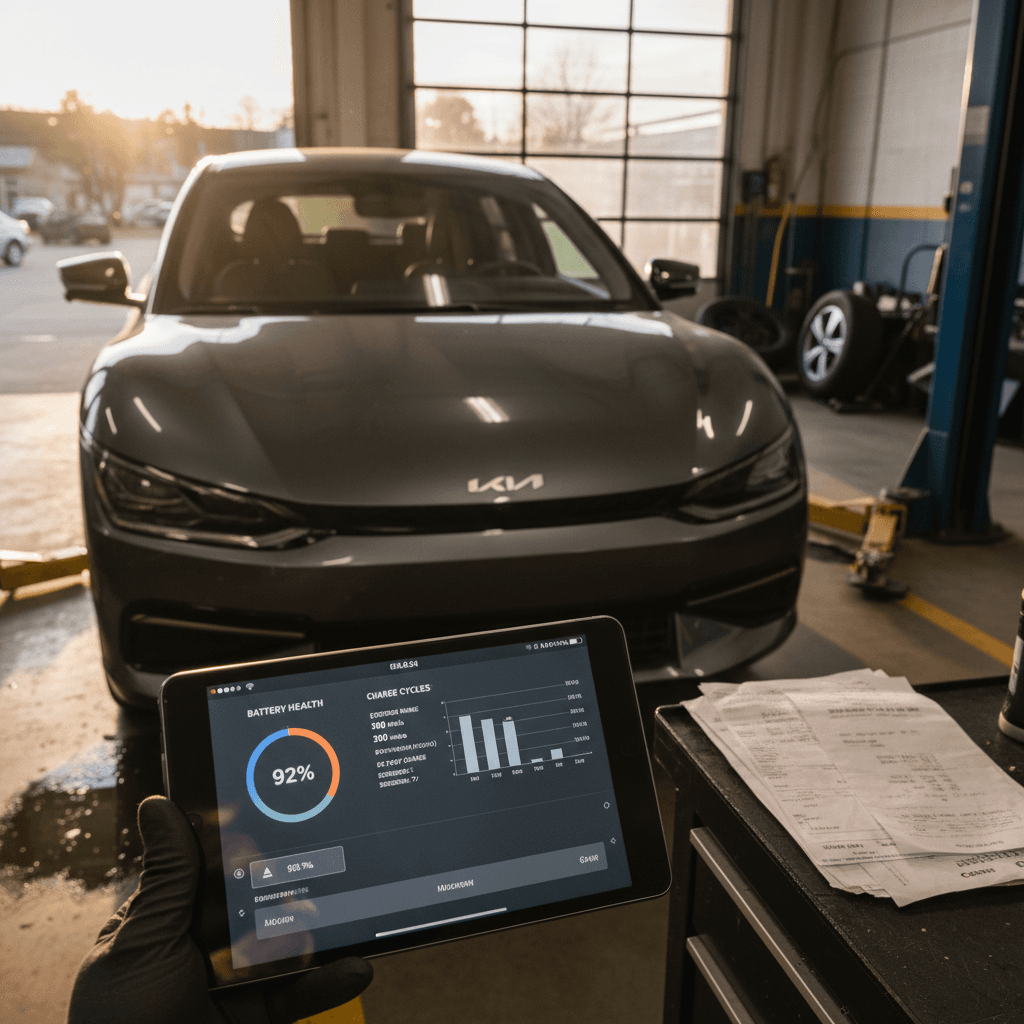
Battery life is the headline question for any long‑term EV review. Owner data and independent analyses suggest the Kia EV6’s 77.4 kWh pack holds up well, often losing only a few percent of usable capacity by 50,000–60,000 miles when properly cared for.
Kia EV6 Long‑Term Battery Snapshot
What owners report by 50,000 miles
- Light degradation: Many EV6 drivers tracking pack data via OBD tools report roughly 2–5% loss in the first 40,000–60,000 miles.
- Even cell balance: Voltage spread between cells tends to remain tight, a good sign of pack health.
- Limited fast‑charge damage: Reasonable DC fast‑charging use (not daily abuse) hasn’t shown dramatic impacts in most logs.
What speeds up degradation
- Parking long‑term at 100% state of charge, especially in hot climates.
- Frequent high‑power DC fast charging from very low states of charge (near 0%) up to 100%.
- Running the pack hot repeatedly, such as repeated high‑speed driving then immediately fast‑charging.
If you’re evaluating a used EV6, ask how it was charged and stored. A car that mostly lived on Level 2 at home and only fast‑charged on road trips will usually look better on a battery‑health scan.
Don’t judge battery health by the dash alone
Real-World Range After Years of Driving
EPA ratings put the long‑range rear‑wheel‑drive EV6 over 300 miles when new, with all‑wheel‑drive and GT trims lower. After 50,000 miles, most owners don’t see a night‑and‑day change, but a modest dip in range is normal.
Typical Real‑World Range: New vs. 50,000 Miles
Approximate ranges based on mixed driving and moderate climates. Individual results vary with speed, weather, elevation, and tire choice.
| Trim (Long-Range) | EPA Range When New | Typical New Real-World | Typical at ~50k Miles |
|---|---|---|---|
| Wind RWD | 305 mi | 270–290 mi | 260–280 mi |
| Wind/GT-Line AWD | 282 mi | 240–260 mi | 230–250 mi |
| EV6 GT | 206 mi | 190–210 mi | 180–200 mi |
Use these numbers as ballpark guides, not guarantees.
Highway vs. city reality
DC Fast Charging Performance Long Term
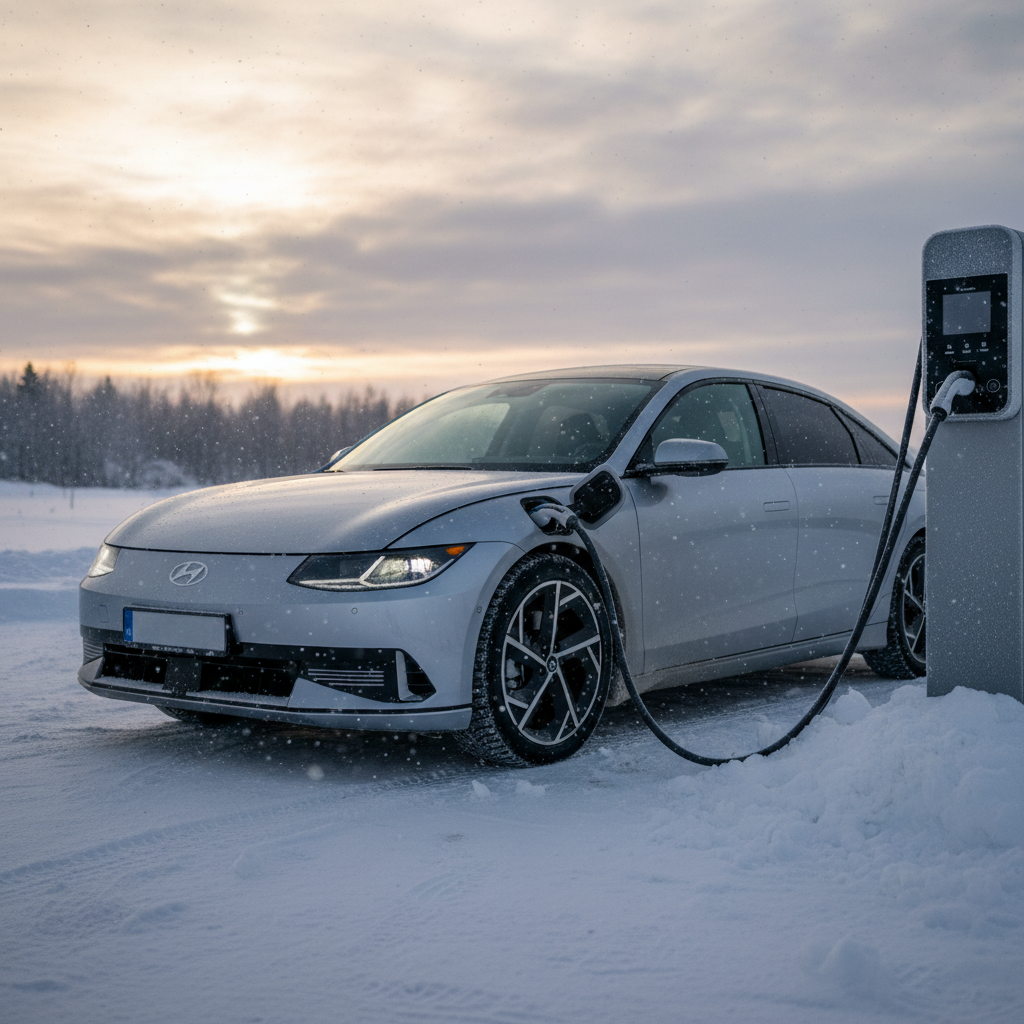
One of the EV6’s calling cards is its 800V architecture, which allows very high DC fast‑charge rates on capable stations. Even after tens of thousands of miles, owners routinely report 10–80% in around 18–25 minutes under favorable conditions.
Kia EV6 DC Fast-Charging Snapshot
What owners see at 50,000 miles
- High peaks remain achievable when the battery is properly preconditioned or at least warmed by driving.
- Charge times are more often limited by station quality and congestion than by the car’s age.
- Repeated ultra‑fast charging doesn’t appear to cripple performance by 50,000 miles, though extremely heavy use can add wear over many years.
How to keep charging fast
- Arrive at a DC fast charger with 10–20% state of charge for best power.
- Avoid fast‑charging all the way to 100%; unplug by 80–85% whenever possible.
- Give the pack a few miles of driving before fast‑charging in winter so it can warm up.
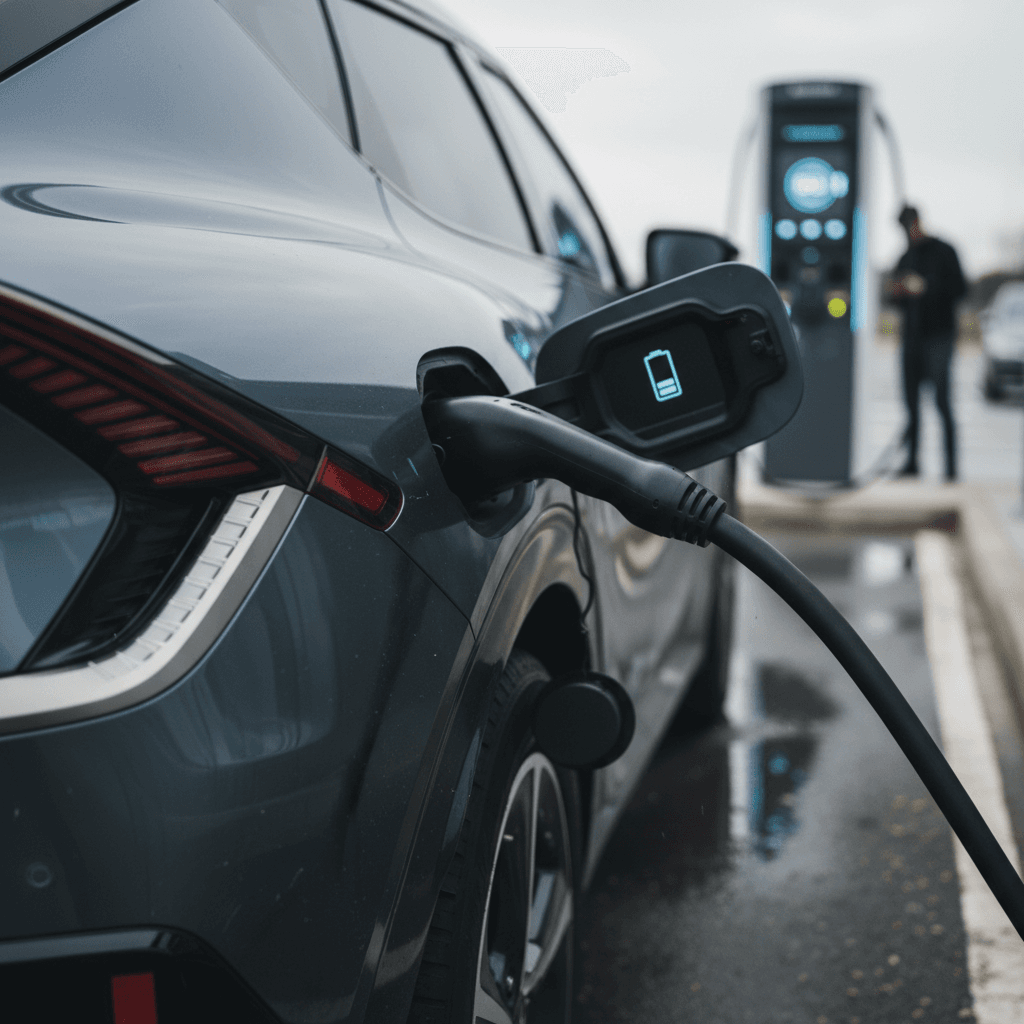
Home charging + road‑trip fast charging is the winning combo
Reliability: ICCU and 12V Battery Issues Explained
The Kia EV6 has not been trouble‑free. The biggest reliability story as these cars age revolves around the Integrated Charging Control Unit (ICCU) and the traditional 12V battery, both of which can leave an otherwise healthy EV6 undriveable.
The Two Big Problem Areas
Most 50k‑mile EV6s are fine, but these are the issues you hear about.
ICCU failures
The ICCU manages AC charging, DC‑DC conversion to the 12V system, and vehicle‑to‑load (V2L). Some EV6s have experienced ICCU failures that disable charging and can throw multiple error messages.
There are recalls and software updates targeting this, but a recall visit doesn’t guarantee no future failures. Parts availability can stretch repair times into weeks in some cases.
12V battery problems
Like many EVs, the EV6 still relies on a small 12V battery for boot‑up and critical systems. Owners have reported sudden 12V failures, sometimes tied to ICCU issues or background app activity that wakes the car repeatedly.
The good news: a 12V battery is relatively inexpensive compared with high‑voltage components, but repeated failures are frustrating and can strand you temporarily.
What a failing ICCU or 12V feels like
None of this makes the EV6 a “bad” car, but it does mean you should treat charging‑system history as a must‑review item for any 50,000‑mile example. On a private sale, that’s hard. On a platform like Recharged, it’s exactly the sort of thing our inspectors dig for, recall completion, ICCU replacement records, and repeated 12V complaints.
Maintenance and Running Costs
The upside to EV ownership is that there are fewer wear items than in a gas car. By 50,000 miles, a typical EV6 owner should have dealt with tires, cabin filters, brake fluid, and possibly a set of wiper blades, plus any recall or warranty visits.
Common Maintenance Items by ~50,000 Miles
Approximate expectations for a daily‑driven EV6 in normal use. Costs vary by region and shop.
| Item | Typical Interval | Notes for EV6 Owners |
|---|---|---|
| Tires | 25,000–40,000 mi | Heavy curb weight and torque can wear tires faster, especially on AWD and GT models. |
| Brake pads & rotors | 60,000+ mi (often much more) | Regenerative braking means pads can last a long time if you drive smoothly. |
| Cabin air filter | 15,000–30,000 mi | Easy DIY job or low‑cost service; improves HVAC performance. |
| Brake fluid | 2–3 years | Scheduled fluid changes still matter even with regenerative braking. |
| High‑voltage coolant | Long interval, check manual | Part of battery and inverter thermal‑management system; usually inspected rather than frequently replaced. |
| 12V battery | 3–5 years (varies) | Some owners see earlier failure; pay attention around the 3‑year mark or after ICCU work. |
Use this as a rough ownership map, not a quote sheet.
Operating costs vs. gas SUV
What It’s Like to Live With a High‑Mileage Kia EV6
At 50,000 miles, the question becomes less about stats and more about feel. Does the EV6 still feel tight and modern, or old before its time?
Driving dynamics
- Instant torque: Even non‑GT trims still feel brisk at this mileage, especially around town.
- Ride and noise: Suspension bushings and interior trim generally hold up well; major squeaks and rattles are the exception, not the rule.
- Brakes: Regenerative braking keeps physical brakes fresh; pedal feel remains consistent unless there’s been unusual wear.
Interior & tech aging
- Seats and steering‑wheel leather on well‑cared‑for EV6s typically show moderate, not severe, wear by 50,000 miles.
- Dual screens and software remain competitive, but over‑the‑air update cadence isn’t as aggressive as Tesla’s.
- Some owners wish for more physical buttons; touch controls can show fingerprints but usually avoid functional issues.
“The EV6 still feels like a modern EV after tens of thousands of miles. The weak links are in the supporting electrical systems, not the motor or big battery.”
Shopping Used EV6: What to Check Before You Buy
If you’re eyeing a 40,000–70,000‑mile Kia EV6, the difference between a smart buy and a headache often comes down to documentation and diagnostics. Here’s how to evaluate one like a pro.
High‑Mileage EV6 Inspection Checklist
1. Pull a true battery health report
Ask for documented <strong>usable capacity in kWh</strong>, not just a screenshot of the range display. A Recharged Score report, or equivalent scan, will quantify degradation and highlight abnormal cell behavior.
2. Review recall and ICCU history
Confirm that all <strong>ICCU‑related recalls and software updates</strong> are completed. Ask whether the ICCU has ever been replaced and if so, when and under what circumstances.
3. Ask about 12V battery replacements
A single 12V replacement isn’t a red flag. <strong>Multiple failures or jump‑starts</strong> in a short time window, however, suggest an underlying charging‑system or app‑wake issue that needs deeper diagnosis.
4. Look for fast‑charge abuse
Check service records and owner stories for patterns like daily DC fast‑charging from near‑empty to 100%. Occasional road‑trip use is fine; extreme fast‑charge habits may accelerate wear.
5. Inspect tires and alignment
Uneven tire wear on a heavy, powerful EV like the EV6 can hint at alignment problems or hard driving. Factor new tires into your budget if the car is on its original set at 50,000 miles.
6. Test all charging modes
On the test drive, verify that <strong>Level 2 charging, DC fast charging (if possible), and vehicle‑to‑load (V2L)</strong> work as designed. Glitches here can point toward ICCU or onboard‑charger issues.
7. Evaluate software and features
Confirm that driver‑assist systems, infotainment, and Kia Connect functions operate normally. Laggy responses or repeated warning messages deserve attention before you sign papers.
Leverage a specialist inspection
Kia EV6 50,000‑Mile FAQ
Frequently Asked Questions About High‑Mileage Kia EV6s
Bottom Line: Should You Buy a High‑Mileage Kia EV6?
At around 50,000 miles, the Kia EV6 still looks like one of the more compelling used EVs on the market. The big pieces, battery capacity, real‑world range, and fast‑charging performance, age gracefully when the car has been treated reasonably well. The main caveats live in the supporting cast: ICCU reliability, 12V battery behavior, and whether key recalls and software updates have been handled correctly.
If you pair a thorough charging‑system and battery‑health check with clear documentation, a high‑mileage EV6 can deliver years of quick, comfortable, low‑cost electric driving. Platforms like Recharged are designed to take the guesswork out of that process, surfacing verified battery health, recall status, and fair pricing so you can focus on choosing the right trim and features, not worrying about what’s hiding under the floor.
If your search started with “Kia EV6 50,000 mile review,” the takeaway is straightforward: look past the odometer, zero in on battery and ICCU health, and the EV6 remains a strong, future‑proof choice in the used EV market.