If you’ve been eyeing a Mercedes EQE, you’ve probably noticed something striking: these cars are getting hammered on depreciation. That’s painful if you bought new, but it can be a huge opportunity if you’re shopping used. This guide breaks down the Mercedes EQE resale value forecast, why prices are where they are in 2026, and how to play this market to your advantage.
Key takeaway
Mercedes EQE resale value at a glance
Quick snapshot of Mercedes EQE value
Because the EQE launched at premium prices right as EV incentives and demand started to wobble, used values have moved quickly to a level the market is more comfortable with. The result: two‑ or three‑year‑old EQE sedans and SUVs often sell for the price of a lightly optioned gas E‑Class, despite offering far more tech and performance.
What Mercedes EQE models are actually selling for today
Forecasts are only useful if they’re grounded in current reality, so let’s start with where the EQE sits in early 2026 in the U.S. market.
Typical used Mercedes EQE price ranges (early 2026)
Real-world asking prices for common configurations in the U.S.
2023 EQE 350+ sedan
Original MSRP typically around $74,000–$80,000 when new.
- Typical mileage: 15,000–30,000 miles
- Common asking prices: low-to-mid $50,000s
- Heavily optioned or AMG Line cars may sit closer to $60,000
2023–2024 EQE 500 / AMG sedan
High-spec dual-motor variants took a bigger initial hit.
- Original MSRP: often $90,000+ with options
- Used examples: upper $50,000s to low $60,000s
- Demo cars or high miles may dip lower
EQE SUV variants
Pricing is still settling, but trends are similar.
- Original MSRP: typically high $70,000s to $90,000+
- Early used units: often mid‑$60,000s with normal miles
- Discounts more aggressive in slower markets
Don’t over-trust asking prices
Illustrative Mercedes EQE depreciation from MSRP
Approximate relationship between original sticker price and current used values for common EQE trims. Numbers are directional, not guarantees.
| Model & age | Typical MSRP when new | Example used price today | Approx. value retained |
|---|---|---|---|
| EQE 350+ sedan, 2 years old | $74,000–$80,000 | $52,000–$56,000 | ~70% |
| EQE 500 sedan, 2 years old | $90,000–$95,000 | $58,000–$62,000 | ~65% |
| EQE SUV, 1–2 years old | $78,000–$90,000 | $60,000–$68,000 | ~70–75% |
Use this as a sanity check when you’re evaluating an EQE price; always adjust for condition, mileage, and equipment.
Why ranges, not single numbers?
5‑year Mercedes EQE resale value forecast
Projecting resale value is always an exercise in probability, not certainty, especially for a relatively new EV nameplate like the EQE. That said, we can combine current data, broader EV trends, and what we know about Mercedes depreciation to sketch a reasonable five‑year outlook.
Baseline forecast (most likely)
Assuming no major economic shocks and a gradual normalization of EV demand:
- Year 1–3: EQE loses roughly 15–18% of value per year from MSRP, front-loaded in the first two years.
- Year 4–5: Depreciation slows to around 10–13% per year as prices find a stable used‑car floor.
- 5‑year outlook: A typical EQE sedan retains somewhere in the 40–50% of original MSRP band by year five.
Downside & upside cases
Downside scenario: If luxury EV demand weakens further or incentives shift unfavorably, 5‑year retention could slide closer to 35–40% of MSRP, particularly for high‑spec AMG variants.
Upside scenario: If charging infrastructure and consumer confidence improve faster than expected, clean low‑mileage EQEs with solid battery health could retain closer to the 50–55% range at year five, especially the SUV in EV‑friendly regions.
How to use this forecast when shopping
Why the Mercedes EQE is depreciating faster than you’d expect
On paper, a sleek electric Mercedes sedan with a big battery, quiet cabin, and the Mercedes badge should hold value well. In reality, several structural forces are pushing EQE resale values down faster than gas E‑Class sedans, and even faster than some competing EVs.
Main forces pushing EQE prices down
Most of these aren’t about the car you’re looking at, they’re about the market around it.
1. Rapid EV price resets
Across the industry, EV MSRPs and transaction prices have been cut to rekindle demand. Mercedes has trimmed EQE pricing and leaned into incentives, which pulls used values down to maintain the discount gap between new and used.
2. Luxury sedans are a tough segment
Even in gas form, big luxury sedans depreciate aggressively. Crossovers and SUVs now dominate demand. The EQE sedan combines both headwinds: sedan body style plus luxury badge.
3. Charging anxiety for non-Teslas
While public charging keeps improving, many mainstream buyers still associate “easy road‑tripping” with Tesla. That hesitation shows up as weaker demand for used non‑Tesla EVs, EQE included, especially away from EV‑dense coasts.
4. Fast-moving software & tech
The EQE launched with cutting‑edge infotainment and driver‑assist features, but EV tech ages faster than traditional powertrains. Shoppers worry older EQEs may feel dated next to newer EVs, even if the core driving experience still holds up.
Where owners feel the pain most
How Mercedes EQE resale compares with Tesla and other EVs
To really understand the EQE’s resale story, you have to look around the segment. No one in the luxury EV world is immune to depreciation, but some models are clearly faring better than others.
EQE vs key luxury EV competitors (5‑year outlook, directional)
How a typical Mercedes EQE compares to similar EVs on expected value retention over five years, assuming normal use and no major market shocks.
| Model | Segment | Typical 5‑yr retention | Resale narrative |
|---|---|---|---|
| Mercedes EQE sedan | Midsize luxury EV sedan | ~40–50% | Strong product in a weak segment: luxury sedans and non‑Tesla EVs both see heavy early depreciation. |
| Tesla Model 3 Long Range | Compact/lower‑midsize EV sedan | ~45–55% | Still benefits from strong brand pull and Supercharger access, though resale has cooled from its peak. |
| Porsche Taycan | Performance luxury EV sedan | ~35–45% | High MSRPs and niche appeal lead to some of the steepest luxury EV depreciation. |
| BMW i5 | Midsize luxury EV sedan | ~40–50% | Similar pattern to EQE; sedan body style plus premium price equals heavy early drops. |
| Tesla Model Y | Compact EV SUV | ~45–55% | SUV form factor and strong demand help it hold value somewhat better than most luxury EV sedans. |
These are broad categories, not precise guarantees, your actual result will depend on trim, mileage, and where you live.
Good news for smart used buyers
Battery health, warranty, and how they shape EQE value
Battery health is the gravitational center of used EV value. With the EQE, the good news is that Mercedes backs the high‑voltage battery with a long warranty, and early real‑world reports don’t show catastrophic degradation. But how that individual pack has been treated still matters, a lot.
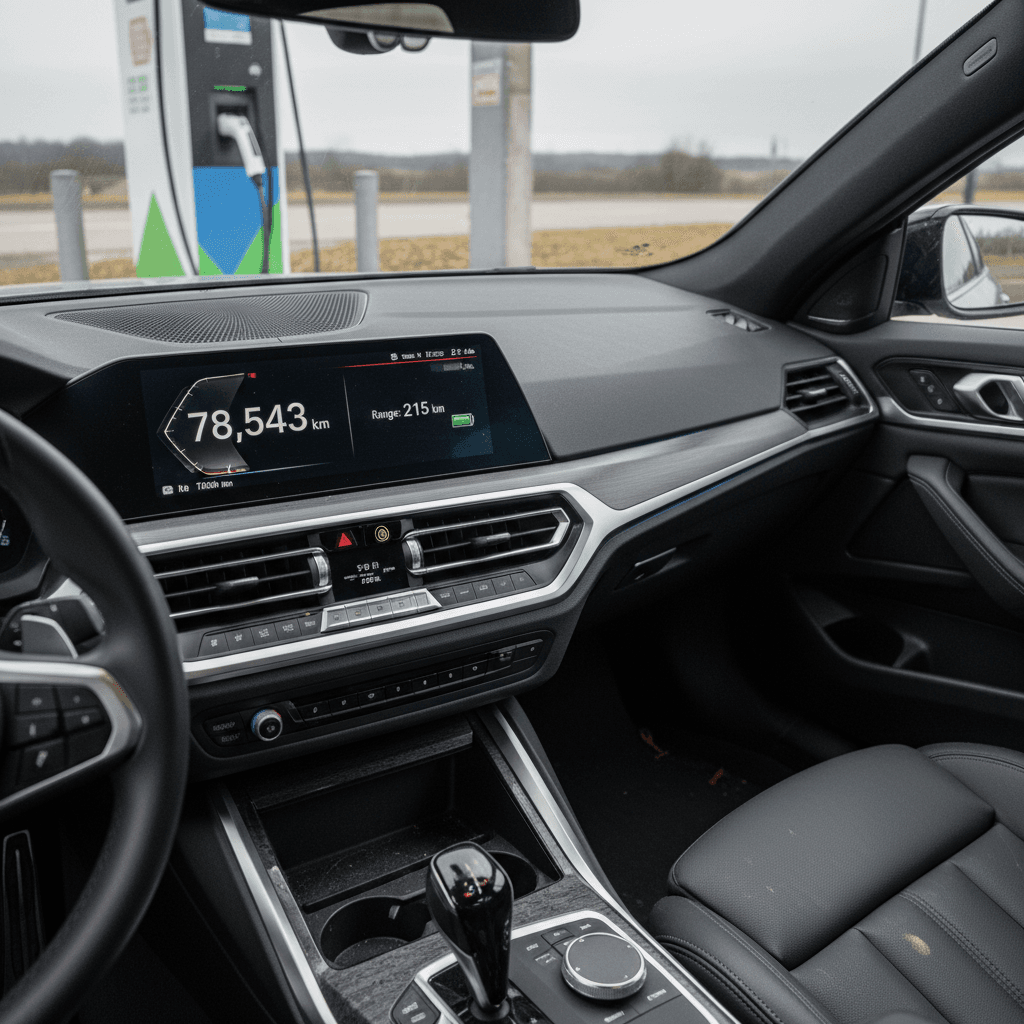
- Most EQEs in the U.S. carry an 8‑year / around 100,000–125,000‑mile high‑voltage battery warranty (check your specific car; coverage can vary by model year and market).
- Battery degradation so far appears broadly in line with other premium EVs: modest capacity loss in the first few years, then a slower taper, assuming normal use and charging habits.
- Fast‑charging use, frequent 100% charges, hot climates, and poor storage habits can all accelerate degradation, which will show up in range and value.
- Buyers are becoming more sensitive to state of health (SoH) reports, not just mileage and Carfax histories. A car with low miles but a tired battery will be valued accordingly.
Where Recharged changes the equation
Why verified battery health boosts resale
Two otherwise identical EQEs, same year, same color, same options, can have very different real‑world value if one has a healthier pack. Sellers who can document strong battery SoH will attract more buyers and justify stronger pricing.
On the flip side, if an inspection shows above‑average degradation, it gives you leverage to negotiate or walk away before you inherit a future range and resale problem.
Think in "usable years," not just price
Instead of only asking, “Is this cheap?”, ask: “How many trouble‑free years of range and warranty do I get?” A slightly more expensive EQE with healthier battery metrics can be cheaper per year of usable life than a bargain‑priced one that’s already lost a chunk of capacity.
Practical strategies if you’re buying or selling a used EQE
With EVs, you’re not just betting on a model, you’re betting on where the whole category is headed. Here are concrete ways to keep the odds in your favor whether you’re buying or exiting an EQE.
5 smart moves for EQE buyers
1. Target the steepest part of the curve
The sweet spot is usually a <strong>1–3‑year‑old EQE</strong> that’s already absorbed the ugly new‑car depreciation but still carries most of its factory battery and bumper‑to‑bumper warranty.
2. Prioritize battery data over shiny options
Panoramic roofs and Burmester audio are nice, but <strong>battery state of health and charging history</strong> should be the first things you verify. A Recharged Score Report or equivalent third‑party diagnostic is worth more than any cosmetic option.
3. Stress-test your use case
Map your real driving: daily commute, weekend trips, occasional road trips. Make sure the EQE’s <strong>usable range with some degradation baked in</strong> still works for you so you’re not forced to sell early into a soft market.
4. Compare total cost against a gas E‑Class
Don’t just compare purchase prices. Look at <strong>fuel vs. electricity, maintenance, and expected depreciation</strong> over at least five years. In many scenarios, a discounted used EQE pencils out better than a new or CPO gas E‑Class.
5. Use market tension to your advantage
Dealers and private sellers know EVs have cooled. Don’t be shy about offering below ask, especially on cars that have sat for weeks. Coming in with financing pre‑qualified through a platform like Recharged strengthens your position.
Don’t ignore software & feature support
4 ways EQE owners can protect resale value
1. Document everything
Keep meticulous records of <strong>service visits, software updates, and charging habits</strong>. A clean paper trail reassures used buyers that the car’s been cared for.
2. Stay ahead on cosmetic fixes
Luxury buyers are picky. Fix curb rash, handle minor dings, and consider professional detailing before listing. A fresh‑looking EQE stands out in a market full of ex‑fleet and demo cars.
3. Time your exit around warranty milestones
You’ll generally get stronger offers while there’s still <strong>meaningful battery and bumper‑to‑bumper coverage</strong> remaining. If you plan to sell, don’t wait until the last year of battery coverage unless you’re pricing aggressively.
4. Sell where EV demand is strongest
If you’re flexible, listing or consigning your EQE through a platform that reaches <strong>EV‑dense regions</strong>, West Coast, Northeast, certain Sun Belt metros, can net you more interest and firmer pricing than staying purely local.
Why a used EQE can still be a smart buy with Recharged
The EQE’s weak spot is not the product; it’s the mismatch between its original price and where the market settled on luxury EVs. That’s exactly the kind of situation where a dedicated used‑EV marketplace can tilt the odds in your favor.
How Recharged helps you derisk a used Mercedes EQE
Making battery‑heavy, tech‑heavy cars feel less like a gamble.
Recharged Score battery diagnostics
Every vehicle includes a Recharged Score Report with verified battery health, charging behavior, and range performance. You’re not left guessing how a previous owner treated the pack.
Fair, market-based pricing
Recharged benchmarks each EQE against current used‑EV trends, auction data, and regional demand. That helps ensure you’re paying a price that reflects today’s market, not yesterday’s MSRP.
Financing, trade-in & delivery
From financing and trade‑in offers to optional consignment and nationwide delivery, Recharged is built to make the entire process digital‑first and EV‑specialist guided, so you can focus on picking the right car, not managing logistics.
Ready to find your next EV?
Browse VehiclesTry before you commit
Mercedes EQE resale value FAQs
Frequently asked questions about EQE resale value
Bottom line: who the Mercedes EQE makes sense for
The Mercedes EQE is a textbook case of a strong product dropped into a volatile moment in the EV market. High launch prices, an unfriendly environment for luxury sedans, and a broader reset in EV expectations have all conspired to push its resale values down faster than many buyers expected.
If you bought early at full sticker and are now looking at trading out, that story is understandably frustrating. But if you’re approaching the EQE from the other side, as a used buyer in 2026 or later, it can be one of the best value plays in the luxury EV space: a quiet, tech‑rich Mercedes with years of battery warranty left, at a price that finally makes sense.
The key is to treat each EQE as a specific asset, not an abstract model: verify battery health, understand how much depreciation has already occurred, and align what you pay with how long you plan to keep it. Work with data, not vibes. Platforms like Recharged exist to give you that data, and to help you turn a messy, fast‑changing EV market into an opportunity instead of a risk.