If you’re shopping for a used electric car, the **extended warranty pitch** is almost guaranteed. And because EV batteries and electronics feel mysterious and expensive, many shoppers wonder: **is an extended warranty on a used electric car actually worth it?** The honest answer: sometimes yes, but often not, once you understand how EV warranties, real repair costs, and battery health actually work.
Key Takeaway in 20 Seconds
Why “Is an Extended Warranty on a Used Electric Car Worth It?” Matters
Extended warranties are big business in the auto world, but **EVs change the math**. Electric cars eliminate entire systems, no engine, transmission, exhaust, or oil changes, so there’s simply **less to break mechanically**. At the same time, the single most expensive component, the high-voltage battery, carries **strong factory protection** that often still applies even when you’re buying used.
That combination creates a strange tension: you’re being asked to spend thousands of dollars protecting a car that’s mechanically simpler, but whose most expensive part may already be under a long factory warranty. This guide breaks down the numbers and scenarios so you can decide if an extended warranty on a used EV is **smart insurance or expensive peace of mind**.
How EV Warranties Actually Work: Factory vs Extended
Two Layers of Protection on Most Electric Cars
Understanding factory coverage before you ever consider an extended warranty
1. Factory bumper-to-bumper
Covers most components, electronics, interior tech, minor hardware, for roughly 3–5 years or 36,000–60,000 miles, depending on brand. This often expires first on a used EV.
2. Factory battery & drive unit
In the U.S., most EVs carry 8-year / 100,000-mile (or more) battery and electric motor warranties, often guaranteeing a minimum battery capacity (commonly around 70%) during that period.
Extended warranties, sometimes called **service contracts** or **vehicle protection plans**, sit on top of (or next to) this factory coverage. They’re sold by automakers, dealers, and independent companies, and they kick in once the original bumper-to-bumper warranty runs out. On a used EV, they typically aim to cover the expensive electronic bits that remain exposed as the car ages.
Don’t Assume the Battery Is Covered
Real EV Repair Costs: The Upside and the Downside
What’s Really at Stake Financially?
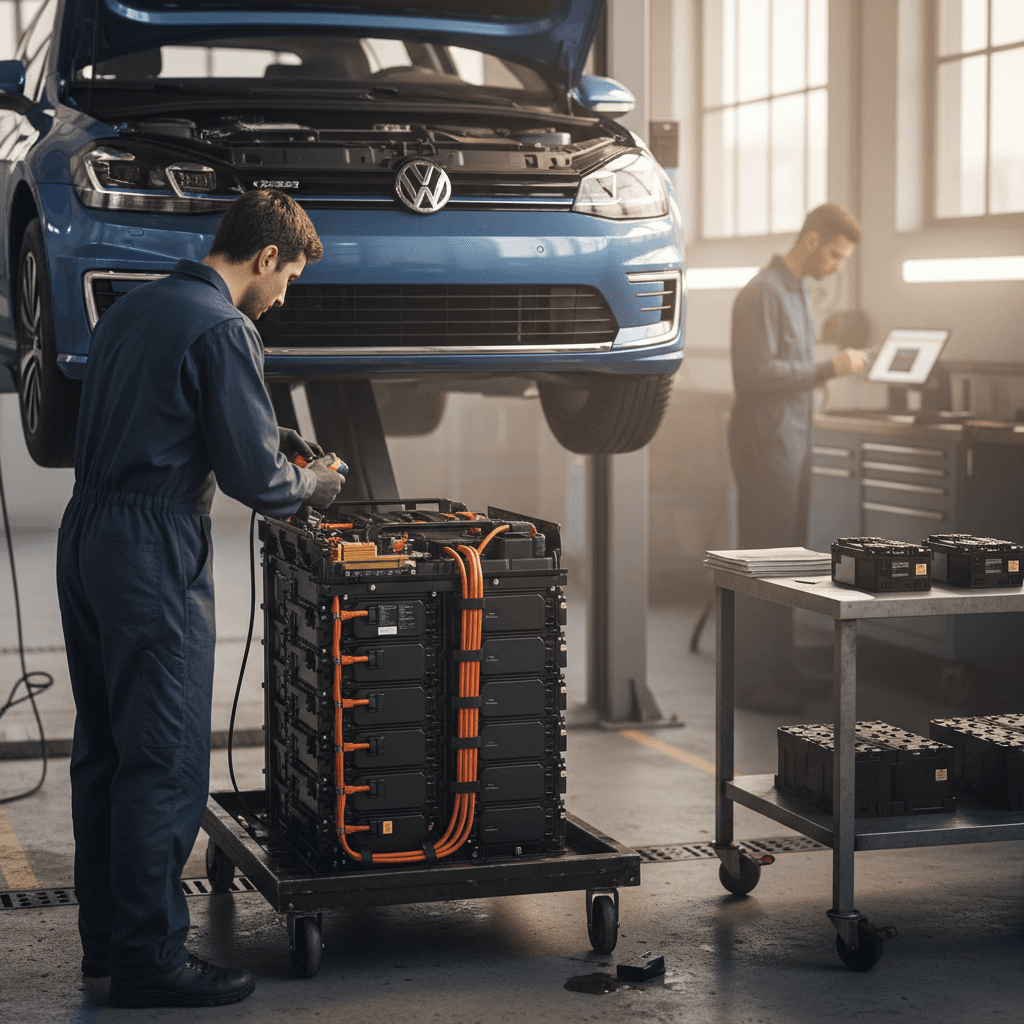
The **headline fear** is the battery. Full pack replacements, out of warranty, can run from around **$5,000 on smaller, older EVs to $15,000–$20,000+** on large crossovers, luxury models, or electric trucks. That’s enough to total some older vehicles on its own.
The **underreported reality**, though, is that pack failures are rare and usually occur **inside the factory warranty window**. Study after study has found that only a small share of EVs, low single‑digit percentages, have ever had a main battery replaced, and most of those were covered by the automaker. Meanwhile, the parts that do fail out of warranty tend to be **onboard chargers, infotainment systems, HVAC components, and sensors**, with repair bills often in the hundreds or low thousands, not tens of thousands.
Think in Probabilities, Not Just Possibilities
What Extended Warranties on Used EVs Do, and Don’t, Cover
Typical EV Extended Warranty Coverage
- High-voltage components like the inverter, DC–DC converter, and sometimes onboard charger.
- Electronics & infotainment (screens, audio, navigation) after factory coverage expires, depending on plan level.
- HVAC and thermal systems, including heat pumps and battery cooling hardware.
- Driver-assistance hardware (sensors, cameras, radar) in higher-tier plans.
Common EV Extended Warranty Exclusions
- Battery capacity loss (range degradation) treated as wear, not a defect.
- Pre-existing conditions, including prior fault codes or known issues.
- Improper modifications or non-OEM software/hardware changes.
- Routine wear items: tires, brake pads, wiper blades, cosmetic trim.
Automaker‑backed extended service plans sometimes mirror factory coverage fairly closely, but **most third‑party contracts are narrower than they sound in the sales pitch**. For EVs, the devil is especially in the sections labeled **“battery,” “degradation,” or “capacity.”** If a contract only covers the battery when it is completely inoperative, that won’t help you with a car that still drives but has lost 30% of its range.

When an Extended Warranty on a Used EV Is Probably Worth It
Scenarios Where Extended Coverage Can Make Sense
These are the edge cases where paying extra for a used EV warranty is defensible.
High annual mileage
If you’re driving 20,000+ miles a year, you’ll chew through time-and-mileage limits quickly. An extended plan that stretches protection into your high-mileage years can be worthwhile, especially for ride-hail or delivery use.
Near end of factory coverage
Buying a 6–7‑year‑old EV with factory battery warranty ending soon? A carefully written, reasonably priced plan that truly covers major electric components might give you a few lower‑stress years.
Long-term ownership plans
If you plan to keep a used EV for another 7–10 years, you’re more exposed to outlier failures. A strong service plan can help you budget, provided it doesn’t double your cost of ownership.
- The car has **complex tech** (air suspension, four‑wheel steering, advanced driver assist suites) that’s historically expensive to repair.
- You live far from independent EV‑savvy shops and would otherwise be **locked into high dealer labor rates**.
- You simply value predictable costs over squeezing every dollar of expected value out of the decision. For some drivers, that peace of mind is genuinely worth paying for.
Green Flags in an EV Extended Warranty
When You Can Probably Skip the Extended Warranty
In many used‑EV scenarios, buying an extended warranty is **more about emotion than math**. If these sound like you, you’re usually better off skipping the contract and keeping cash in your own “repairs fund.”
Common Situations Where the Warranty Isn’t Worth It
1. You’re still deep in the battery warranty window
If your used EV still has <strong>3–5+ years of factory battery coverage</strong> left and the pack tests healthy, the odds of a wallet‑destroying battery bill are quite low during your ownership window.
2. The car has a strong reliability record
Models like mainstream Teslas, Hyundai/Kia crossovers, and Chevy Bolt/Equinox EVs are showing solid long‑term battery reliability. For these, catastrophic failures outside factory coverage are rare events, not regular occurrences.
3. The warranty costs more than 10–15% of the car
If a $2,800 warranty is being pitched on a $15,000 EV, you’re handing over nearly 20% of the car’s value up front. That’s a tough hurdle for any policy to clear in expected value.
4. You tend to swap cars every few years
Short ownership cycles mean fewer years at risk for big repairs. In that case, paying to protect the next owner’s years of use is usually a bad deal for you.
5. You have savings and low risk aversion
If you can comfortably absorb a $1,500–$2,500 surprise repair every few years, **self‑insuring** (skipping the warranty and keeping a reserve fund) is almost always the better bet.
How to Analyze the Numbers for Your Specific Car
To decide if an extended warranty on a used electric car is worth it, treat it like any other insurance product: compare the **cost of coverage** to the **probability and cost of realistic failures** during the years you’ll own the car.
Simple Framework for Evaluating a Used EV Warranty
Plug in your own numbers to see if the math works.
| Question | How to Estimate It | Example |
|---|---|---|
| Remaining factory coverage? | Check in‑service date, mileage, and battery warranty terms for your exact model. | Battery warranty to 2030 / 120,000 miles; you plan to keep car until 2028. |
| Warranty price & term? | Total cost, years of coverage, and per‑visit deductible. | $2,200 for 4 years, $200 deductible per visit. |
| Realistic failures in that time? | Research common issues for your model and talk to an EV‑savvy shop. | Two likely repairs: onboard charger ($1,400) and infotainment screen ($900). |
| Expected cost vs price | Add likely repairs × probability; compare to warranty cost + hassle. | If there’s a 30% chance of $2,300 in repairs, expected value is ~$690, far below $2,200. Not worth it. |
If your expected repair costs are far below the price of the warranty, plus its deductible and exclusions, it’s probably not worth buying.
A Quick Rule of Thumb
Dealer vs Third-Party vs Built-In Protection
1. Automaker-backed plans
These often have the best parts quality and claim experience, and may integrate more cleanly with existing factory coverage. Availability on used EVs varies widely, and pricing can still be aggressive.
2. Dealer/third-party contracts
Usually the most heavily marketed in a finance office. They can be fine, but also the most likely to exclude EV-specific pain points like degradation, infotainment glitches, or ADAS sensor recalibration.
3. Built-in “soft” protection
Things like a verified battery-health report, transparent pricing, and return policies don’t replace a warranty, but they dramatically reduce your odds of starting with a problem car.
Watch the Sales Tactics
How Recharged Handles Used EV Risk Without Forcing Warranties
At Recharged, we’ve seen both sides of the extended‑warranty question. Done right, they can offer genuine peace of mind for the right driver and car. Done wrong, they simply add markup to a deal without meaningfully reducing risk. Our approach is to attack the risk at its source instead of asking every buyer to roll the dice on a complex contract.
Lower Risk, Fewer Surprises: The Recharged Way
How we make used EV ownership more predictable before warranties even enter the picture.
Recharged Score battery health diagnostics
Every vehicle we sell includes a Recharged Score Report with verified battery health. Instead of guessing about degradation, you see measured capacity, charging behavior, and how the pack has aged, crucial context before you ever think about extended coverage.
Fair pricing & flexible paths
We ground every price in fair market data and give you options: financing, trade‑in, instant offer or consignment, plus nationwide delivery from our digital platform and Richmond, VA Experience Center. That leaves more room in your budget if you decide to self‑insure repairs instead of buying a warranty.
Because we specialize in EVs, our team can also **talk through realistic failure risks** for the specific models you’re considering, based on actual fleet data, not just what sells an add‑on. Whether you choose an extended warranty or not, the goal is the same: a used EV that fits your budget, your range needs, and your risk tolerance.
Checklist: Before You Say Yes (or No) to a Used EV Extended Warranty
7 Steps to a Smarter Warranty Decision
1. Map your ownership window
How many years and miles do you realistically plan to keep this EV? Don’t buy coverage for years you’ll never use.
2. Audit remaining factory coverage
Confirm exact in‑service date and mileage limits for the battery, drive unit, and bumper‑to‑bumper coverage. You may already be protected where it matters most.
3. Get battery health data
Use a trusted report, like a <strong>Recharged Score</strong>, or specialist inspection to verify state of health. A strong battery today greatly reduces catastrophic risk tomorrow.
4. Research model‑specific issues
Search for common failures and recall history for your exact make, model, and year. Focus on high‑voltage systems and electronics, not just early social‑media horror stories.
5. Read the full contract, not the brochure
Look for explicit wording on battery coverage, degradation, deductibles, claim limits, and where you’re allowed to get repairs done.
6. Compare price vs realistic risk
Estimate a few plausible repair scenarios and assign rough probabilities. If the contract costs a lot more than your expected repair bill, it’s likely not worth it.
7. Decide how you prefer to manage risk
If you sleep better with a safety net and the contract is fairly priced, go for it. If you’re comfortable self‑insuring, skip it and earmark the same money for future repairs.
FAQ: Extended Warranties and Used Electric Cars
Frequently Asked Questions
Bottom Line: Is It Worth It?
For most shoppers, an **extended warranty on a used electric car is not automatically worth it**, and in many cases, the combination of factory battery coverage, simpler mechanicals, and good upfront due diligence makes it unnecessary. Where it can shine is in specific high‑risk, high‑mileage, or long‑ownership scenarios, provided the coverage is transparent and fairly priced.
The most powerful tools you have aren’t add‑on contracts; they’re **information and alignment**. Know the remaining factory coverage. Understand your EV’s real battery health through something like a Recharged Score. Be honest about how long you’ll keep the car and how much uncertainty you can stomach. From there, whether you choose to self‑insure or layer on an extended warranty, you’ll know you’re making a clear‑eyed decision, not just reacting to a scary slide in a finance office.