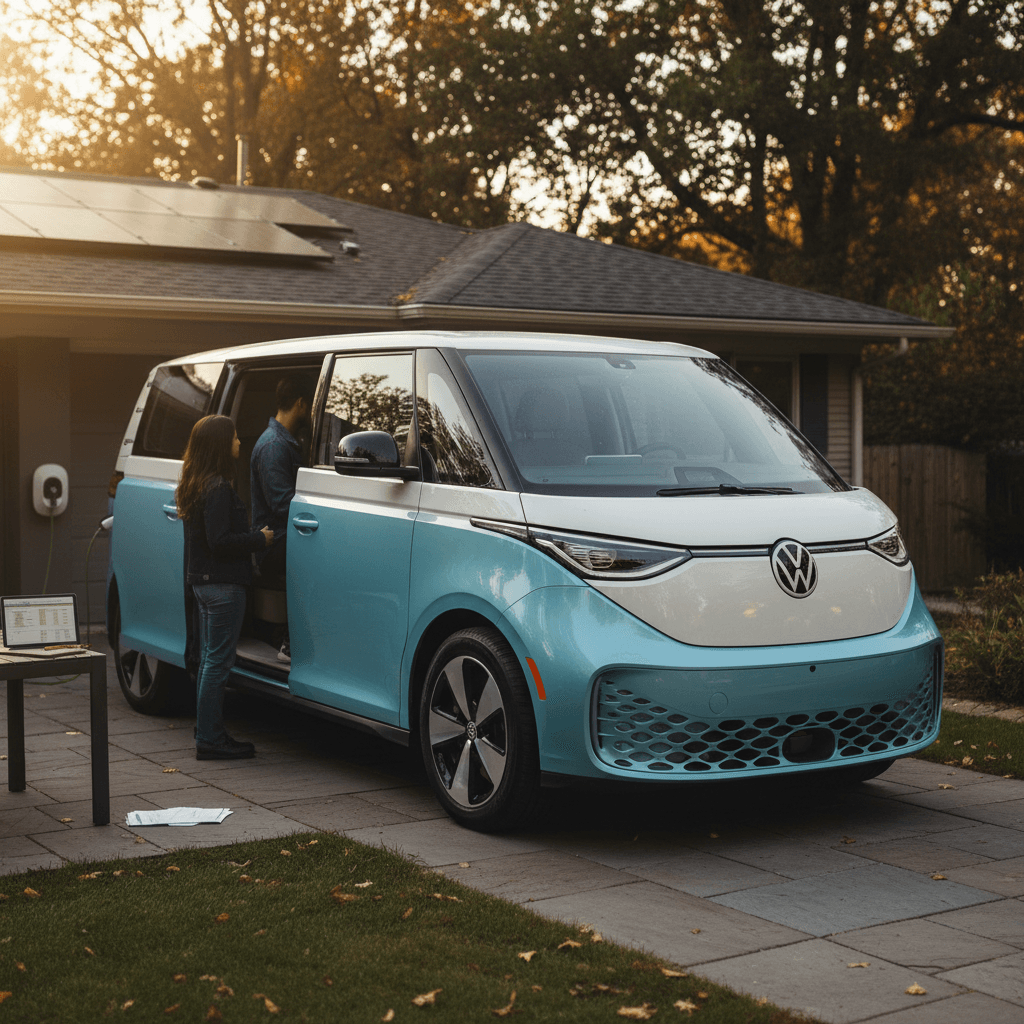
If you’re asking whether the 2026 Volkswagen ID. Buzz is a good buy, you’ve probably fallen for its retro charm and huge windows, and now you’re trying to reconcile that emotion with spreadsheets. That’s exactly where you should be: the ID. Buzz is one of the most characterful EVs on sale, but it also comes with real tradeoffs in price, range, and timing that U.S. shoppers need to understand.
Important 2026 model-year note
Context: 2026 ID. Buzz and the U.S. market
For U.S. buyers, the North American ID. Buzz is a long‑wheelbase, three‑row electric van built on VW’s MEB platform. Europe gets shorter two‑row and cargo versions, but here you’re limited to the family‑friendly passenger model. Underneath, you’ll find an 86‑kWh battery (usable capacity) and either rear‑wheel drive or all‑wheel drive, plus DC fast charging and the usual suite of driver assists.
Key 2025–2026 VW ID. Buzz numbers (North America)
Mind the model‑year vs calendar‑year confusion
Quick answer: Is the 2026 ID. Buzz a good buy?
ID. Buzz 2026: Where it shines and where it doesn’t
The elevator pitch before we go deep
When it IS a good buy
- You want a distinctive, three‑row EV that isn’t just another SUV.
- Your typical days are well under 150–180 miles, with occasional road trips.
- You value space, visibility, and comfort more than outright efficiency.
- You’re okay paying luxury‑SUV money for a characterful van.
When it ISN’T a good buy
- You need 300+ miles of real‑world range or tow regularly.
- Your budget is under the mid‑$50ks.
- You’re sensitive to first‑generation software quirks and potential depreciation.
- You’d rather maximize value with a used premium EV or a more efficient crossover.
Big‑picture verdict
Pricing and value: How much van for the money?
Let’s start where most ID. Buzz discussions go sideways: price. In the U.S., the long‑wheelbase ID. Buzz is the most expensive Volkswagen you can buy. Real‑world dealer stickers for 2025‑spec vans frequently land in the high‑$60,000s or even low‑$70,000s once you add desirable options like all‑wheel drive, larger wheels, and nicer interior trims.
ID. Buzz 2026 pricing context
How the ID. Buzz sits versus other EV people‑movers you might cross‑shop.
| Vehicle | Type | Seats | Approx. Price New | Key Tradeoff vs. ID. Buzz |
|---|---|---|---|---|
| VW ID. Buzz (LWB) | 3‑row EV van | 6–7 | ≈$67k–$75k | Most charm and space, but pricey and modest range |
| Kia EV9 | 3‑row EV SUV | 6–7 | ≈$56k–$75k | More range and towing, less quirky character |
| Hyundai Ioniq 7 / Ioniq 9 | 3‑row EV SUV | 6–7 | ≈$55k–$70k | Strong value and range, conventional SUV body |
| Tesla Model X (used) | 3‑row EV SUV | 6–7 | ≈$40k–$60k (3–5 yrs old) | More performance and range, but older tech and styling |
| Chrysler Pacifica PHEV | PHEV minivan | 7 | ≈$43k–$55k | Not fully electric, but far cheaper and very practical |
Approximate U.S. pricing as of early 2026; always verify current deals and incentives.
What you’re really paying for
Value positives
- Huge, flexible interior compared with most three‑row SUVs.
- Lots of glass and light; passengers love being in it.
- Standard safety and driver‑assist tech is competitive.
- Access to both CCS fast charging and, via adapter, Tesla Superchargers improves usability.
Value negatives
- MSRP lands in luxury EV SUV territory without luxury‑brand cachet.
- Range is fine, not great, for the price point.
- First‑generation buzz means unknown depreciation and software aging curve.
- Better pure‑value options exist if you’re agnostic about form factor.
Range, battery, and charging: What living with it really looks like
On paper, the U.S.‑spec long‑wheelbase ID. Buzz pairs an ~86‑kWh usable battery with rear‑wheel or all‑wheel drive. EPA numbers depend on configuration, but you’re generally looking at a band in the low‑200‑mile range. In the real world, with family, cargo, and highway speeds, you should think in terms of ~180–220 miles between fast‑charges depending on conditions.
- Expect closer to the lower end of that range with big wheels, AWD, cold weather, or 75+ mph cruising.
- Expect the higher end with RWD, smaller wheels, mild temps, and mostly suburban driving.
- Like any big, boxy vehicle, the ID. Buzz is more sensitive to speed and headwinds than a sleek crossover.
How to sanity‑check Buzz range for your life
Charging experience: what to expect
From home Level 2 to road‑trip DC fast charging
Home charging
On a 40‑ to 48‑amp Level 2 charger at home, you’re looking at a full overnight refill from low state of charge. Most owners simply plug in every evening and wake up with more than enough range for daily life.
Public CCS fast charging
The ID. Buzz uses the CCS port and supports DC fast charging. You won’t match Tesla’s network density, but between Electrify America, EVgo, and others, major corridors are covered. Expect a 30–40 minute stop to go from low state of charge back up to a sensible road‑trip buffer.
Supercharger access via NACS adapter
Starting in late 2025, U.S. ID. Buzz owners get access to portions of the Tesla Supercharger network via a NACS adapter supplied by VW. That dramatically improves your charging options on road trips, even if not every Supercharger stall will support non‑Tesla vehicles immediately.
If long‑range road trips are your life
Space, practicality, and ride comfort: The good part
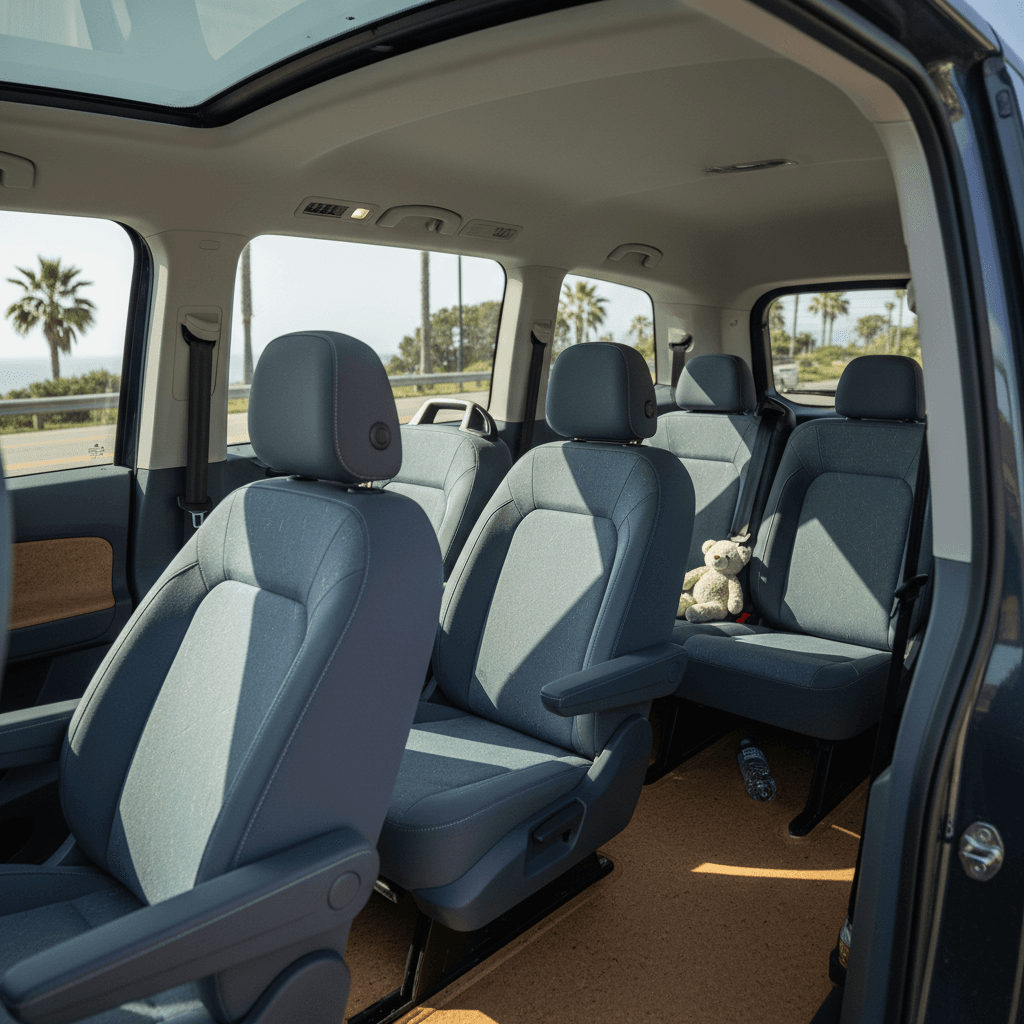
Where the ID. Buzz really earns its keep is as a rolling living room. The long wheelbase version sold here offers three rows of seating, a tall roof, and huge windows. Passengers get an airy, upright seating position, and the cargo hold is genuinely useful even with all three rows in place, something many three‑row SUVs can’t claim.
Everyday strengths of the ID. Buzz
Why families and road‑trippers love it despite the specs
Real third‑row usability
Adults can actually sit in the third row without feeling punished. The boxy shape means more headroom and a less claustrophobic feel than most crossovers.
Flexible cargo space
With three rows up you still have meaningful cargo room for strollers, luggage, or a big grocery haul. Fold or remove the third row and you’re in small‑cargo‑van territory.
Road‑trip versatility
Folded seats and the flat floor make the Buzz a favorite for camping, DIY campers, and people who treat their vehicle as a mobile studio or office.
EV ride and refinement
Tech and driving experience: Charm vs. quirks
From behind the wheel, the ID. Buzz drives like a friendly, slightly tall EV hatchback. Steering is light, acceleration is adequate to brisk (especially in AWD form), and visibility is excellent. Where opinions diverge is on VW’s software and controls, which borrow heavily from the ID.4.
What owners and reviewers tend to like
- Quiet, smooth powertrain with enough punch for merging and passing.
- Excellent outward visibility thanks to the big windshield and side glass.
- Strong suite of driver‑assist tech (adaptive cruise, lane centering, etc.).
- Playful design details that make it feel special instead of generic.
Where frustrations show up
- Touch‑sensitive sliders and screen‑heavy controls can be fiddly.
- Some software lag and menu complexity versus Tesla or Hyundai/Kia.
- Early build quality niggles reported in Europe on trim and rattles.
- Not a sports car; tall, heavy, and more about comfort than dynamics.
Performance expectations check
Ownership costs and reliability: Early signals
Hard reliability data for the ID. Buzz is still developing, especially for U.S.‑spec long‑wheelbase vans. What we do know from European experience and platform‑mate vehicles like the ID.4 is that the MEB electric powertrain itself has been solid, while most headaches stem from software, infotainment glitches, and the odd hardware quality issue.
What to budget and watch for
1. Insurance and repair costs
As a large, expensive EV with plenty of glass and unique bodywork, the ID. Buzz won’t be cheap to insure or repair after a collision. Get real quotes before you sign.
2. Software updates and support
Ask your dealer about the current software version, over‑the‑air update capability, and what’s changed since early production. Later‑build vans often have fewer glitches.
3. Battery health over time
Like any EV, long‑term value hinges on battery health. When you’re shopping used, look for independent battery‑health verification, something like a <strong>Recharged Score</strong>, rather than trusting range guesses on the dash.
4. Depreciation reality check
First‑wave niche vehicles often depreciate faster than mainstream SUVs. If you’re payment‑sensitive, consider leasing or buying used once early depreciation has already happened.
Be wary of early‑build discounts with hidden costs
Who the 2026 ID. Buzz is perfect for, and who should avoid it
Is the 2026 ID. Buzz a good buy for you?
Match your use‑case to what the Buzz actually does well
Great fit
- Families who road‑trip but don’t chase 800‑mile days.
- People who prioritize experience and space over spec‑sheet bragging rights.
- Urban/suburban households that want one flexible, do‑everything EV.
- Creative pros, van‑lifers, or small businesses using it as a people‑mover with personality.
Poor fit
- High‑mileage drivers in rural areas with sparse fast charging.
- Buyers stretching financially just to get into an EV.
- Shoppers who mainly care about range per dollar or 0–60 times.
- Anyone who hates learning new interfaces or dealing with software updates.
Smart alternatives, new and used
If you’re not 100% sold on the ID. Buzz but like the idea of an electric family hauler, you’ve got options. Some feel less special but are objectively better buys; others are older but deliver more capability for the same money, especially in the used market.
Alternatives to consider if you’re Buzz‑curious
These options won’t all replicate the Buzz vibe, but they may fit your budget or needs better.
| Vehicle | New/Used focus | Why consider it | Typical Price |
|---|---|---|---|
| Kia EV9 | New or lightly used | Three‑row SUV with more range and towing, better long‑distance tool. | New ≈$56k–$75k; used (coming soon) lower |
| Hyundai Ioniq 7 / 9 | New | Tech‑forward three‑row EV with strong range and charging speeds. | New ≈$55k–$70k |
| Tesla Model X | Used | Big three‑row EV with strong road‑trip capability and wide Supercharger access. | Used ≈$40k–$60k |
| VW ID.4 | New or used | Cheaper, more efficient VW EV if you don’t truly need three rows. | Used often in $25k–$35k range |
| Chrysler Pacifica PHEV | New or used | If you just need a family box and can live with plug‑in hybrid instead of full EV. | Used often in the mid‑$30ks |
Used pricing is approximate for well‑kept 3–5‑year‑old examples as of early 2026.
How to compare honestly
How a used ID. Buzz or other EV through Recharged could make more sense
Because the ID. Buzz is expensive new and likely to see meaningful early depreciation, there’s a strong case for being a second‑wave buyer. That’s especially true if you’re shopping in 2026 or 2027, once the first batch of U.S. vans has a couple of years and tens of thousands of miles under its belt.
Why a used ID. Buzz might be the sweet spot
- Early owners absorb the steepest depreciation curve.
- Real‑world issues and software updates are better understood.
- You can compare multiple build dates and option sets side‑by‑side.
How Recharged can help you shop smarter
- Every EV on Recharged comes with a Recharged Score Report, including verified battery health so you’re not guessing about range.
- Expert EV specialists help you compare an ID. Buzz against alternatives like a used Model X or Kia EV9 in plain language.
- Financing, trade‑in, instant offer or consignment, and nationwide delivery let you handle the whole process digitally, or visit the Recharged Experience Center in Richmond, VA if you prefer in‑person.
Stack the deck in your favor
FAQ: 2026 Volkswagen ID. Buzz buying questions
Common questions about the 2026 VW ID. Buzz
Bottom line: Should you buy a 2026 ID. Buzz?
If you’re wondering whether the 2026 Volkswagen ID. Buzz is a good buy, the honest answer is that it’s a great EV for the right person, at a price that demands clear priorities. You’re paying premium money for design, space, and a uniquely enjoyable experience rather than segment‑leading range or efficiency. For families and road‑trippers who fall in love with the way it looks and feels, and who have realistic range expectations, the Buzz can absolutely be worth it.
If, on the other hand, you simply need the best spec sheet for the dollar, there are better choices new, and often much better choices used. That’s where it’s worth broadening your search: a used ID. Buzz with a verified battery‑health report, or a different used three‑row EV with more range, may fit your life just as well for far less money. However you decide, take the time to drive your shortlist back‑to‑back and let both your head and your gut weigh in, because an EV this distinctive deserves a buyer who’s genuinely sure.