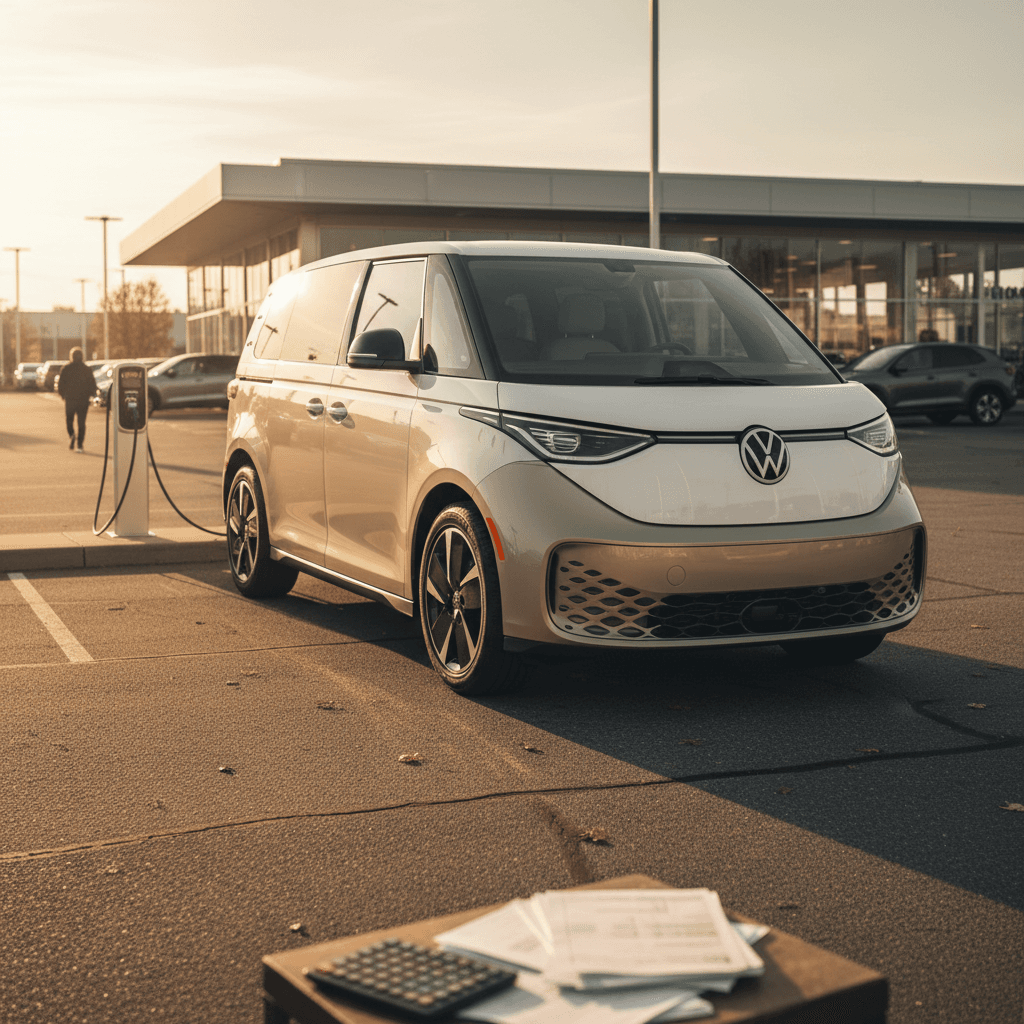
If you’re drawn to the retro‑cool styling and three‑row practicality of Volkswagen’s electric van, you’re probably wondering the same thing as everyone else: is the 2025 Volkswagen ID. Buzz a good buy or just an expensive nostalgia play? The answer depends heavily on what you value most: style and space, or range and pure numbers.
Quick verdict
2025 Volkswagen ID. Buzz at a glance
2025 ID. Buzz key numbers (U.S. spec)
For the U.S. in 2025, Volkswagen sells the long‑wheelbase ID. Buzz with three rows, rear‑wheel drive or dual‑motor all‑wheel drive, and an 85–86 kWh usable battery. Think of it as an all‑electric alternative to a Honda Odyssey or Toyota Sienna, just with fewer cupholders than a traditional minivan and a lot more character.
How to use this guide
Who the 2025 ID. Buzz is really for
Great fit if you:
- Regularly haul kids, friends, dogs, or outdoor gear and want a flexible three‑row electric vehicle.
- Mostly drive short to medium distances, school runs, commuting, weekend trips under ~150 miles each way.
- Value design, airy visibility, and a fun cabin more than having 300+ miles of range.
- Plan to DC fast charge occasionally, not every single day.
- Have access to home Level 2 charging so you can start each morning with a full battery.
Probably not a fit if you:
- Routinely drive 200–300 highway miles in one shot and hate stopping to charge.
- Need maximum towing capacity or heavy off‑road ability, this is a people hauler first.
- Are extremely price‑sensitive and look strictly at dollars per mile of range.
- Are nervous about being an early adopter of a relatively new EV platform and software stack.
Don’t buy the look alone
Pricing, trims, and value for money
Volkswagen positions the 2025 ID. Buzz at the premium end of family EVs. Depending on trim, options, and destination, most U.S. buyers are seeing out‑the‑door MSRPs that land roughly in the high‑$50,000s to low‑$70,000s. That’s serious money, even before you start thinking about accessories or camper conversions.
How ID. Buzz pricing stacks up
Approximate starting MSRPs before incentives and destination, for context only.
| Vehicle | Powertrain | Approx. Starting Price (USD) | EPA Range (mi) | Seats |
|---|---|---|---|---|
| VW ID. Buzz (RWD) | Electric | High‑$50Ks | ~234 | 7 |
| VW ID. Buzz (AWD) | Electric | Low‑$60Ks+ | ~231 | 7 |
| Kia EV9 (base RWD) | Electric | Low‑$50Ks | High‑200s | 6–7 |
| Hyundai Ioniq 7 (est.) | Electric | Mid‑$50Ks+ | High‑200s+ | 6–7 |
| Toyota Sienna | Hybrid | Mid‑$30Ks | Gas | 7–8 |
Always verify current pricing and local incentives, numbers move quickly in the EV market.
On pure value metrics, dollars per mile of range or dollars per cubic foot of cargo, traditional minivans and some three‑row electric SUVs win. Where the ID. Buzz fights back is character, packaging, and safety: it feels special in a way few family haulers do, and it offers a very modern safety suite.
EV tax credits and deals
If you’re mainly sensitive to monthly payment rather than sticker price, the ID. Buzz has already seen aggressive lease offers in some markets as Volkswagen works to move volume. That can make the van feel like a better buy on a three‑year horizon than it looks on paper.
How Recharged can help on price
Range, charging, and real‑world usability
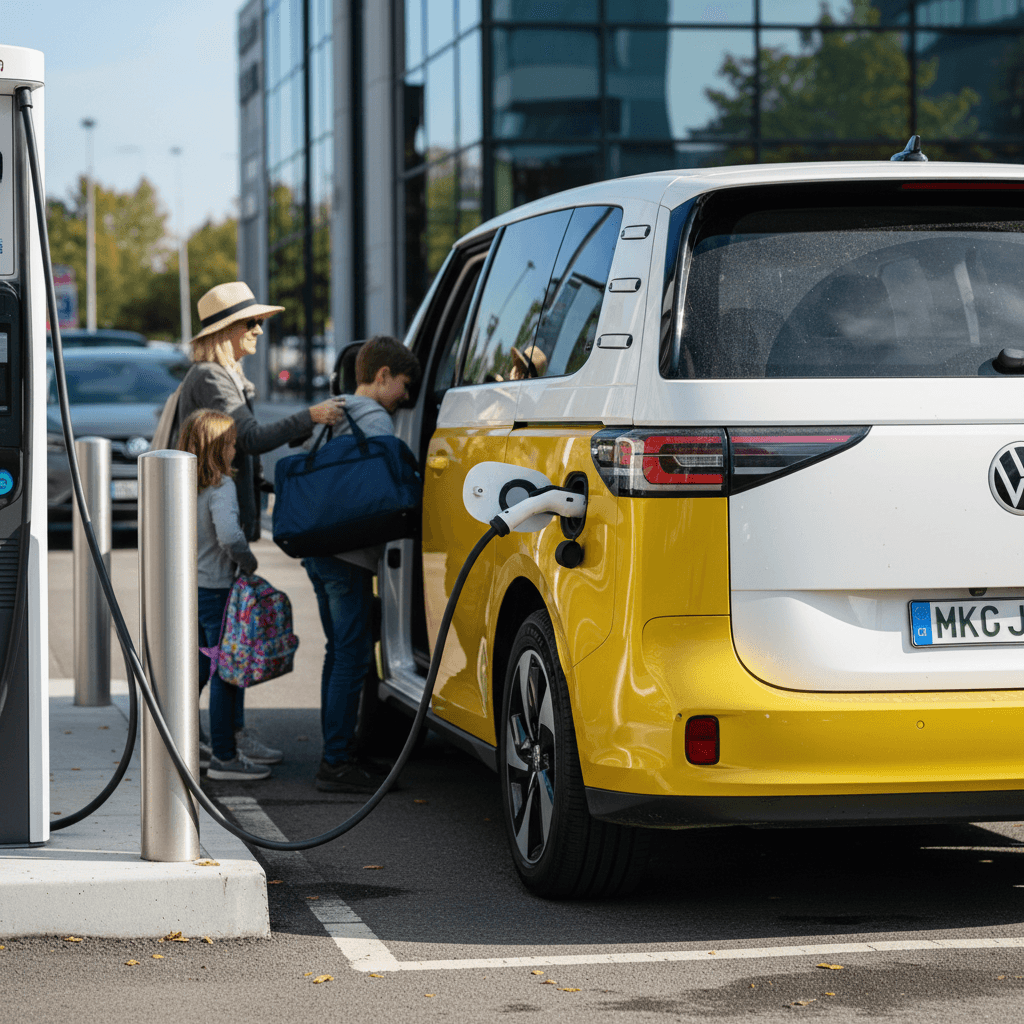
Officially, the long‑wheelbase 2025 ID. Buzz in the U.S. carries EPA range estimates in the low‑230‑mile band, around 234 miles for rear‑wheel drive and roughly 231 miles for all‑wheel drive. That’s on par with many first‑generation EV crossovers, but below the 275–310‑mile figures now common in larger three‑row EVs.
Range, charging speed, and what they really mean
Looking past the window sticker to how the Buzz feels on the road.
Real‑world highway range
At a steady 70–75 mph, testers consistently report shorter range than the EPA label. Think ~180–200 miles on a full charge before you hit a comfortable 10–15% buffer.
DC fast charging
Plugged into a strong DC fast charger, VW quotes about 10–80% in ~30 minutes. That’s competitive, but not class‑leading, and repeat fast charges on long days will add up to more time stopped.
Home charging
On a 240V Level 2 home charger, expect roughly 9 hours from empty to full. For most owners, that means plug in at night and wake up to a full battery with no time pressure.
Range reality check
For urban and suburban families who treat the Buzz like a daily driver and occasional weekend‑trip vehicle, its range is usually enough, especially with home charging. For road‑trip warriors who routinely crush multi‑state drives, the Buzz demands more planning and patience than a sleek SUV with similar battery capacity.
Space and practicality vs. minivans and SUVs
The packaging is where the 2025 ID. Buzz shines. The long‑wheelbase body, flat floor, and upright glass give it a surprisingly airy cabin. Adults can actually sit in the third row without feeling like cargo, and there’s still useful space behind that row for groceries or weekend bags.
How the Buzz works as a family hauler
Comparing it mentally to the minivans and SUVs you already know.
Versus traditional minivans
- More character and better forward visibility; less of a rolling appliance.
- Generally less hidden storage and fewer clever family‑friendly touches than an Odyssey or Sienna.
- No sliding doors that disappear into the body the way some minivans manage.
Versus three‑row SUVs
- Easier third‑row access; boxy shape makes all three rows feel more open.
- Cargo area is more upright and square, great for bulky gear.
- Not as quiet at highway speeds as the best luxury SUVs, partly due to the van profile.
Where the Buzz really delivers
Safety ratings and driver‑assistance tech
From a safety standpoint, the 2025 ID. Buzz is one of Volkswagen’s strongest efforts. It has earned top crash‑test scores in both Europe and the U.S., including a five‑star overall rating and solid performance in updated moderate overlap and side tests. That matters when you’re moving kids and friends around in a tall, roomy vehicle.
- Standard front and rear automatic emergency braking with pedestrian detection
- Adaptive cruise control with lane centering (VW IQ.DRIVE suite)
- Blind‑spot monitoring and rear cross‑traffic alert
- Available surround‑view camera system to help with tight parking lots
- Robust structure and multiple airbags tuned for three‑row use
Does safety make it a better buy?
Ownership costs, reliability, and software
The Buzz rides on Volkswagen’s MEB platform, shared with the ID.4, so some of its long‑term behavior will mirror that crossover. That’s mostly good news: the battery and motors have so far avoided widespread, systemic failures. Where VW has taken lumps has been on software glitches and infotainment quirks more than core mechanical issues.
What to expect to pay after you buy
Beyond the sticker price or lease payment.
Energy costs
At national‑average electricity rates, you’re generally paying the equivalent of $1–$2 per “gallon” of energy versus $3–$5 for gas, depending on your state.
Maintenance
No oil changes, fewer moving parts, and regenerative braking mean lower routine maintenance than a gas van. You’ll still budget for tires, cabin filters, brake fluid and occasional software visits.
Software and bugs
Early ID‑family owners reported laggy screens and phantom warnings. VW has been pushing updates, but if you’re sensitive to tech rough edges, plan for some patience in the first year.
Used‑market advantage
Big pros and cons: is the Buzz worth it?
Key reasons to buy, or skip, the 2025 ID. Buzz
PRO: Unique design and feel
The ID. Buzz doesn’t look or feel like any other family EV on sale. If you want something cheerful and distinctive that still works as a real daily driver, it nails that brief.
PRO: Roomy, flexible interior
Three usable rows, a flat floor, big glass, and upright cargo space make it a natural for families, pets, and gear. It’s genuinely more practical than most three‑row crossovers.
PRO: Strong safety story
Five‑star crash ratings and a full suite of active‑safety tech put the Buzz on solid footing versus both new competitors and older used vans.
CON: Price vs. range equation
You’re often paying luxury‑SUV money for range that looks closer to first‑wave EV crossovers. If you’re purely rational about cost per mile, the math can be hard to justify.
CON: Highway efficiency
The brick‑like profile that makes the Buzz look cool also hurts it at 70–75 mph. Expect more frequent charging on long trips than with a sleeker EV of similar battery size.
CON: VW software reputation
VW has improved its infotainment, but it still trails the best systems for speed and intuitiveness. If glitch‑free tech is non‑negotiable, test every screen and feature in your demo drive.
A good buy, if your priorities match
Should you buy, lease, or wait for used ID. Buzz inventory?
Buy new
- Best if you plan to keep the van 7–10 years and want full warranty coverage.
- You’ll take the depreciation hit, but also enjoy the van in its “best years.”
- Make sure your budget comfortably absorbs the payment without counting on future incentives.
Lease new
- Attractive if you’re unsure about long‑term EV tech or VW software.
- Lets you walk away in 3 years if range or charging needs change.
- Dealer and captive‑finance incentives can quietly make leases cheaper than buying.
Wait for used
- Smart play if you love the Buzz but not today’s price.
- First off‑lease vans will begin hitting the used market, often with lower effective cost and plenty of warranty remaining.
- Shopping via a marketplace like Recharged adds verified battery health and transparent value data to the equation.
How Recharged fits into the decision
Ready to find your next EV?
Browse VehiclesFAQ: 2025 Volkswagen ID. Buzz as a buy
Frequently asked questions about buying a 2025 ID. Buzz
Bottom line: is the 2025 ID. Buzz a good buy?
For the right buyer, the 2025 Volkswagen ID. Buzz is absolutely a good buy. It’s safe, charming, and genuinely practical in daily use, delivering a kind of rolling living room that makes errands and outings feel lighter. You just have to walk into the deal with clear eyes about its range, pricing, and software maturity.
If you’re range‑sensitive, demand the latest tech polish, or need to minimize your payment above all else, you’ll likely find better fits in today’s EV or hybrid market, especially on the used side. If, however, you want an electric family vehicle with real personality and can live within its range envelope, the ID. Buzz can be a purchase you enjoy every single day.
Not sure whether to stretch for a new Buzz or shop used? Spend a few minutes comparing it to high‑value used EVs on Recharged. With battery‑health diagnostics, transparent pricing, financing, trade‑in options, and nationwide delivery, you can quickly see whether the 2025 ID. Buzz is the right call, or if another EV gives you more for the same money.