If you’re looking at a Hyundai Kona Electric, new or used, you’ve probably heard two things: it’s impressively efficient, but its fast‑charging isn’t the quickest in the game. This Hyundai Kona Electric charging speed test pulls together manufacturer data and independent tests to show you what to expect on Level 1, Level 2, and DC fast charging, plus how to work around the limitations on real road trips.
Why charging speed matters more than peak kW
Hyundai Kona Electric charging overview
Across generations, the Kona Electric has built a reputation as one of the most efficient small EVs on sale, squeezing excellent range out of a relatively small battery. That efficiency helps offset its modest DC fast‑charging speeds, but it doesn’t erase them, so understanding how the car really charges is crucial if you commute long distances or road‑trip frequently.
- First‑generation Kona Electric (roughly 2019–2023 in the U.S.) uses a ~64 kWh pack with a DC fast‑charge peak around the high‑70 kW range and an 11 kW AC onboard charger.
- Second‑generation 2024–2025 Kona Electric offers a smaller ~48.6 kWh pack and a larger 64.8 kWh pack, both with an 11 kW onboard charger and a claimed 10–80% DC fast charge in about 43 minutes on a 100 kW station.
- Real‑world tests show peak DC charging typically below the 100 kW claim, often in the 80–90 kW range, but with reasonably steady power through much of the 10–60% window.
Quick reference: Kona Electric charging times
Key Hyundai Kona Electric charging specs
Hyundai Kona Electric charging at a glance
Hyundai Kona Electric charging specs by version (high level)
Approximate manufacturer specs and independent test results for common Kona Electric variants. Always confirm exact specs for your model year and trim.
| Model / Pack | Onboard AC Charger | Max DC Fast Charge (claimed) | Typical DC Peak (tested) | 10–80% DC Time (claimed) |
|---|---|---|---|---|
| 2019–2023 Kona Electric 64 kWh | 7.2–11 kW (varies by market) | Up to ~77 kW | ≈70–77 kW | ≈44 min |
| 2024–2025 Kona Electric 48.6 kWh (SE) | 11 kW | 100 kW | ≈80–90 kW | ≈43 min |
| 2024–2025 Kona Electric 64.8 kWh (SEL/Limited) | 11 kW | 100 kW | ≈80–90 kW | ≈43 min |
Charging performance can vary slightly by market, temperature, software version, and charger quality.
Real-world DC fast charging speed test
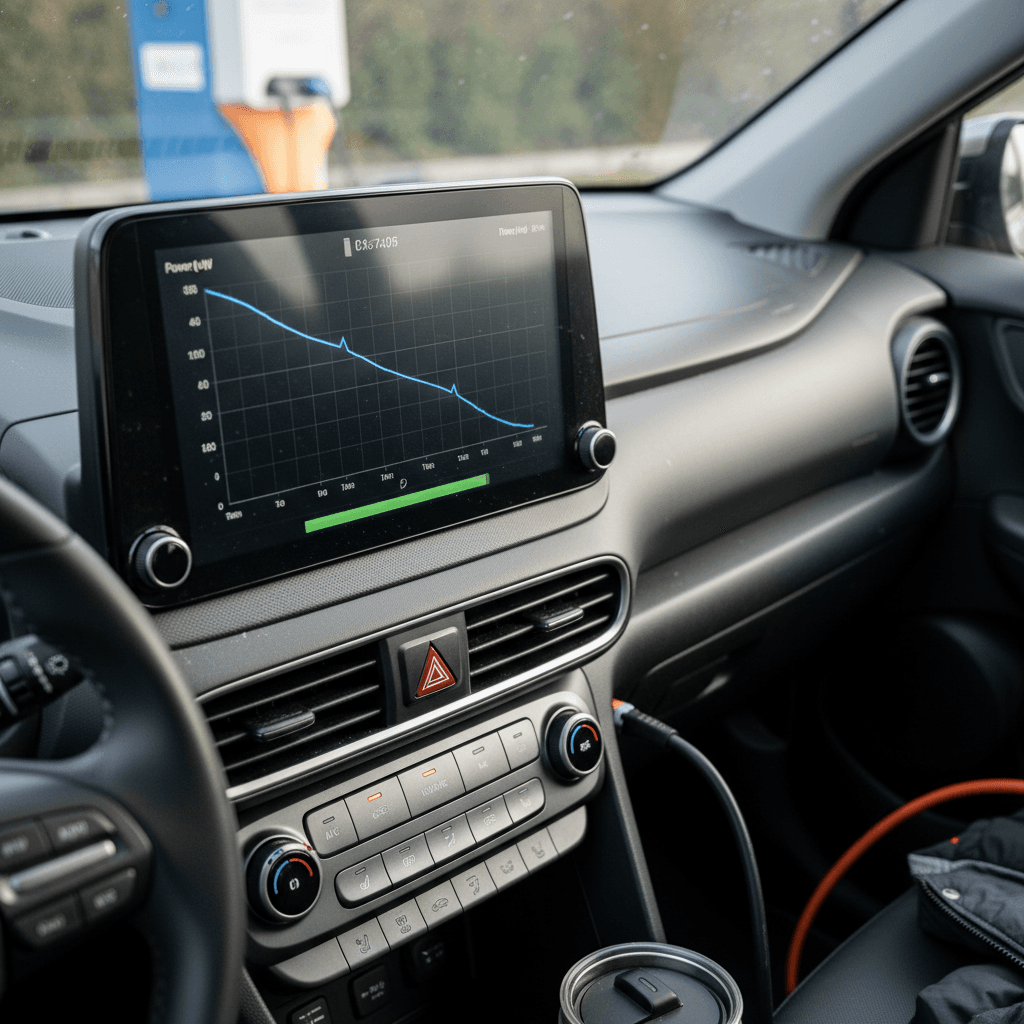
Hyundai’s brochure numbers for the latest Kona Electric promise 10–80% in about 43 minutes at a 100 kW DC fast charger. Independent testing paints a slightly more nuanced picture: the Kona rarely hits that 100 kW headline number, but it holds decent power long enough that overall charge times are still workable for most trips.
Typical modern (2024–2025) Kona Electric test results
On a 150 kW capable public charger, recent road tests of the extended‑range Kona Electric have reported:
- Starting around 10–15% state of charge.
- Peak power near 90 kW rather than the full 100 kW claim.
- An average of roughly 70 kW from the low teens to 80%.
- 10–80% achieved in the mid‑30 to low‑40 minute range under good conditions.
That’s not class‑leading, but it’s consistent and predictable, valuable traits on a road trip.
Older 64 kWh Kona Electric behavior
Earlier Kona EVs with the 64 kWh pack typically top out in the mid‑70 kW range on CCS DC fast chargers. Well‑documented charging curves show:
- Peak of ~75 kW when the battery is warm and below ~40%.
- Average power for a 10–80% session in the mid‑60 kW range.
- 10–80% times in the low‑to‑mid‑40‑minute window on a healthy charger.
In practice, you’ll see similar stops to the newer car, just a touch slower off the line.
Fast chargers aren’t all created equal
- Plan to arrive at DC fast chargers between about 10–25% state of charge; that’s where the Kona charges fastest.
- Expect usable power (50 kW+) up into the 60–70% range on a warm battery, then a steeper taper.
- Beyond about 80–85%, charge speed falls off sharply. For road trips, it’s usually quicker to unplug and drive to the next charger.
Level 2 home charging: how long does it really take?
For most owners, Level 2 home charging is where the Kona Electric shines. With an 11 kW onboard charger on recent models, you can comfortably recharge overnight even if you arrive home with a very low battery.
Kona Electric Level 2 charging expectations
What you’ll see at home on a 240V circuit
Stronger 40A–48A circuit
On a 240V, 40A or 48A circuit (typical dedicated home EVSE), the Kona Electric can take advantage of most of its 11 kW onboard charger.
Result: Going from near‑empty to full on the larger pack typically takes about 6 hours, give or take.
30A dryer‑style circuit
If you share a 30A circuit or use a mid‑power portable Level 2 charger, you’ll see more like 6–7 kW going into the car.
Result: Count on 7–9 hours to fully recharge a nearly empty battery, still fine for overnight use.
Top‑up pattern
Most daily drivers arrive home with 40–60% left. Topping back to 80–90% on Level 2 often takes only 2–4 hours.
Set a departure time and let the Kona finish just before you leave to maximize battery comfort and pre‑conditioning.
Home charging tip
Level 1 charging: fine for emergencies, not for daily driving
Level 1 charging uses a standard 120V household outlet and the portable cordset that comes with the car. Recent independent tests of the Kona Electric show around 4 miles of range per hour of Level 1 charging, among the better results in the segment, but still slow compared with Level 2.
- If you plug in from 6 p.m. to 6 a.m., you might gain roughly 40–50 miles of range, enough for light commuters or as a temporary solution.
- Many Kona owners report that the portable charger defaults to a lower amperage (for example, around 6A). There’s often a button on the brick that lets you bump it up to 12A if your outlet and wiring can safely handle it.
- Because Level 1 is so slow, it’s best seen as a backup or apartment‑dweller stopgap until you can access Level 2 at work or a public station.
Safety first on Level 1
How battery size and model year change charging speed
Hyundai has used a few different battery configurations and onboard chargers in the Kona Electric over the years. That means two Konas parked side‑by‑side might not charge exactly the same way, even if the experience behind the wheel feels similar.
Battery & charging differences to keep in mind
1. Early 64 kWh cars vs. newer 64.8 kWh
First‑gen North American Konas packed a usable battery in the mid‑60 kWh range and typically maxed in the high‑70 kW range on DC. Newer 64.8 kWh models claim up to 100 kW, though real‑world peaks are usually a bit lower.
2. Smaller 48.6 kWh pack on base models
Entry trims on the latest Kona Electric use a ~48.6 kWh pack. The benefit is shorter Level 2 charge times and lower cost; the tradeoff is range, not charging speed, since the DC hardware is similar.
3. Onboard charger upgrades
Earlier Konas in some markets shipped with a 7.2 kW onboard AC charger. Newer models offer 11 kW AC, slashing home charging times if your wallbox and wiring can deliver the amps.
4. Software and temperature behavior
Charging curves have evolved via software updates, and cold‑ or hot‑soaked batteries will limit power on any EV. If your Kona is charging much slower than expected, temperature and software level are worth checking.
5 big factors that slow your Kona Electric’s charging
Based on both lab testing and owner reports, the Kona Electric’s charging speed is as much about conditions as it is about hardware. Here are the main culprits when a "fast" charge doesn’t feel very fast.
What can drag down your charging speeds?
Most issues are about conditions, not a broken car.
Cold battery
Arrive at a DC fast charger right after the car has been sitting in freezing temps and you’ll likely see a much lower initial kW figure. The battery protects itself when it’s cold.
Fix: Drive 20–30 minutes before fast charging, use any available pre‑conditioning, and favor chargers near the midpoint of your route.
Very hot battery
On the flip side, extended 75+ mph driving on a hot day can warm the pack. The Kona’s management will taper power if temperatures creep too high.
Fix: Back off speed slightly before the stop and don’t insist on charging beyond ~80% in extreme heat.
Conservative or crowded chargers
Some DC stations simply can’t maintain their advertised power, especially when multiple cars share a cabinet. Kona owners sometimes see under 40 kW at 100 kW posts.
Fix: Try another stall or another site, and favor reputable networks on key routes.
High state of charge
All lithium‑ion batteries slow down as they fill; the Kona is no exception. Above ~70–80% state of charge, expect the kW number to fall quickly.
Fix: For trip efficiency, charge in shorter bursts between ~10% and ~70% instead of waiting for a full pack.
When your Kona looks “slow” but isn’t
Road-trip planning with the Kona Electric
Let’s put the charging numbers into a real‑world road trip scenario. Assume a newer Kona Electric with the larger battery, driven at typical U.S. highway speeds. You’re not going to plug in once and blast through 400 miles, but you can cover long distances comfortably with smart stop planning.
Practical highway range between stops
On a healthy Kona Electric driven around 70–75 mph, many testers see 200–230 miles between full and near‑empty, depending on weather and load.
For stress‑free planning, think in terms of 140–170 mile legs between DC fast chargers, arriving with 10–20% remaining, then charging back to ~70–80%.
Charging stop rhythm
- Drive 2–3 hours.
- Stop at a DC fast charger, plug in around 10–25%.
- Use the 25–35 minutes to grab food, stretch, and hit restrooms.
- Unplug in the 70–80% range and get back on the road.
Three of these stops in a day can move you as effectively as one very long "full" charge, and feel less tiring, too.
Kona Electric road‑trip checklist
1. Map DC fast chargers ahead of time
Use apps from major charging networks plus tools like PlugShare to confirm locations, power levels, and recent reliability reviews along your route.
2. Favor 100–150 kW stations
The Kona’s sweet spot is a well‑behaved 100 or 150 kW DC charger. You won’t use all 150 kW, but these sites often have stronger infrastructure and more stalls.
3. Aim for 10–70%, not 0–100%
You’ll spend less total time stopped if you charge in the fastest part of the curve and avoid trickling up to 100% unless your next leg truly requires it.
4. Watch temperature and wind
Cold headwinds at highway speed can dent range noticeably. Build a buffer into your plan and don’t be afraid to take an earlier "top‑off" if conditions change.
5. Have a Level 2 backup plan
If a fast‑charging site is down, look for nearby Level 2 chargers at hotels, restaurants, or big‑box retail where you can pause longer while the car sips.
How Recharged can help on road‑trip planning
Recharged data
Used Hyundai Kona battery health
100%
avg remaining capacity
From Recharged battery inspections, not manufacturer estimates.
- Lowest
- 97%
- Median
- 100%
- Highest
- 100%
- Est. range
- 265 mi avg
- Cell balance pass
- 100%
- Quick charges
- 11 avg
- Slow charges
- 89 avg
Average cell imbalance: 2.5 mV
Based on vehicles Recharged tested as of Jul 23, 2026
Recharged data
Used EV prices at Recharged
$29,998
median list price
Current list prices for matching inventory at Recharged.
- Lowest
- $11,998
- Average
- $34,432
- Highest
- $106,998
Average Recharged Score on these listings
4.8 / 5
Range
4.1 – 5.0
Based on available listings as of Jul 23, 2026
Buying a used Kona Electric? What to check about charging
On the used market, the Kona Electric is attractive because of its efficiency and relatively modest battery size, which usually means lower replacement costs down the road. But you still want to understand how a specific car has been charged and how quickly it charges today.
Used Kona Electric charging checklist
Questions that separate a great used EV from an average one
Battery health status
Ask for any dealer battery health reports or third‑party diagnostics. On Recharged, every vehicle comes with a Recharged Score Report, including verified battery health so you’re not guessing.
Fast‑charging history
Light DC fast‑charging use is normal. If the previous owner relied on DCFC every day instead of home Level 2, you may see slightly more degradation, and potentially more conservative charging behavior.
Onboard charger & updates
Confirm whether your car has the 7.2 kW or 11 kW AC charger and whether all software updates have been applied. Updates can refine charging behavior and improve station compatibility.
Why the Recharged Score matters
Ready to find your next EV?
Browse VehiclesHyundai Kona Electric charging speed FAQ
Frequently asked questions about Kona Electric charging speed
Bottom line: Is the Kona Electric’s charging speed good enough?
If you judge the Hyundai Kona Electric purely by its peak kW number, you might be underwhelmed. Plenty of newer EVs can charge faster on paper. But that leaves out the Kona’s secret weapon, its standout efficiency. In real‑world charging speed tests, the Kona may sip energy more slowly than some rivals, yet it turns every kWh into more miles.
For most owners with access to a decent Level 2 setup, overnight charging is easy, even with a long commute. On the highway, it rewards a little planning with predictable 25–35 minute DC fast‑charging stops every few hours. If that rhythm fits your life, the Kona Electric’s combination of low running costs, compact size, and solid charging performance makes it an excellent candidate, especially on the used market.
And when you’re ready to find the right Kona Electric, or compare it with other efficient EVs, Recharged can help you evaluate real‑world charging behavior, battery health, and total cost of ownership, then deliver the vehicle straight to your driveway. That way you spend less time worrying about kW numbers and more time enjoying quiet, electric miles.