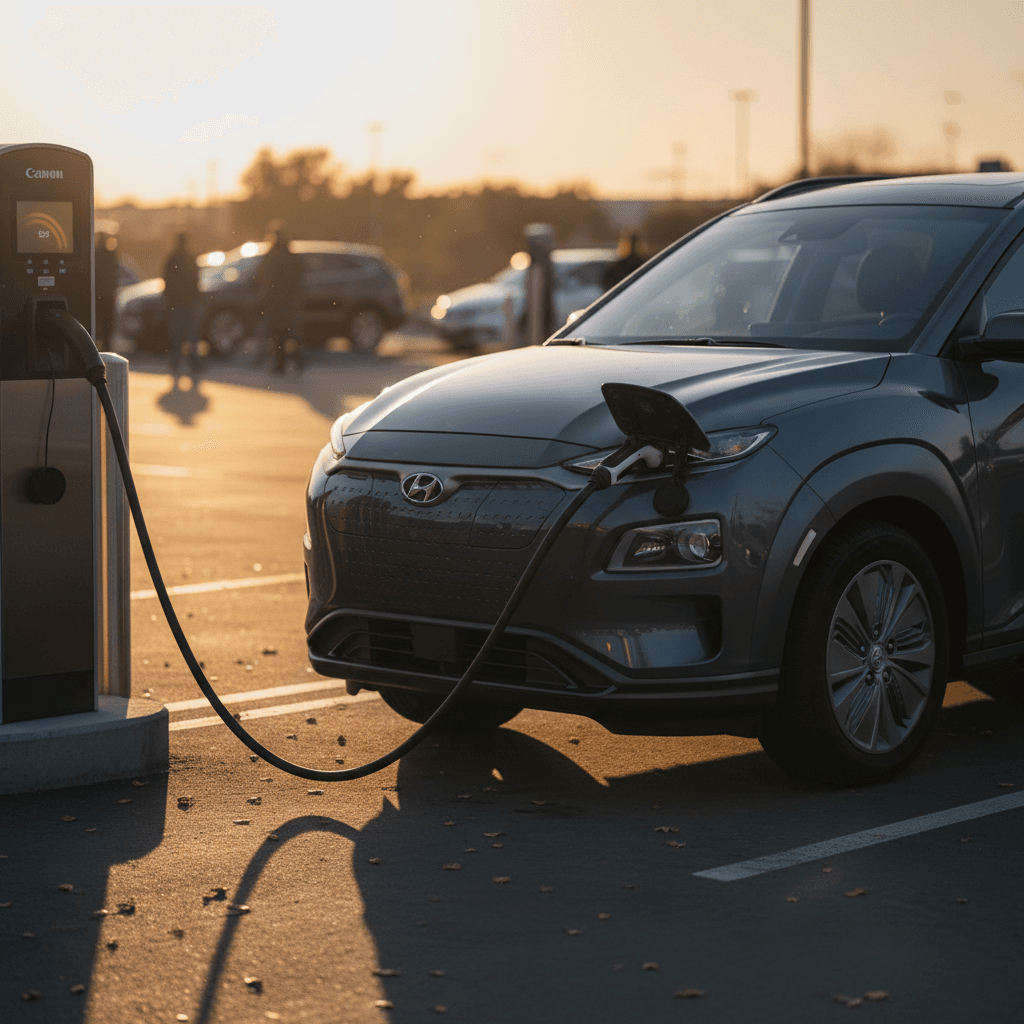
The most useful charging result is a record of how power changes throughout the session. A brief peak can look impressive without showing how quickly power tapers as the battery fills. If you’re unfamiliar with the terminology, kW measures charging power, while kWh measures the amount of energy delivered; our DC fast-charging guide explains the distinction in more detail. For a used Kona Electric, record the charging curve and review battery diagnostics rather than relying on one number.
A speed test is a charging-curve test
A valid speed test shows how the Kona Electric accepts power from a relatively low state of charge until charging power begins to taper. State of charge, often shortened to SoC, is the battery percentage shown by the vehicle. Record the starting SoC, charging power in kW at regular intervals, energy delivered, battery percentage, and any message from the car or charger. This produces a curve you can compare with another session under similar conditions.
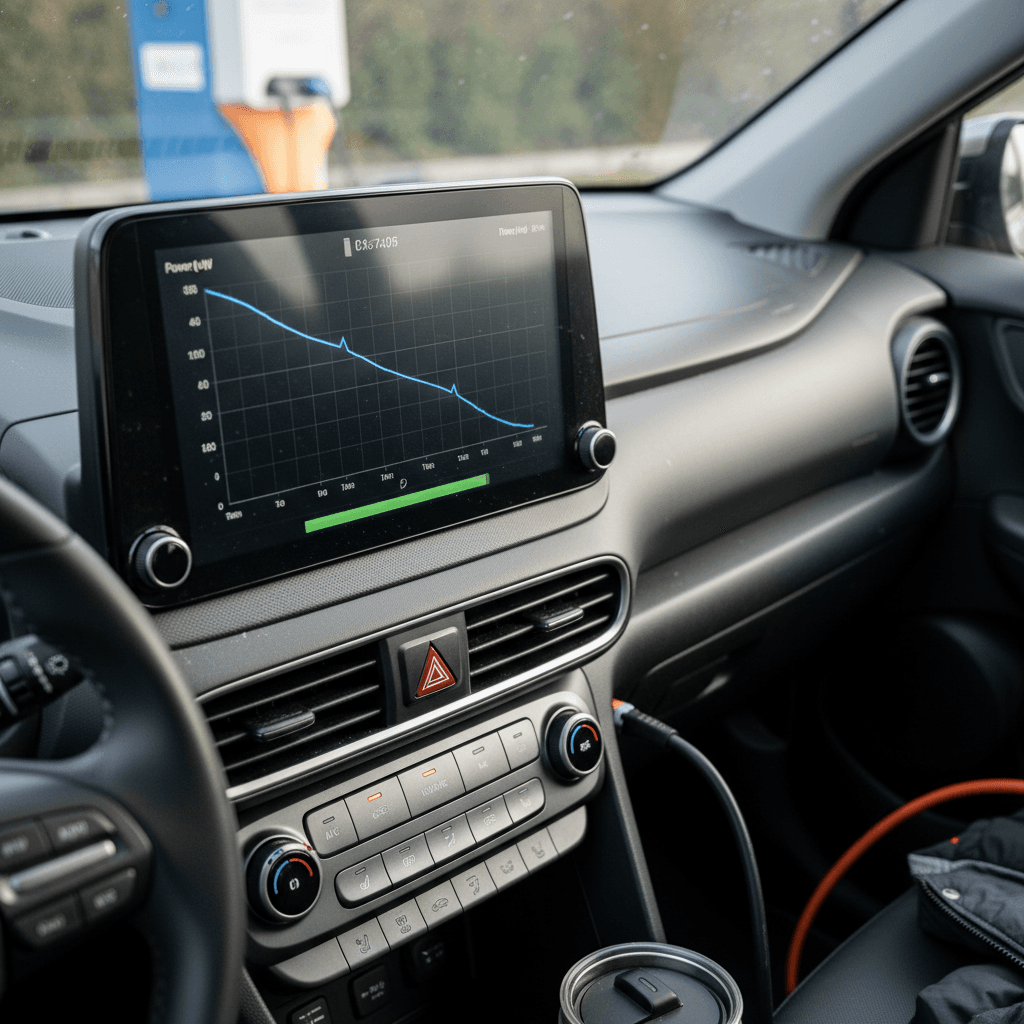
A single peak tells you what happened for one moment. For a useful used-EV evaluation, we want to see whether charging power builds normally, stays reasonably consistent, and tapers without unexplained interruptions.
Which charging session answers your question?
Use a DC fast charger if you want to evaluate road-trip charging performance. A standard household outlet or Level 2 AC charger can confirm that the car accepts a charge, but those sessions don’t reveal its DC fast-charging curve. Each charging method answers a different ownership question.
Charging sessions compared
Choose the session that matches what you need to verify.
| Session | Best for | Measure | Main limitation |
|---|---|---|---|
| Household outlet | Basic charging check | Energy added | Very low power |
| Level 2 AC | Home charging | Time and consistency | Not a DC test |
| DC fast charging | Road-trip performance | Full power curve | Conditions vary |
The charger and vehicle must both support the type of session being tested.
If home charging is your main concern, test the onboard AC charging system separately and review how EV charging levels differ. Don’t use a successful Level 2 session as proof that the DC system will perform the same way, because the car uses different charging hardware and communication paths.
How do you run a repeatable Kona charging test?
A repeatable test controls the starting conditions and documents anything that could limit power. Use a functioning charger capable of supplying more power than the vehicle is requesting, and avoid comparing sessions from different starting percentages as though they were identical. If the vehicle offers battery preparation or preconditioning, note whether it was active rather than assuming it operated automatically.
Kona Electric charging-test checklist
Start at a relatively low charge
Beginning too full can place the battery closer to its normal tapering region and hide earlier behavior.
Record ambient conditions
Note whether the car and battery are likely cold, moderate, or hot after driving and parking.
Identify the charger
Save the station name, connector, displayed power limit, and any power-sharing notice.
Capture regular readings
Photograph or note battery percentage, charging power, elapsed time, and energy delivered throughout the session.
Watch for interruptions
Record disconnects, charging errors, sudden drops, or a session that stops before you request it.
Repeat before diagnosing
If the result looks abnormal, try a known-working charger under comparable conditions before blaming the vehicle.
Separate charger problems from vehicle problems
What Recharged battery data shows
Recharged battery diagnostics show strong tested capacity across the Hyundai Konas in our inspected sample. Among 39 Hyundai Konas, tested remaining capacity averaged 99.7% of original capacity, with a 100% median and a 94.4% minimum. Tested real-world range averaged 263 miles, with results spanning 246 to 324 miles. These figures come from Recharged Score inspections and describe the inspected vehicles, not every Kona Electric on the road.
The takeaway is that the inspected Konas retained high tested capacity, but capacity and charging speed aren’t interchangeable. A battery can store substantial energy while a particular charging session is limited by temperature, state of charge, the station, software, or charging-system behavior. That’s why a used-EV evaluation should combine a charging session with a verified battery-health inspection.
Recharged data
Used Hyundai Kona battery health
100%
avg remaining capacity
From Recharged battery inspections, not manufacturer estimates.
- Lowest
- 94%
- Median
- 100%
- Highest
- 100%
- Est. range
- 263 mi avg
- Cell balance pass
- 100%
- Quick charges
- 11 avg
- Slow charges
- 89 avg
Average cell imbalance: 3.4 mV
Based on vehicles Recharged tested
Recharged data
Used EV prices at Recharged
$30,997
median list price
Current list prices for matching inventory at Recharged.
- Lowest
- $12,996
- Average
- $34,803
- Highest
- $146,998
Average Recharged Score on these listings
4.8 / 5
Range
3.7 – 5.0
Based on available listings
Every EV is battery-tested with a Recharged Score. Nationwide delivery.
Why can two charging tests produce different results?
Two tests can differ because the car and charger rarely begin under identical conditions. Charging power is managed continuously to protect the battery, so a changing rate isn’t automatically evidence of a defect. Before comparing results, check the major variables that can alter the curve.
- Starting battery percentage: A fuller battery may already be near the portion of the session where power tapers.
- Battery temperature: A battery that is too cold or too hot may accept less power until conditions improve.
- Charger capability: The station, cable, or site can limit delivered power independently of the vehicle.
- Power sharing: Some sites divide available power between connected vehicles.
- Recent driving: Highway driving before arrival can leave the battery in a different thermal condition than arriving after a short local trip.
- Vehicle settings or software: Battery preparation, charging limits, and control-system behavior can affect the session.
- Station errors: A poor connector, communication fault, or derated charger can create an abnormal result.
What the test means for a used Kona Electric
For a used Kona Electric, a clean, documented curve matters more than chasing an unsupported peak-power claim. Look for a session that begins normally, increases or settles into a consistent pattern, and then tapers without repeated faults or unexplained stops. Compare only tests with similar starting charge, temperature, and charger capability. Our used Hyundai Kona Electric buying guide covers the other condition and ownership checks that should accompany the charging test.
Don’t diagnose the battery from one slow session
Instant offer, trade-in, or consignment. Pickup available.
Hyundai Kona Electric charging test FAQ
The bottom line
The right way to judge Kona Electric charging speed is to examine the complete, well-documented DC charging curve. Control the starting charge, battery temperature, and charger capability as much as practical, and repeat an abnormal result before drawing a conclusion. For a used vehicle, pair that session with verified battery-health diagnostics so you understand both how much energy the battery can hold and how it accepts a fast charge.