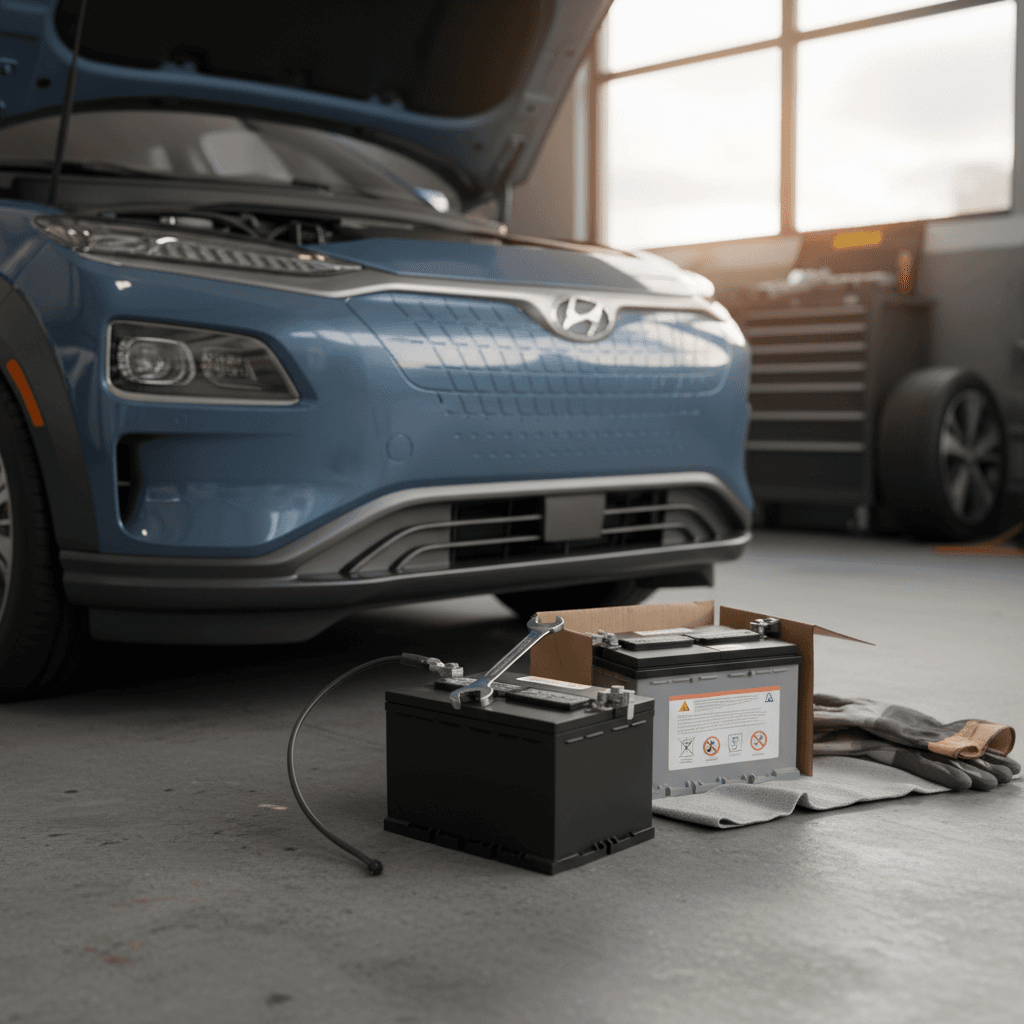
If your Hyundai Kona Electric suddenly refuses to “wake up,” throws random warning lights, or leaves you hunting for jumper cables, the culprit usually isn’t the big high-voltage pack. It’s the humble 12V auxiliary battery. Understanding Hyundai Kona Electric 12V battery replacement, when you need it, which battery to buy, and whether you can do it yourself, can save you a tow bill and a lot of frustration.
Quick reminder
Why the 12V battery matters in your Kona Electric
In your Kona Electric, the big lithium‑ion pack drives the wheels, but the 12V lead‑acid battery runs the show behind the scenes. It powers the car’s computers, unlocks the doors, boots the infotainment, and closes the high‑voltage relays that let the car go into READY mode. If that little battery is weak, the car may not start, even if the main traction battery is nearly full.
What the 12V battery handles
- Boots ECUs, safety systems, and dash displays
- Runs interior and exterior lights, locks, and alarm
- Closes high‑voltage contactors so the car can drive
- Powers accessories when the vehicle is in ACC mode
What it doesn’t do
- It does not move the car, that’s the high‑voltage pack
- It doesn’t affect official driving range ratings
- It won’t be checked by most tire‑and‑oil quick shops
- It’s often overlooked until it fails completely
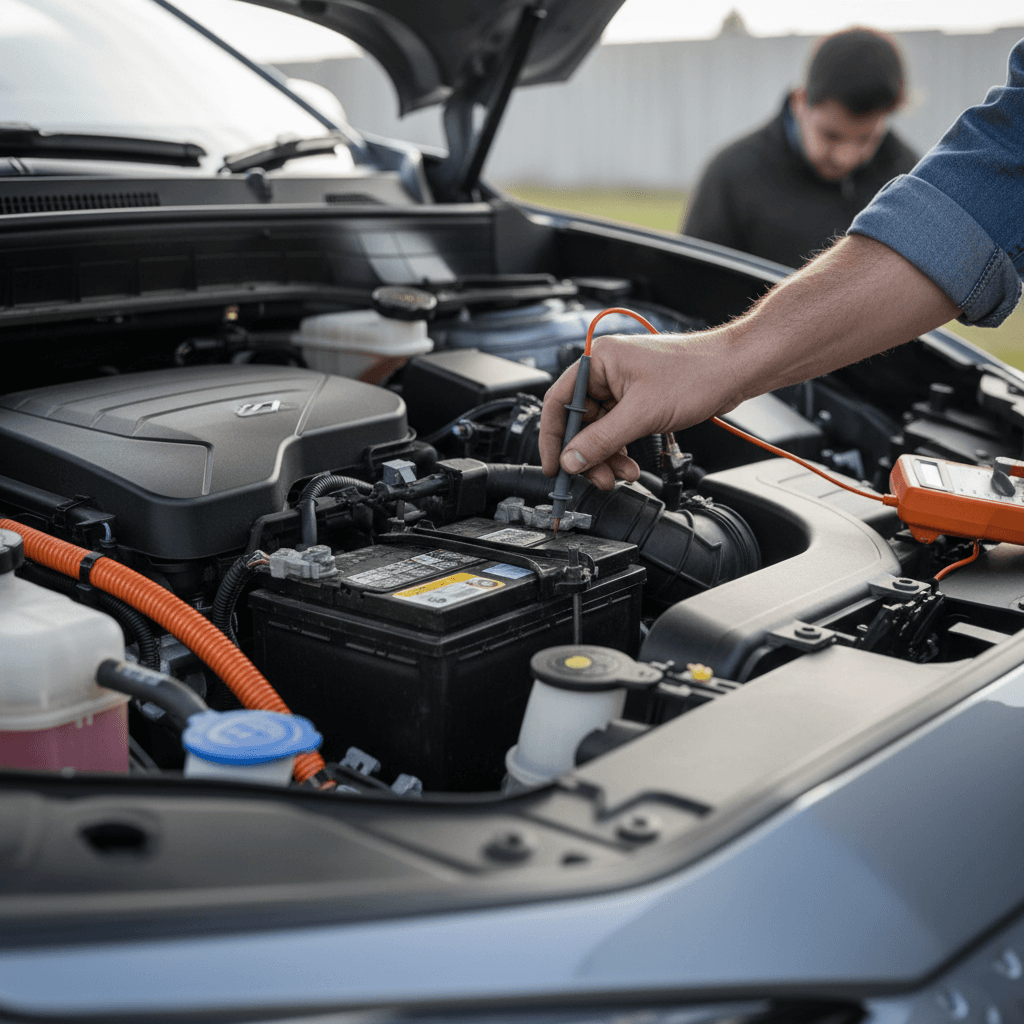
How long does a Kona Electric 12V battery last?
Typical Hyundai Kona Electric 12V battery life
Most owners can expect the factory Hyundai Kona Electric 12V battery to last roughly 3–5 years. Short trips, long parking periods, extreme cold or heat, and lots of accessory use while parked all chip away at that lifespan. Because the big battery quietly tops off the 12V when the car is awake or charging, problems often stay hidden until the 12V battery is already weak enough to cause strange behavior.
Watch the calendar
Signs your Kona Electric 12V battery is failing
The 12V battery rarely fails gracefully. One day everything seems normal, the next morning your Kona EV won’t start. Before that drama, it often whispers a few warnings. Here are the most common dead or dying 12V battery symptoms in a Hyundai Kona Electric:
- Slow or chattering power door locks when you press the fob
- Dim interior lights or the dome light pulsing when you open the door
- Instrument cluster lighting up with multiple random warning messages on startup
- The car refusing to go into READY, even though the main battery shows plenty of range
- Need to jump‑start the car after it has been parked for a few days
- Intermittent glitches in infotainment or Bluetooth that seem to “fix themselves” after driving
Don’t ignore warning lights
Which 12V battery does the Hyundai Kona Electric use?
The Kona Electric uses a conventional 12‑volt lead‑acid battery, located under the hood on the driver side. From the factory it’s typically an AGM or enhanced flooded battery sized similarly to an H5/Group 47 or regional equivalent. Always confirm the exact type and capacity in your owner’s manual or by reading the label on your existing battery.
Choosing the right replacement 12V battery
Match type, size, and specs to keep your Kona Electric happy
Match the size
Look for a battery that matches the OEM physical size and terminal layout (often H5/Group 47 or equivalent). A poor fit can stress cables or prevent the hold‑down from working properly.
Choose AGM when possible
AGM batteries handle EV duty cycles, short trips, and accessory loads better than basic flooded designs. They also resist vibration and deep discharge more gracefully.
Check cold‑cranking amps
The Kona Electric doesn’t crank an engine, but it still needs sufficient cold‑cranking amps (CCA) and reserve capacity to power safety systems in extreme weather. Match or exceed the OEM specs.
Bring your VIN
Step-by-step Hyundai Kona Electric 12V battery replacement
If you’ve ever replaced a 12V battery in a gas car, the Kona Electric won’t scare you, as long as you stay away from the orange high‑voltage cables and follow basic safety rules. Here’s a general DIY overview; always double‑check with your owner’s manual for your specific model year.
DIY Kona Electric 12V battery replacement steps
1. Park safely and power down
Park on a flat surface, engage the parking brake, and switch the car fully OFF. Remove the key or key fob from the cabin so the vehicle doesn’t try to wake up while you’re working.
2. Open the hood and locate the 12V battery
Pull the hood release, secure the hood prop, and find the 12V battery on the driver side. Identify the positive (+, usually red cover) and negative (–) terminals before touching anything.
3. Protect your settings if needed
If you’re worried about losing radio presets or window indexing, you can use a small 12V memory saver in the OBD-II port. It’s optional but helpful, especially on older vehicles.
4. Disconnect the negative terminal first
Using the correct socket, loosen the clamp on the negative (–) terminal and remove it from the post. Tuck it safely aside so it can’t spring back and touch the terminal.
5. Disconnect the positive terminal and hold-down
Remove the positive (+) terminal next, lifting the cover as needed. Then unbolt the battery hold‑down bracket or clamp so the battery can be lifted out.
6. Lift out the old battery carefully
Lead‑acid batteries are heavy. Lift with both hands, keeping the battery upright so no acid can spill. Watch nearby wiring and plastic trim as you maneuver it out.
7. Clean the tray and terminals
Before installing the new battery, clean the battery tray and cable ends. Use a battery terminal brush if there’s corrosion, and wipe away any debris in the tray.
8. Install the new battery
Place the new battery in exactly the same orientation. Reinstall the hold‑down so the battery can’t move. Connect the <strong>positive terminal first</strong>, then the <strong>negative terminal</strong>, and tighten both securely.
High‑voltage safety
After replacement: resets and checks
Once the new 12V battery is in place, your Kona Electric may need a moment to wake up and re‑learn a few things. Here’s what to expect after a 12V battery replacement:
- Clock and radio presets may reset and need to be set again
- One‑touch window auto‑up/auto‑down may need to relearn (cycle each window fully down and up while holding the switch)
- Some warning lights may appear briefly on the first start and then clear themselves
- The car might take a few seconds longer than usual to go into READY the first time after reconnection
Simple health check
Costs, warranties, and when to let a shop handle it
Budget-wise, a Hyundai Kona Electric 12V battery replacement is far from scary. Most owners in the U.S. will see total costs in the same ballpark as a typical compact SUV.
Typical Kona Electric 12V battery replacement costs
Approximate 2025 U.S. pricing; your local market may vary.
| Where | What’s included | Estimated cost |
|---|---|---|
| DIY at home | Battery only (quality AGM, H5/Group 47 equivalent) | $170–$260 |
| Independent shop | Battery + testing + installation | $250–$350 |
| Hyundai dealer | OEM battery + health check + software updates if needed | $300–$450 |
These are ballpark figures for budgeting. Always get a firm quote from your local shop or dealer.
Warranty fine print
If you’re not comfortable working around batteries, or if your Kona Electric is still under warranty and showing strange electrical behavior, it’s smart to let a dealer or EV‑savvy shop handle the job. They can also check for parasitic drains, update software, and verify that nothing else is causing repeated 12V failures.
Preventative care: keeping your new 12V battery healthy
Once you’ve invested in a fresh 12V battery, a few simple habits can stretch its life and reduce your chances of another surprise no‑start.
Simple habits that extend 12V battery life
Little routines that keep your Kona Electric ready to go
Drive or charge regularly
EVs are efficient sleepers, but long stretches parked without driving or charging can slowly drain the 12V. Aim to drive or plug in at least once a week, especially in cold weather.
Avoid heavy accessory use while parked
Running climate control, audio, or lights for long periods while parked and not in READY mode leans on the 12V battery. If you need cabin heat or A/C for a while, put the car into READY so the high‑voltage pack can support the load.
Protect it from temperature extremes
Whenever possible, park in a garage or shaded area. Both extreme cold and extreme heat are hard on 12V batteries and will shorten their life.
Have it tested yearly
Ask for a 12V battery load test during an annual service visit. Catching a weak battery early lets you replace it on your schedule instead of on the side of the road.
Pair it with other maintenance
What this means if you’re shopping for a used Kona Electric
If you’re eyeing a used Hyundai Kona Electric, the 12V battery is one of those tiny details that can have an outsized effect on your first week of ownership. A car can look spotless in photos yet show up on your driveway needing a jump.
Questions to ask the seller
- “Has the 12V battery been replaced? If so, when?”
- “Any recent issues with warning lights or no‑start situations?”
- “How often does the car sit for more than a week without being driven?”
How Recharged helps
When you shop for a used EV through Recharged, every vehicle comes with a Recharged Score Report that looks well beyond the odometer. We verify battery health, review fault codes, and flag electrical issues that could hint at 12V problems or parasitic drains, so you know what you’re buying before it arrives at your door.
Stress‑free EV ownership
Ready to find your next EV?
Browse VehiclesHyundai Kona Electric 12V battery FAQ
Common Hyundai Kona Electric 12V battery questions
Key takeaways for Kona Electric owners
In the world of EVs, the Hyundai Kona Electric 12V battery is small but mighty. When it gets tired, your car can feel broken even though the big battery is just fine. Plan on a 3–5‑year lifespan, watch for early warning signs, and don’t be afraid to replace the 12V battery proactively, whether you tackle it yourself or let a shop handle it. And if you’re stepping into Kona Electric ownership with a used model, partners like Recharged can help you read between the lines of both the high‑voltage pack and the modest little 12‑volt that keeps the whole show running.