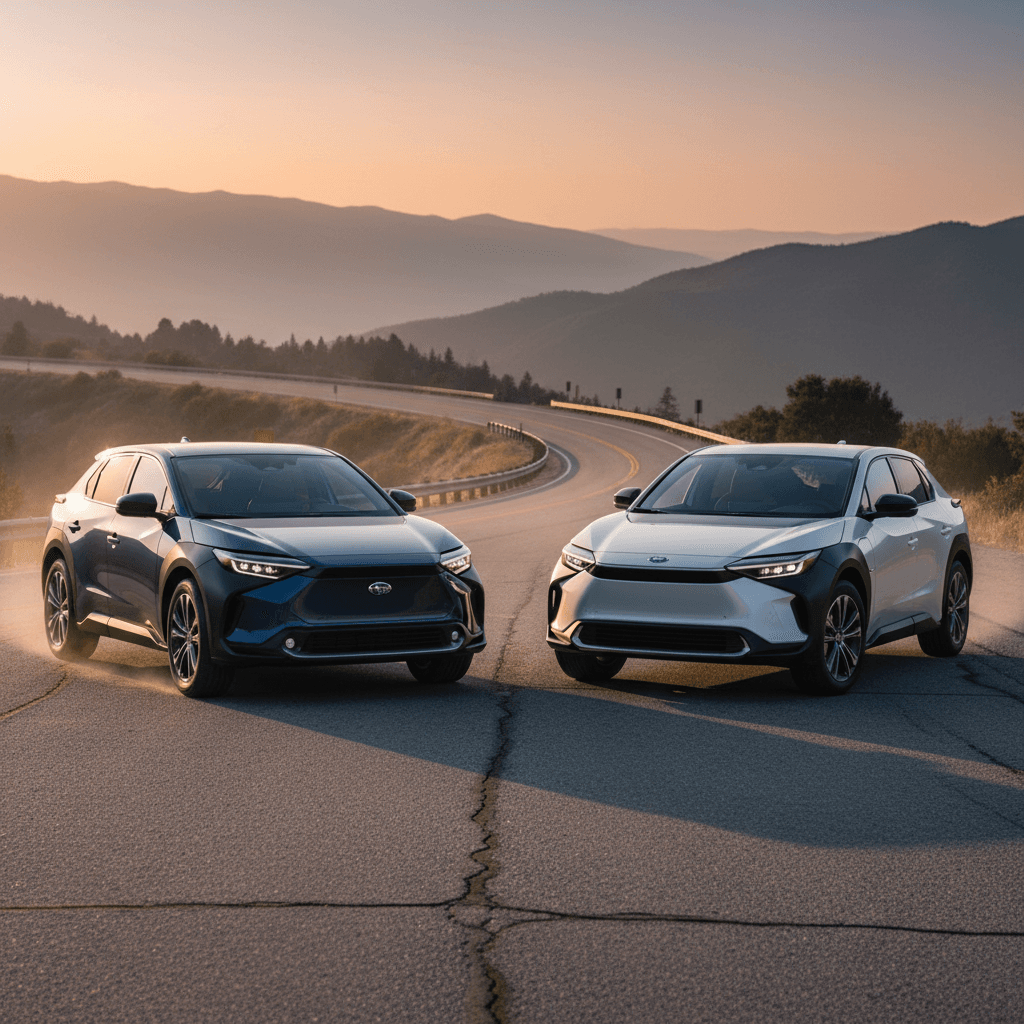
Shopping the Toyota bZ4X vs Subaru Solterra quickly reveals how closely related these compact electric SUVs are. They share a platform, battery size, and even some software, but they don’t feel identical to live with. If you’re trying to decide which one belongs in your driveway, the details matter.
Same bones, different personalities
Overview: Toyota bZ4X vs Subaru Solterra
At a high level, the Toyota bZ4X skews toward efficiency and on-road comfort, with front-wheel drive (FWD) available and typically a slightly lower price. The Subaru Solterra leans into standard all-wheel drive (AWD), ground clearance, and traction modes that fit Subaru’s outdoorsy image. Both seat five, both use a roughly 72–75 kWh battery in recent model years, and both now benefit from hardware and software updates that improve range and DC fast charging.
Key numbers at a glance (recent model years)
Model-year nuances matter
Quick specs: bZ4X vs Solterra
Core spec comparison (typical U.S. trims, recent model years)
Approximate specs for mainstream trims; exact figures vary slightly by model year, wheel size, and equipment.
| Spec | Toyota bZ4X | Subaru Solterra |
|---|---|---|
| Drivetrain | FWD or AWD | Standard AWD |
| Horsepower | ~201 hp FWD / ~214–230+ hp AWD (earlier U.S. models; higher on newer updates) | ~215–230+ hp dual-motor AWD (higher on newest updates) |
| Battery capacity | ~71–73 kWh gross (later packs up to ~73 kWh) | ~72.8–74.7 kWh gross |
| EPA range (typical early AWD) | ~228 mi AWD, up to ~252 mi FWD | ~222–227 mi AWD (later updates closer to high-280s) |
| Ground clearance | ≈8.1 in | ≈8.3 in |
| DC fast charge peak | Up to ~150 kW | Up to ~150 kW (notably improved in 2024+ for cold weather) |
| On-board AC charger | 6.6 kW early; 11–22 kW on some later global trims | ~6.6 kW early; charging and conditioning improved on 2024+ models |
| Seating | 5 | 5 |
Use this as a directional guide; confirm final specs for the exact car you’re looking at, especially in the used market.
How to read these specs
Pricing, trims and value
On paper, pricing is very close. In recent model years, the bZ4X typically undercuts the Solterra by around a thousand dollars at MSRP, especially at the base trim level. Toyota offers multiple trims (XLE, Limited, Nightshade and others depending on year), with FWD on lower trims and AWD as an option or standard on higher ones. Subaru positions the Solterra as a fully AWD lineup, with Premium, Limited, Touring, and special appearance packages like the Onyx Edition.
How pricing and value really compare
It’s less about sticker price, more about what you care about day-to-day.
Toyota bZ4X: Slightly cheaper, more configurations
If you want the lowest possible entry price or prefer front-wheel drive, the bZ4X usually wins on upfront cost. Toyota also runs more frequent incentives in many U.S. markets, especially on remaining inventory or leases.
On the used side, this translates into a wider range of prices and specs. You’ll see more variation in range and options, but also more opportunities to find a deal that matches your budget.
Subaru Solterra: Standard AWD value
The Solterra may sticker a bit higher, but you’re buying standard dual-motor AWD, Subaru’s X-MODE off-road software, and that extra smidge of ground clearance. For buyers who’d spec an AWD bZ4X anyway, the real-world price gap often narrows.
On the used market, Solterras will frequently be better equipped for snowbelt or outdoors-oriented buyers without having to hunt for a specific option package.
Where incentives and used pricing help you
Ready to find your next EV?
Browse VehiclesRange, battery and charging
Because Toyota and Subaru co-developed the battery and power electronics, the broad strokes are similar: a pack in the low-to-mid 70 kWh range, reasonably efficient motors, and DC fast charging that targets roughly 10–80% in about half an hour on a capable public charger. Where they’ve diverged is in how quickly they improved cold-weather charging and how aggressive they’ve been with software updates.
Real-world range
- Toyota bZ4X: Earlier FWD models were rated around the low-250-mile mark, with AWD trims in the high-220s. Owners and testers have often reported winter range substantially below the sticker number, especially on highway-heavy driving.
- Subaru Solterra: Early AWD ratings around 222–227 miles were modest, but updates to battery conditioning and software for 2024+ model years noticeably improve usable range and especially cold-weather behavior.
Both are fine for typical daily driving and modest road trips if you’re willing to plan charging stops, but neither is a long-range champion in the EV world.
Charging behavior
- DC fast charging: Both top out around 150 kW on paper, but the charging curve, how long they hold higher power, matters more. Later Solterras, in particular, gained better thermal management that cuts fast-charge times roughly in half versus the earliest cars.
- AC (Level 2) charging: Early examples of both use a 6.6 kW onboard charger, which means a full charge at home can take 9–11 hours on a 240 V Level 2. Newer global bZ4X variants add 11–22 kW onboard chargers, but U.S.-spec updates lag a bit; check the specific car’s equipment list.
For U.S. daily use, assume an overnight Level 2 session will comfortably take you from low state-of-charge to full on either model.
Supercharger access and NACS
Checklist: Range and charging questions to ask before you buy
1. What’s the exact model year and drivetrain?
Range and charging improvements have arrived in waves. A later-model Solterra or bZ4X with improved conditioning may be worth a small price premium over a launch-year car, especially in cold climates.
2. How do you actually drive?
If you do mostly city and suburban miles with home charging, both are easily workable. If you live in a cold region, do frequent 75+ mph highway runs or tow, you’ll want to dig deeper into real-world owner reports.
3. Home charging setup
Plan on installing a 240 V Level 2 charger if you can. That makes the modest onboard AC chargers far less of an issue, both can be fully recharged overnight.
4. Public charging network access
Look at CCS coverage where you live and where you road-trip, and factor in the pace of NACS/Supercharger access. A car that works brilliantly in California might feel constrained in a rural CCS desert today.
Performance, AWD and driving feel
The core hardware story is simple: bZ4X gives you a choice of FWD or AWD, while Solterra is AWD-only. But beneath that, tuning differences give each its own character. Toyota skews toward on-road comfort and light steering; Subaru aims for confidence on loose surfaces with its Symmetrical AWD branding and X-MODE software.
How they drive: on-road and off
Same platform, different personalities from the driver’s seat.
Toyota bZ4X: Quiet and easygoing
The bZ4X is tuned to feel approachable: light steering, smooth ride, and a cabin that stays reasonably quiet. FWD versions are perfectly adequate for most climates and will feel familiar to Toyota hybrid owners trading up to an EV.
Acceleration is brisk enough for daily use, especially in dual-motor trims, but Toyota isn’t chasing performance halo numbers here.
Subaru Solterra: Confident in the rough
With standard dual-motor AWD, 8.3 inches of ground clearance, and Subaru’s X-MODE and Grip Control systems, the Solterra can handle light trails, snow, and muddy trailheads with more confidence than most EV crossovers.
If you already love what a Crosstrek or Forester can do off pavement, the Solterra will feel like a familiar, electric extension of that formula.
Updated powertrains: quietly getting quicker
Both models are seeing incremental power bumps and improved eAxles over the 2024–2026 timeframe, with some trims pushing well beyond the original ~215 hp ballpark. The newest variants can feel legitimately quick, not just "EV adequate."
In the used market, though, most examples you’ll see today are still in that 200–230 hp window, plenty for daily duty, but not performance EV territory.
Snowbelt and dirt-road shoppers
Interior space, tech and comfort
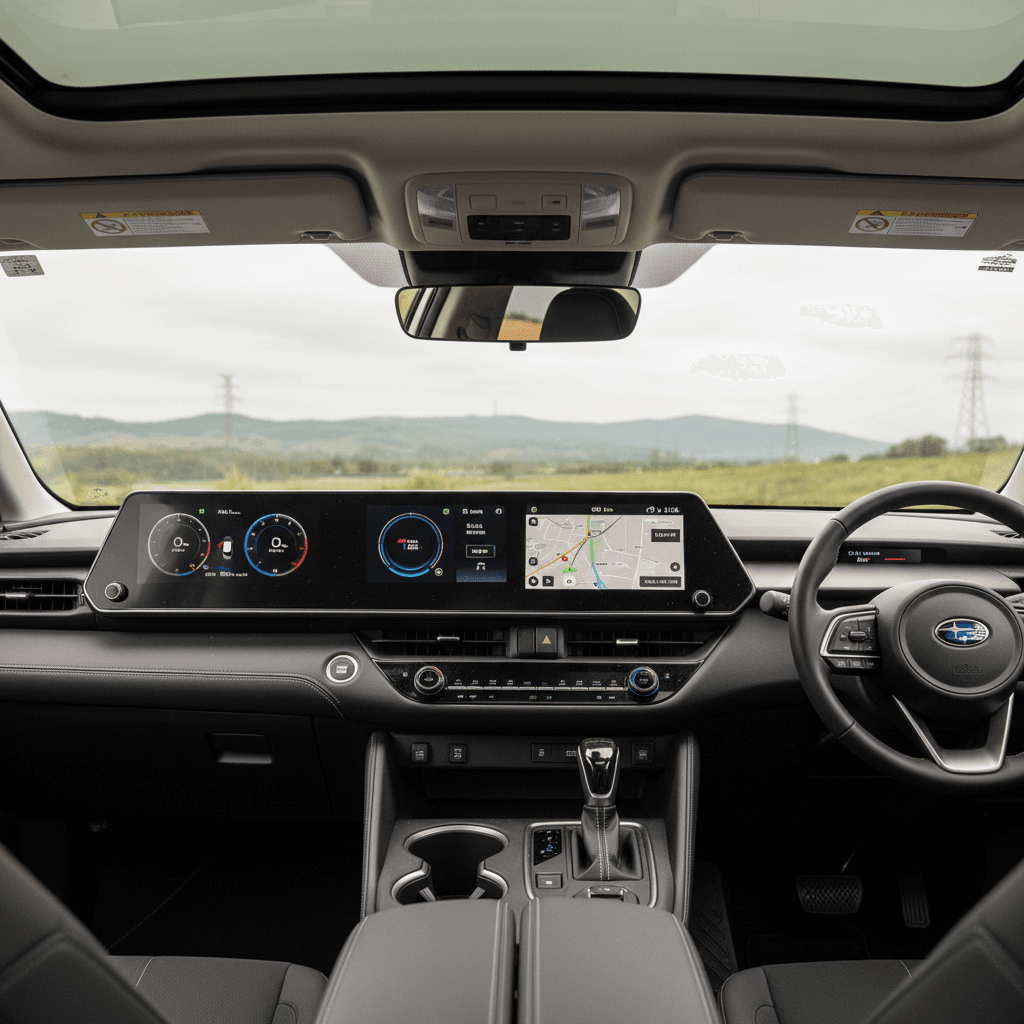
Inside, the family resemblance is obvious: similar dash layout, similar seating position, and a blend of physical controls with touchscreens. The further you look, though, the more the brands’ priorities stand out. Toyota leans into its latest multimedia system with large central screens, while Subaru layers on EyeSight driver assist tech and, in newer model years, a larger infotainment display and expanded safety features.
Space and practicality
- Passenger room: Both comfortably seat four adults; a fifth in the middle rear seat is fine for short trips. Headroom and legroom are competitive with other compact crossovers.
- Cargo: You’re looking at a compact-SUV cargo hold, not a three-row hauler. Both bZ4X and Solterra offer fold-flat rear seats and enough space for family errands, luggage, or camping gear.
- Cabin vibe: Toyota skews a bit more urban and tech-forward; Subaru retains some of its rugged charm in materials and color choices.
Infotainment and driver aids
- Toyota: Newer bZ4X models get Toyota’s latest multimedia system with strong smartphone integration, over-the-air updates, and available larger touchscreens.
- Subaru: Solterra leans heavily on EyeSight driver-assist tech, with ongoing additions like Traffic Jam Assist and more advanced lane-keeping and monitoring features on later model years.
- Shared quirks: Both cars have slightly unconventional gauge-cluster placement that some drivers love and others never quite warm up to. Always test-drive long enough to see if the ergonomics work for you.
Comfort test before you commit
Safety, reliability and recalls
Toyota and Subaru both have long-standing reputations for durability and conservative engineering, and that carries over into their first mass-market EVs. At the same time, early EVs inevitably hit a few snags, and the bZ4X/Solterra twins are no exception.
What to know about safety, recalls and long-term confidence
The most important facts if you’re buying used.
Active safety features
Both models come loaded with modern driver-assistance tech: adaptive cruise control, lane-keeping assist, automatic emergency braking, and more. Later Solterra model years add Traffic Jam Assist, enhanced lane-change support, and additional monitoring features.
These systems are great when they work well, but they also add complexity. Test every function you care about during your test drive.
HVAC / visibility recall
Recent years have seen a recall covering HVAC control software in certain 2023–2025 bZ4X and Solterra models. In affected vehicles, the system can enter a failsafe mode that reduces or eliminates heating and defrost capability, which is a real safety concern in cold climates.
If you’re shopping used, confirm that all recall work has been completed. A dealer can verify this by VIN, and shops perform software fixes at no cost to the owner.
Cold-climate buyers: Do extra homework
Which EV SUV fits your lifestyle?
Toyota bZ4X vs Subaru Solterra: Best fit by buyer type
Urban commuters and first-time EV buyers
You value easy driving manners, a smooth ride, and strong dealer coverage in metro areas.
You’re okay with FWD if it saves you money and improves efficiency.
You want a familiar Toyota ownership experience and potentially lower entry pricing on the used market.
Best fit: <strong>Toyota bZ4X</strong>, especially FWD trims with solid range.
Snowbelt families and outdoor enthusiasts
You routinely drive in snow, slush, or on unpaved roads.
You care more about confident traction and clearance than squeezing out every last mile of range.
You already like Subaru’s brand image and want EyeSight and X-MODE baked in.
Best fit: <strong>Subaru Solterra</strong>, thanks to standard dual-motor AWD and well-tuned traction modes.
Tech-forward drivers and frequent road-trippers
You’re sensitive to charging speeds and want the best possible access to DC fast-charging networks.
You plan to keep the car into the NACS/Tesla Supercharger era and care about adapter support.
You’re flexible between brands and just want the most up-to-date hardware and software you can afford.
Best fit: Whichever model offers the <strong>newest model year</strong>, strongest software update story, and clear NACS path in your price range.
Value hunters in the used market
You’re shopping based on payment and total cost of ownership, not just brand loyalty.
You’re willing to trade some range or options for a lower purchase price, if battery health is verified.
You like the idea of letting someone else take the steepest first-year depreciation hit.
Best fit: Whichever of the two you find as a <strong>well-priced, well-documented used EV</strong> with a clean battery-health report. That’s where Recharged can tilt the scales.
How Recharged simplifies the choice
Buying a used Toyota bZ4X or Subaru Solterra
Because these EVs launched in the 2022–2023 timeframe, the used market is just starting to get interesting. Early lease returns and trade-ins mean you can now find bZ4X and Solterra examples with several years of battery warranty coverage left, often at a meaningful discount to new.
Used bZ4X / Solterra checklist
1. Battery health and warranty
Both models typically carry 8-year/100,000-mile battery warranties from new. Ask for a recent battery health diagnostic, at Recharged, this is built into the Recharged Score, so you’re not guessing about degradation.
2. Recall and software history
Confirm that recall work, especially HVAC and charging-related updates, has been completed. A car with all campaigns closed and up-to-date software is worth more than one that still needs a trip to the dealer.
3. Charging behavior in real life
If possible, fast-charge the car during your evaluation, or at least review data from previous fast charges. You’re looking for consistent charging performance and no surprise throttling that points to thermal or software issues.
4. Tires, brakes and underbody
AWD EVs are heavy and can be hard on tires and suspension components if driven off-road. Inspect for uneven tire wear, curb rash, and any signs of underbody damage, especially on Solterras that have seen trail use.
5. Interior wear and feature function
Cycle through all infotainment, driver-assist, and HVAC functions. Make sure seat heaters, cameras, parking sensors, and apps behave as expected. A glitchy user experience can sour ownership even if the drivetrain is rock-solid.
6. Total cost of ownership
Look beyond the sticker. Factor in insurance, home-charging installation, any remaining tax incentives for used EVs, and the fuel savings versus your current vehicle. For many households, a used bZ4X or Solterra will be cheaper to run than a comparable gas SUV.
FAQ: Toyota bZ4X vs Subaru Solterra
Frequently asked questions
Bottom line: How to choose with confidence
When you put the Toyota bZ4X vs Subaru Solterra side by side, the right answer isn’t hiding in a spec sheet. If you’re drawn to Toyota’s brand, want the lowest possible price, or prefer FWD with good range, the bZ4X is an easy recommendation. If you live in the snowbelt, spend time on rough roads, or just want standard AWD that feels truly dialed in, the Solterra is the more natural fit.
Whichever way you lean, remember that model year, software updates, and battery health matter just as much as badges. That’s exactly why Recharged exists: to give you transparent diagnostics, fair-market pricing, financing, trade-in options, and specialist guidance on used EVs, all in one digital experience. Take the time to define your needs, confirm the details on any individual car, and you’ll end up with an electric SUV that genuinely works for your life, not just on paper, but every day you drive it.