If you’re looking at a Hyundai Ioniq 5 today, you’re probably wondering how its value will hold up over the next few years. The Hyundai Ioniq 5 depreciation curve over 5 years looks very different from a traditional gas crossover, and even from some rival EVs. Understanding that curve before you buy (or sell) can save you thousands of dollars.
Quick context
Hyundai Ioniq 5 5‑year depreciation at a glance
Ioniq 5 depreciation snapshot (2025 market)
Those are directional ranges, not a guarantee. Actual Hyundai Ioniq 5 depreciation over 5 years will depend heavily on trim, mileage, condition, incentives at time of sale, and local demand. But they give you a realistic ballpark to plan around.
How fast does the Hyundai Ioniq 5 depreciate?
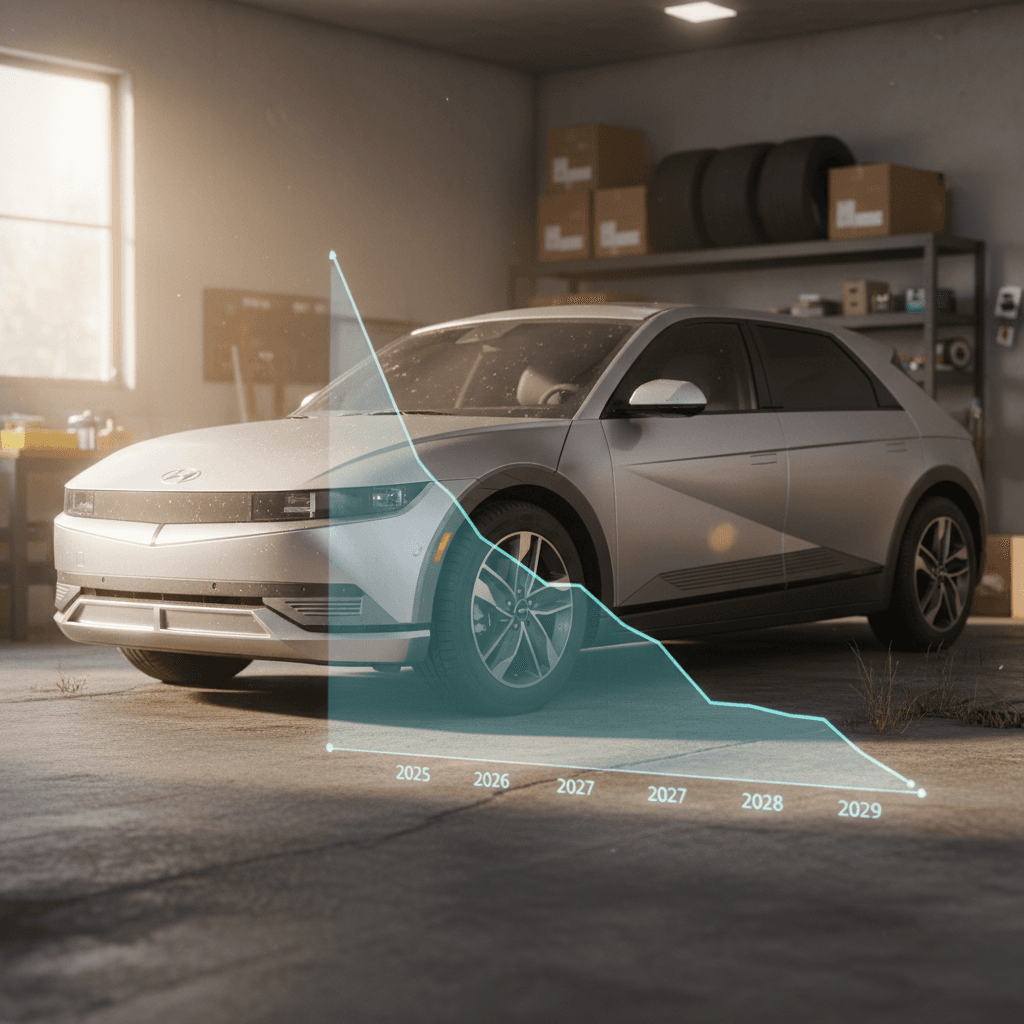
We now have enough real‑world data from early 2022–2023 Hyundai Ioniq 5s showing up on the used market to sketch a credible depreciation curve. Broadly, the Ioniq 5 follows a front‑loaded depreciation pattern, you lose the most money early, then the curve flattens.
- Years 0–1: Initial hit as soon as you drive off the lot and early incentives get priced in. Expect something like 15–20% off MSRP for a “nearly new” Ioniq 5 with low miles.
- Years 1–3: The steepest part of the curve. As more used inventory arrives and tech moves quickly, total depreciation commonly reaches the mid‑30s to low‑40s percent range by year three.
- Years 3–5: The curve starts to flatten. By year five, total depreciation of around 55–60% is typical for modern EVs, and the Ioniq 5 appears to land right around that mark.
Watch the “EV discount” effect
Hyundai Ioniq 5 depreciation vs other EVs
Ioniq 5 vs average EV
Recent large‑scale studies of 5‑year‑old vehicles in the U.S. show:
- All EVs: around 58–59% average depreciation after 5 years.
- All vehicles (gas, hybrid, EV): around 45–46% average.
The Ioniq 5’s estimated 5‑year loss of roughly 59% puts it almost exactly on the EV segment average. In other words, it’s not the bargain of the century on depreciation, but it’s also not the disaster some early‑EV horror stories might suggest.
Ioniq 5 vs Tesla Model Y
One of the most useful benchmarks is the Tesla Model Y, because both are popular, family‑friendly electric crossovers. An iSeeCars comparison pegs 5‑year depreciation at about:
- Hyundai Ioniq 5: ~59.1% loss after 5 years.
- Tesla Model Y: ~60.8% loss after 5 years.
That’s effectively a wash. The Tesla’s brand strength is offset by aggressive price cuts and rapid product evolution, while the Hyundai benefits from strong real‑world efficiency, a smart interior, and mainstream appeal.
Good news for Ioniq 5 shoppers
What’s driving Ioniq 5 depreciation in 2025
To understand the Hyundai Ioniq 5 depreciation curve over 5 years, you have to look beyond the vehicle itself. Macro EV headwinds are doing as much work here as anything Hyundai built.
Key forces pushing Ioniq 5 values down
Most apply to all modern EVs, not just Hyundai
Falling new‑EV prices
Price cuts from Tesla, Hyundai, and others, plus factory incentives, pull used values down. When a new Ioniq 5 is heavily discounted, yesterday’s used prices suddenly look too high.
Rapid tech turnover
Updates to range, charging speed, driver‑assist tech, and infotainment come quickly in EVs. A 3‑year‑old Ioniq 5 can feel older than a 3‑year‑old gas SUV.
Charging standard shift (NACS)
From 2025, new Ioniq 5s adopt the Tesla NACS port, improving fast‑charging access. Earlier CCS‑only cars may see a pricing gap until adapters are cheap and ubiquitous.
Incentives & tax credits
Federal and state EV incentives effectively reduce the real transaction price of new cars. Used buyers often demand a discount that reflects those savings.
Inventory & lease returns
As early leases and fleet Ioniq 5s return to market, dealers in some regions are long on EV crossovers. Oversupply forces wholesale and retail prices down.
Battery & reliability perceptions
Even though the Ioniq 5’s battery and drivetrain have held up well so far, lingering consumer anxiety about long‑term EV batteries keeps some used‑car shoppers cautious, which suppresses bids.
Use headwinds to your advantage
A sample 5‑year Hyundai Ioniq 5 depreciation curve
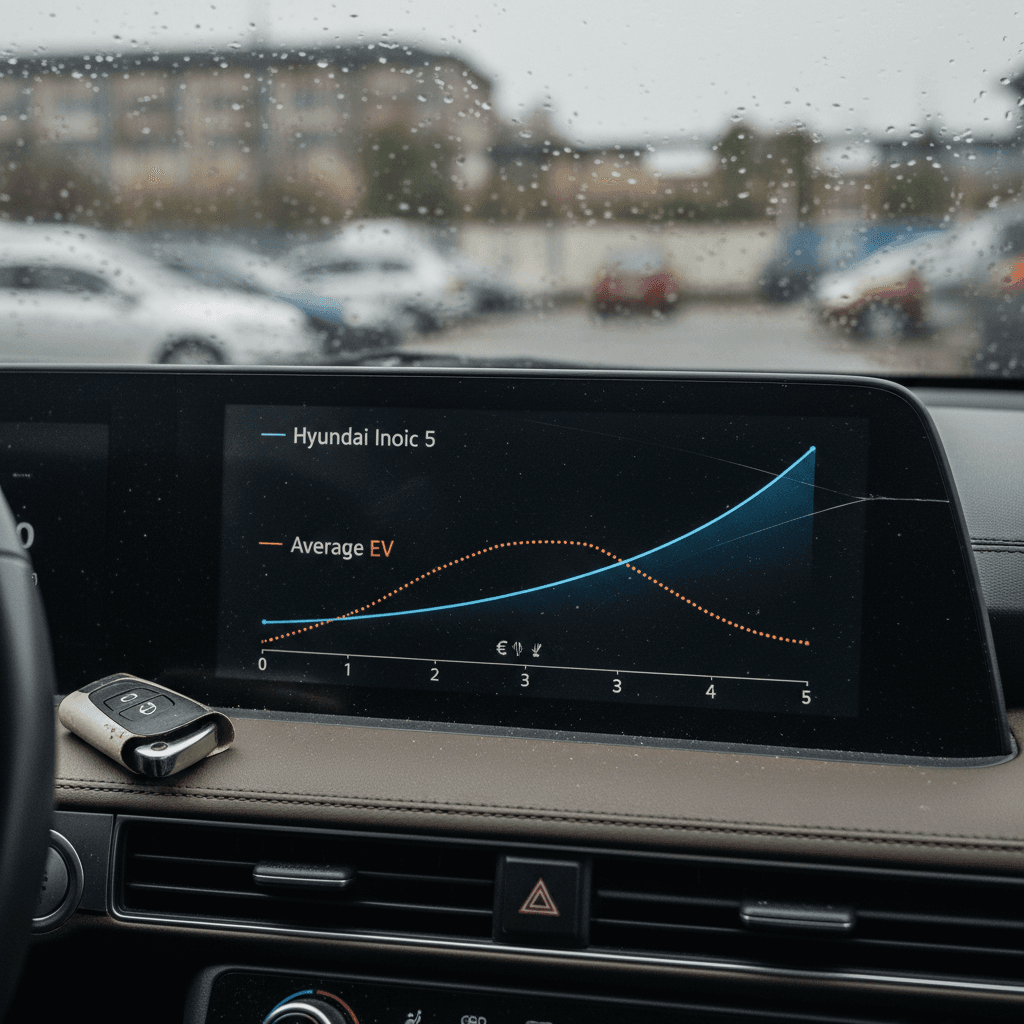
Let’s walk through a realistic, but simplified, Hyundai Ioniq 5 depreciation curve over 5 years using today’s market data. To keep it concrete, assume:
- Original MSRP: $45,000 (well‑equipped mid‑trim AWD)
- Typical U.S. annual mileage: 12,000 miles
- Normal wear, no accidents, full maintenance records
Illustrative 5‑year Hyundai Ioniq 5 depreciation curve
Approximate private‑party values in a balanced U.S. market, assuming normal mileage and condition.
| Age | Odometer | Est. value | % of original MSRP | Total depreciation |
|---|---|---|---|---|
| Brand‑new | 0 miles | $45,000 | 100% | 0% |
| Year 1 | 12,000 mi | $36,000 | 80% | 20% |
| Year 2 | 24,000 mi | $30,000 | 67% | 33% |
| Year 3 | 36,000 mi | $25,000 | 56% | 44% |
| Year 4 | 48,000 mi | $21,000 | 47% | 53% |
| Year 5 | 60,000 mi | $18,000 | 40% | 60% |
These are directional, educational estimates, not valuation offers. Always check live market pricing before buying or selling.
Notice how years 1–3 account for most of the value loss. By year five, depreciation has largely “done its thing,” and the curve flattens. If you buy a 3‑year‑old Ioniq 5 at roughly 55–60% of original MSRP, you’re skipping the nastiest part of the curve and stepping into a more predictable ownership cost.
Don’t treat this as a quote
How trim, model year, and mileage change the curve
Not all Ioniq 5s depreciate equally. Within the same model, different trims and usage patterns can put you on very different parts of the curve.
Factors that bend your Ioniq 5’s depreciation curve
Three big levers you actually control
Trim & options
Top‑trim Limited models with every option take a bigger absolute dollar hit than a base SE. When buying new, be honest about which features you’ll truly use, high‑end options often don’t retain their full cost on resale.
Model year & refresh
The 2025 Ioniq 5 brings incremental improvements and a switch to the Tesla NACS port. Earlier model years may see a slightly steeper curve until the market normalizes around adapter availability and cross‑compatibility.
Mileage & use pattern
High mileage compresses values. A 5‑year‑old Ioniq 5 with 90,000 miles will likely sit well below our sample curve, while a garage‑kept 5‑year‑old with 35,000 miles could outperform it.
How Recharged handles these differences
Leasing vs buying an Ioniq 5 when depreciation is high
Because the Hyundai Ioniq 5 depreciation curve over 5 years is both steep and somewhat unpredictable, the lease‑versus‑buy decision matters more than it would on a mature gas model.
When leasing can make sense
- Uncertain tech and policy: If you’re worried about new incentives, battery chemistry shifts, or charging‑standard changes, a 2–3‑year lease lets Hyundai’s captive finance company absorb the residual‑value risk.
- High incentive passthrough: In some periods, Hyundai’s lease programs have effectively funneled federal EV tax credits into subvented lease rates and attractive residuals, making the lease cheaper than expected depreciation.
- Short ownership horizon: If you know you’ll want the latest tech every 2–3 years, leasing is often a cleaner way to budget for that churn.
When buying (especially used) is smarter
- Buying after the big drop: Pick up a 2–3‑year‑old Ioniq 5 that’s already down 40–45%, and your remaining 2–5‑year depreciation exposure could be modest in dollar terms.
- Driving more than lease limits: If you routinely exceed 12,000–15,000 miles per year, lease over‑miles and wear charges can effectively recreate steep depreciation.
- Long‑term keeper: If you’re happy to drive the Ioniq 5 for 7–10 years, the 5‑year curve matters less than total cost of ownership, energy savings, and maintenance simplicity.
Think in total cost, not just resale
How to protect your Hyundai Ioniq 5’s resale value
Seven practical ways to keep your Ioniq 5 above the curve
1. Keep battery health front and center
Avoid regularly charging to 100% or running the pack to 0%. Use scheduled charging, favor 20–80% for daily use, and log DC fast‑charging history. A documented, healthy battery is one of the strongest resale arguments you have.
2. Maintain and document everything
Follow Hyundai’s maintenance schedule and keep receipts. For EVs, perception matters, well‑documented service reassures the next buyer that you’ve taken care of the car.
3. Avoid accidents and visible damage
Minor fender‑benders still show up on history reports and hammer EV values. Park carefully, fix cosmetic damage properly, and avoid cheap repairs that show in photos.
4. Price realistically for incentives
Remember that new Ioniq 5 buyers may be getting tax credits and discounts. When you sell used, buyers will expect some share of that value. Benchmark against current dealer and online‑marketplace pricing, not just what you owe.
5. Highlight charging flexibility
If your Ioniq 5 can use Tesla’s Supercharger network via NACS or an adapter, call that out in your listing. Fast‑charging access is a big value driver for used‑EV shoppers.
6. Present the car professionally
Quality photos, a clean interior, and a straightforward, honest description can easily swing $1,000 or more in the final sale price. Treat your listing like a product page, not a classified ad.
7. Consider selling through an EV‑specialist marketplace
Platforms that understand EVs, like Recharged, can surface your Ioniq 5 to buyers who care about battery health, fast‑charging, and software updates, rather than just chasing the lowest price.
Why buying a used Ioniq 5 can be a smart play
If you’re shopping instead of selling, much of this Hyundai Ioniq 5 5‑year depreciation discussion flips from “problem” to “opportunity.” Someone else already rode the steepest part of the curve; you get to buy what’s left.
The math on a 3‑year‑old Ioniq 5
Take that earlier $45,000 example. If a 3‑year‑old Ioniq 5 is trading closer to $25,000:
- You’re paying roughly 55% of original MSRP for a vehicle that still has modern range, charging speed, and safety tech.
- If it loses another $7,000 over the next four years, your effective depreciation cost is less than $2,000 per year, often less than leasing new.
- Pair that with low energy and maintenance costs, and your total cost of ownership can look very compelling.
Where Recharged fits in
Recharged is built specifically around the used‑EV equation:
- Every Ioniq 5 comes with a Recharged Score Report that verifies battery health and helps explain expected future range.
- Pricing is benchmarked against nationwide market data, so you see how a given car’s mileage, trim, and condition stack up.
- You can finance, trade‑in, or get nationwide delivery in a fully digital experience, or visit our Richmond, VA Experience Center if you want to see and drive in person.
The result: you’re not guessing where on the depreciation curve a particular Ioniq 5 sits, you can actually see it.
Frequently asked questions about Ioniq 5 depreciation
Hyundai Ioniq 5 depreciation FAQs
Bottom line: Is the Hyundai Ioniq 5 a good 5‑year bet?
Looked at purely through the lens of the Hyundai Ioniq 5 depreciation curve over 5 years, the Ioniq 5 is an average modern EV: it loses more value than a typical gas SUV, but tracks closely with segment peers and the Tesla Model Y. Where it distinguishes itself is in how much real‑world capability, fast charging, usable range, roomy interior, you still get after the big depreciation hit is over.
If you buy new and trade quickly, that front‑loaded curve will sting. If you buy a well‑vetted used Ioniq 5 that’s already down 40–50% from MSRP, you’re stepping into a spacious, efficient, future‑proofed EV at a price point that rivals many compact gas crossovers. With the right shopping strategy, and transparent tools like the Recharged Score Report to quantify battery health and pricing, you can make the Ioniq 5 a very solid 5‑year ownership play.