Parking your electric car for weeks or months isn’t like tossing an old lawn mower in the shed. Lithium batteries have long memories, and if you get long-term storage wrong, you can quietly shave years off your pack’s life. The good news: if you understand how to store an electric car long term, state of charge, temperature, 12V system, and a few old‑school car-care basics, your EV can sit for a season and wake up like nothing happened.
Quick answer
Why long-term EV storage deserves special attention
EVs are kinder to themselves… up to a point
Compared with a gas car, an EV in storage has a lot going for it. There’s no stale fuel, no engine oil, and far fewer moving parts to corrode or gum up. Provided the battery is kept within a healthy range, most modern EVs will lose only a few percent of charge over weeks of sitting thanks to efficient electronics and thermal management.
…but the battery is a high‑stakes component
The flip side: your traction battery is the most expensive single part of the car. Replacing a pack can run into five figures. Lithium‑ion cells age fastest when they sit at very high state of charge in heat, or are allowed to go deeply discharged for long periods. Long-term storage is where those conditions can sneak up on you.
The silent battery killer
Ideal battery level for long-term storage
Battery-friendly storage targets at a glance
Lithium‑ion batteries age on two main axes: temperature and state of charge (SoC). The higher the SoC and the hotter the pack, the faster the side reactions that slowly rob you of capacity. That’s why nearly every battery lab test and EV owner’s manual converges on the same advice: don’t store the car full, and don’t leave it empty.
- Aim for 40–60% SoC if the car will sit a month or more.
- Up to 70% is fine if you expect a little self‑discharge and want margin.
- Avoid parking it at 90–100% for weeks at a time, especially in summer heat.
- Never put an EV into storage near 0%; deep discharge plus self‑drain can push cells into the danger zone.
Use your car’s tools
Should you leave your EV plugged in?
The question that haunts every airport parking garage: plug in or walk away? The correct answer is annoyingly specific: it depends on your car’s software and whether it offers a true storage mode.
Plugged vs. unplugged for long-term storage
Use your owner’s manual as the tiebreaker
Leaving it plugged in
- Best when your EV has a dedicated storage, transport, or long‑parking mode that caps SoC and only wakes systems when needed.
- Pros: Maintains a steady charge level, can power battery heating in extreme cold.
- Cons: Some cars will gently hover near your charge limit, keeping the pack at higher SoC than ideal.
Leaving it unplugged
- Best when your EV is known to have low standby drain and you can start at 40–60% SoC.
- Pros: Pack naturally drifts downward toward a mid‑range SoC, avoiding high‑voltage stress.
- Cons: If you start too low or leave the car for many months, you risk crossing into low‑voltage territory.
What the manuals usually say
Step-by-step checklist to store an electric car long term
Long-term EV storage checklist (2+ weeks)
1. Target the right state of charge
A day or two before you park the car, set a charge limit around 50–60% and drive normally. Top off or burn off charge as needed so the car sits in that band when you shut it down.
2. Turn off energy-hungry features
Disable sentry-style monitoring, always‑on cabin overheat protection (unless you’re in extreme heat), frequent app polling, or third‑party services that constantly ping the car. Every wake‑up eats into your storage window.
3. Decide plug-in strategy
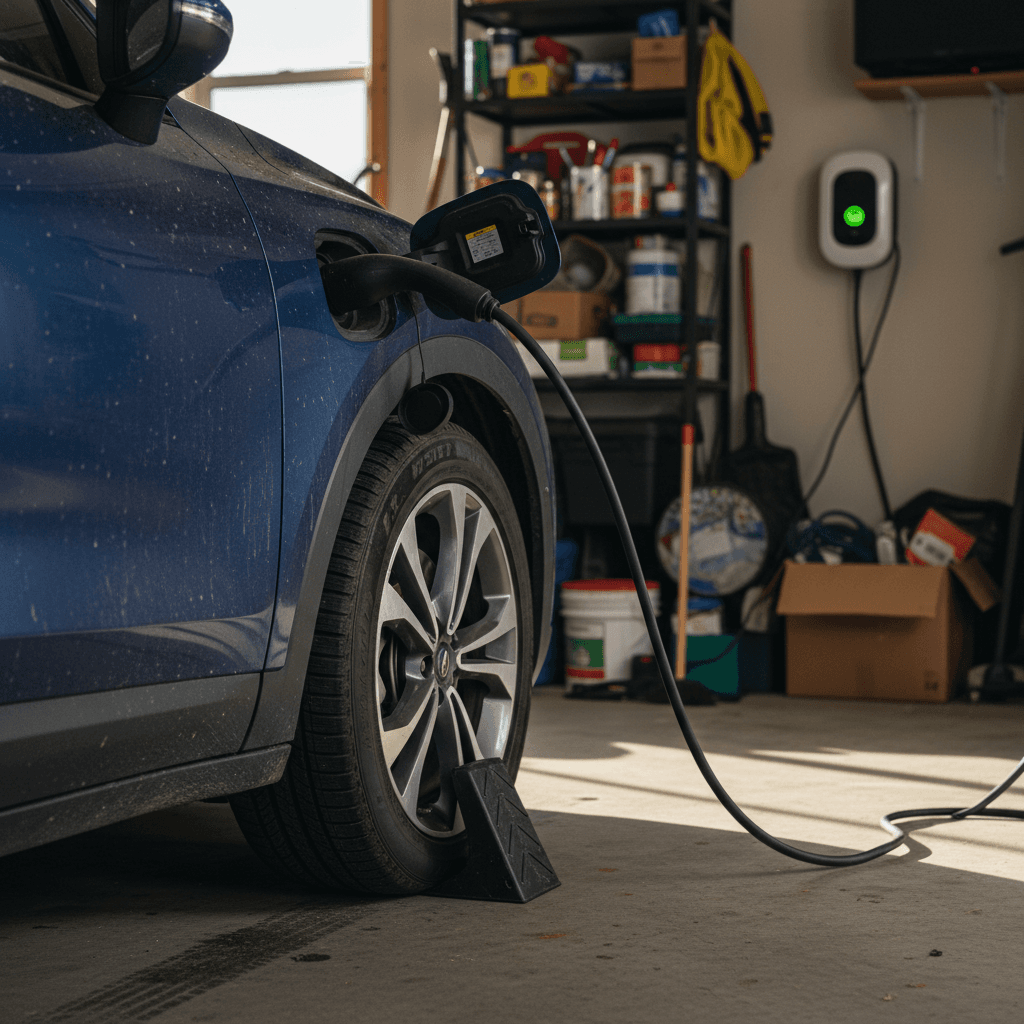
If your manual recommends storage while connected, set the charge limit around 50–60% and plug in. Otherwise, park it at your target SoC and leave it unplugged. In both cases, confirm there’s no scheduled departure that will pre‑heat the cabin every morning.
4. Protect the 12V battery
Even in an EV, a weak 12V battery can strand you. If you’re storing the car for several months and can’t plug in, consider using an approved 12V maintainer or, in some models, disconnecting the 12V (only if the manufacturer allows it and you’re comfortable with the procedure).
5. Prep tires and suspension
Inflate tires to at least the recommended pressure, or a couple of PSI higher if the car will sit for months. If you’re going beyond six months, think about tire cradles, rolling the car a few inches every month, or, in extreme cases, using jack stands per the manual.
6. Clean, dry, and seal the car
Wash and dry the exterior, remove any food or trash from the cabin, and close windows and sunroof fully. A breathable car cover in a garage can keep dust off without trapping moisture; avoid plastic tarps that can sweat on the paint.
7. Note your starting SoC and dates
Snap a photo of the dash showing state of charge, odometer, and date. It’s a simple way to track vampire drain over time, and handy evidence if anything goes wrong while a car is stored at a facility.
Where to park your EV for months
Location matters almost as much as state of charge. High heat plus a high‑voltage battery is the toxic combo you want to avoid. Cold, by contrast, mostly makes the car sluggish until it warms up again, annoying, but reversible.
Best: Cool, dry garage
- Temperature typically stays between ~50–80°F.
- Protects paint, tires, and rubber seals from UV.
- Reduces the chance of rodents nesting in the engine bay or underbody.
Acceptable: Covered carport
- Better than open sky; less sun on the cabin and battery.
- Still subject to ambient heat and humidity swings.
- Consider a breathable cover in dusty or salty environments.
Last resort: Open driveway or lot
- Start closer to 40–50% SoC if you’re in a hot climate.
- Avoid parking over grass or dirt that holds moisture under the car.
- Use a high‑quality, breathable cover and revisit more often.
Don’t bake the pack
Tires, brakes, and bodywork: avoiding “sitting” damage
The battery is the headline act, but traditional car‑storage gremlins still apply. An EV can develop flat‑spotted tires, rusty brake rotors, and musty interiors just like anything else on four wheels.
Common long-term storage issues and fixes
A quick reference for non-battery problems when your EV sits too long.
| Issue | What causes it | How to prevent it | What to do when you return |
|---|---|---|---|
| Flat spots on tires | Weight of the car sitting on one patch of tire for months | Inflate to spec or slightly higher; use tire cradles or move the car a few inches monthly | Drive gently at first; mild thumps often disappear after a few miles |
| Rusty brake rotors | Moisture plus disuse, especially with EVs that rely on regen | Store in a dry location; occasionally use friction brakes before storage to sweep rotors clean | On return, make a few medium‑firm stops from 30–40 mph to scrub rust off |
| Stale smells or mold | Trapped humidity and organic debris in cabin | Remove food, vacuum the interior, dry damp mats, consider a desiccant pack inside | Air out the car, run HVAC on fresh air, replace cabin filter if needed |
| Paint and trim fade | UV exposure and environmental fallout | Wash, dry, and consider wax/sealant; use a breathable cover if stored outside | Wash thoroughly; consider paint decontamination and protection if the car sat under trees or near industry |
You don’t need to be obsessive, just hit the big risks before you lock the door.
Use regen wisely before storage
How long can an EV sit unused?
Modern EVs are surprisingly tolerant of being ignored, as long as they started with the right charge and the software isn’t constantly waking the car up. With a 60 kWh pack parked at 50–60% SoC and just a couple of percent per month in standby losses, you have many months of runway before charge becomes a problem.
- For 2–4 weeks: Almost any EV will be fine at 40–80% SoC, even outdoors, as long as temperatures aren’t extreme.
- For 1–3 months: Start around 50–60%, disable unnecessary background features, and aim for a cool garage or shaded parking.
- For 3–12 months: Treat this as true storage, perfect your SoC, location, and 12V plan, and commit to checking on the car every 4–8 weeks if possible.
- Beyond 12 months: This enters museum territory. You’ll want professional‑grade storage prep, including regular inspections and possibly climate‑controlled space.
The 0% trap
Special cases: Tesla, LFP batteries, and airport parking
Tesla owners
Most Teslas let you set a charge limit and schedule charging, and they offer features like Sentry Mode and Cabin Overheat Protection that quietly chew through energy. For a month or more of storage:
- Turn off Sentry Mode unless security is a real concern.
- Disable frequent third‑party app polling.
- Set a 50–60% charge limit; plug in only if Tesla specifically recommends it for your conditions.
LFP (iron phosphate) batteries
LFP packs, found in some Teslas, Chinese EVs, and base trims of certain models, are more tolerant of high SoC but not invincible. The same rule applies: mid‑pack (around 50%) and cool temperatures are your safest bet, especially beyond a few weeks.
Long airport parking stays
Airport garages are a perfect storm of temptation and risk. If you can’t babysit the car from afar:
- Arrive with 50–70% SoC, not 100%.
- Turn off non‑essential background features.
- If there’s free Level 2, set a low charge limit and plug in; if not, park unplugged in covered parking and relax.
Remote-app reality check
Signs your EV didn’t like being stored
Most EVs will shrug off a few months in a garage, but if something did go sideways, the car will usually tell on itself. When you return, run a quick health check instead of just tossing your bags in and hammering the on‑ramp.
- Big SoC drop: If you left at 60% and returned to 5%, something was left on or the car has higher standby consumption than expected. Inspect settings and consider a service visit if this repeats.
- Warning lights: Any battery, 12V, or brake system warnings deserve attention before you resume normal driving.
- Noticeable range loss: A few miles of variation is normal. If you see a step change in estimated range at the same charge level, ask your service center to run a battery health check.
- Dead 12V battery: Classic symptom is a car that won’t “wake up” even though the high‑voltage pack is fine. You’ll need a jump or replacement 12V battery; after that, revisit your storage strategy.
When to call a tow, not a friend
Long-term storage and used EVs: what buyers should know
A car that’s been sitting isn’t automatically a bad buy, in fact, some low‑mileage used EVs are garage queens. The question is how it was stored. A pack that lived for years at 100% in Phoenix will age very differently than one that spent winters at 50% in a cool Vermont barn.
Questions to ask about a long-sat used EV
You’re buying a battery’s life story, not just its mileage
Storage conditions
- Where was the car kept, garage, driveway, storage lot?
- Was it plugged in all the time, or only occasionally?
- Did the owner deliberately hold it at 100% for convenience?
Battery health data
- Ask for recent battery health reports or screenshots of range at known SoC.
- Have an independent EV inspection if possible to read state of health (SoH) from the diagnostics.
How Recharged helps here
Ready to find your next EV?
Browse VehiclesIf you’re planning to store your own EV for an extended stretch before selling it, treating the battery gently now can turn into real resale value later. A buyer who sees healthy SoH and a credible storage story is much more willing to pay for the car’s remaining electric years.
FAQ: long-term EV storage
Frequently asked questions about storing an electric car long term
The bottom line on storing an electric car long term
If you remember nothing else, remember this: long-term EV storage is all about middle ground. Middle of the charge gauge, middle of the temperature scale, and a middle path between obsessive tinkering and benign neglect. Get those basics right, and your car can sit quietly for months without the battery drama you might fear.
Whether you’re parking your current EV for a sabbatical or shopping for a used one that’s lived an unusually quiet life, paying attention to storage habits is one of the smartest things you can do for long‑term battery health. And if you’d rather let someone else do the worrying, buying and selling through Recharged means every EV comes with verified battery diagnostics, transparent pricing, and EV‑savvy support from first click to final hand‑off.