If you’re trying to figure out how to save money buying an EV in South Carolina, you’ve probably already noticed: the Palmetto State isn’t exactly showering drivers with state-level EV rebates. That just means your job is to be a little more strategic, stacking federal credits, utility perks, and smart used-EV shopping to get a very good deal anyway.
Quick reality check
Why saving money on EVs in South Carolina is a little different
States like Colorado or New Jersey throw thousands of dollars at EV buyers. South Carolina takes a quieter route: encouraging utilities to support EV adoption and using federal dollars (like NEVI highway charging funds and Inflation Reduction Act rebates) to build infrastructure rather than send you a check at the dealership. If you know where to look, that still adds up to serious savings over the life of the car.
The South Carolina EV money picture, 2026
So the question isn’t “Is South Carolina generous?” It’s, “How do I line up the pieces that do exist, federal money, utility rebates, rate plans, and a well-priced car, so I’m not overpaying for the privilege of driving electric?” Let’s start with the big ticket: the car itself.
Stack your biggest savings: federal EV tax credits
In South Carolina, federal incentives do most of the heavy lifting on EV purchase price. For 2026, think in terms of two buckets: credits for new EVs and credits for used EVs.
New vs. used EV federal credits, in plain English
Know which bucket you fall into before you start shopping
New EV credit (up to $7,500)
If you buy a new EV and it meets the federal rules (battery sourcing, assembly location, MSRP caps), you may qualify for up to $7,500 off your federal tax bill.
- MSRP caps apply (typically around $55,000 for cars, higher for SUVs/trucks).
- Your income must be below federal limits.
- Many models let you apply the credit at the point of sale, so it acts like an instant discount.
Used EV credit (up to $4,000)
Buy a qualifying used EV from a dealer and you may get up to $4,000 (or 30% of the price, whichever is less) as a federal used clean vehicle credit.
- Vehicle must be at least 2 years old.
- Purchase price generally must be under $25,000.
- Buyer income limits are lower than for new EVs, but the bar to entry is also cheaper.
Use the credit like a discount
If you’re stretching to afford a new EV at all, the full $7,500 credit can be the difference between a base model and something with the range and features you actually want. But if you’re more payment-sensitive than tech-sensitive, the used EV credit plus a sharply priced pre-owned car often wins on total cost.
Why used EVs are South Carolina’s sweet spot
South Carolina’s EV market has a particular flavor: commuters along the I‑26 and I‑85 corridors, lots of single-family homes with driveways, and a steady influx of off-lease EVs coming from higher-incentive states. That last point is where you win: used EV prices have softened dramatically since the peak of 2022–2023, while the cost of gasoline hasn’t shown similar generosity.
Why a used EV makes sense in SC
- Lower upfront price: Depreciation hits EVs hard in the first few years, which is painful for the first owner and a gift for you.
- Plenty of range for real life: A 230‑mile used EV easily covers a Charleston–Columbia round trip with a stop at a DC fast charger, or a week of commuting in Greenville.
- Home‑friendly lifestyle: Many South Carolinians have driveways or garages, so overnight Level 2 charging fits neatly into daily life.
What to watch out for
- Battery health: Range isn’t just the number on the original window sticker; you want proof of current battery capacity.
- Fast‑charging history: Hard, frequent DC fast charging and extreme heat can accelerate degradation.
- Warranty status: Many EVs still carry 8‑year/100k‑mile battery warranties; know what’s left.
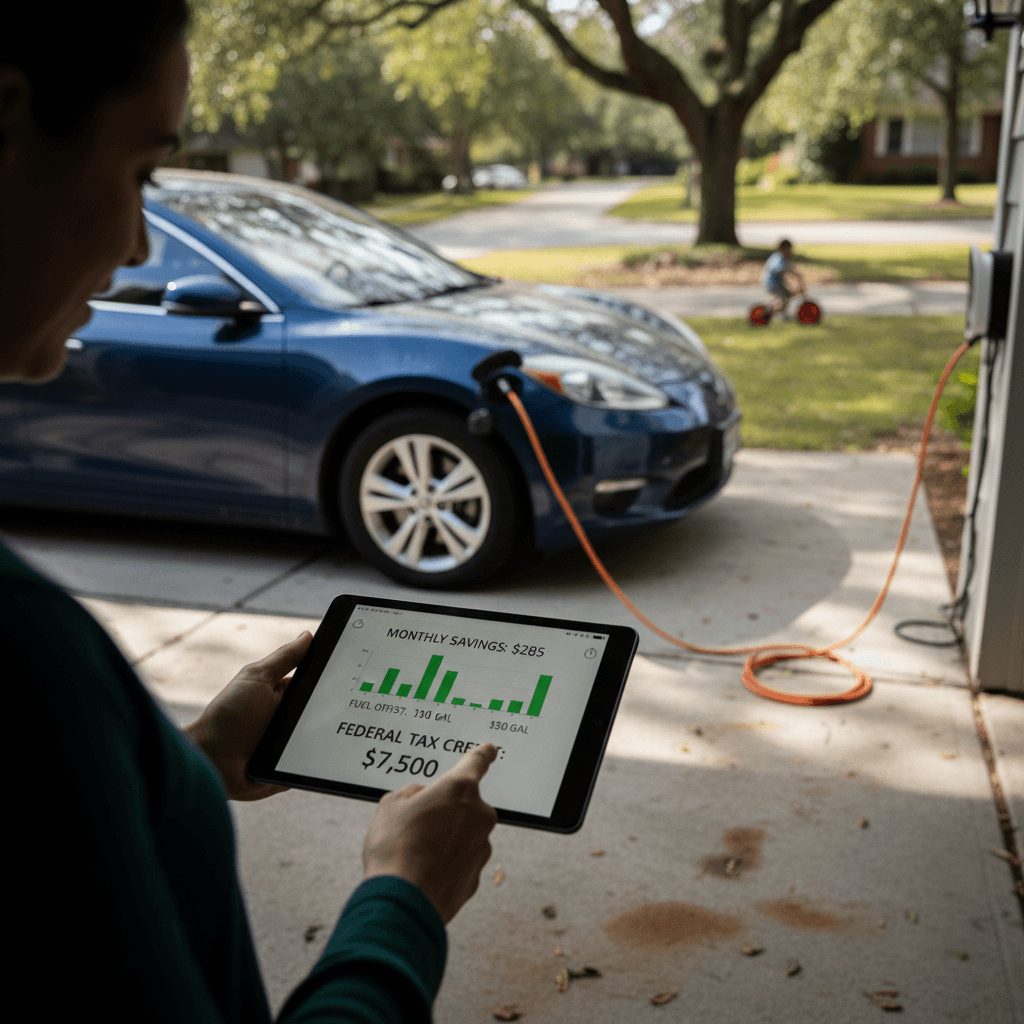
Don’t buy a used EV blind
This is where Recharged comes in. Every used EV on Recharged includes a Recharged Score Report with verified battery health, so you know whether that attractive price in Columbia or Greenville is attached to a pack that will still feel healthy five years from now.
Cut your home charging costs with credits and rebates
The car is only half the equation. The real South Carolina advantage is cheap, off‑peak electricity combined with federal and utility help to install a home Level 2 charger. If you play this right, your “fueling station” at home is both convenient and heavily subsidized.
Three ways South Carolinians save on home charging
Most of your EV fuel will come from your driveway, not a highway fast charger
1. Federal home charger tax credit
Through June 30, 2026, you can use the federal Alternative Fuel Vehicle Refueling Property Credit for a home charger installation.
- Covers 30% of costs (equipment + installation).
- Maximum benefit of $1,000 for residential customers.
- Applies to Level 2 chargers installed at your primary residence.
2. Utility charger rebates
Several South Carolina utilities offer rebates when you install a Level 2 charger at home.
- Some co‑ops offer around $200–$500 per charger.
- Certain Duke Energy programs can cover over $1,000 of panel or wiring upgrades.
- Eligibility varies by service area, so always confirm details with your utility.
3. IRA home energy rebates
South Carolina is rolling out Inflation Reduction Act home energy rebate programs that can help with electrical upgrades.
- Designed to cut overall home energy use and bills.
- May help offset service‑panel or wiring work.
- Exact benefits depend on income and project details.
How to stack your charger savings
Sample Level 2 home charging cost breakdown in South Carolina
Actual numbers will vary by house, panel size, and distance to your parking spot, but here’s how the math often shakes out when you stack incentives.
| Line item | Typical cost | With utility rebate | After 30% federal credit |
|---|---|---|---|
| Level 2 charger hardware | $500 | $500 | $350 |
| Electrical work (240V circuit, permit) | $900 | $500 (example Duke/coop rebate) | $280 |
| Total out-of-pocket | $1,400 | $1,000 | $630 |
Illustrative example only. Always confirm current programs and your eligibility before committing to an electrician.
In this example, you’ve turned a $1,400 project into something closer to $600–$700. Over a few years of $1‑something‑per‑gallon‑equivalent electricity, it’s one of the best investments you can make in your EV ownership experience.
Slash your electric bill: time-of-use rates and programs
Once the charger is in, the name of the game is when you charge. Both Dominion Energy South Carolina and Duke Energy have experimented with time‑of‑use (TOU) or EV‑friendly rate plans that make overnight electricity significantly cheaper than late‑afternoon peak hours.
What to ask your utility about
TOU plans can cut your EV fueling costs by 30–50%
Dominion Energy South Carolina
Dominion’s residential TOU offerings (like the “You Shift/You Save” plan) reward customers who move usage to off‑peak hours.
- Substantially lower rates overnight versus late‑afternoon peaks.
- Perfect for setting your EV to charge after 9–10 p.m.
- Enrollment is usually voluntary and reversible if it doesn’t fit your lifestyle.
Duke Energy Carolinas & Progress (SC service areas)
Duke has rolled out a mix of EV‑specific pilots, overnight advantage rates, and demand response options in the Carolinas.
- Discounted overnight rates for EV owners in some territories.
- Bill credits for allowing the utility to throttle charging during rare peak events.
- Programs and eligibility differ by county and service area, so always read the fine print.
Time-of-use isn’t one-size-fits-all
In an ideal South Carolina scenario, you’re charging your EV almost exclusively during the cheapest overnight window, using a relatively small amount of kWh compared with your home’s total usage. In that world, an EV on a TOU rate plan can feel like you’re buying “fuel” for the cost of a nice cup of coffee each week.
Shop smart in South Carolina: new vs used and when to buy
You’ve got incentives, rebates, and rate plans swirling in your head. Now let’s talk about how to actually deploy them when you walk into a showroom, or browse a used EV marketplace, from Greenville to Charleston.
New vs used EV in South Carolina: which saves you more?
Think total cost of ownership, not just sticker price
When a new EV makes sense
- You qualify for the full $7,500 new EV credit and can use it at the point of sale.
- You plan to keep the car for 8–10 years and want the latest tech, range, and safety features.
- You drive enough miles that long‑term fuel and maintenance savings matter more than short‑term payments.
When a used EV is the smarter play
- You want the lowest possible payment and a car that’s already taken the worst depreciation hit.
- You’re okay with 200–260 miles of real‑world range, not 330.
- You want to combine a lower purchase price with the used EV federal credit and cheap home charging.
Timing your purchase
- Watch for model refreshes: When a new version of a popular EV lands, the previous generation often gets discounted, both new and used.
- Keep an eye on federal changes: 2025–2026 are transition years for several IRA‑related incentives, including charger credits that sunset after June 30, 2026.
- End-of-quarter deals: Dealers chasing volume targets often get more flexible near the end of March, June, September, and December.
Where you buy matters
- Franchise dealers: Better for brand‑new EVs and capturing the new‑vehicle federal credit at the point of sale.
- Specialized used‑EV platforms like Recharged: Better for transparent battery health data, fair market pricing, and EV‑savvy support.
- Private sales: Can be cheap, but you’re on your own for diagnostics and paperwork.
South Carolina leverage move
How Recharged helps you save on a used EV in South Carolina
When you’re hunting for a deal, information is leverage. Recharged is built around the idea that used EV buyers shouldn’t have to guess about battery health, real‑world range, or whether that price is actually good for the South Carolina market.
Ways Recharged can lower your real EV cost
Especially useful if you’re buying your first electric car
Verified battery health
Every vehicle on Recharged comes with a Recharged Score Report that includes verified battery health diagnostics.
- See how much usable capacity the pack still has.
- Understand likely future range, not just the day‑one number.
- Avoid overpaying for a car with an underperforming pack.
Fair market pricing
Recharged benchmarks every listing against the market, so you know if that price for a bolt in Columbia or a Model 3 near Charleston is actually fair.
- Transparent pricing, no inflated “EV tax.”
- Tools to compare across trims and years.
- Support in understanding how tax credits apply.
Financing, trade-ins & delivery
Recharged isn’t just a listings board. You get:
- Financing options tailored to used EVs.
- Trade‑in or instant offer for your current vehicle.
- Nationwide delivery, so you can shop beyond your zip code and still get the car to your South Carolina driveway.
Ready to find your next EV?
Browse VehiclesIf you want a human sanity check, Recharged’s EV‑specialist team can help you weigh models, incentives, and total cost of ownership, whether you’re commuting from Spartanburg, navigating Charleston traffic, or splitting weekends between Columbia and the coast.
Checklist: how to save money buying an EV in South Carolina
Your South Carolina EV savings playbook
1. Confirm your incentives
Use the federal IRS tools and reputable EV incentive calculators to see whether you qualify for the <strong>$7,500 new EV credit</strong> or the <strong>$4,000 used EV credit</strong>. Note any income or price limits that affect you.
2. Get real about your driving
Write down a typical week: commute miles, weekend trips, occasional road‑trips. This keeps you from overbuying range you’ll never use, which usually costs more upfront and in insurance.
3. Check your electrical panel
Have an electrician, or at least a savvy friend, check your service panel. Ask what it will take to add a <strong>240V circuit</strong> for a Level 2 charger and whether there’s room to grow.
4. Call your utility before you buy
Ask Dominion, Duke, or your co‑op about <strong>home charger rebates</strong>, EV‑specific rate plans, and whether they’re participating in any IRA‑funded home energy rebate programs.
5. Shop used EVs with battery data
If you go used, only seriously consider cars with <strong>verified battery health information</strong>, like the Recharged Score Report, so you’re not guessing at future range and resale value.
6. Compare total cost, not just payment
Price out fuel (electric vs gas), insurance, maintenance, and charging equipment. A slightly higher monthly payment on the right EV can be cheaper annually than a lower‑payment gas car.
7. Time your purchase
If you’re close to a model‑year change or a new federal rule taking effect, run the numbers both ways. Sometimes buying a current‑year car with bigger discounts beats waiting for the next shiny thing.
FAQ: Saving money on EVs in South Carolina
Frequently asked questions about saving on EVs in South Carolina
South Carolina won’t hand you a fat state rebate for going electric, but that doesn’t mean you’re paying full retail for the EV revolution. If you line things up, federal credits, a subsidized home charger, smart TOU rates, and a used EV with a healthy battery, you can end up with a car that’s cheaper to own than the gasoline equivalent, and nicer to live with day to day. The key is doing the homework before you sign. And if you’d like a partner in that homework, Recharged was built exactly for shoppers like you.