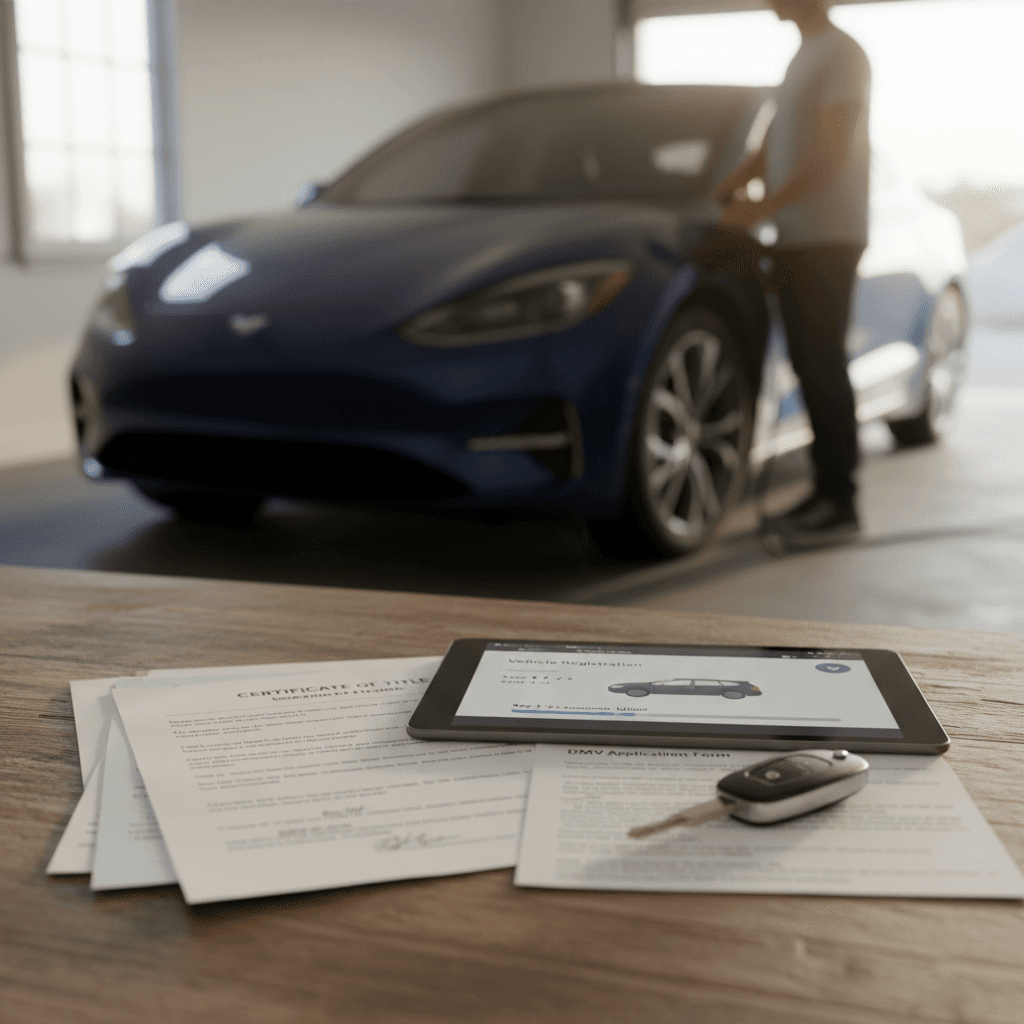
You’ve found the right used EV. Now comes the part nobody loves: figuring out **how to register a used electric car** without spending a full day at the DMV or discovering a nasty surprise at the counter. The good news is that the basic steps are the same as for any used car, but there are a few EV-specific twists you’ll want to know about before you sign anything.
Big picture
Why registration for a used EV feels confusing
If you’ve only skimmed EV news headlines, you’ve seen a swirl of **tax credits ending in late 2025**, new EV-only fees, and HOV perks coming and going. It’s no wonder a simple question like “How do I register this used electric car?” suddenly feels like an IRS audit and a DMV line rolled into one.
- Federal purchase tax credits for *new* EVs ended for cars bought after September 30, 2025, but paperwork about them still appears in dealer contracts and online guides.
- A separate federal credit for *used* EVs (up to $4,000) was also cut off for vehicles acquired after September 30, 2025, yet you’ll still see old references in ads and listings.
- 39+ states now add dedicated EV registration or road-use fees on top of normal registration, and those amounts can change year to year.
- Procedures and required forms differ by state, what’s standard in California looks a little different in Texas, Virginia, or Colorado.
Underneath all that churn, though, the process is straightforward once you separate **registration** (a state function) from **tax credits and incentives** (federal and state). Registration is about proving you own the car, that it’s safe and insured, and that you’ve paid the right taxes and fees.
What actually changes when the car is electric
EV vs. gas car registration: what’s different?
Most of the paperwork is the same, these are the subtle EV twists.
EV-specific fees
Many states add an extra annual fee for electric vehicles, often $75–$250, to replace lost gas-tax revenue.
It’s usually charged when you first register the car and each time you renew.
Incentive forms & disclosures
Even though federal EV purchase credits ended in September 2025, some state and local rebates remain.
Your paperwork may include tax forms or rebate affidavits tied to the car being electric.
Battery & emissions differences
EVs generally skip emissions testing but may have special inspection lines or forms.
Some states also track EVs separately for statistics and future policy changes.
Watch for outdated advice
Documents you need to register a used electric car
Every state has its quirks, but the core documentation you’ll need to register a used EV is remarkably consistent. Think of it as three buckets: **proof you own the car, proof you exist and live where you say, and proof the car can be legally driven**.
Core documents for registering a used electric car
Use this list as your pre-DMV packing list. Check your state DMV site for exact form names.
| Document | What it proves | EV-specific notes |
|---|---|---|
| Signed title (or Manufacturer’s Certificate of Origin) | You own the vehicle and can transfer it into your name. | Make sure the VIN matches the EV and that any lienholder information is correct. |
| Bill of sale or purchase agreement | Purchase price, date of sale, and parties involved. | Needed to calculate sales or use tax; may reference any old EV incentives but those don’t control registration. |
| Odometer disclosure | True mileage at transfer. | Usually part of the title or a separate federal/state form; EVs follow the same rules as gas cars. |
| State registration application | Your official request to register and title the car. | Each state has its own form number; many can be filled out online and printed. |
| Proof of identity and residency | You are who you say you are and live where you claim. | Driver license plus utility bill, lease, or similar; exact rules vary by state. |
| Proof of insurance | The car will be insured as required by law. | Policy must list the EV and meet state minimums; some insurers give EV discounts. |
| Safety/emissions inspection (if required) | The vehicle meets state safety or emissions rules. | Many states exempt EVs from emissions tests but still require a safety or VIN inspection. |
| Lien release or financing paperwork (if applicable) | Any previous loan on the vehicle has been cleared, or your new lienholder is recorded correctly. | If you financed the used EV, your lender may handle some title steps for you. |
Most of these documents also apply to gas cars, EVs mainly add fee differences and, sometimes, a few extra disclosures.
Pro move: pre-fill everything at home
Step-by-step: how to register a used electric car
The exact order can vary a little by state, but if you follow this framework you’ll be 95% of the way there whether you’re in California, Virginia, or Kansas. We’ll assume you bought from a private seller or marketplace; if you bought from a dealer, they often handle many of these steps for you.
Step-by-step used EV registration
1. Confirm the title is clean and in the seller’s name
Before money changes hands, match the VIN on the title to the VIN on the car, check for salvage or rebuilt branding, and confirm any lien listed on the title has a release. A messy title is a registration time bomb.
2. Capture a complete bill of sale
Write or print a bill of sale including buyer and seller names and addresses, VIN, year/make/model, sale price, and date. For marketplace purchases like <strong>Recharged</strong>, this will be part of your digital contract.
3. Check EV inspection and emissions rules
Look up your state DMV site to see if a safety, VIN, or emissions inspection is needed. EVs are usually exempt from emissions tests but may still need a quick safety or VIN verification before you can register.
4. Line up insurance before you visit the DMV
Most states require proof of insurance to register. Call your insurer with the VIN and set the effective date to your purchase date or the day you’ll be driving the car home.
5. Complete the registration/title application
Fill in your personal information, the EV’s details (VIN, year, make, model, body style), lienholder info if financed, and whether the car is new to the state. This is where you’ll often see a box or code for electric vehicles.
6. Gather taxes and fee money
Plan to pay state and local sales or use tax, plus registration and title fees and any EV-specific road-use fee. Many DMVs list fee calculators online so you’re not guessing at the counter.
7. Visit the DMV or submit online/mail if allowed
Some states let you complete the entire registration online or by mail for used vehicles; others want an in-person VIN check. Follow your state’s instructions closely to avoid duplicate trips.
8. Attach plates, keep temporary permits, and set reminders
Once issued, install your plates or temporary tags according to instructions. Set a calendar reminder for your renewal date and, in EV-fee states, remember that the extra EV charge usually appears every year.
State EV fees and incentives: what to expect
Here’s where owning an electric car really diverges from a gas car at registration time. States are trying to replace lost gas-tax revenue and, at the same time, hit their climate targets. The result: a patchwork of **extra EV fees** and **still-surviving local incentives** layered on top of normal registration.
The EV registration landscape in 2025–2026
Examples of EV registration fees by state (illustrative)
Actual amounts can change with new legislation; always confirm current fees with your state DMV.
| State | Approx. EV annual fee | Notes |
|---|---|---|
| Texas | Around $200/year after an initial higher first payment | Charged in addition to standard registration; effectively pre-pays some road taxes. |
| Georgia | Around $230/year | One of the higher EV fees; no purchase credit currently available. |
| California | Around $100–$120/year | California dropped its statewide purchase credit but assesses an EV registration surcharge. |
| Colorado | Around $60/year | Colorado focuses more on upfront purchase credits; ongoing EV fee is relatively modest. |
| Pennsylvania | About $200/year, increasing over time | EV fee indexed to inflation, with scheduled increases after 2025. |
These numbers are rounded snapshots to give you a feel for how EV fees vary around the country.
Don’t confuse credits with registration
Out-of-state and online purchases: special cases
Buying a used electric car from another state, or from an online marketplace with nationwide delivery, adds a few twists, but the principles are the same. You still register in the state where the car will primarily live and be garaged, not where you bought it.
When the EV comes from another state
- Expect a VIN inspection. Many states require a quick VIN verification when you bring in an out-of-state title.
- Watch emissions exceptions. EVs are usually emissions-exempt, but some offices will still route you through a lane or form that’s labeled for ".out-of-state inspections."
- Sales tax gets reconciled. If you paid sales tax elsewhere, your home state may credit it or collect the difference up to your local rate.
When you buy fully online
- Dealer vs. marketplace matters. Franchised dealers often handle registration directly; marketplaces may provide paperwork and coach you through the DMV visit instead.
- Mind shipping dates. Your registration clock often starts when you take possession or when temporary tags are issued.
- Keep every digital document. Save e-signed contracts, title images, and emails in one folder to show the DMV if anything is questioned.
Where Recharged fits in
Registration costs for used EVs
You can’t dodge registration, but you can avoid sticker shock. Your total cost to **register a used electric car** in the U.S. generally combines four buckets of money.
- **Title and base registration fees** – What every vehicle pays for license plates, registration, and title, often based on weight or vehicle value.
- **EV-specific surcharges** – The extra annual fee for electric vehicles that many states now charge to replace gas-tax revenue.
- **Sales or use tax** – Calculated as a percentage of the purchase price (and sometimes adjusted if you paid tax in another state).
- **Optional extras** – Specialty or vanity plates, rush processing, and sometimes county or city add-ons.
Use the fee calculator, then add a cushion
How Recharged simplifies registration for used EV buyers
If you buy a used EV from an individual stranger, you’re on your own to spot title problems, calculate taxes, and decode your state’s EV fees. Recharged was built to make that experience less… DMV-ish.
Why registering a used EV is easier after a Recharged purchase
The paperwork and prep work are baked into the buying experience.
Clean, ready-to-transfer paperwork
Every vehicle on Recharged comes with a Recharged Score Report and verified ownership history. We confirm VINs, titles, and liens so you aren’t discovering problems at the DMV window.
Battery health you can hand to the clerk
Our diagnostics give you a documented picture of the EV’s battery condition. It’s not required to register, but it’s powerful proof of value when you’re insuring the car or thinking about long-term ownership.
Digital trail, human help
From financing docs to the bill of sale, everything lives in your Recharged account. Our EV specialists can walk you through exactly which registration forms your state uses and what fees to expect before you ever set foot in line.
Ready to find your next EV?
Browse VehiclesUsed EV registration checklist
Quick checklist before you head to the DMV
Verify VIN and title details twice
VIN on the title matches the VIN on the EV, seller’s name is correct, and any lien releases are attached.
Print or save your bill of sale
You have a clear purchase agreement showing price, date, and buyer/seller info, especially important for sales tax and out-of-state deals.
Confirm whether you need an inspection
You’ve checked your state DMV for safety/VIN/emissions requirements, and if needed, you’ve booked or completed the inspection.
Get insurance in place
Your policy lists the EV by VIN and effective date, and you have digital or printed proof of insurance ready.
Download and pre-fill state forms
You’ve completed your registration and title application, plus any odometer or tax forms, before you leave the house.
Budget for EV fees and taxes
You’ve used your state’s fee calculator (if available) and set aside enough for sales/use tax, base registration, EV surcharge, and extras.
FAQ: registering a used electric car
Frequently asked questions about used EV registration
Key takeaways
Registering a used electric car is less mysterious than it looks from the outside. At heart, you’re proving ownership, identity, insurance, and safety, then paying your share of taxes and fees, including any EV-specific surcharges your state has layered on since 2025. The smarter you are about paperwork ahead of time, the more your DMV trip feels like a quick formality instead of a bureaucratic gauntlet.
If you’re still shopping, consider starting with a used EV that comes with **clean documentation, verified battery health, and human support**. That’s exactly what Recharged was built for: transparent used EV listings, a Recharged Score Report on every vehicle, financing and trade-in options, nationwide delivery, and EV specialists who can help you translate “state requirements” into a simple, step-by-step plan. Handle the homework now, and your next registration should be the least dramatic part of going electric.