If you’re hunting for an EV deal in 2025, you’re walking onto a chessboard in the middle of the game. Federal incentives are shifting, brands are dangling subsidized leases, and used EV prices, especially Teslas, have quietly deflated. The good news: if you understand how the money actually moves, you can walk away with a deal that’s objectively excellent, not just cleverly advertised.
Why EV deals feel confusing right now
EV Deals in 2025: What’s Really Going On
Start here: a “deal” is just a way of disguising who’s paying for the discount. In 2025, a lot of that money is coming from automakers and finance arms trying to move inventory before incentives change, not from some magical generosity.
The EV deal landscape at a glance
That’s the macro picture. The practical question is simpler: how do you personally turn this market into a win, whether that’s a cheap commuter, a family crossover, or a well-priced used Tesla with plenty of battery life left?
What Actually Counts as a Good EV Deal?
Forget the billboard price for a moment. A genuinely good EV deal has three ingredients: total cost that beats comparable options, flexibility that matches your life, and risk that’s been managed instead of ignored.
The anatomy of a strong EV deal
Price is just the headline; the fine print decides if it’s a win.
1. Effective monthly cost
Don’t stop at the payment. Add:
- Monthly payment
- + Taxes & fees
- + Down payment spread over term
The deal is good if the effective monthly stacks up well against other EVs and gas cars you’d realistically drive.
2. Real-world range & fit
A bargain EV that can’t comfortably handle your commute isn’t a bargain.
- Range with your driving and climate
- Cargo & passenger needs
- Charging access where you live
3. Managed risk
EVs introduce new unknowns: battery health, charging curve, resale.
- Warranty coverage
- Battery health report on used
- Exit options if your needs change
Look beyond “under $300/month”
Lease vs Buy: Which EV Deal Works for You?
Leasing and buying both produce “great” EV deals, but for different kinds of drivers. The trick is to be honest about how long you’ll keep the car and how comfortable you are with battery and resale risk.
When an EV lease is the best deal
- You like changing cars every 2–3 years.
- You want to sidestep long-term battery degradation risk.
- You want to benefit from incentives that the lender passes through as lease cash.
- Your driving is predictable and under 12–15k miles a year.
Many 2025 lease offers quietly build in thousands of dollars in support from the manufacturer. That’s how you end up with sub-$300 deals on well-equipped EV crossovers that would be painfully expensive to finance at market interest rates.
When buying is the better EV deal
- You keep cars 6–10 years.
- You drive high annual mileage that would punish a lease.
- You want freedom to road-trip without overage anxiety.
- You’ve found a used EV that’s already absorbed the big depreciation hit.
On a purchase, the best EV deals often involve low-APR financing or a fairly priced used EV with a clean battery health report, something Recharged includes on every car via the Recharged Score.
Watch the fine print on low leases
Stacking Incentives: How to Make a Great EV Deal Unbeatable
Every EV deal you see is a layer cake: MSRP, factory incentives, dealer discounts, and government programs. Your job is to stack as many layers as possible without wasting time on the ones you can’t realistically claim.
- Manufacturer incentives: cash rebates, bonus lease cash, or loyalty/conquest offers when you switch brands or stay with the same one.
- Finance incentives: low-APR loans (sometimes 0–1.9%) when you finance through a captive lender on in-stock vehicles.
- Government programs: federal and state incentives may apply differently to new vs used, purchase vs lease, and income level.
- Utility & local perks: home charger rebates, off-peak charging rates, or HOV-lane access that changes the daily value of the car.
Don’t count a tax credit twice
How to Find the Best New EV Deal Right Now
New EV deals move fast, month to month, sometimes week to week, but the process for finding a good one is timeless: start broad, narrow ruthlessly, then let the numbers, not the marketing, do the talking.
Three ways to hunt for new EV deals
Use them together; they each see a different part of the elephant.
1. National & regional deal pages
Automakers and third-party sites publish monthly deal roundups: lease specials, low-APR offers, bonus cash.
- Great for spotting headline bargains.
- Always check the fine print: region, term, miles.
2. Local dealer inventory filters
Once you know which models have strong support, search dealer sites near you:
- Filter for in-stock EVs.
- Watch for extra dealer discounts on cars that have sat.
- Ask for an out-the-door quote by email.
3. Pre-qualify and compare real payments
Payment calculators lie. Lenders don’t.
- Get pre-qualified so you know your rate.
- Compare dealer offers against your pre-approval.
- Make them beat your best number, not your guess.
How Recharged fits in
Ready to find your next EV?
Browse Vehicles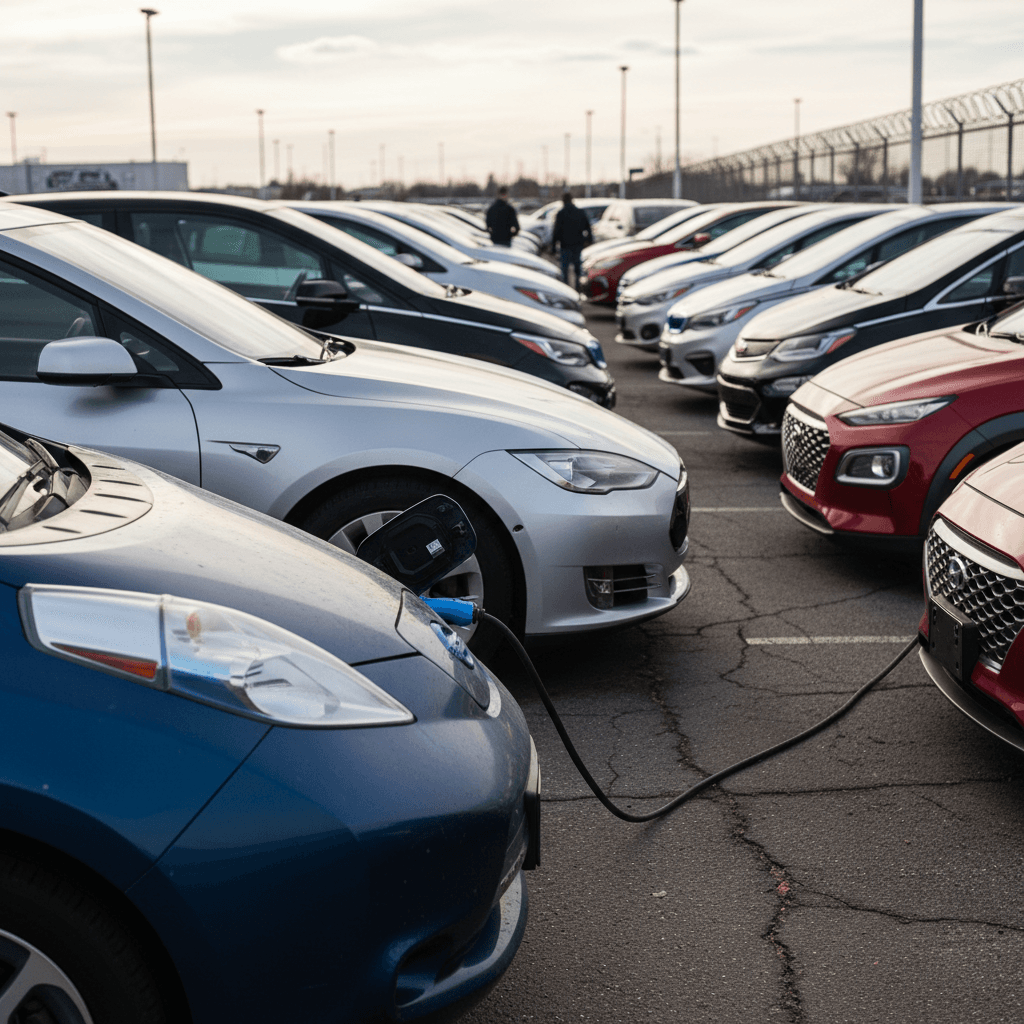
Used EV Deal Opportunities: Where the Quiet Bargains Are
If new EVs are the fireworks, used EVs are the clearance aisle where the good stuff quietly gets mispriced. A wave of off-lease cars, plus softer demand in some segments, means you can now buy EVs, especially certain Teslas, for less than you’d expect a few years ago.
- Three- to five-year-old EVs have taken the worst of their depreciation hit but still have plenty of battery warranty left.
- Used Teslas have seen sharper price drops than many rivals, which can turn a once-pricey Model 3 or Model Y into a very rational buy.
- Early-adopter trims with big batteries and options can now cost what the base model did new. That’s free equipment, courtesy of time.
A used EV is the rare case where yesterday’s aspirational purchase becomes tomorrow’s sensible one, if the battery checks out.
How to Judge a Used EV Deal (Without Getting Burned)
With a gas car, you listen for noises and look for oil leaks. With an EV, the engine is software and the oil leak is the battery health. If you can’t see that, you can’t really judge the deal.
Used EV deal checklist: under the skin
1. Get a real battery health report
Ask for data from a proper diagnostic tool, not just the dash range estimate. At Recharged, the <strong>Recharged Score</strong> includes a verified battery health rating so you know how much usable capacity remains.
2. Check remaining battery warranty
Most EVs have separate battery warranties, often 8 years and a set mileage cap. A car with years of battery coverage left is inherently a safer deal.
3. Look at charging history
Frequent DC fast charging isn’t automatically bad, but it can accelerate wear. A mix of home Level 2 and occasional fast charging is ideal.
4. Confirm included charging equipment
Factor in the cost of a portable charger, home wall unit, or adapters. Buying all that after the fact can quietly erase what looked like a bargain price.
5. Inspect tires and brakes
EVs are heavy and eat tires faster than you might expect. A set of worn tires can add four figures to the true cost of your “great” deal.
Lean on specialists
Quick Checklist: Is This Really a Good EV Deal?
Here’s your five-minute sanity check before you sign anything, lease, loan, or cash purchase.
The 10-second-per-line EV deal filter
1. Is the monthly payment honestly calculated?
You’ve added the payment, taxes, and your down payment spread over the term. No mystery fees lurking in the finance office.
2. Does the range cover your real life with margin?
Your daily driving plus a buffer for winter, detours, and days you forget to plug in. If you’re at the edge, it’s not a deal; it’s a stress plan.
3. Are you using all incentives you reasonably qualify for?
You’ve checked for manufacturer cash, low-APR offers, and any state or utility perks, and you’re not double-counting anything that’s already baked into the lease or price.
4. On a used EV, do you know the battery health?
You’ve seen more than a sales pitch. Ideally, you’re looking at a structured battery report like the Recharged Score, not just a guess based on the displayed range.
5. Is there a clear exit if your needs change?
Understand lease termination fees, equity position on a financed car, and what similar vehicles are actually selling for today.
6. Have you compared it to one boring alternative?
Compare against a sensible hybrid or gas car at a similar total cost. If you’d still pick the EV, the deal isn’t just financial, it’s rational for your lifestyle.
EV Deal FAQ
Frequently Asked Questions About EV Deals
The Bottom Line: Your Next Move
A good EV deal isn’t the loudest number on the ad; it’s the one that still makes sense when you add the fine print, your commute, and your long-term plans. In 2025, that might be a heavily subsidized new EV lease, a low-APR finance offer on in-stock inventory, or a used EV that someone else already paid dearly to depreciate.
If you’re leaning used, start by browsing EVs with transparent battery health and honest pricing. That’s exactly what Recharged was built for: verified battery diagnostics, fair market pricing, financing and trade-in options, and delivery to your driveway. However you shop, take ten minutes to run through the checklists above, do the math in cold blood, and you’ll know the difference between a marketing stunt and a truly great EV deal.