If you’re wondering how to charge a Volkswagen ID.4 at home, you’re not alone. Most ID.4 owners quickly learn that figuring out outlets, charger sizes, and installation costs matters more than DC fast‑charging numbers on a spec sheet. The good news: once you set things up correctly, home charging becomes as simple as plugging in your phone at night.
Key takeaway
Why home charging matters for your ID.4
Volkswagen designed the ID.4 around the idea that most charging happens at home. DC fast charging is great for road trips, but day‑to‑day living is much easier when you can plug in where you sleep and wake up with the range you need. For used‑EV shoppers, a solid home‑charging setup can be the difference between loving the car and constantly worrying about range.
What home charging gives VW ID.4 owners
Three everyday wins once your setup is dialed in
Time back in your day
Skip weekly stops at public chargers. Plug in at night, unplug in the morning, and start each day with the range you need.
Lower energy costs
Home electricity is usually cheaper than DC fast charging. Off‑peak rates can make your ID.4 dramatically cheaper than gas.
Less battery stress
Regular Level 2 home charging is gentler on the pack than constant DC fast charging, which helps long‑term battery health.
VW ID.4 home charging basics in one minute
Volkswagen ID.4 home charging at a glance
Quick rule of thumb
Level 1 vs Level 2: Which home charging option fits your life?
Level 1: Standard 120 V outlet
What it is: Plugging your ID.4 into an ordinary household outlet using the portable cable that often comes with the car (or a similar aftermarket unit).
- Voltage: 120 V
- Power: ~1–1.4 kW
- Typical speed: about 3–5 miles of range per hour of charging
- Best for: low mileage drivers, temporary setups, or renters who can’t install a 240 V line
If you drive 10–20 miles a day and can leave the car plugged in overnight, Level 1 can quietly work in the background.
Level 2: 240 V home charging
What it is: A dedicated 240 V circuit, similar to what an electric dryer uses, feeding a wall‑mounted or plug‑in EV charger (also called an EVSE).
- Voltage: 208–240 V
- Power: typically 7.2–11 kW for an ID.4
- Typical speed: roughly 20–35 miles of range per hour
- Best for: most ID.4 owners, especially families, commuters, and road‑trippers
Level 2 maximizes the ID.4’s 11 kW onboard charger and makes full overnight recharges realistic, even from low states of charge.
Don’t DIY what should be permitted
How long does it take to charge a Volkswagen ID.4 at home?
Actual times depend on which battery your ID.4 has (around 62 kWh or 82 kWh gross), the amperage of your circuit, and your local voltage. But the ranges below are solid ballparks for charging from near empty to full under normal temperatures.
Approximate VW ID.4 home charging times
Rough 0–100% charging times for common home setups. In daily use you’ll typically go from, say, 30% to 80%, which is faster.
| Home setup | Approx. power | Smaller battery (0–100%) | Larger battery (0–100%) | Miles added per hour* |
|---|---|---|---|---|
| Level 1 (120 V, 12 A) | ~1.3 kW | ~60–70 hours | ~75–80 hours | ~3–5 mi/hr |
| Level 2 (240 V, 30–32 A) | ~7.2 kW | ~9–10 hours | ~11–12 hours | ~20–25 mi/hr |
| Level 2 (240 V, 40 A) | ~9.6 kW | ~7–8 hours | ~9–10 hours | ~25–30 mi/hr |
| Level 2 (240 V, 48 A / 11 kW) | ~11 kW | ~6–6.5 hours | ~7.5–8 hours | ~30–35 mi/hr |
Use these numbers as planning tools, not promises, your exact times will vary.
Why your charger and car both matter
Step‑by‑step: How to charge your VW ID.4 at home
From parking to unplugging: the daily routine
1. Park where the cable reaches easily
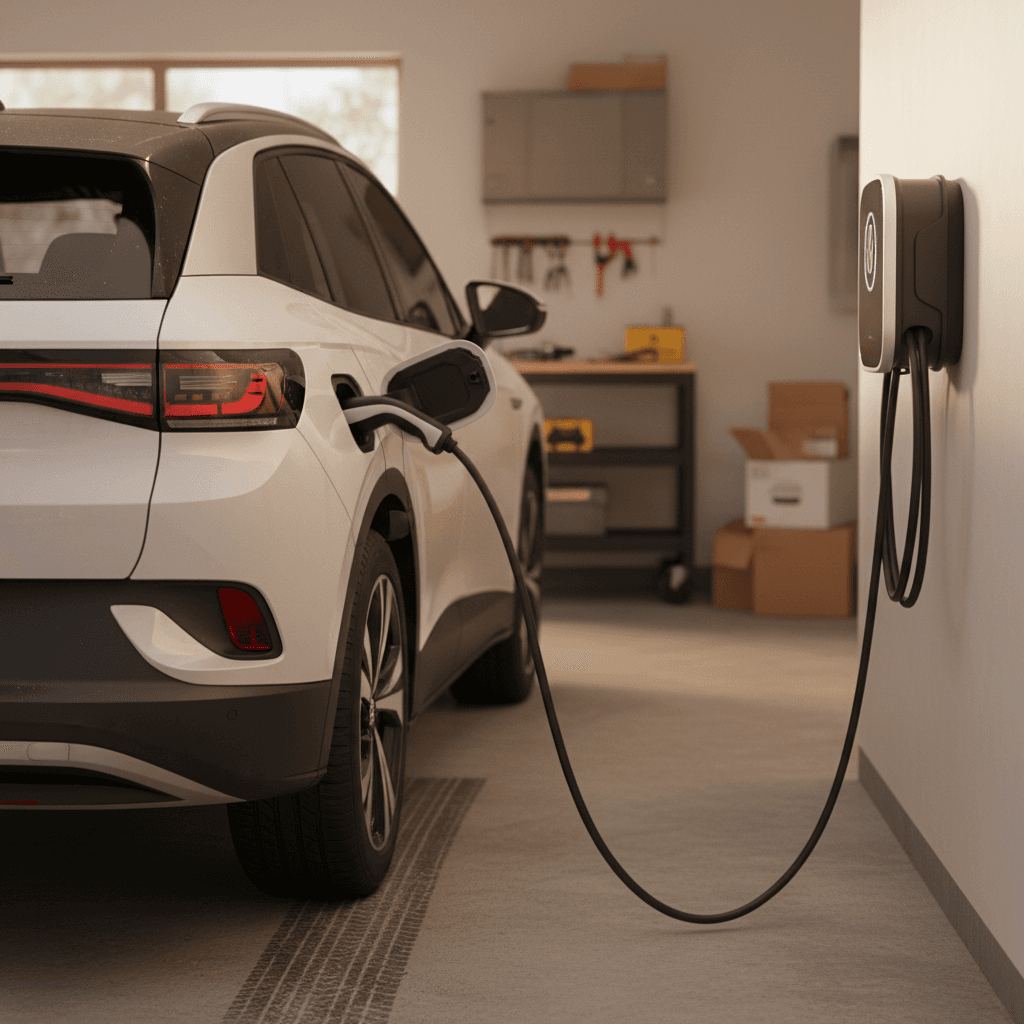
Back or nose in so the charge port (on the rear passenger side for most ID.4s) lines up comfortably with your outlet or wallbox. Avoid stretching the cable tight across walkways.
2. Make sure the charger is powered
For Level 1, confirm the outlet is working and not on a switch. For Level 2, check the charger’s indicator lights or app to confirm it’s ready and not in a fault state.
3. Open the charge port door
Tap the door, press the unlock button on your key fob, or use the button in the infotainment menu, depending on your model and software version.
4. Plug the connector into the car
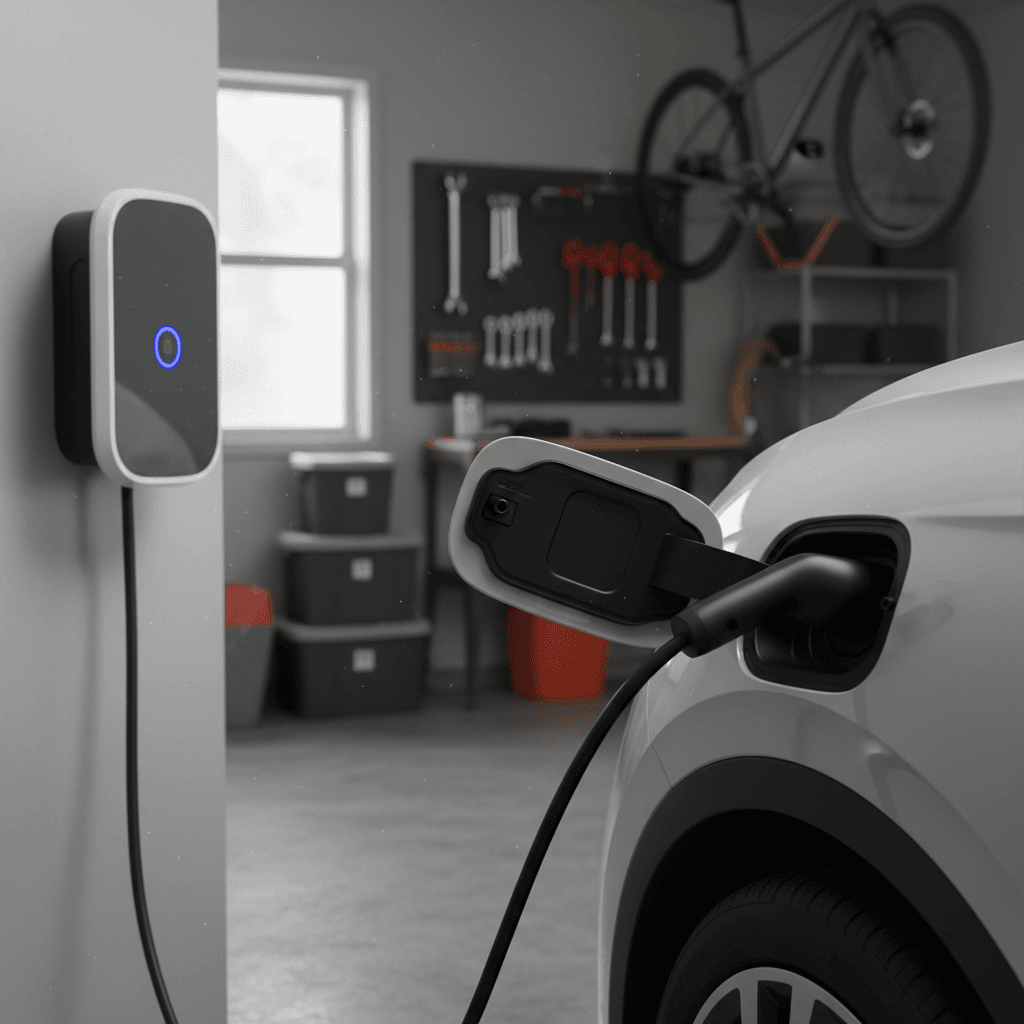
Align the J1772 handle with the ID.4’s charge port and push firmly until you hear or feel it click. The ring around the port should light up to show charging status.
5. Confirm charging on the dash or app
The ID.4’s cluster and infotainment will show charging power and an estimated completion time. If you’ve set a charge limit (for example 80%), make sure it matches your daily needs.
6. Unplug when you’re done
When you’re ready to leave, unlock the car if needed, press the button on the connector to release it, coil the cable back onto the holder, and close the charge port door to keep dirt out.
Choosing the right home charger for your ID.4
You don’t need a VW‑branded unit to charge your ID.4. Any well‑built J1772 Level 2 charger on a properly sized circuit will work. What matters is matching the charger’s maximum amperage to both your electrical panel and the ID.4’s 11 kW limit.
What to look for in a VW ID.4 home charger
Focus on power, reliability, and features you’ll actually use
Amperage and power
For most ID.4 owners, a 32–40 A charger is a sweet spot: fast enough to refill overnight without oversizing wiring or breakers. If your panel has room, a 48 A unit fully matches the car’s 11 kW capability.
Smart features
Wi‑Fi‑enabled chargers let you schedule off‑peak charging, track energy use, and sometimes integrate with utility rebate programs.
Safety and reliability
Look for UL or ETL listings, a solid enclosure rating (NEMA 3R or better outdoors), and a reputable brand with clear support.
Good news for used‑EV buyers
Ready to find your next EV?
Browse VehiclesElectrical panel and installation basics
The most common surprise new EV owners run into isn’t the car, it’s the house. A Level 2 charger is only as good as the wiring behind it. Before you order a wallbox online, it’s worth understanding what your panel can safely support.
1. Check your main service and free capacity
Most modern U.S. homes have 100–200 amp service. Your electrician will look at your existing loads, HVAC, electric range, dryer, etc., and decide whether you can add a 40–60 amp EV circuit without overloading the system.
A common solution for ID.4 owners is a 50 amp breaker feeding a 40 amp charger, which delivers around 9.6 kW. That’s plenty for overnight charging in most situations.
2. Decide hard‑wired vs. plug‑in
Hard‑wired: The charger is permanently wired to the circuit. This is usually required for 48 A units and can be cleaner outdoors.
Plug‑in (NEMA 14‑50 or similar): The charger plugs into a heavy‑duty outlet. This can simplify replacement later, but you’re typically limited to around 40 A continuous on a 50 A circuit.
Either approach works for the ID.4 as long as the circuit size, wiring, and breaker match the charger’s settings.
Safety first with 240 V work
Home charging costs and how to save money
Compared with public DC fast charging, or a gas SUV, an ID.4 charged mostly at home can be surprisingly inexpensive to run. Your exact costs depend on your local electricity rate and driving habits, but you can estimate them with a few quick assumptions.
- A typical ID.4 uses roughly 2.7–3.3 miles per kWh in mixed driving.
- An average U.S. electricity rate around $0.16/kWh means roughly $0.05–$0.06 per mile.
- At 12,000–13,000 miles per year, many ID.4 owners see $50–$60 per month in home charging costs instead of fuel bills.
Use scheduling to chase off‑peak rates
Three simple ways to cut home charging costs
You don’t need solar panels to make your ID.4 cheap to run
Charge when power is cheap
Use scheduled charging in the car or charger app to target off‑peak hours, typically late at night.
Check for rebates
Many utilities offer rebates on home chargers or even free hardware. Before you buy, search your ZIP code for EVSE incentives.
Track your usage
Smart chargers and some utility apps let you monitor exactly how many kWh your ID.4 uses, so you can fine‑tune habits over time.
Safety, battery health, and good habits
The ID.4’s battery pack and charging system are engineered to handle daily use, but the way you charge can still influence long‑term health and day‑to‑day convenience. A few habits go a long way.
Healthy charging habits for your Volkswagen ID.4
Avoid living at 100%
For daily driving, many owners set an 80–90% charge limit and only go to 100% before trips. That leaves more headroom for the battery and can reduce long‑term stress.
Don’t fear partial charges
Topping from 40% to 70% during the evening is fine. Lithium‑ion packs don’t need full cycles; in fact, they prefer staying away from both 0% and 100% when possible.
Keep cables out of harm’s way
Use cable hooks and organizers so no one trips and the cable insulation isn’t crushed under garage doors or tires.
Watch for recurring faults
If your charger frequently throws errors or your ID.4 stops charging unexpectedly, investigate rather than ignoring it. It might be a weak outlet, bad wiring, or a failing unit.
Limit DC fast charging when you can
Road trips are what DC fast chargers are for, but relying on them daily introduces more heat and stress than slow home charging.
Document your setup for resale
If you ever sell your ID.4, or trade into a used EV at Recharged, photos and details of a quality home charging install can be a selling point.
Most ID.4 owners discover that once their home charging is sorted, they almost never think about public chargers except on road trips, and that’s when the car’s DC fast‑charging capability really earns its keep.
FAQ: Volkswagen ID.4 home charging
Common questions about charging a Volkswagen ID.4 at home
How Recharged can help with your next ID.4
A Volkswagen ID.4 is easy to live with once your home charging is sorted out. Whether you’re starting with a basic 120 V outlet or planning a full 240 V wallbox install, the right setup turns range anxiety into simple nightly routine. If you’re considering a used ID.4, or another EV entirely, Recharged can help you line up home charging, understand real‑world charging times, and evaluate battery health with a detailed Recharged Score Report. That way, when your next EV shows up in the driveway, all that’s left to do is plug in.