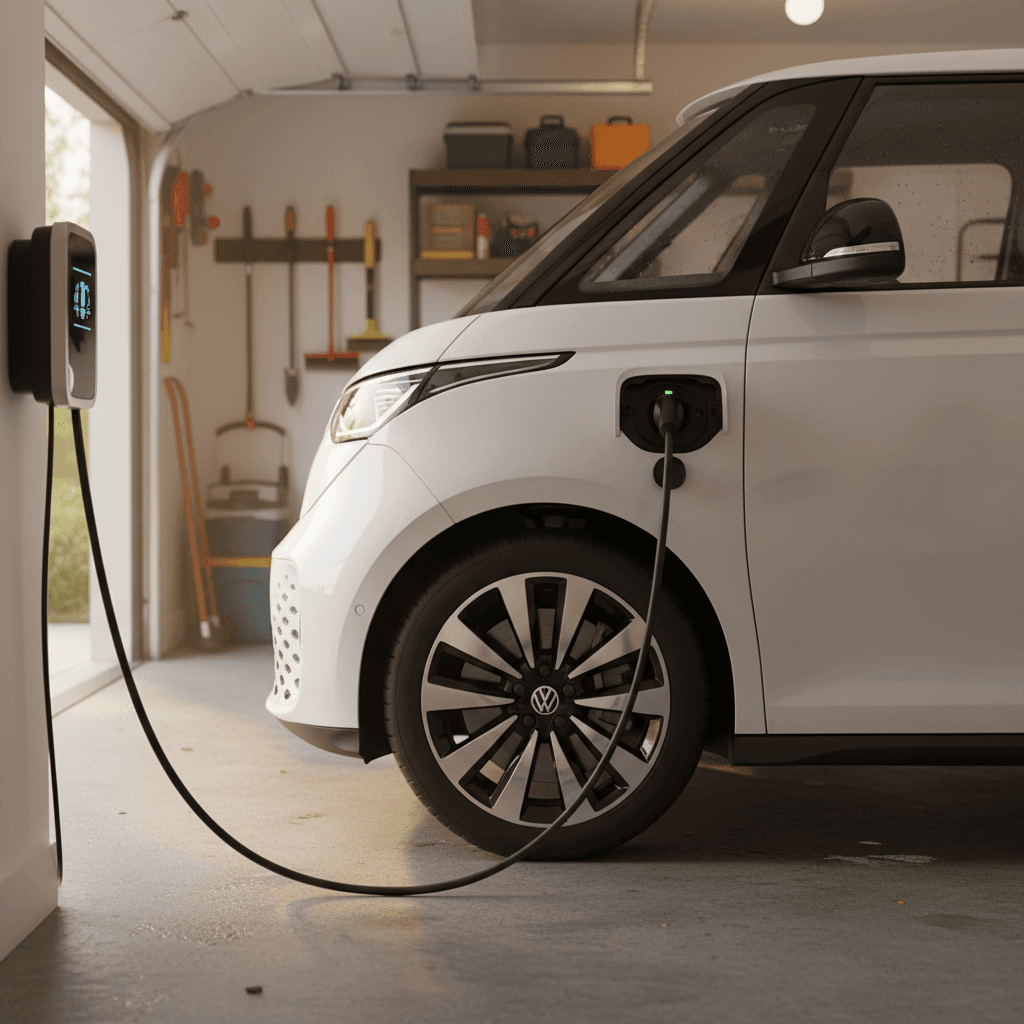
You don’t buy a Volkswagen ID. Buzz because you like subtlety. It’s a rolling conversation piece, a three‑row nostalgia bomb with a 91 kWh battery hiding under the floor. To keep that big pack happy, you need a sensible plan for how to charge your Volkswagen ID. Buzz at home, not just “plug it in and hope.” This guide walks you through hardware, wiring, charging times, costs, and habits that keep both your electric bill and your battery in a good mood.
Key takeaway
VW ID. Buzz battery and charging basics
Volkswagen ID. Buzz charging fundamentals
In North America, the 2025+ Volkswagen ID. Buzz uses a high‑voltage battery around 91 kWh gross (about 86 kWh usable). That’s great for road trips and hauling kids, dogs, and IKEA furniture, but it means you’re moving a lot of energy in and out of the pack. The van’s onboard AC charger is rated around 11 kW, which is the maximum power it can accept from any home Level 2 charger. Bigger wallbox on the garage wall? Fine. The Buzz will still sip only 11 kW at most.
At home you’ll almost always be using AC charging. DC fast charging, the big road‑trip stations promising 10–80% in under half an hour, is for highways and downtime near coffee shops, not your breaker panel. The only questions at home are: 120 V or 240 V, how many amps, and how smart you want the setup to be.
Level 1 vs. Level 2 charging at home
Level 1: 120 V household outlet
- Power: Typically 1.2–1.4 kW on a 15 A circuit.
- Speed: Roughly 2–3 miles of range per hour in a big van like the ID. Buzz.
- Hardware: The VW 2‑in‑1 Mobile EV Charge Cable or a basic Level 1 EVSE.
- Best for: Low daily mileage (10–20 miles), overnight top‑ups, apartments where 240 V isn’t possible.
Level 1 is the "drip coffee" of EV charging, slow, but it works if you don’t drive much.
Level 2: 240 V circuit
- Power: 7.2–11 kW, depending on your charger and circuit (32–48 A typical).
- Speed: Commonly 20–35 miles of range per hour for the ID. Buzz.
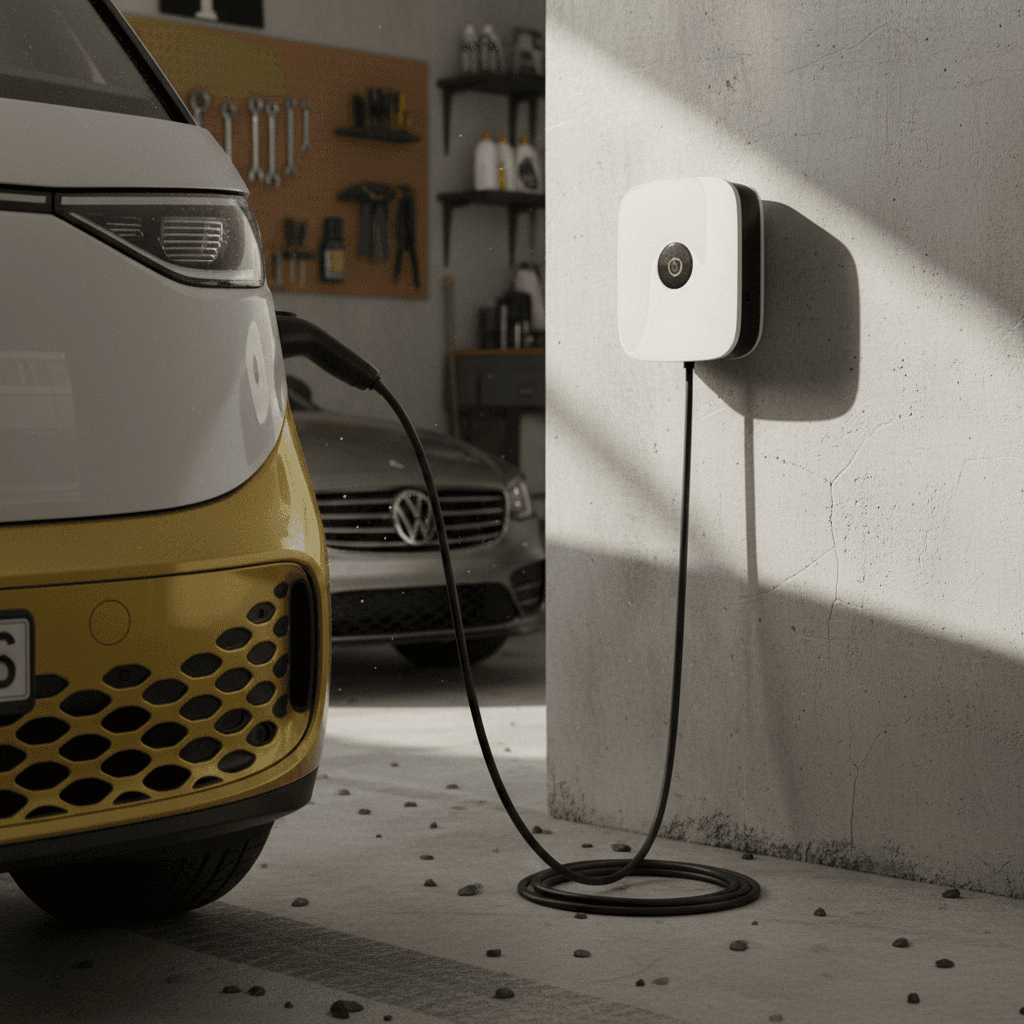
- Hardware: Wall‑mounted or plug‑in Level 2 EVSE, often with Wi‑Fi/app controls.
- Best for: Daily use, families, road‑trip prep, and anyone who wants a full battery by morning.
Level 2 turns your garage into your own private charging station. For an ID. Buzz, it’s not a luxury, it’s basically standard equipment.
When Level 1 is enough
Choosing a home charger for your ID. Buzz
Common home charging options for the ID. Buzz
Pick based on your driving pattern, not just the box art
VW 2‑in‑1 Mobile EV Charge Cable
Volkswagen offers a compact mobile cable that can do both Level 1 (120 V) and Level 2 (240 V) when paired with the right outlet.
- Good for: Flexibility, occasional travel, temporary setups.
- Downside: Lower power than a dedicated 48 A wallbox, more clutter.
Hard‑wired Level 2 wallbox
A dedicated 240 V charger mounted on the wall, typically 40–48 A.
- Good for: Daily drivers, multi‑EV households, fastest home charging.
- Downside: Requires an electrician and permanent installation.
Plug‑in Level 2 (NEMA 14‑50, etc.)
A 240 V EVSE that plugs into a NEMA 14‑50 or similar outlet, like an electric range or RV plug.
- Good for: Renters, flexibility, easier replacement.
- Downside: Still needs a 240 V circuit; ensure outlet and wiring are sized correctly.
Your ID. Buzz uses the standard J1772 inlet for AC charging in the U.S. (hidden behind that little door on the rear quarter), so any reputable Level 2 charger with a J1772 plug will work. You don’t need anything VW‑branded or van‑specific. What matters is amperage, build quality, and whether the app experience makes sense to you.
Don’t overspend on “too big” amperage
Electrical requirements, outlets, and safety
Common home outlet / circuit options for ID. Buzz charging
Always consult a licensed electrician before adding new 240 V circuits.
| Use case | Voltage | Typical breaker | Charger type | Notes |
|---|---|---|---|---|
| Basic Level 1 | 120 V | 15–20 A | Mobile EVSE | Use a dedicated outlet if possible; avoid extension cords. |
| Solid Level 2 (most common) | 240 V | 40–50 A | 32–40 A wallbox | Good balance of speed and panel load. |
| Maxing out onboard charger | 240 V | 60 A | 48 A wallbox | Gets you close to the 11 kW onboard charger limit. |
| Shared garage / multi‑EV | 240 V | 50–60 A with load sharing | Smart dual‑port EVSE | Lets two EVs share one circuit without tripping breakers. |
These are typical North American residential setups; details vary by home.
For Level 2, you’re in 240 V territory. That means a dedicated double‑pole breaker in your panel, correctly sized wire, and a properly installed outlet or hard‑wired connection. This is not “YouTube and a screwdriver” work, hire an electrician, describe your vehicle (large battery, 11 kW onboard charger), and let them evaluate your panel capacity.
Safety first, always
How long does it take to charge at home?
With a ~86 kWh usable battery and an 11 kW onboard charger, the math for the ID. Buzz is straightforward. Real‑world charging is never perfectly linear, but these ballpark numbers are close enough for planning school runs and road trips.
Approximate Volkswagen ID. Buzz home charging times
Assumes around 86 kWh usable battery and typical charging efficiencies.
| Charging setup | Power at the car | From 20% to 80% | From 0% to 100% | Use case |
|---|---|---|---|---|
| Level 1, 120 V ~12 A | ~1.3 kW | ~40–50 hours | Well over 60 hours | Emergency top‑ups, very light use |
| Level 2, 240 V 32 A | ~7.7 kW | ~8–9 hours | ~11–12 hours | Good overnight solution for most owners |
| Level 2, 240 V 40 A | ~9.6 kW | ~6–7 hours | ~9–10 hours | Comfortable daily home charging |
| Level 2, 240 V 48 A | Up to ~11 kW | ~5–6 hours | ~8–9 hours | Fastest typical home charging, panel permitting |
Actual times vary with temperature, battery state of charge, and charging losses.
You almost never need 0–100% at home
Smart charging schedules and time-of-use rates
Many utilities now offer time‑of‑use (TOU) plans where electricity is cheapest late at night. The ID. Buzz and most modern home chargers let you schedule charging to start at, say, midnight and finish before your morning commute, without you wandering into the garage in pajamas.
Set up smart, cheap overnight charging
1. Call your utility about EV or TOU plans
Ask if there’s a discounted overnight rate or a dedicated EV meter option. Sometimes the difference between peak and off‑peak can cut your home charging cost by a third or more.
2. Decide if the car or charger controls the schedule
You can usually schedule charging in the ID. Buzz settings or in the charger’s app. Pick one brain to be in charge to avoid conflicts, don’t set overlapping schedules in both.
3. Create a “home” profile in the ID. Buzz
In the van’s charging menu, save your home location and assign preferred charging hours or a departure time. That way the Buzz behaves differently at home than at random public plugs.
4. Test the schedule for a week
Watch a few nights closely. Make sure charging actually starts when it should, and that the van reaches your target charge level before you leave.
Beware dueling schedules
Battery health best practices for your ID. Buzz
- For daily use, keep the battery between roughly 20% and 80% when practical.
- Save 100% charges for road trips and long days, and start driving soon after you hit full.
- If you’re parking for days, leave the van somewhere in the 40–60% range rather than full.
- Avoid fast‑charging repeatedly back‑to‑back when a Level 2 session would do.
- Use preconditioning (heating/cooling) while plugged in so cabin energy comes from the wall, not the pack.
What “good behavior” looks like
If you’re looking at a used ID. Buzz, this is where Recharged comes in handy. Every van on Recharged gets a Recharged Score battery health report, so you can see how that big pack is doing before you bring it home, and before you invest in a charger built around your daily routine.
Step-by-step: setting up home charging
Two paths to home charging: quick setup vs. full install
Path A: Simple, low‑mileage setup
Use the VW 2‑in‑1 Mobile EV Charge Cable on a dedicated 120 V outlet while you get to know the van.
Track your first two weeks of driving. If you’re averaging under 15–20 miles per day, Level 1 may be enough.
Have an electrician inspect the outlet circuit to confirm it’s safe for continuous EV charging.
Set a conservative charge limit (around 80%) and plug in whenever you’re home.
Re‑evaluate after a month; if you’re constantly near empty, move to Path B.
Path B: Proper Level 2 installation
Estimate your daily mileage and how quickly you want to “refuel” at home.
Call at least two licensed electricians to quote a 40–60 A, 240 V circuit in your preferred charging spot.
Choose a reputable Level 2 EVSE (40–48 A, J1772 plug, app features you’ll actually use).
Schedule installation, including any panel upgrades or trenching if your parking spot is far from the main panel.
Configure Wi‑Fi, user accounts, and schedules in the charger app and in the ID. Buzz.
Test a full 20–80% overnight session and verify that breakers stay cool and the charger behaves as expected.
Roll charging into the car deal
Why home charging matters for your ID. Buzz
Cost per “fill‑up” vs. gasoline
Assuming around 3 mi/kWh and an off‑peak rate of $0.12/kWh, driving 300 miles in your ID. Buzz uses roughly 100 kWh. That’s about $12 in electricity. Even at $0.20/kWh, you’re looking at about $20. Compare that to a thirsty gas minivan or SUV and you’ll see why EV owners quietly loosen their grip on the fuel‑receipt envelope.
Quality of life and convenience
Once home charging is set up, your “fuel stop” is literally walking past the van on your way inside. No detours, no gas station coffee, no wrestling kids in the rain. You wake up, the Buzz is warm or cool, and you have the range you need for the day. That’s the whole game.
The Volkswagen ID. Buzz is a big, loveably silly object with a very serious battery underneath. Getting home charging right, matching charger, circuit, schedule, and your actual life, is the difference between EV ownership that feels like a science project and one that just works. Take the time to spec a sensible Level 2 setup, lean on off‑peak electricity, and treat that big pack kindly. And if you’re shopping used, let a Recharged Score report and Recharged’s EV specialists guide you into an ID. Buzz whose battery and charging habits fit your reality, not just your Pinterest board.