Owning a Tesla Model X without easy home charging is like owning a smartphone and never plugging it in overnight. If you’re wondering how to charge a Tesla Model X at home, how fast it charges, what equipment you actually need, and what it will do to your electric bill, this guide walks you through it in plain English.
Good news for Model X owners
Why home charging matters for Model X owners
Convenience beats any gas station
The single biggest upgrade you can give your Model X is the ability to plug in where you park. Instead of detouring to a Supercharger, you wake up every morning with the range you need for the day.
- No weekly fuel stops
- No waiting in line at public chargers
- Perfect for school runs, commuting and errands
Cost control and battery health
Home charging lets you control when and how your battery charges. You can schedule charging for off‑peak rates, avoid the repeated high‑power DC fast charging that ages batteries faster, and keep your State of Charge (SoC) in the healthy middle range day to day.
For a big‑battery SUV like the Model X, that’s the difference between an easy ownership experience and constantly thinking about range.
Tesla Model X home charging at a glance
Tesla Model X home charging basics
Before you buy any hardware, it helps to know what’s inside the vehicle. Every Model X has an onboard AC charger, which converts AC power from your home into DC power for the battery. Recent U.S. Model X builds support up to 48 amps on AC when paired with a suitable circuit and a Tesla Wall Connector. The more amps your circuit and equipment can safely supply (up to that limit), the faster the car can charge.
- Battery size: Most recent Model X variants have packs in roughly the 90–100 kWh range, so a full charge is a lot of energy.
- Onboard charger limit: Up to 48A on AC (about 11.5 kW) on current North American configurations when wired to a 60A breaker.
- Daily use vs road trips: Home charging covers everyday needs; Superchargers are for fast top‑ups on long drives.
Think in miles per hour, not kilowatts
Home charging options for your Model X
There are three main ways to charge a Tesla Model X at home in the U.S. They all use the same charge port on the car; what changes is the outlet, equipment, and speed.
Three main home charging paths for Model X
From “do nothing yet” to full Tesla Wall Connector
1. Standard 120V outlet (Level 1)
This uses the Mobile Connector with a regular household outlet (NEMA 5‑15).
- ~3–5 miles of range per hour
- Works anywhere there’s a grounded 120V outlet
- Good for low‑mileage drivers or short term
2. 240V outlet + Mobile Connector (Level 2)
Install a 240V outlet (like NEMA 14‑50 or 6‑50) and use Tesla’s Mobile Connector with the right adapter.
- Often 20–30 miles of range per hour
- Lower hardware cost than a Wall Connector
- Great sweet spot for many households
3. Tesla Wall Connector (best experience)
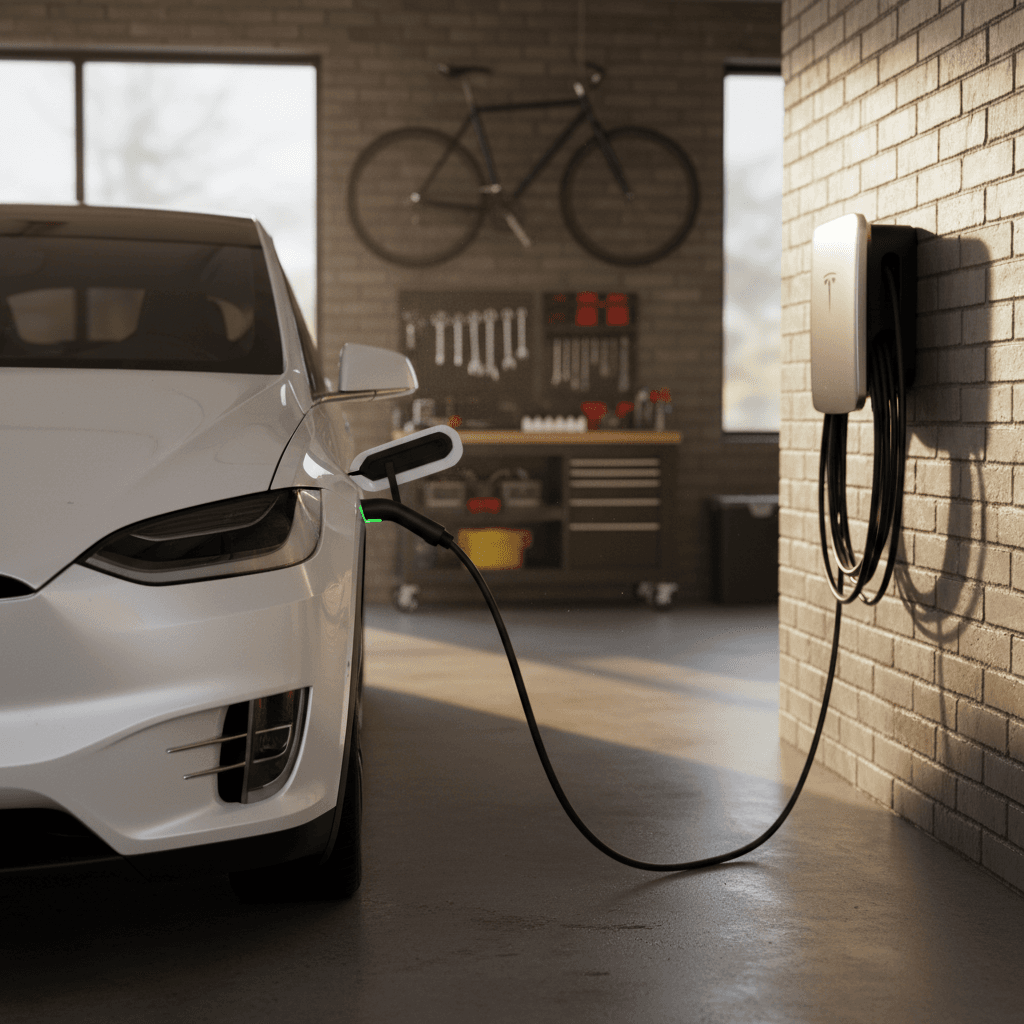
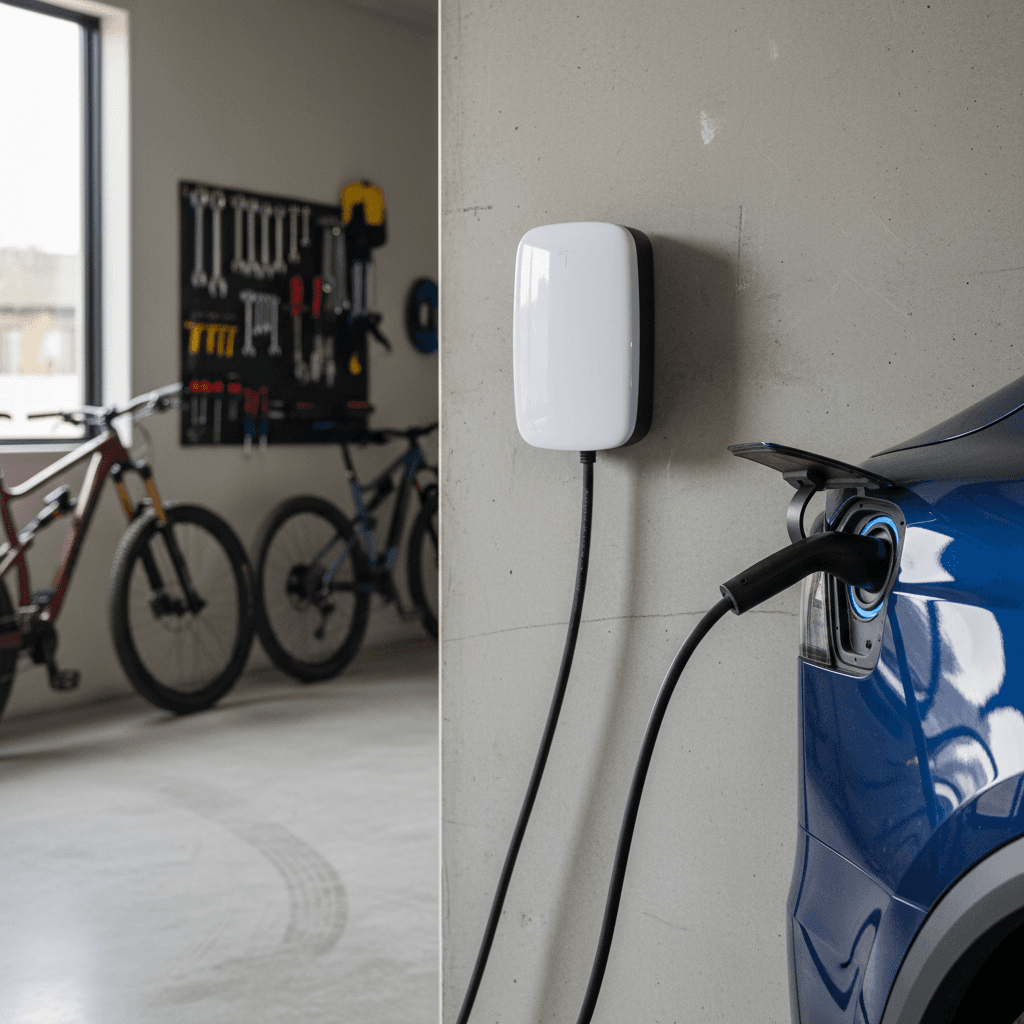
Hard‑wired or plugged into a 240V circuit, this is Tesla’s dedicated home charger.
- Up to 48A with the right wiring
- Clean install, built‑in cable management
- Supports multiple Teslas and load sharing
Don’t DIY high‑voltage work
How long does it take to charge a Model X at home?
“How long does it take?” really means “How much range do I get while I’m sleeping?” Your exact numbers depend on your Model X variant, wheel size, climate, and driving style, but you can use these ballpark figures for planning.
Approximate Tesla Model X home charging speeds
Typical real‑world range added per hour for common home setups in the U.S.
| Setup | Electrical service | Approx power (kW) | Miles of range per hour* | Best for |
|---|---|---|---|---|
| Mobile Connector, 120V (NEMA 5‑15) | 120V, 15A circuit (12A charging) | ~1.4 kW | ~3–5 mi/hr | Apartment/garage with no 240V, very light use |
| Mobile Connector, 240V 20–30A outlet | 240V, 20–30A circuit (16–24A charging) | ~3.8–5.8 kW | ~10–18 mi/hr | Moderate commuting, overnight top‑ups |
| 240V 50A outlet + Mobile Connector (if supported)** | 240V, 50A circuit (~32A charging limit) | ~7.7 kW | ~18–25 mi/hr | Heavier use, two drivers sharing one car |
| Tesla Wall Connector @ 48A | 240V, 60A circuit (hard‑wired) | ~11.5 kW | ~25–35+ mi/hr | Fastest AC home charging, big daily miles or multiple EVs |
Assumes a modern Model X with roughly 350–400 Wh/mi energy use. Your actual results will vary with weather, speed, and load.
You don’t start from 0% every night
What you need: electrical requirements and safety
Think of your home as another fueling station that has to be built to code. The Model X is smart about protecting its battery, but your panel and wiring still need to be sized correctly for continuous EV charging loads.
Home charging readiness checklist
1. Check panel capacity
Look at the main breaker rating (often 100–200A) and how many spaces are left. An electrician can run a proper load calculation to see if you can support a 50–60A EV circuit or if you need a panel upgrade.
2. Decide 120V vs 240V
If you drive fewer than ~25–30 miles a day and have no way to add a 240V outlet, 120V might be enough short‑term. Otherwise, plan for a 240V Level 2 circuit, it’s the right match for a large SUV like the Model X.
3. Choose outlet or Wall Connector
A 240V outlet plus Tesla Mobile Connector is flexible and cheaper upfront. A Wall Connector is cleaner, can deliver higher current, and supports multiple Teslas with load sharing.
4. Hire a licensed electrician
Ask specifically for EV charging experience. Share Tesla’s Wall Connector installation guide and your target amperage (e.g., 60A circuit for 48A charging).
5. Confirm permits and inspection
Many U.S. jurisdictions require a permit for a new 240V circuit or panel work. Your electrician should pull and close the permit; don’t skip this step.
6. Plan the parking and cable run
Think about where the Model X charge port is (driver‑side rear) and where you park. Place the outlet or Wall Connector so the cable reaches easily without stretching across walkways.
Never “over‑break” a circuit
Step-by-step: how to charge your Model X at home
Once the hardware is in, the everyday routine is simple. Here’s the basic playbook whether you’re on a standard outlet, a 240V receptacle, or a Wall Connector.
- Park your Model X so the driver‑side rear charge port is within easy reach of the cable.
- Tap the charge‑port door on the car, press the button on the Tesla connector handle, or use the app to open the port.
- Insert the connector fully until you feel and hear it click; the port light will go blue, then pulse green when charging starts.
- On the center screen or in the Tesla app, confirm the amps and schedule. If you’re on 120V or a weak circuit, you can manually reduce amps; on a professionally installed 240V circuit, you’ll usually leave it at the maximum the electrician configured.
- Set a daily charge limit, many owners choose 70–90% for routine use. Slide the charge limit slider to your preferred level in the Charging menu.
- Unplug in the morning (or when you’re ready to leave). Press the button on the connector handle to release, coil the cable, and close the charge‑port door.
Use scheduled charging for cheap power
How much does it cost to charge a Model X at home?
The big fear is that your electric bill will explode. In reality, even a large SUV like the Model X is usually cheaper to “fuel” at home than a comparable gas vehicle, especially on off‑peak rates.
Rule‑of‑thumb math
To estimate your cost, you only need three numbers:
- Your electricity rate in $/kWh (for many U.S. households, roughly $0.15–$0.20 in 2025–2026).
- Your Model X’s energy use, often around 0.35–0.40 kWh per mile in mixed driving.
- Your monthly miles.
Multiply miles × kWh/mile × price per kWh to get your monthly charging cost.
Example: 1,000 miles per month
Say your X averages 0.37 kWh/mi, you drive 1,000 miles per month, and you pay $0.17/kWh:
- 1,000 mi × 0.37 kWh/mi = 370 kWh
- 370 kWh × $0.17 ≈ $63/month
That’s the fuel bill for a three‑row luxury SUV with instant torque. A comparable gas SUV getting 20 mpg at $3.50/gal would burn about $175 in fuel for the same miles.
Public fast charging vs home
Smart settings to protect your battery
The Model X battery is happiest when it’s neither empty nor full and when it’s warmed gently before hard use. Home charging gives you the control to do exactly that.
Battery‑friendly charging habits
Easy settings that add years of useful range
Set a daily limit
For daily use, set the charge limit to around 70–90%. Use 100% only for long trips and drive soon after reaching it.
Schedule around departure
Use scheduled departure so the car times charging and battery conditioning to finish near the moment you leave. This minimizes time spent at high state‑of‑charge.
Let it precondition in winter
In cold climates, let the car warm the battery while still plugged in. You’ll see higher efficiency and less sudden range drop once you’re on the road.
Home charging is battery‑friendly by default
Troubleshooting common home charging issues
Tesla’s software is usually good at telling you what’s wrong, but a few issues come up often when people first set up home charging.
If your Model X isn’t charging as expected
1. Charging slower than expected
Check the amperage on the car’s Charging screen. If it shows something low (like 12A on a 240V circuit), the car or the charger may be derating because of heat or a weak circuit. Don’t try to “force” more current, call your electrician.
2. Breaker trips when you plug in
This suggests the circuit is overloaded or mis‑wired. Reduce the current in the car’s charging menu as a temporary measure and schedule an electrician visit; the long‑term fix is proper wiring and breaker sizing.
3. Car won’t start charging
Make sure the connector is fully seated, the charge port is clean, and the outlet or Wall Connector shows normal status lights. Try another outlet if you’re on 120V. If the problem is only at one location, the issue is likely on the home side, not the car.
4. No option to adjust amps
If the slider is missing, the car may be following a limit communicated by a smart charger or building system. That’s common in shared parking or apartment chargers and something the property manager has to adjust.
5. GFCI outlet keeps tripping
Some 120V GFCI outlets are sensitive to EV loads. An electrician can evaluate whether a different circuit or a dedicated EV branch circuit is safer and more reliable.
If in doubt, stop and inspect
Home charging tips when buying a used Model X
If you’re shopping for a used Tesla Model X, especially from a private seller, home charging should be on your checklist right next to battery health and tire condition. A great deal on the vehicle can be undercut by a bad or missing home‑charging plan.
Questions to ask the seller
- Which charging hardware is included? Confirm whether you’re getting a Tesla Mobile Connector, any outlet adapters, and whether a Wall Connector is staying with the home (it usually does).
- How was the car charged day to day? Home Level 2 charging with reasonable daily limits is ideal; heavy lifetime DC fast charging is harder on the pack.
- Any charging issues or repairs? Ask explicitly about past faults, wall charger replacements, or panel upgrades.
How Recharged can help
Every used EV listed on Recharged comes with a Recharged Score Report that includes verified battery health and charging history signals where available. Our EV specialists can also help you:
- Estimate home charging costs in your state
- Choose between 120V, 240V outlet, and Wall Connector setups
- Plan electrician work before the car even arrives via nationwide delivery
If you’re trading in a gas SUV for a used Model X, dialing in home charging is where the ownership experience really flips in your favor.
Tesla Model X home charging FAQ
Frequently asked questions
Bottom line: making Model X home charging easy
Charging a Tesla Model X at home doesn’t have to be mystical or expensive. Start with what you have, a standard outlet if that’s all that’s available, then, as budget and panel capacity allow, step up to a 240V Level 2 setup that matches your driving patterns. A well‑installed Wall Connector or 240V outlet turns the Model X from a spectacular road‑trip machine into an easy, no‑drama daily driver.
If you’re considering a used Model X, or moving from a gas SUV to any used EV, home charging is where ownership either sings or stumbles. Recharged pairs each vehicle with a Recharged Score battery health report and expert guidance on charging, financing, trade‑in, and nationwide delivery, so you’re not guessing about either the car or the plug that feeds it.