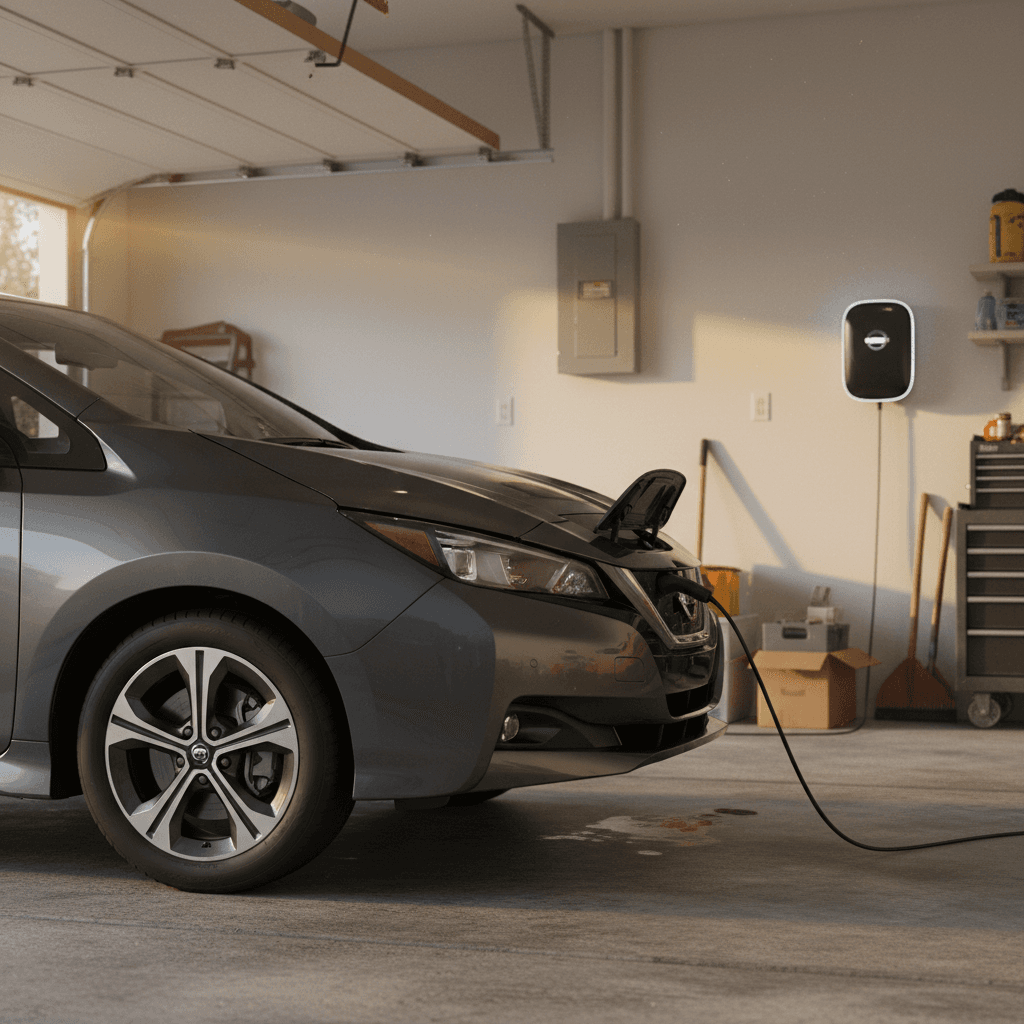
Charging a Nissan Leaf at home is where this EV makes the most sense. You plug in when you park, wake up to a full battery, and skip gas stations entirely. The good news: whether you own a 24 kWh first‑gen Leaf or a newer 40–62 kWh car, the basics of home charging are simple if you understand a few key concepts.
The short version
Nissan Leaf home charging basics
Two main ways to charge a Leaf at home
Same car, different outlets and speeds
Level 1: 120V household outlet
What it is: The portable Nissan EVSE that comes with the car, plugged into a standard 120V outlet.
- Charging speed: roughly 4–5 miles of range per hour of charging.
- Best for: short daily commutes, topping up 20–40% overnight.
- Pros: no installation if you already have a suitable outlet.
- Cons: very slow if your battery is low or you have a long commute.
Level 2: 240V home charger
What it is: A dedicated 240V circuit feeding either a wallbox or a higher‑power portable EVSE with a NEMA 14‑50 or similar plug.
- Charging speed: typically 3–6.6 kW on a Leaf, or about 15–25 miles of range per hour.
- Best for: daily use, bigger batteries, shared households.
- Pros: far faster, future‑proof for other EVs.
- Cons: requires a 240V circuit and usually an electrician.
Both options use the same J1772 AC charging port on your Leaf. DC fast charging (CHAdeMO) is great for road trips and quick top‑ups, but it’s a public‑station thing, not something you install at home.
Understand your Leaf’s battery and onboard charger
Battery size by common Leaf versions
- 24 kWh (early models, roughly 2011–2016)
- 30 kWh (select 2016–2017 models)
- 40 kWh (most 2018+ non‑Plus models)
- 62 kWh (Leaf Plus, extended‑range trim)
The bigger the battery, the more energy you’re storing, and the longer it takes to fill at a given power level.
Onboard charger: your real speed limit
The Leaf’s AC onboard charger is what actually decides how fast you can charge on Level 1 or Level 2. Most modern Leafs in the U.S. have a 6.6 kW onboard charger.
- Older models: 3.3–3.6 kW standard, 6.6 kW optional.
- Newer models: 6.6 kW (about 27–32 amps at 240V).
Buying a 48‑amp wallbox won’t make an older 3.3 kW Leaf charge faster. The car will simply pull what it can handle, and ignore the rest.
Where to find your max AC rate
Option 1: Level 1 (120V) charging at home
Level 1 is the slow‑and‑steady workhorse of EV charging. Your Leaf’s included portable charge cable (Nissan Portable Charge Cable) plugs into a standard 120V household outlet and delivers about 1.3–1.8 kW of power. That’s enough for many drivers, especially if you’re only using 20–40 miles of range per day.
Set up Level 1 charging safely
1. Choose the right outlet
Use a <strong>dedicated 15‑ or 20‑amp circuit</strong> if possible, for example, a garage outlet that doesn’t also power a fridge, tools, or space heater. Avoid long daisy‑chains of outlets or ancient wiring.
2. Inspect the outlet and plug
Check for discoloration, loose receptacles, or heat. If the plug or outlet feels hot after 15–20 minutes of charging, stop and have an electrician inspect it.
3. Use the factory cable correctly
Plug the Nissan cable fully into the outlet, then into the car. Don’t use extension cords or power strips; they’re not designed for sustained high current.
4. Manage your schedule
Expect around <strong>4–5 miles of range per hour</strong>. If you drive 30 miles a day, 8 hours overnight is usually enough. For heavier use, consider Level 2.
5. Keep it dry and ventilated
The EVSE unit is weather‑resistant, but outlets in damp locations (old exterior boxes, basements) can be risky. Keep the connection clean and protected from standing water.
Don’t treat Level 1 as a long‑term band‑aid for heavy use
Option 2: Level 2 (240V) charging at home
Level 2 turns your Leaf into a true plug‑and‑forget appliance. Using a 240V circuit, often the same type used for dryers or ranges, you can charge 2–4x faster than Level 1. For most Leaf owners in the U.S., this means going from nearly empty to full overnight instead of over a full day or more.
Two common paths to Level 2 charging
Hardwired wallbox vs. plug‑in portable EVSE
Hardwired wallbox
A permanent charger bolted to the wall and wired directly into your electrical panel.
- Pros: clean installation, can support higher amps, best for long‑term homeowners.
- Cons: requires an electrician and usually a permit; not portable if you move.
- Good match: Single‑family homes, owners who know they’ll keep an EV for years.
240V plug‑in EVSE
A portable charger that plugs into a NEMA 14‑50, 6‑50, or similar 240V outlet.
- Pros: Often cheaper, removable if you move, can double as travel charger.
- Cons: You still need a 240V outlet installed and protected from weather.
- Good match: Renters in houses, people with existing 240V outlets in garages.
The 80% rule, in one sentence
What Level 2 feels like on a Nissan Leaf
Step‑by‑step: how to charge your Nissan Leaf at home
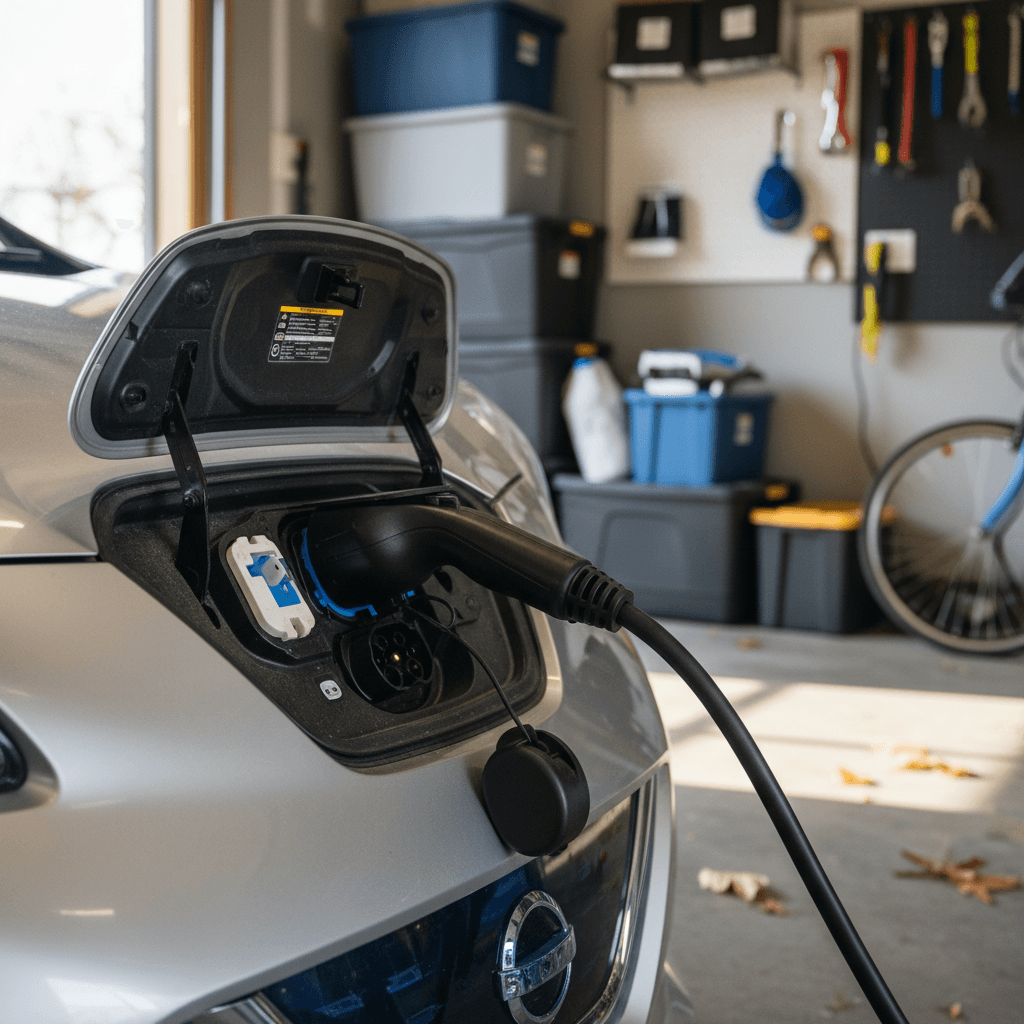
- Park and secure the car. Put the Leaf in Park, set the parking brake if you’re on an incline, and switch off the ignition.
- Open the charge port door. Use the button on the dash (or the fob/app on some models) to pop open the charge port flap at the nose of the car.
- Check your EVSE. Make sure the indicator lights on your portable cable or wallbox show it’s ready, typically a solid green or blue status light.
- Plug into the car first. Align the J1772 connector with the Leaf’s port and push until it clicks. A locking tab will keep it in place.
- Verify charging. Look at the Leaf’s dash lights or app: you should see charging indicators blinking and an estimated time to full.
- Schedule smartly. If your utility offers off‑peak rates, use the Leaf’s charging timer or the app so charging happens overnight when electricity is cheaper.
- Unplug correctly. When you’re done, stop charging via the car or app if needed, press the release button on the connector, and close the charge port door. Coil and store the cable so it doesn’t become a trip hazard.
Good news for used‑Leaf shoppers
Ready to find your next EV?
Browse VehiclesHow long does it take to charge a Nissan Leaf at home?
Approximate Nissan Leaf home charge times
Rough estimates from low state of charge to near full under typical conditions. Actual times vary with temperature, driving style, and battery health.
| Leaf battery size | Charging type | Power at car | Approx. time from low to full |
|---|---|---|---|
| 24 kWh | Level 1 (120V) | ≈1.4 kW | 20–24 hours |
| 24 kWh | Level 2 (240V) | 3.3–6.6 kW | 4–8 hours |
| 30 kWh | Level 1 (120V) | ≈1.4 kW | 24–28 hours |
| 30 kWh | Level 2 (240V) | 3.3–6.6 kW | 5–9 hours |
| 40 kWh | Level 1 (120V) | ≈1.4 kW | 30–36 hours |
| 40 kWh | Level 2 (240V) | 6.0–6.6 kW | 6–8 hours |
| 62 kWh | Level 1 (120V) | ≈1.4 kW | 48+ hours |
| 62 kWh | Level 2 (240V) | 6.0–6.6 kW | 9–11 hours |
Use this as a planning tool, not a lab spec sheet.
Think in “miles per hour” of charge
How much does it cost to charge a Nissan Leaf at home?
Your Leaf’s battery is essentially a gas tank measured in kilowatt‑hours (kWh). To estimate cost, multiply the energy you add by your electricity rate. In many parts of the U.S., off‑peak residential rates fall in the $0.10–$0.20 per kWh range; some dense coastal markets are higher.
Simple cost math
- Full 40 kWh charge at $0.15/kWh: 40 × $0.15 ≈ $6.00.
- Full 24 kWh charge at $0.15/kWh: 24 × $0.15 ≈ $3.60.
- If your Leaf averages 3.5 mi/kWh, that $6 buys you ~140 miles of driving.
Compare that with a compact gas car at 30 mpg and $3.50/gal, you’d spend more than $16 on fuel to go the same distance.
Ways to lower your charging bill
- Use your utility’s time‑of‑use or EV rate plan if available.
- Schedule charging during off‑peak windows (often late night to early morning).
- If you have solar, align daytime Level 2 charging with your production peak.
- Avoid frequent DC fast charging at home (if it ever becomes an option); it’s usually pricier and harder on the battery.
Real‑world owner experience
Charging safely: what to do and what to avoid
Home charging safety checklist
Use dedicated circuits when possible
For both Level 1 and Level 2, a dedicated circuit sized correctly for continuous load greatly reduces nuisance breaker trips and heat in the wiring.
Let an electrician handle 240V work
Installing a new 240V outlet or hardwired wallbox isn’t a DIY science‑fair project. A licensed electrician will size wire and breakers correctly and pull permits if needed.
Mount cables thoughtfully
Use cable hooks or reels to keep cords off the ground, away from puddles and lawn equipment. Think of it like routing garden hoses: neat, predictable, safe.
Check for heat and wear periodically
Every few months, feel the plug, outlet, and EVSE body during a charge. Warm is normal; too hot to touch is not. Look for cracks, discoloration, or frayed insulation.
Protect outdoor equipment
If you charge outside, make sure outlets and chargers are rated for outdoor use and protected from direct sprinkler spray and standing water.
Hard no’s for Leaf home charging
Home charging tips for renters and apartment dwellers
Not everyone has a private garage and a friendly breaker panel. The Leaf is still one of the easiest EVs to live with in an apartment, as long as you’re realistic and a little strategic.
Making a Nissan Leaf work without a perfect garage
Small hacks that add up to a usable daily routine
Negotiate reserved outlet access
Ask your landlord if you can use an existing outlet near your parking spot, many small properties already have one for block heaters or maintenance.
Offer to pay for a dedicated circuit upgrade if needed; it can improve the property and make your Leaf much easier to charge.
Ask about shared Level 2
More multifamily buildings are adding shared Level 2 stations in parking areas.
If your complex is considering it, a Leaf is a great “anchor tenant” thanks to its modest battery size and predictable needs.
Blend home and public charging
If home charging is only Level 1 or inconsistent, build in a weekly Level 2 stop at a grocery store, gym, or workplace.
Your Leaf’s CHAdeMO port also gives you access to DC fast charging where it’s still supported.
Portable EVSE as a renter’s secret weapon
FAQ: Nissan Leaf home charging
Common questions about charging a Nissan Leaf at home
Is a used Nissan Leaf right for your home‑charging setup?
If you can plug in where you park, even to a humble 120V outlet, a Nissan Leaf is one of the most forgiving, budget‑friendly EVs you can own. A simple Level 2 setup turns it into a genuine refueling appliance: park, plug, sleep, repeat. The key is understanding how your home’s wiring, your Leaf’s onboard charger, and your daily mileage fit together.
If you’re shopping for a Leaf, especially a used one, it’s worth pairing the car with a smart charging plan. At Recharged, every used EV comes with a Recharged Score Report so you know the battery’s true health, plus EV‑savvy specialists who can talk through home‑charging options, electrician quotes, and what makes sense for your lifestyle. Get the charging right, and the Leaf quietly does what great appliances do: it simply works in the background while you get on with your life.