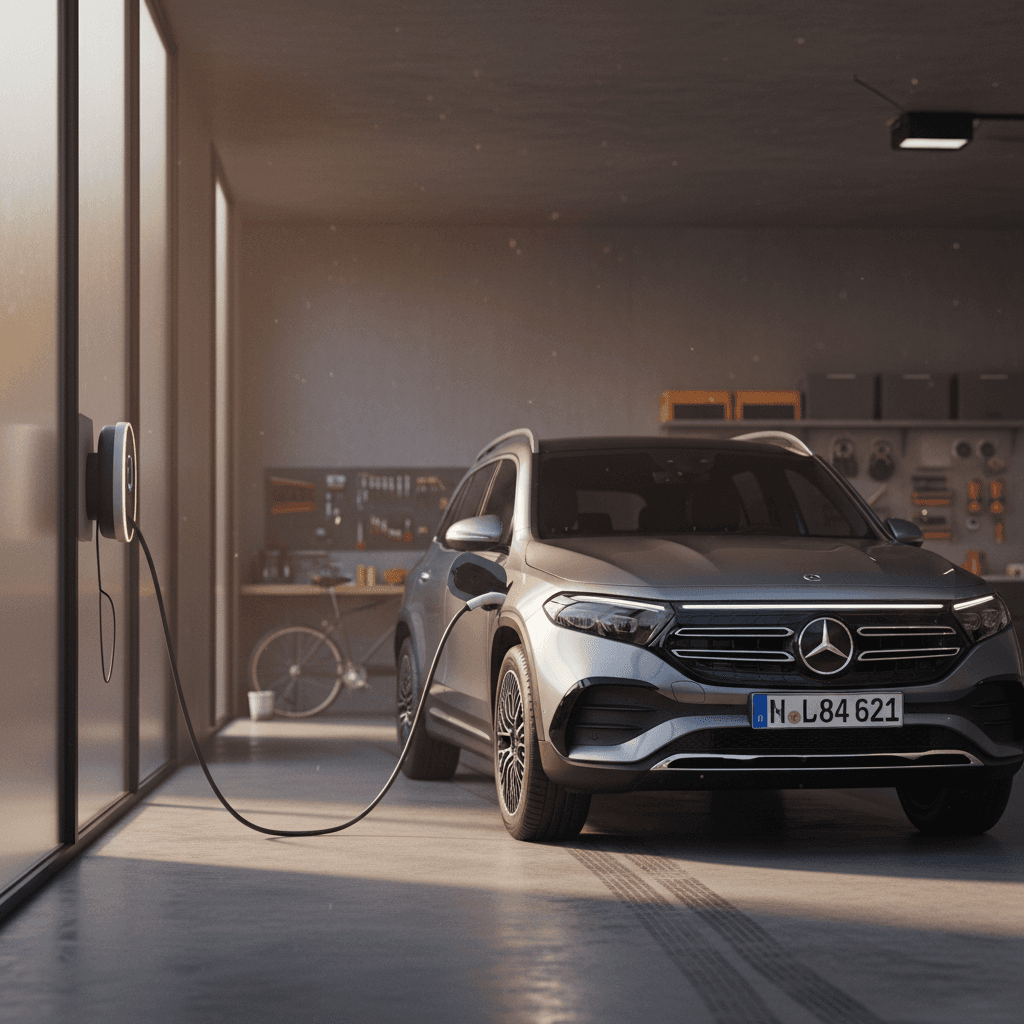
If you’ve just brought home a Mercedes EQB, your biggest quality‑of‑life upgrade isn’t another option package, it’s a smart home charging setup. Understanding how to charge a Mercedes EQB at home is what turns it from a nice electric crossover into an easy, low‑stress daily driver.
Quick EQB home charging snapshot
Mercedes EQB home charging basics
Before you think about wallboxes and electricians, it helps to understand what the EQB can actually accept. Recent EQB trims (EQB 250, 300, 350) use a battery in the ~70 kWh range and support up to about 9.6–11 kW on AC at home and roughly 100 kW on DC fast charging on the road. At home you’re almost always using AC, which is limited by the car’s onboard charger and your house wiring, not the magic number on a DC fast‑charge poster.
- Connector: In North America the EQB uses the familiar J1772 plug for AC Level 1 and Level 2 charging (often via an included Mobile Flex or similar portable cable).
- Charging levels: Level 1 = 120V household outlet (slow but convenient). Level 2 = 240V circuit (dryer or dedicated EV circuit) using a wallbox or higher‑power portable EVSE.
- Onboard charger: Think of the EQB’s 9.6–11 kW AC rating as its "maximum appetite". A bigger home charger than that doesn’t speed things up; a smaller one just feeds it more slowly.
DC fast charging vs home charging
Level 1 vs Level 2: What actually works for an EQB?
Two ways to charge a Mercedes EQB at home
Level 1 can work in a pinch; Level 2 is what makes the EQB feel seamless.
Level 1 (120V household outlet)
What it is: The standard three‑prong outlets already in your home (NEMA 5‑15 or 5‑20), used with a portable charging cable.
- Power: Typically ~1.3–1.9 kW (12–16 amps).
- Speed: Roughly 3–5 miles of range per hour.
- Best for: Very light drivers (under ~25–30 miles/day) or temporary setups.
Level 1 works, but an EQB’s 70 kWh battery means full charges can take well over 24 hours from low state of charge.
Level 2 (240V dedicated circuit)
What it is: A 240V circuit (like an electric dryer) feeding a wallbox or higher‑power portable EVSE.
- Power: Commonly 7.7–11.5 kW (32–48 amps at 240V).
- Speed: About 20–35 miles of range per hour.
- Best for: Almost every EQB owner, especially if you drive 30–60+ miles/day.
Level 2 lets you arrive home nearly empty and still wake up with a full (or at least 80%) battery by morning.
Don’t just plug into any outlet
How long does it take to charge a Mercedes EQB at home?
Exact times vary with model year, battery size, temperature, and how low you run the pack. But you can get realistic expectations by combining the EQB’s ~70 kWh battery with common home charging power levels.
Typical Mercedes EQB home charging times
Approximate 10–100% charge times for a ~70 kWh EQB battery under good conditions. Real‑world charging slows slightly above ~80%, so these are ballpark figures, not promises.
| Home power source | Approx. power to car | 10–80% top‑up | 10–100% full charge | Good use case |
|---|---|---|---|---|
| 120V Level 1 (15A circuit) | ~1.3 kW | ~30–32 hours | ~38–40 hours | Very low daily miles, emergency backup |
| 120V Level 1 (20A circuit) | ~1.8–1.9 kW | ~22–24 hours | ~28–30 hours | Low‑mileage drivers with lots of time parked |
| 240V Level 2, 30A EVSE | ~5.7 kW | ~7.5–8 hours | ~9–10 hours | Overnight top‑ups for moderate commuters |
| 240V Level 2, 40A EVSE | ~7.6 kW | ~5.5–6 hours | ~7–8 hours | Comfortable overnight refills from low SOC |
| 240V Level 2, 48A EVSE | ~9.6–11 kW (EQB max) | ~4.5–5 hours | ~6.5–7.5 hours | Fastest practical home charging for most EQB trims |
Use these numbers as planning tools, not hard guarantees. Cold weather, shared circuits, and older wiring will increase real‑world times.
Why 10–80% is the useful window
Choosing the right home charger for your EQB
You don’t have to buy the most expensive wallbox with every smart feature to make an EQB work. You just need equipment that matches your driving and your home’s electrical capacity. Think in terms of three decisions: power level, form factor, and smart features.
Key decisions when picking an EQB home charger
Match your charger to your driving, not the other way around.
1. Power level (amps)
The EQB can use up to ~9.6–11 kW on AC. In practice, that means:
- 32A Level 2 (~7.7 kW) is enough for many drivers.
- 40–48A Level 2 (~9.6–11.5 kW) is ideal if you often arrive home low and need full refills overnight.
- There’s no benefit to anything higher than the car’s onboard limit.
2. Hard‑wired vs plug‑in
- Hard‑wired wallbox: Clean look, often supports higher amps (40–48A), usually requires an electrician.
- Plug‑in (NEMA 14‑50, 6‑50): Easier to replace or move, typically limited to 40A continuous, but that’s plenty for an EQB.
- Portable EVSE: More flexible, especially for renters, as long as you have a suitable 240V outlet.
3. Smart features and ecosystem
Some owners want deep app control; others just want to plug in and forget it.
- Look for Wi‑Fi or Bluetooth plus scheduling if you have time‑of‑use rates.
- Utility‑rebate eligible brands (ChargePoint, Emporia, etc.) can cut costs.
- Mercedes‑branded wallboxes integrate nicely with the brand, but they’re not mandatory, the EQB will happily charge from any properly installed J1772 wallbox.
EQB home charger buying checklist
Confirm your daily mileage
Roughly estimate how many miles you drive on a typical day. Under ~30 miles/day? A modest 30–32A Level 2 or even Level 1 might work. Over 50–60 miles/day? Aim for 40–48A Level 2 so you can comfortably recharge overnight.
Check your main service panel
Look at the amperage rating on your main breaker (often 100A, 150A, or 200A) and how full your panel is. This will determine whether you can support a 40–60A circuit for a higher‑power charger without upgrading the service.
Choose an outlet or hard‑wire path
Decide whether you want a plug‑in charger (with a 240V receptacle like NEMA 14‑50) or a hard‑wired installation. Plug‑in is more flexible; hard‑wired is slightly cleaner and can support higher amps.
Consider cable length and placement
Measure from your panel or outlet to your preferred parking spot. A 20–25 ft cable is common, but tight garages or multiple parking spots may justify a longer cord and flexible mounting location.
Look for rebates and incentives
Many U.S. utilities offer rebates for installing a qualifying Level 2 charger. That can make a well‑known smart charger cheaper than a budget no‑name box. Check your utility’s EV programs before you buy.
Think about future EVs
If you might add a second EV or replace the EQB with something larger later, it’s worth sizing the circuit and charger once to support future needs, as long as your electrical service can handle it.
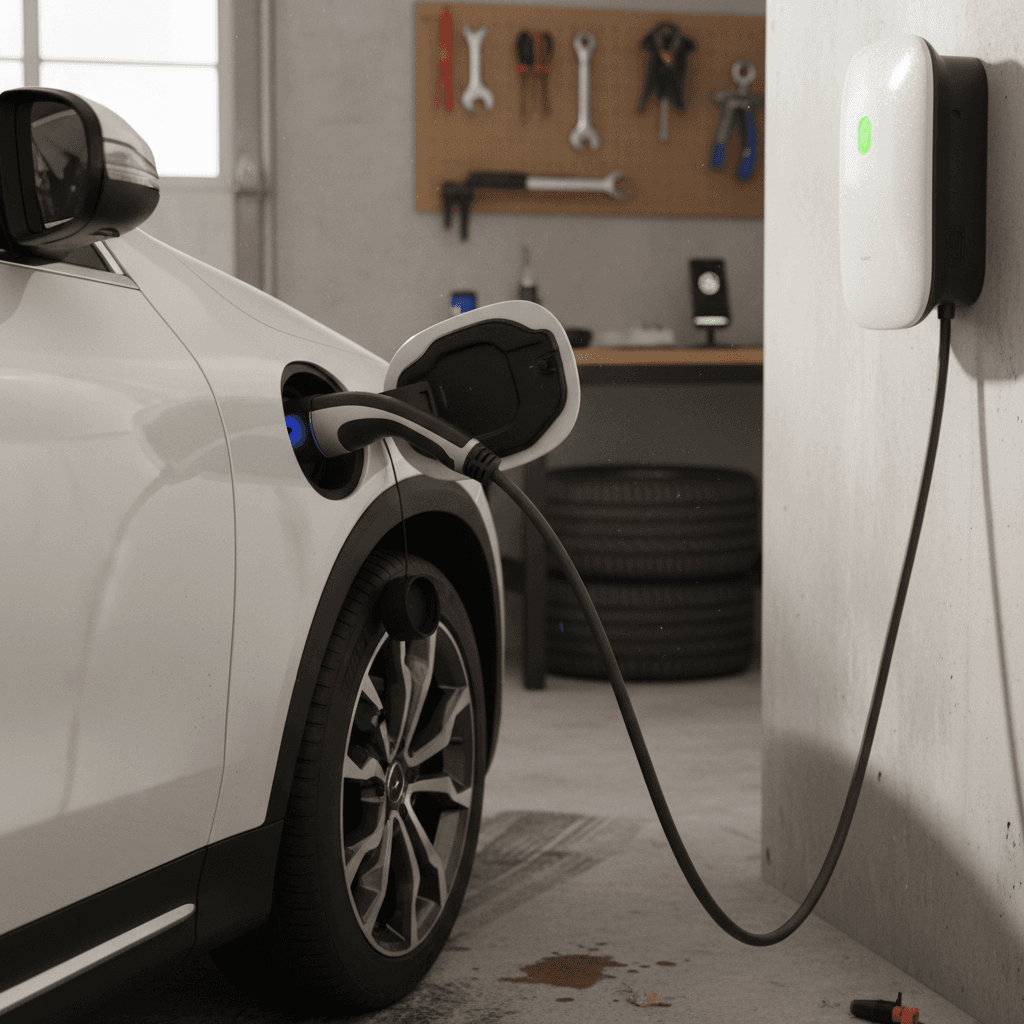
Installation, safety, and scheduling tips
Work with a licensed electrician
Any permanent 240V install for an EQB should go through a licensed electrician. They’ll size the circuit (usually 40–60A), check your panel capacity, and pull permits where required. Trying to DIY a high‑amp circuit to save a few hundred dollars is a false economy when you’re protecting a vehicle worth tens of thousands of dollars, not to mention your home.
Plan location and usability first
Don’t just put the charger right next to the panel because it’s easy. Think about how you’ll park, whether you might back in, and if you might own a second EV later. A charger near the front corner of the garage, with the cord reaching both bays, can save you a re‑install later.
Safety red flags to watch for
- Use the EQB’s charging limit settings (if available on your model year) or your wallbox app to cap charge level for daily use, around 80–90% is a good default.
- If your charger or utility program supports it, schedule most charging after midnight to take advantage of off‑peak rates and lower grid demand.
- Avoid daisy‑chaining extension cords, splitters, or power strips. Your EVSE should plug directly into a properly rated outlet or be hard‑wired.
- Label your EV circuit in the panel, and keep manuals for both the EQB and charger handy in the garage.
Battery‑healthy home charging habits for the EQB
Mercedes engineered the EQB’s battery management system to protect the pack, but your charging habits still matter, especially if you plan to keep the SUV for a long time or care about resale value. Home charging is where you have the most control.
Simple habits that keep your EQB’s battery happier
None of these require babying the car, they’re just sensible defaults.
Live in the middle of the pack
For daily use, try to keep the EQB between roughly 20% and 80% state of charge. Full charges to 100% are fine for road trips, but there’s no need to sit at 100% every night if you’re just driving around town.
Be kind in extreme temperatures
Cold and heat both slow charging and stress the pack. Whenever possible, charge in a garage rather than outdoors, and don’t panic if winter charging speeds are lower, that’s protective behavior, not a defect.
Time full charges to departure
If you know you’re starting a long drive, set your wallbox or EQB (if supported) to finish charging close to departure time. The battery spends less time at a high state of charge, which is slightly healthier over the long term.
How Recharged helps with battery health
Ready to find your next EV?
Browse VehiclesHow much does it cost to charge an EQB at home?
Charging cost is where home charging quietly undercuts gasoline. The EQB’s real‑world efficiency is roughly in the ballpark of 2.7–3.1 miles per kWh in mixed driving, and U.S. residential electricity averages around $0.15 per kWh, though that swings widely by region.
Back‑of‑the‑envelope EQB home charging economics
Time‑of‑use (TOU) rate plans can improve those economics further. If your utility offers cheaper power after 9 p.m. or midnight, scheduling the EQB’s charging window into those hours shifts most of your consumption into the lowest tier without changing how you drive.
Check for EV‑specific utility programs
If you’re buying a used EQB, think about charging first
A surprising number of used‑EV shoppers fall in love with the monthly payment and forget to plan the charging side. With the Mercedes EQB, that’s backward: the SUV is at its best when your home setup is sorted from day one.
Match the car to your home, not just your budget
If you rent, live in a condo, or have limited panel capacity, you might be constrained to Level 1 or modest Level 2 charging. That doesn’t rule out an EQB, but it changes the math. At Recharged, our EV specialists routinely walk shoppers through home‑charging scenarios before they commit to a specific vehicle.
Use the Recharged Score as your compass
Every EQB on Recharged includes a Recharged Score Report with verified battery health and pricing analysis. That gives you two critical data points: how much useful range you’ll actually have, and whether your home charging setup will comfortably support your real‑world driving.
If you’re cross‑shopping other used EVs, this also helps you compare how quickly different models will recharge overnight on the same home circuit.
Mercedes EQB home charging FAQ
Frequently asked questions about charging a Mercedes EQB at home
Charging a Mercedes EQB at home isn’t about chasing the biggest kilowatt number on a spec sheet; it’s about building a setup that quietly keeps the SUV ready every morning without stressing your panel, your schedule, or the battery. For most drivers that means a well‑installed Level 2 charger in the 32–48A range, sensible charge limits, and some basic attention to wiring and rate plans. Get those pieces right and the EQB becomes what it was meant to be: a compact luxury SUV that just happens to skip gas stations entirely. And if you’re exploring a used EQB, pairing a solid home‑charging plan with a Recharged Score Report is the simplest way to be sure the car, and your home, are a good fit.