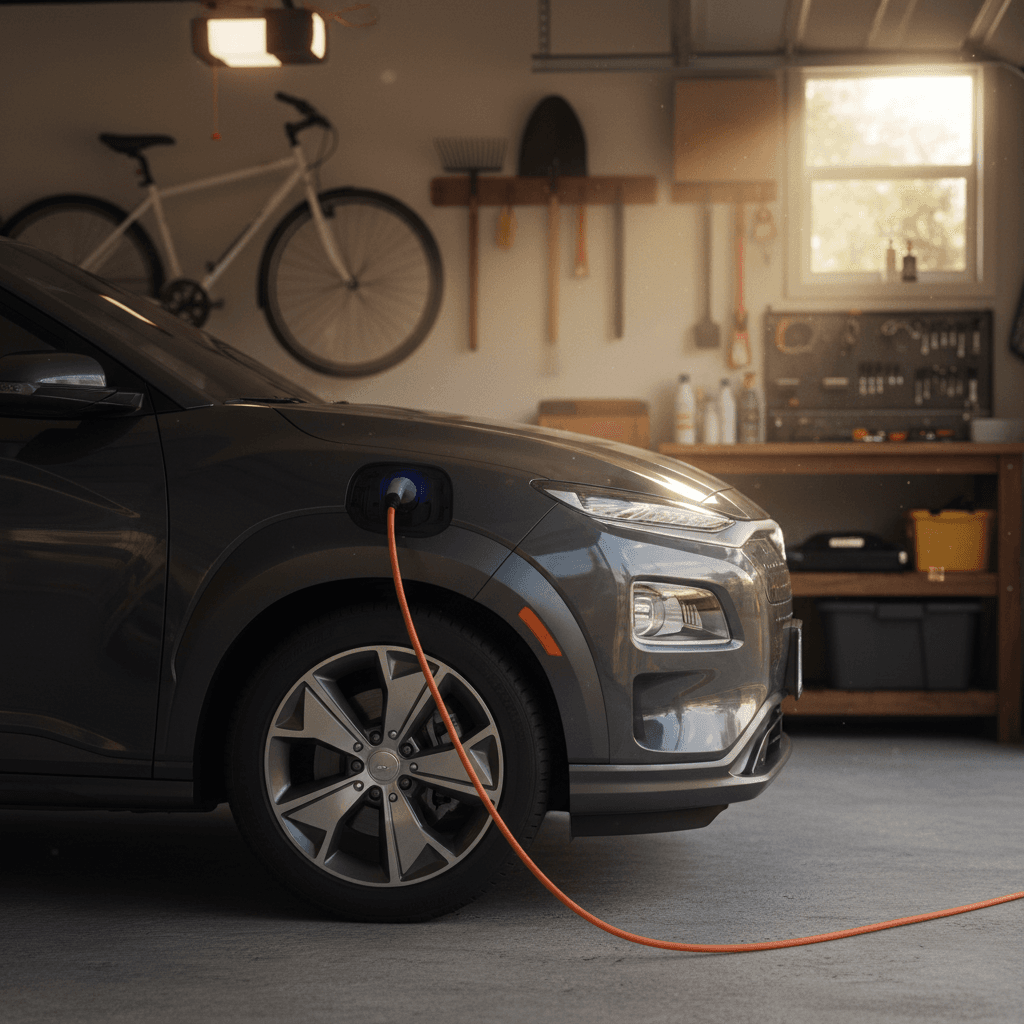
If you’re wondering how to charge a Hyundai Kona Electric at home, you’re not alone. The Kona’s compact size and generous range make it a perfect daily driver, but living with one is much easier when you can plug in where you sleep. This guide walks you through every option, from the simple 120V plug that comes with (most) cars to a full 240V Level 2 setup, plus charging times, costs, and battery‑friendly habits.
Good news for Kona owners
Hyundai Kona Electric home charging basics
Before you buy any equipment, it helps to understand what “home charging” actually means for your Kona Electric. At home you’ll always be using AC charging, either Level 1 (120V) or Level 2 (240V), through the J1772 side of the inlet. DC fast charging is great for road trips, but that happens at public stations, not in most garages or driveways.
Two ways to charge your Kona Electric at home
Both use the same port on the car, but very different power levels.
Level 1 (120V) – "trickle" charging
Uses a standard household outlet and the portable cordset that usually comes with the car.
- Power: ~1.4–1.9 kW in real‑world use
- Typical rate: ~3–5 miles of range per hour
- Best for: Light daily driving, overnight top‑ups
Level 2 (240V) – faster home charging
Uses a dedicated 240V circuit and wallbox (or plug‑in EVSE) similar to an electric dryer outlet.
- Power: Up to ~7.2–11 kW depending on model/year and circuit
- Typical rate: ~25–35 miles of range per hour
- Best for: Heavier driving, multiple drivers, no daytime charging access
Think like a gas tank, not a phone battery
Know your Kona Electric’s charging hardware
Different model years of the Hyundai Kona Electric share the same basic charging layout, but the onboard charger, the AC hardware that actually pulls power from your wall, can vary slightly. Most North American Kona Electrics support around 7.2 kW Level 2 charging, which is more than enough for overnight refills on a 240V circuit.
Charging inlet and connectors
- Port type (North America): J1772 for AC (Level 1 & Level 2) plus CCS1 for DC fast charging.
- At home: You’ll use J1772 only. Any standard Level 2 EVSE with a J1772 plug will work.
- Adapters: You don’t need a Tesla/NACS adapter for home use unless your home unit is Tesla‑only.
Onboard AC charger
- Early Kona Electric models typically have a 7.2 kW onboard charger.
- Some newer trims can take advantage of slightly higher power (around 10–11 kW) if your EVSE and circuit can supply it.
- The car will limit itself to its own maximum rate, even if you install a bigger charger.
Don’t guess, check your owner’s manual
Option 1: Level 1 home charging (standard 120V outlet)
Level 1 is the easiest way to charge a Hyundai Kona Electric at home because you’re just using a regular household outlet. In many North American markets, Hyundai supplies a portable 120V EVSE (often called a “trickle charger”) that plugs into a standard three‑prong outlet and into your Kona’s J1772 port.
- Park your Kona Electric on a flat surface where the cord can reach the charge port without tension or tripping hazards.
- Locate a dedicated 120V outlet, ideally in your garage or on an exterior wall, that’s not shared with heavy‑draw appliances (space heaters, freezers, power tools).
- Plug the Hyundai portable charger into the outlet first, then into the car’s J1772 port until you hear and feel it click.
- Use the dash or infotainment screen to confirm the car sees the charger and shows an estimated completion time.
- If you have time‑of‑use (off‑peak) rates, set a delayed charging schedule in the Kona’s settings to start during cheaper overnight hours.
- Let the car charge. With Level 1, think in terms of overnight top‑ups, not fast refills from low state of charge.
How fast is Level 1 on a Kona?
Safety first with 120V charging
Option 2: Level 2 home charging (240V)
If you want your Kona Electric to feel as effortless to refuel as a gas car, Level 2 home charging is the sweet spot. A 240V circuit, similar to what powers an electric dryer, feeds a wall‑mounted or plug‑in charging station and can refill a mostly empty Kona battery overnight instead of over multiple days.
Why most Kona owners upgrade to Level 2
Faster, more flexible, and better for busy households.
Much faster top‑ups
On a typical 32–40A Level 2 charger, many Kona Electrics can add roughly 25–35 miles of range per hour. That turns a near‑empty battery into a full pack in a single night.
Convenience and flexibility
With Level 2, you can comfortably skip nights, handle unexpected trips, and support two EVs in one household without juggling public chargers.
Lower per‑mile cost
Home electricity, especially on off‑peak rates, is usually cheaper than public charging. Your utility may offer special EV or time‑of‑use plans that make 240V charging even more economical.
Wallbox vs. plug‑in EVSE
Installing a Level 2 charger at home, step by step
From idea to first plug‑in: Level 2 install checklist
1. Decide how fast you really need to charge
Look at your daily mileage. If you typically use 40–60 miles of range per day, a 32A charger on a 40A circuit is often more than enough for a Kona Electric. There’s little benefit to oversized hardware your car can’t fully use.
2. Choose a mounting location
Ideally, mount the charger close to where the Kona’s charge port will sit in your driveway or garage. Consider cord length, parking habits, and whether you might later charge a second EV.
3. Talk to a licensed electrician
Have an electrician inspect your panel to confirm there’s sufficient capacity for a new 240V circuit. They’ll recommend the correct breaker size, wire gauge, and outlet type or hard‑wire plan based on your charger choice.
4. Confirm code and GFCI requirements
Most U.S. jurisdictions now require <strong>GFCI protection</strong> for EV charging circuits and may have specific rules for garages, carports, or outdoor mounts. Your electrician should pull any required permits and follow NEC Article 625.
5. Install the circuit and charger
Once the permit is approved (where required), the electrician runs the 240V line, installs the breaker, mounts the EVSE (or outlet), and tests voltage and grounding. Keep the installation manual for future reference.
6. Set up the charger and the car
Connect the charger to Wi‑Fi if it’s “smart,” set maximum current, and configure schedules in the charger app and in the Kona’s settings. Do a short test charge while you’re home to watch for any error messages.
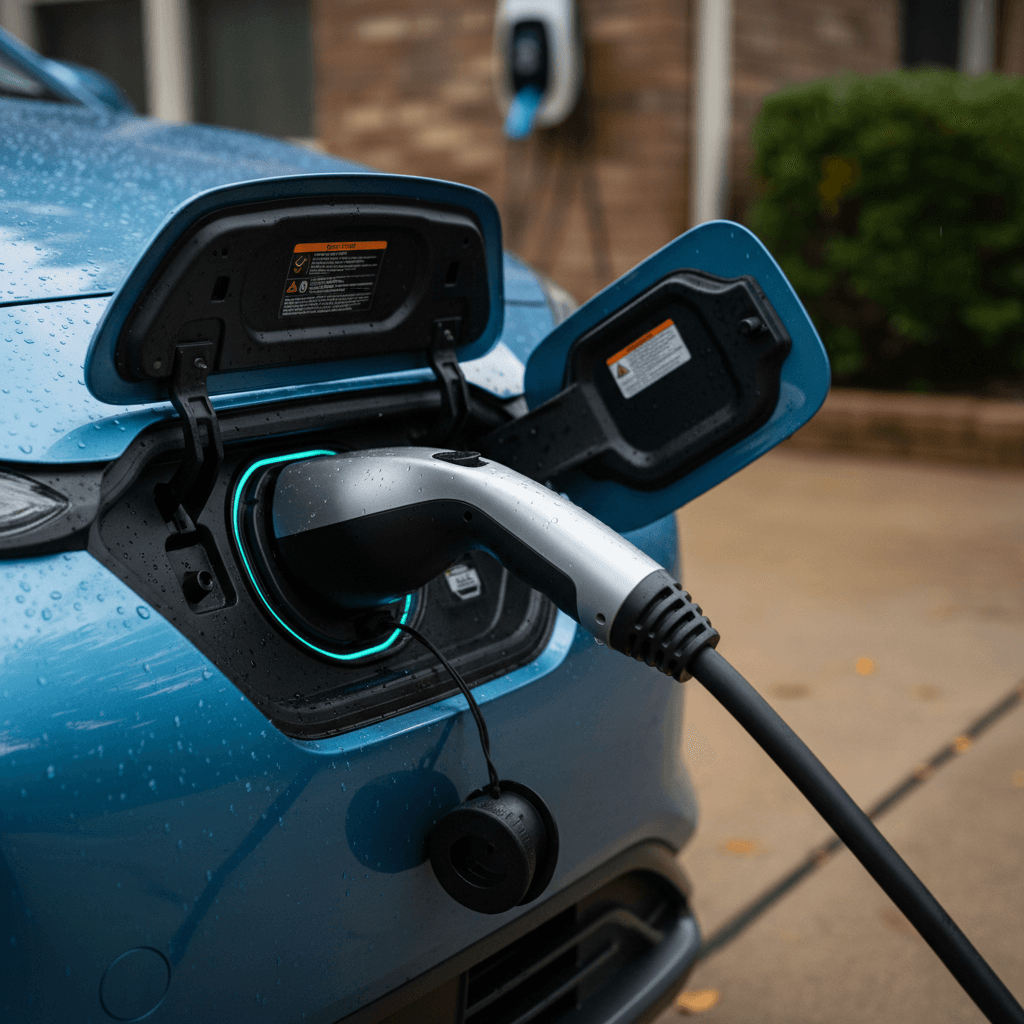
Always use a pro for new 240V work
How long it takes to charge a Kona Electric at home
Charging times depend on your battery size, starting state of charge, temperature, and the power available from your outlet or EVSE. But we can ballpark how long it takes to charge a Hyundai Kona Electric at home using common setups.
Approximate Hyundai Kona Electric home charging times
Estimates assume a long‑range Kona Electric battery around 60–65 kWh and typical real‑world power levels. Your exact times will vary, but these numbers are useful for planning.
| Home charging setup | Approx. power | Miles of range added per hour* | 0–100% time (from very low SOC) |
|---|---|---|---|
| 120V Level 1 @ 12A | ~1.4 kW | ~3–5 mi/hr | 40–60+ hours |
| 240V Level 2 @ 16A (3.8 kW) | ~3.8 kW | ~10–15 mi/hr | 15–18 hours |
| 240V Level 2 @ 32A (7.7 kW) | ~7.2–7.7 kW | ~25–30 mi/hr | 8–10 hours |
| 240V Level 2 @ 40A (9.6 kW) | Limited by car if max ~7.2–11 kW | Up to ~30–35 mi/hr | As little as ~7–9 hours on newer models |
Think in hours to add a chunk of range, not just 0–100% numbers.
Real life: you rarely charge from empty
What it costs to charge a Kona Electric at home
Running the math on home charging cost is easier than it looks. Take your local electricity rate (per kWh), multiply by the usable battery size you’re adding back, and you’ve got your approximate cost. Hyundai’s own estimates for the 2025 Kona Electric SE assume around $0.14 per kWh, which is close to the U.S. average.
Typical Kona Electric home charging costs (ballpark)
Estimate your own charging costs
- Find your electricity rate on your utility bill (for example, $0.15 per kWh).
- Multiply by the kWh you typically add. A 60 kWh refill at $0.15/kWh is $9.00.
- Divide by the miles you get from that energy (say, 240 miles). That’s about 3.75¢ per mile.
Don’t forget time‑of‑use plans
Many utilities offer cheaper overnight rates just for EV charging or time‑of‑use plans with lower off‑peak prices. If you schedule your Kona to charge after, say, 11 p.m., you could shave another 20–40% off each kWh.
Where Recharged fits in
Ready to find your next EV?
Browse VehiclesBattery‑friendly habits when charging at home
Your Kona’s battery pack is engineered to last, but how you charge at home can make a noticeable difference over years of ownership. A few simple habits will help you keep range and performance strong well past the honeymoon phase.
Home charging habits that help your battery age gracefully
Stay between roughly 20% and 80% for daily driving
For errands and commuting, there’s no need to hit 100% every time. Many owners set a daily target around 80% and reserve full charges for road trips or when they truly need max range.
Avoid leaving it full or empty for days
Parking at 100% or near 0% for long stretches is harder on lithium‑ion cells. If you must charge to 100% before a trip, aim to finish charging shortly before you depart.
Use Level 2 as your workhorse, Level 1 as backup
Regular AC charging, especially at home on Level 2, is gentler on the battery than frequent DC fast charging. Save the high‑power DC stations for long‑distance travel, not daily refills you could handle overnight at home.
Charge more often in extreme heat or cold
Very hot or cold weather can temporarily limit charge rates and reduce apparent range. In those seasons, shorter, more frequent plug‑ins at home can be easier on the pack than deep cycles.
Keep your charging gear in good shape
Inspect cords and connectors occasionally for damage, make sure plugs stay snug in outlets, and keep vents on wallboxes or portable EVSEs clear of dust and debris.
Garage vs. driveway charging
Common Kona home‑charging mistakes to avoid
- Using an old or overloaded 120V circuit for Level 1 charging and wondering why breakers trip or cords feel hot.
- Buying the biggest, most expensive Level 2 charger on the shelf without checking your Kona Electric’s max AC charge rate, or your home’s panel capacity.
- Mounting the charger where the cable barely reaches the car, forcing awkward parking angles or strain on the connector.
- Forgetting to enable or update charge schedules when you switch to a new utility rate plan, and missing out on cheaper off‑peak power.
- Relying on DC fast charging for daily needs instead of fixing a weak home setup, great for road trips, not so great as your only “refuel” plan.
One mistake you should never make
Hyundai Kona Electric home charging FAQ
Frequently asked questions about charging a Kona Electric at home
Bringing it all together
Charging a Hyundai Kona Electric at home doesn’t have to be mysterious. Start simple with the 120V cord if that’s all you have, but if your life includes long commutes, unpredictable errands, or more than one EV, a properly installed 240V Level 2 charger turns the Kona into an easy, plug‑and‑forget appliance. Size the hardware to your driving, let a professional handle the 240V work, and use the Kona’s built‑in scheduling and charge‑limit tools to keep both your energy bill and battery happy.
If you’re still shopping and want a used Kona Electric that’s been evaluated specifically for battery health and charging performance, explore the Hyundai listings on Recharged. Every car includes a Recharged Score Report and access to EV‑specialist support, so you can shop, finance, and arrange delivery knowing exactly how it will fit into your home‑charging life.