You don’t need a two‑car garage and a wallbox charger to drive electric. If you’re wondering how to charge an EV in an apartment without turning your life into a logistics experiment, you’re not alone, and you’re not out of luck. Apartment charging just works differently, and once you design a routine around it, it can be surprisingly low‑stress.
The apartment EV reality
Can You Actually Own an EV in an Apartment?
Short answer: yes, if your driving pattern and local charging options line up. The biggest shift is mental. Instead of a private fuel pump in your garage, you’re sharing infrastructure, much like taking a subway that happens to run on kilowatts.
Who Apartment EV Ownership Works Best For
Focus on your weekly miles first, not the charger you don’t have yet.
City & close‑in suburban drivers
If you drive under ~150 miles a week and have any mix of workplace, grocery‑store, or DC fast charging nearby, an EV can fit your life with a bit of planning.
Commuters with workplace charging
Regular access to Level 2 charging at work is almost as good as a home charger. You plug in while you’re parked anyway and arrive home full.
Apartments with on‑site chargers
More properties are adding EV spaces in garages and lots, often through third‑party networks. You might already be paying for this amenity in your rent, use it.
When an EV may be painful
Step 1: Know Your Charging Basics (So You Don’t Overthink This)
Before you start negotiating with a landlord or hunting for plugs, get clear on the three main types of charging. The labels sound technical; the reality is simple.
EV Charging Levels in Plain English
How fast each level charges and where you’re likely to find it as an apartment dweller.
| Charging level | Typical plug | Where you’ll see it | Approx. speed* | Best use in an apartment life |
|---|---|---|---|---|
| Level 1 | 120V household outlet | Older garages, parking lots, some carports | ~3–5 miles of range per hour | Overnight top‑ups; low‑mileage drivers |
| Level 2 | 240V outlet or wallbox | On‑site chargers, workplaces, public lots | ~20–40 miles per hour | Weekly or twice‑weekly deep charge |
| DC Fast (DCFC) | Dedicated high‑power hardware | Highways, big shopping centers, travel corridors | ~150–250+ miles per hour (to ~80%) | Road trips, occasional fast top‑ups |
Real‑world charging speeds vary by car and conditions, but these ballpark numbers are enough for planning.
The 80/20 rule of apartment charging
Step 2: Using Existing Outlets at Your Apartment Safely
If your building won’t install a full charger tomorrow, the next best thing is often… a boring old outlet. Used correctly, Level 1 charging can quietly add 30–50 miles of range overnight and radically cut how often you need public chargers.
Three Ways Apartment Dwellers Use Existing Power
Always confirm rules with your landlord or property manager first.
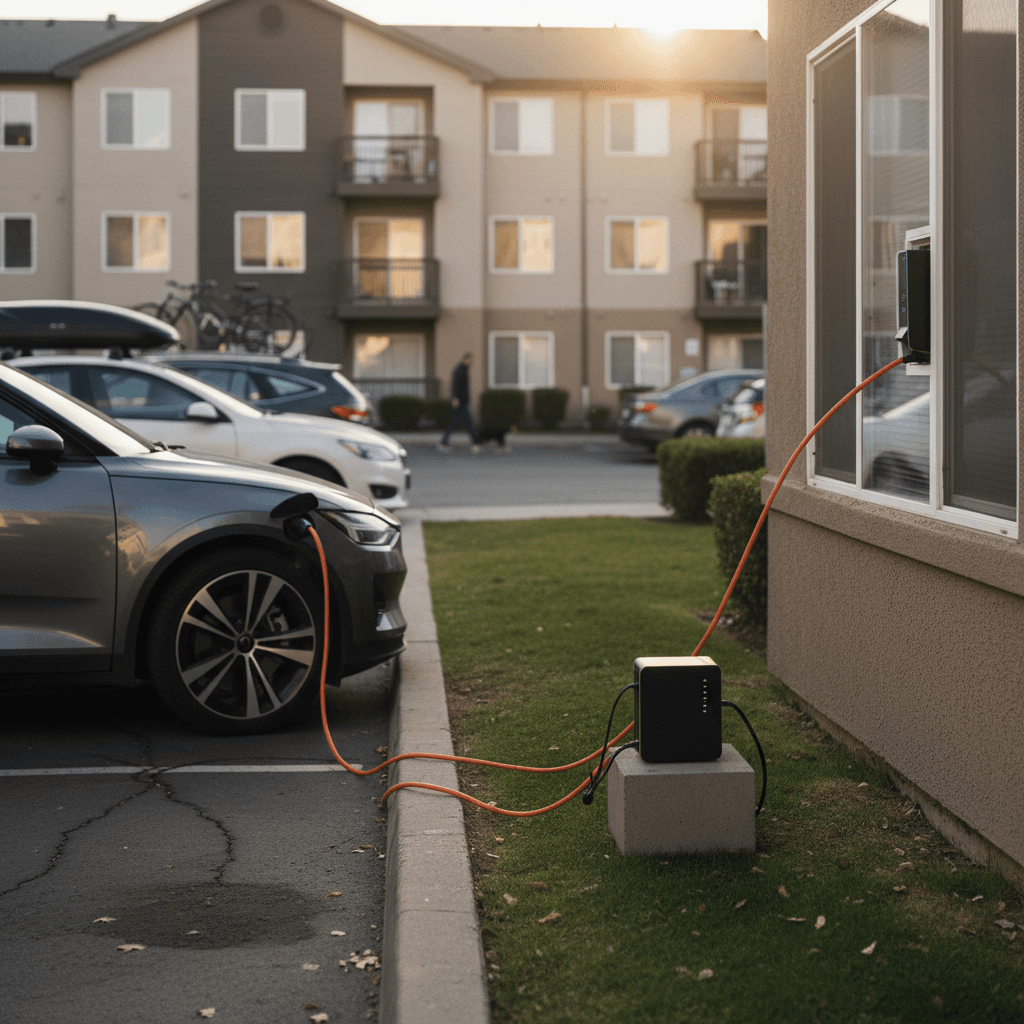
Dedicated 120V outlet
Gold standard for Level 1. A grounded, dedicated 15–20A outlet near your spot that isn’t also running freezers, lights, or vacuums.
Shared garage outlet
Less ideal but common. If multiple tenants use the same circuit, you may need to lower the amp setting on your portable EVSE to avoid tripping breakers.
Installed 240V receptacle
If the panel allows, a NEMA 14‑50 or 14‑30 outlet can support portable Level 2 charging. This is cheaper and easier than a full hardwired station.
Do not improvise with cords
Quick Safety Checklist Before You Plug Into an Apartment Outlet
1. Get written permission
Ask your landlord or HOA in writing before using any common‑area outlet. Many properties prohibit EV charging from random plugs; getting a clear yes protects you both.
2. Verify the circuit rating
Look at the breaker panel (or have maintenance do it). A 15A circuit should only see about 12A of continuous load; 20A circuits about 16A. Set your EV or portable charger accordingly.
3. Inspect the outlet itself
Loose, warm, or discolored outlets are a red flag. If the plug face looks tired, don’t charge there. Have a licensed electrician or building maintenance replace it first.
4. Avoid cheap extension cords
If you absolutely must use an extension, it needs to be a <strong>heavy‑gauge, outdoor‑rated, EV‑specific cable</strong>, not the skinny orange cord from a hardware bargain bin.
5. Test for nuisance trips
On your first few sessions, stay nearby. If the breaker trips or the outlet gets hot to the touch, stop and have the circuit evaluated. Don’t just keep resetting the breaker.
6. Make it tidy and legal
Use cord covers or approved cable management if your landlord allows it, and keep everything within your parking bay. No cables across public walkways, ever.
Step 3: Make the Most of Public and Workplace Charging
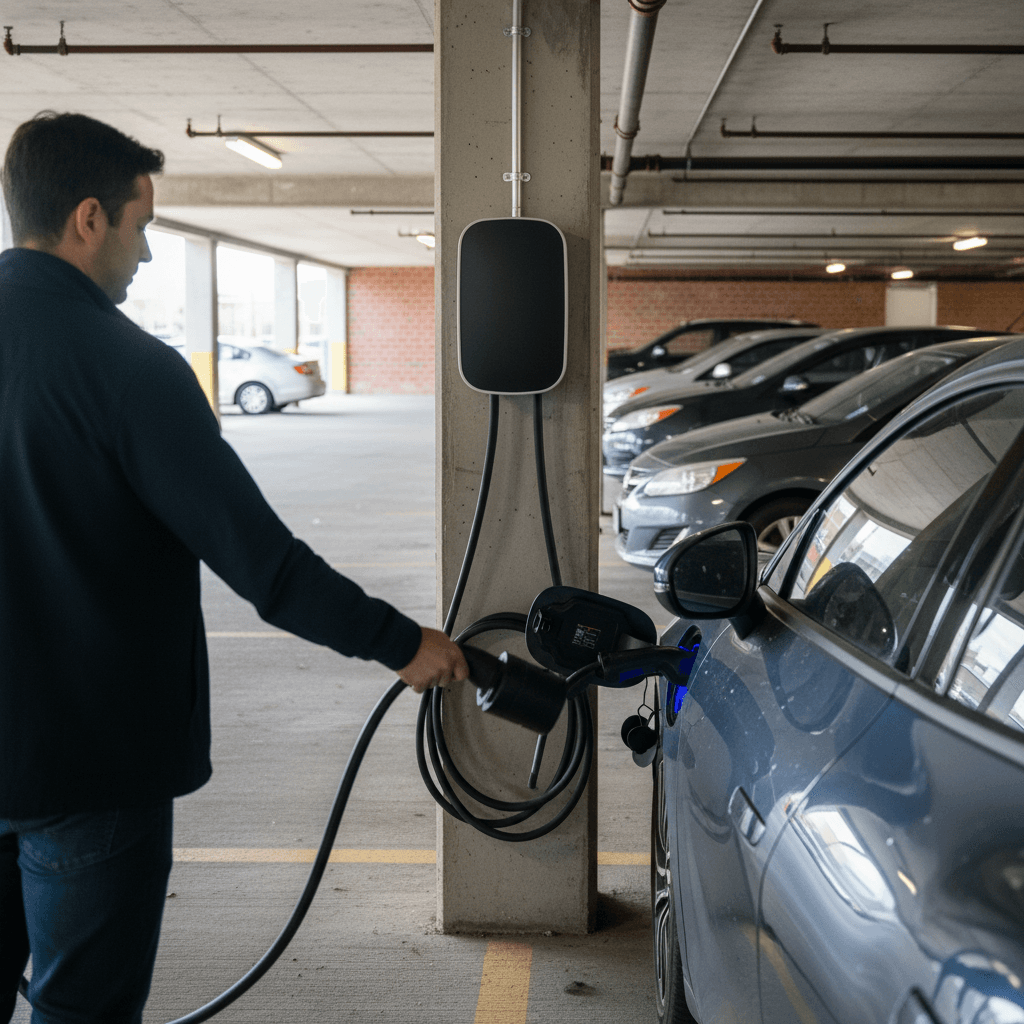
Most apartment EV drivers build their routine around public Level 2 and DC fast charging, with workplace charging as the quiet hero where it exists. The trick is to make charging happen while you’re already doing something else, shopping, working, going to the gym, so it doesn’t feel like an extra chore.
Essential Tools to Find and Plan Charging
You don’t need them all, but you should master at least one map and one route planner.
Charging‑station maps
Apps like PlugShare, ChargePoint, EVgo, and others show live availability, pricing, and connector types. Spend 10 minutes bookmarking spots near work, home, and your grocery store.
Route planners
Tools built into your car or in apps can auto‑insert stops on longer drives and estimate arrival charge. Learn how yours works before your first road trip.
Workplace and campus portals
Many employers and universities run private charging networks. Check HR, facilities, or your campus parking office for policies and pricing.
Turn errands into charging sessions
Dialing in a public DC fast‑charging routine
Think of DC fast chargers as your “refuel to 80%” stations. They’re ideal when you’re low, short on time, or on a road trip. For apartment drivers, once every week or two is common. Just know that per‑mile cost at DCFC can be higher than gas in some areas, so use it strategically, not daily.
Workplace and community Level 2: the quiet MVP
If you can park at a 6–11 kW Level 2 charger for 6–8 hours while you work, you’re getting a full “tank” that may last several days. Many apartment drivers structure their week around this, charging at the office Monday and Thursday, then barely thinking about it otherwise.
Step 4: Talking to Your Landlord or HOA About EV Charging
We’re in the early innings of apartment charging policy. The good news: more states are adopting “right to charge” laws that limit how much a landlord or HOA can stonewall a reasonable request for EV charging in your assigned space. The less‑good news: you’ll usually need to bring a clear, low‑friction proposal.
Know your state’s rules
How to Pitch EV Charging to Your Landlord or HOA
1. Lead with benefits, not demands
Frame charging as an <strong>amenity that boosts property value</strong> and helps attract higher‑quality tenants, not as a personal favor. Bring examples of nearby buildings already offering it.
2. Offer a simple, low‑cost starting point
Instead of insisting on a $2,000 smart charger, propose a <strong>single 120V or 240V outlet</strong> on your circuit or a shared Level 2 in a high‑demand area, with clear cost estimates.
3. Bring quotes and vendors
Get ballpark quotes from local electricians or turnkey providers that specialize in multifamily EV charging. Hand your landlord a one‑page summary instead of homework.
4. Address metering and billing up front
Suggest practical options: a dedicated sub‑meter, a smart outlet that tracks your kWh, or a flat monthly fee added to your rent based on typical usage.
5. Volunteer to be the pilot case
Offer to <strong>sign an addendum</strong> that you’ll pay for removal if you move, maintain your equipment, and follow posted rules. You’re de‑risking their first step into EV charging.
6. Use the law as a backstop, not a hammer
If your state has a right‑to‑charge law, mention it calmly as context. Most landlords respond better to “here’s a win‑win” than to threats. Save the heavy legal talk for last resort.
Sample Weekly Charging Strategies That Actually Work
Abstract talk about kilowatts is nice; what you really want to know is, “What does living with this thing look like week to week?” Here are three realistic patterns that Recharged customers use today.
Three Apartment‑Friendly Charging Routines
Low‑mileage city driver (~80 miles/week)
Plug into a <strong>Level 2 public charger</strong> at a grocery store or parking garage for 1–2 hours once a week.
Top up with <strong>Level 1 at home</strong> using a dedicated outlet one or two evenings if allowed (adds ~25–30 miles overnight).
Rarely use DC fast charging; save it for road trips or unexpected long drives.
Moderate commuter (~200 miles/week)
Use <strong>workplace Level 2</strong> twice a week (for example, Monday and Thursday), staying plugged in during your full workday.
If no work charging, hit a <strong>DC fast charger</strong> near your usual errands once every 7–10 days, adding 150–200 miles in 30–40 minutes.
Consider a small Level 1 top‑up at home if your building allows, mainly to smooth over busy weeks.
Higher‑mileage driver (~300+ miles/week)
Prioritize an EV‑friendly apartment with <strong>on‑site Level 2</strong> or a workplace with charging before you buy.
Treat DC fast charging as a <strong>planned weekly stop</strong>, for example, every Sunday morning while you shop or grab coffee.
Choose an EV with a larger battery so you’re not constantly arriving at chargers on fumes.
Why Apartment Charging Is Getting Easier
Safety First: What Not to Do in an Apartment
It’s tempting to treat electricity like water from a hose, if you can reach the car, it must be fine. Unfortunately, that’s how you end up with overheated cords, angry neighbors, and visits from the fire marshal. A few hard no’s are worth spelling out.
- Do not drape cords across sidewalks, driveways, or hallways, even "just overnight."
- Do not plug into random outlets in shared parking without written permission.
- Do not exceed your circuit’s continuous amp rating just because the breaker hasn’t tripped yet.
- Do not use cheap, undersized extension cords or power strips for EV charging, ever.
- Do not block fire lanes, loading zones, or ADA spaces just to reach a charger.
If anything smells hot, stop
Choosing the Right EV If You Rent or Live in a Condo
Not every EV asks the same things of your charging setup. As a renter, you want a car that’s forgiving of imperfect infrastructure: decent range, efficient at highway speeds, and not overly thirsty on DC fast charging.
EV Features That Make Apartment Life Easier
You can’t control your building’s wiring, but you can choose a car that plays nice with it.
Comfortable real‑world range
A usable range of 230–300+ miles gives you more flexibility to cluster charging into one or two sessions a week instead of constantly topping up.
Good efficiency, not just big battery
Look for an EPA combined rating in the 3+ mi/kWh neighborhood. Efficient cars wring more miles out of every kilowatt‑hour you buy at public rates.
Solid DC fast‑charging speed
If you’ll rely on DCFC, check real‑world tests, not just marketing numbers. A car that can hold 100–150 kW for a good chunk of the curve saves you time and money at stations.
Where used EVs shine for renters
Ready to find your next EV?
Browse VehiclesHow Recharged Helps Apartment Drivers Go Electric
If you’re shopping for an EV while renting, you’re juggling more variables than a typical suburban buyer. You’re not just choosing a car; you’re designing a charging routine that won’t fall apart the first time your favorite station is occupied.
Transparent range and battery health
Every EV on Recharged comes with a Recharged Score Report that includes verified battery diagnostics and fair‑market pricing. That helps you understand how far the car really goes today, not just when it was new, which is crucial if you’re depending on public chargers.
Help matching a car to your charging reality
Our EV specialists can walk through your weekly mileage, access to outlets, workplace charging, and nearby networks, then steer you toward models that fit that pattern. We also support trade‑ins, financing, and nationwide delivery, so you can upgrade to an EV even if your parking spot is three floors underground.
Use your charging plan as a buying filter
FAQ: Common Questions About Charging an EV in an Apartment
Apartment EV Charging FAQ
Living with an EV in an apartment isn’t about recreating the suburban home‑charger fantasy. It’s about designing a charging routine that matches the way you already live, where you park, shop, and work, and choosing a car that plays well with that reality. With a bit of planning and the right support, plugging in becomes just another background habit. If you’re ready to explore which used EV would fit your building and your week, Recharged is built to help you make that leap with clear data, fair pricing, and specialists who speak fluent apartment life.