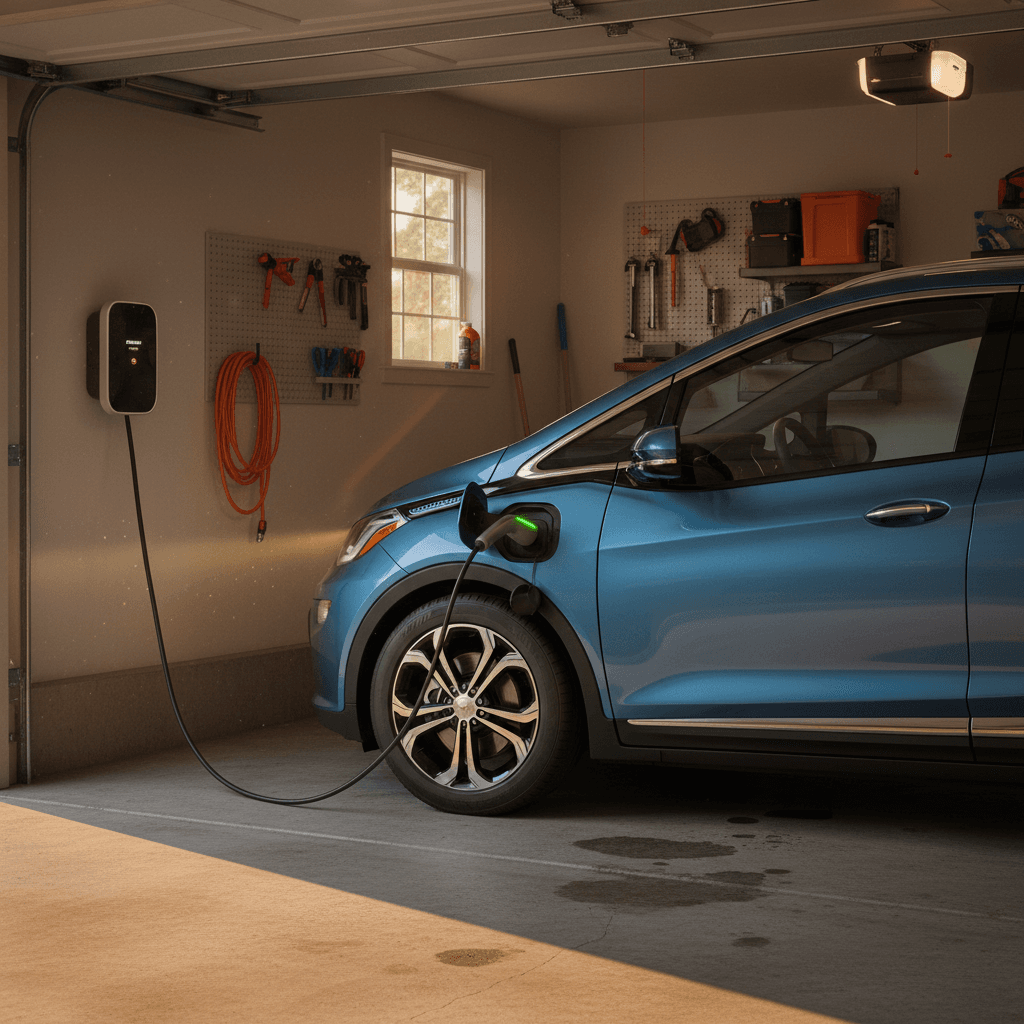
If you’ve just brought home a Chevrolet Bolt EV, learning how to charge it at home is the single biggest step toward making it feel as easy as a gas car, only cleaner, quieter, and cheaper to run. The good news: charging a Chevy Bolt at home is straightforward once you understand the difference between Level 1 and Level 2 charging, what equipment you need, and how to treat the battery so it stays healthy for years.
What this guide covers
Why home charging matters for your Chevrolet Bolt EV
Most Bolt owners quickly discover that **home charging is where the magic happens**. Instead of hunting for public chargers, you simply plug in where you park and wake up to a car that’s ready to go. For a Chevy Bolt EV with roughly a 60–65 kWh battery and an EPA range around 238–259 miles (depending on model year), even a partial overnight charge can easily cover a typical American commute.
- Convenience: Plug in at night, drive off with plenty of range in the morning.
- Cost control: Home electricity rates are usually much lower than DC fast charging, especially with off-peak or EV time-of-use plans.
- Battery friendliness: Regular Level 1 or Level 2 home charging is gentler on the pack than frequent DC fast charging.
- Resale value: A Bolt that’s been mostly home-charged and well cared for often shows better long-term range, which matters if you ever sell or trade it.
Used Bolt owners: home charging tells a story
Chevy Bolt EV home charging basics: Levels, volts, and amps
Before you worry about which charger to buy, it helps to decode the jargon. Your Bolt can charge at home in two main ways: **Level 1 (120V)** and **Level 2 (240V)**. Both use AC power and the same J1772-style inlet, the difference is how much power they can deliver, and therefore how quickly they add miles.
Chevy Bolt home charging options at a glance
Approximate values for most 2017–2023 Bolt EVs and EUVs. Real-world results vary with temperature, driving efficiency, and battery state of charge.
| Charging level | Voltage / circuit | Approx. power into car | Miles of range added per hour* | Best for |
|---|---|---|---|---|
| Level 1 | 120V standard outlet, 8–12A | ~1.2–1.4 kW | ~3–5 miles/hour | Very light daily driving, emergencies, renters |
| Level 2 | 240V dedicated circuit, typically 16–40A | ~3.8–7.7 kW on most older Bolts, up to 11.5 kW on later models | ~25–40 miles/hour | Daily home charging, longer commutes, topping up before trips |
Level 1 is enough for light daily use; Level 2 is ideal if you drive more or want full overnight charges.
Mind the circuit limits
Option 1: Level 1 (120V) charging at home
Level 1 charging is the slowest way to charge your Chevrolet Bolt EV at home, but it’s also the easiest to start with. You plug the factory cord set into a standard three-prong household outlet (120V) and into the charge port on your Bolt. That’s it, no electrician, no new hardware.
Setting up Level 1 charging safely
1. Choose the right outlet
Use a dedicated, grounded 120V outlet in good condition, ideally on a 15- or 20-amp circuit with **nothing else drawing heavy power**. Avoid daisy-chained power strips or old, loose receptacles.
2. Inspect the circuit
If the outlet or breaker is warm to the touch while charging, stop and have an electrician inspect it. Continuous 8–12 amp loads for hours can expose weak wiring or old connections.
3. Use the OEM charge cord correctly
Plug the Chevy dual-level or factory Level 1 cord into the wall **first**, then into the car. Make sure the control box is off the ground and the cable isn’t pinched in doors or under tires.
4. Set your Bolt’s charge current
In the Bolt’s charging menu, you can often select 8A or 12A for Level 1. Use 12A if the circuit is healthy and dedicated; drop to 8A if you’re unsure or if the breaker trips.
5. Plan around overnight charging
Expect roughly 3–5 miles of range per hour on 120V. If you sleep 10–12 hours, that’s 30–60 miles of range back in the pack, plenty for a short commute, but tight for longer drives.
Who Level 1 works for
Option 2: Level 2 (240V) charging at home
Level 2 is where a Chevy Bolt EV really shines for home charging. By using a 240-volt circuit, the same kind of power your electric dryer or oven uses, you can add **roughly 25–40 miles of range per hour**, enough to go from low to nearly full in a single overnight session.
Hardwired wall unit
This is a dedicated wall-mounted EVSE wired directly into a 240V circuit by an electrician. It’s the cleanest, most permanent solution and ideal if you own your home and plan to stay put for a while.
- Can support up to 32–48 amps depending on model and wiring.
- Often includes Wi-Fi/app features, scheduling, and usage tracking.
- Best choice if you want to take full advantage of later Bolts with 11.5 kW AC capability.
Plug-in Level 2 (NEMA 14-50 or 6-50)
These chargers plug into a 240V outlet, like an RV-style NEMA 14-50. They’re popular because you can take them with you when you move.
- Requires a properly installed 240V receptacle on a matching breaker.
- Commonly limited to 32–40 amps for continuous use.
- Great flexibility if you rent but have a cooperative landlord.
Always use a licensed electrician
Step-by-step: How to charge your Chevy Bolt at home
Whether you’re using the factory cord on 120V or a wall-mounted Level 2 charger, the steps to actually charge your Chevrolet Bolt EV at home are nearly identical. Once you’ve done it twice, it will be muscle memory.
- Park and put the car in Park. Set the parking brake if you’re on a slope.
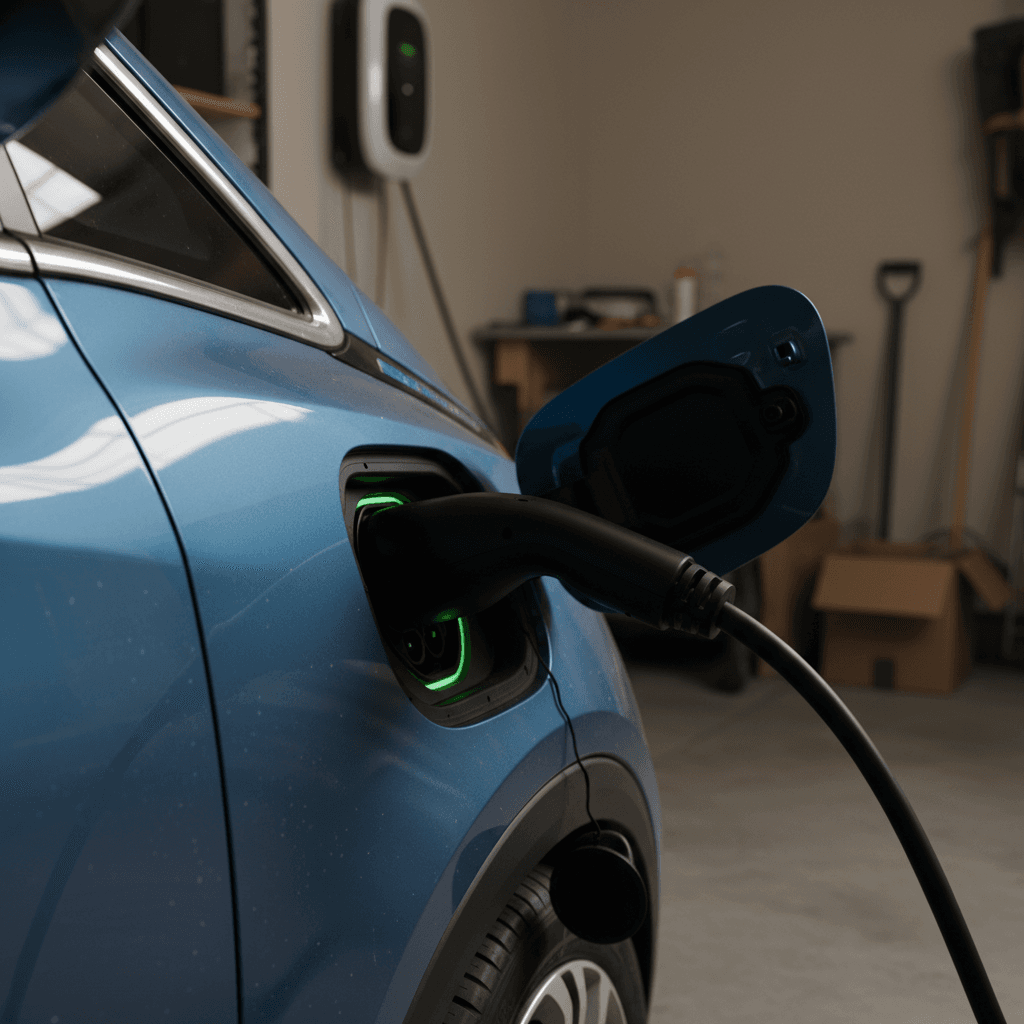
- Open the charge port door on the driver’s side front fender.
- If you’re using the dual-level cord, plug it into the wall first; for a Level 2 wallbox, make sure it’s powered on.
- Insert the connector firmly into the Bolt’s charge port until it clicks. The car will lock the connector when charging starts.
- Check the Bolt’s charging indicator lights or the instrument cluster to confirm that charging has started and see the estimated completion time.
- Use your in-car screen or the myChevrolet app to set a **charge limit** (often 80–90% for daily use) and, if available, schedule charging for off-peak hours.
- When you’re ready to leave, unlock the car, press the button on the connector, remove the plug, close the charge port door, and stow the cable.
Let the car do the thinking
How long does a Chevy Bolt take to charge at home?
Charging time depends on your model year, how low the battery is, and whether you’re on Level 1 or Level 2. But you can ballpark it using the Bolt’s battery size (about 60–65 kWh for most 2017–2023 models) and your charging power.
Approximate Chevy Bolt EV home charging times
Think in “miles per hour of charge”
Battery-health best practices for home charging
Modern Bolts have robust battery management, and GM has tuned their chemistry and software carefully. Still, **how you charge at home** can have a real impact on how much range the car retains after 5–10 years. The principles are simple: avoid extremes when you don’t need them, and keep the pack comfortable.
Simple home-charging rules to keep your Bolt’s battery happy
You don’t have to obsess, just build a few smart habits.
Aim for 20–80% for daily use
For most nickel-rich Bolt batteries, keeping daily charging in the roughly 20–80% state-of-charge window is a good rule of thumb. It leaves headroom at both ends where batteries are least stressed.
Save 100% for trip days
Charging to 100% is fine when you need the range, just don’t park it full for days on end. Try to finish charging to 100% shortly before you leave on a road trip.
Be kind in extreme temperatures
In very hot or cold weather, leaving the Bolt plugged in lets the car manage battery conditioning. That’s especially helpful if you park outside through winter or summer heat waves.
Use charge limits and scheduling
Home charging costs and smart charging tips
One of the reasons people ask how to charge a Chevrolet Bolt EV at home is simple: they want to know what it will cost. The math is friendlier than filling a gas tank. Multiply your local kWh rate by the Bolt’s battery size or your typical kWh usage per week.
Rough cost per full charge
Suppose electricity is $0.15 per kWh, a common U.S. residential rate, and your Bolt’s pack is around 65 kWh.
- 65 kWh × $0.15 ≈ $9.75 for a 0–100% session.
- Real-world costs are often a bit lower because you rarely charge from empty.
Spread over ~250 miles of EPA-rated range, that’s roughly 4 cents per mile, much cheaper than gasoline for most drivers.
Ways to lower your charging bill
- Ask your utility about EV or time-of-use rates that discount overnight charging.
- Use the Bolt’s schedule feature to charge during off-peak hours.
- Match your Level 2 charger size to your needs, there’s no point in overspending on high-amperage hardware you’ll never use.
Plan ahead if you move or upgrade
Choosing the right home charger for a Chevrolet Bolt EV
Choosing a home charger for a Chevy Bolt EV isn’t about chasing the biggest number on the box. It’s about **matching your driving habits, your home’s electrical capacity, and your Bolt’s onboard charger** so you get reliable overnight charging without overspending.
Key decisions when picking a Bolt home charger
Use these questions to narrow your options quickly.
How many miles do you drive?
If you’re regularly under 30 miles/day and have good 120V access, you might live comfortably on Level 1. Over that, or if you want fast recovery after road trips, install Level 2.
What can your panel handle?
An electrician can tell you if your panel can spare a 30–50A circuit. In older homes, a modest 16–32A Level 2 charger is often the sweet spot.
Hardwired vs. plug-in
Hardwired units look clean and are less tempting to steal. Plug-in units add flexibility if you move. For most Bolt owners, either is fine as long as the circuit is sized correctly.
If you’re buying a **used Bolt through Recharged**, you can lean on their EV specialists to sanity-check charger choices and installation quotes, especially if you’re also planning a trade-in or financing. Getting home charging right the first time makes daily life with an EV dramatically easier.
FAQ: Charging a Chevrolet Bolt EV at home
Frequently asked questions about Chevy Bolt home charging
Bottom line: Make your Bolt easy to live with
Learning how to charge a Chevrolet Bolt EV at home isn’t about memorizing kilowatts and amps, it’s about setting up a routine that fits your life. Level 1 is a fine starting point if your driving is light, but a properly installed Level 2 charger is what turns your driveway or garage into a personal fueling station, ready to refill 200-plus miles of range while you sleep.
Treat the battery kindly, use charge limits and schedules, and let the car sip inexpensive off-peak electricity instead of gulping down public fast charging. And if you’re still shopping for a Bolt, or thinking about trading into one, working with a used-EV specialist like Recharged can give you verified battery data, fair pricing, financing, and guidance on getting your home charging dialed in from day one.