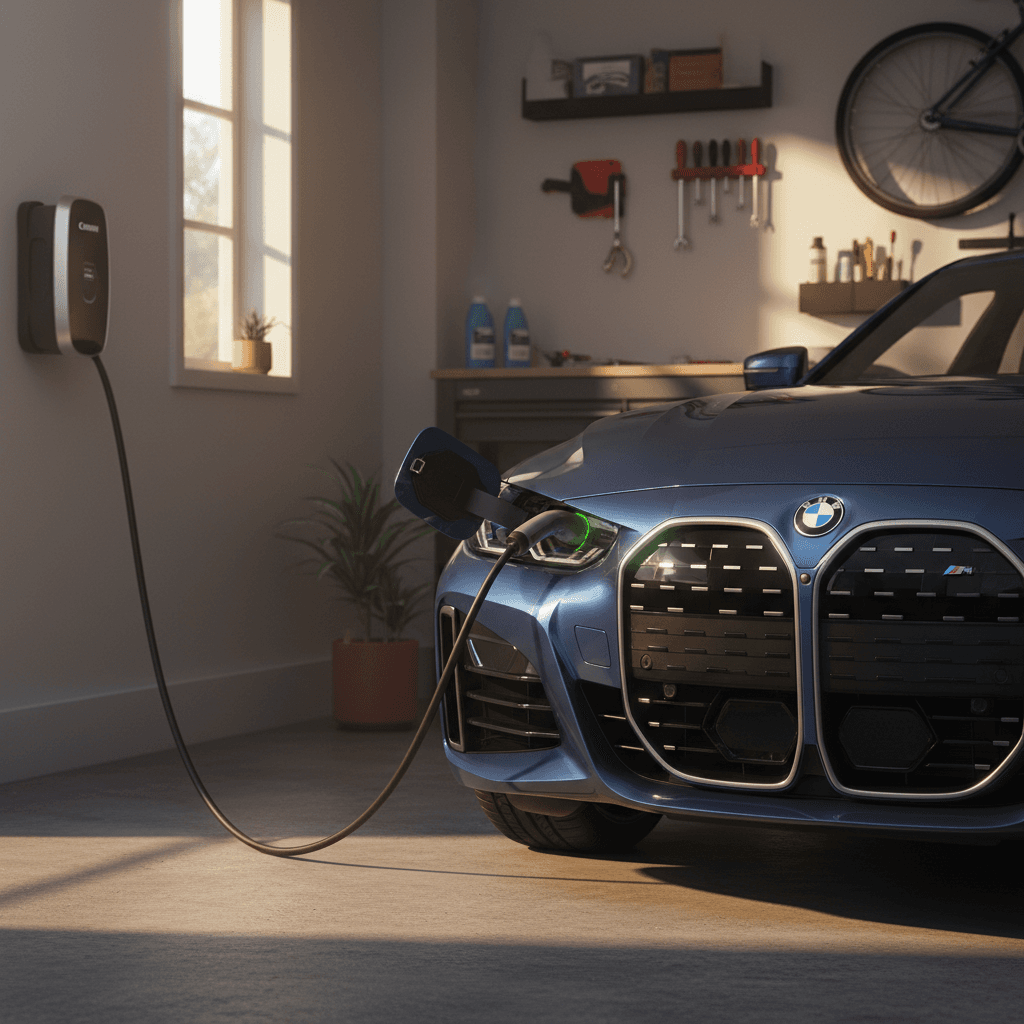
If you’re trying to figure out how to charge a BMW i4 at home, you’re really asking two questions: what hardware do I need, and what’s the smartest way to use it day to day? The i4 is an easy car to live with, but BMW doesn’t exactly send an electrician home with the keys. This guide cuts through the jargon so you can plug in with confidence, whether you’re using a regular outlet or a full‑blown Level 2 wallbox.
Quick takeaway
BMW i4 home charging basics
Before you buy any hardware, it helps to know what’s inside the car. All i4 trims, eDrive35, eDrive40, xDrive40 and M50, use a 400‑volt battery pack and an 11 kW onboard AC charger. That onboard unit is the real bottleneck for home charging: even if you install a monster 19.2 kW wallbox, your i4 will still top out around 11 kW on AC power.
- Typical usable battery size: roughly 67 kWh (eDrive35) or ~81 kWh (eDrive40/xDrive40/M50)
- Max AC charging rate at home: about 11 kW on Level 2 (240V)
- Standard U.S. household outlet: 120V (Level 1), slow but workable for light use
- Faster home charging: 240V circuit (Level 2) with a dedicated EVSE (wallbox or portable unit)
Think in miles per hour, not kilowatts
What you get from BMW for home charging
Newer i4s in the U.S. typically ship with a portable charging cable, BMW’s “Flexible Fast Charger” in recent years. It’s meant to be a universal backup, not a perfect long‑term home solution.
BMW’s included cable vs. a dedicated home charger
Good enough to get you started, not always the best to live with
BMW portable charging cable
- Usually supports 120V (Level 1) out of the box, and 240V with the right adapter/outlet.
- Great as a travel backup or for occasional home use.
- Limited power vs. a hard‑wired wallbox; often 30A or less.
- Lives in your trunk if you road-trip a lot.
Dedicated Level 2 home charger
- Hard‑wired or plugged into a 240V outlet (NEMA 14‑50, etc.).
- Commonly 40–48A, enough to max out the i4’s 11 kW onboard charger.
- Wi‑Fi/app controls, load sharing, and better cable management.
- Meant to stay on the wall 24/7.
Check your exact cable
Level 1 vs. Level 2 home charging for your BMW i4
Level 1: 120V regular outlet
This is the wall outlet in your garage or driveway, the same one that runs a lamp or phone charger. It’s technically compatible with the BMW i4 using the included cable, but it’s the slow lane.
- Power: ~1.3–1.4 kW on a typical 15A circuit.
- Real-world speed: roughly 3–5 miles of range per hour.
- Best for: apartment/condo dwellers, low-mileage drivers, or short-term use before your electrician visit.
If you drive 20–30 miles a day and can leave the car plugged in every night, Level 1 can work. If you’re doing 50+ miles a day, it becomes a headache quickly.
Level 2: 240V dedicated circuit
Level 2 is where the BMW i4 comes alive as a daily driver. A 240V circuit (like what your oven or dryer uses) lets the onboard 11 kW charger stretch its legs.
- Power: up to ~11 kW with a 48A EVSE on a 60A breaker.
- Real-world speed: typically 25–35 miles of range per hour.
- Best for: most suburban owners, anyone without easy daytime public charging, and households with more than one EV.
Think of Level 2 like bringing a gas station home. You plug in at night, wake up to a full battery and never think about it again.
A note on panel capacity
How fast will my BMW i4 charge at home?
Charging time depends on three numbers: your battery size, the car’s 11 kW onboard charger, and how much power your home circuit can safely deliver. Below is a practical snapshot for typical U.S. setups, assuming you’re charging from about 10% to 90%, a common daily window that’s healthy for the battery.
Estimated BMW i4 home charging times
Approximate 10–90% charge times for common home setups. Real‑world results vary with temperature, driving efficiency and how full the battery is when you plug in.
| Setup | Circuit / EVSE rating | Typical power to i4 | eDrive35 (~67 kWh) 10–90% | eDrive40/xDrive40/M50 (~81 kWh) 10–90% |
|---|---|---|---|---|
| Level 1, standard outlet | 120V / 15A circuit (~12A usable) | ≈1.4 kW | ~30–34 hours | ~36–40 hours |
| Level 2, 30A EVSE | 240V / 30A (24A continuous) | ≈5.7 kW | ~7–8 hours | ~9–10 hours |
| Level 2, 40A EVSE | 240V / 40A (32A continuous) | ≈7.7 kW | ~5–6 hours | ~7–8 hours |
| Level 2, 48A EVSE | 240V / 48A (40A continuous) | ≈9.6 kW | ~4.5–5.5 hours | ~6–7 hours |
Use this as a planning tool, not a promise. Your i4 will slow down as it approaches your set charge limit.
You rarely charge 10–90%
Step-by-step: how to charge a BMW i4 at home
Charging your BMW i4 at home, step by step
1. Park and put the car in Park
Come to a complete stop, press the brake, then press the Park button. The i4 won’t start charging unless it’s fully in Park.
2. Open the charging flap
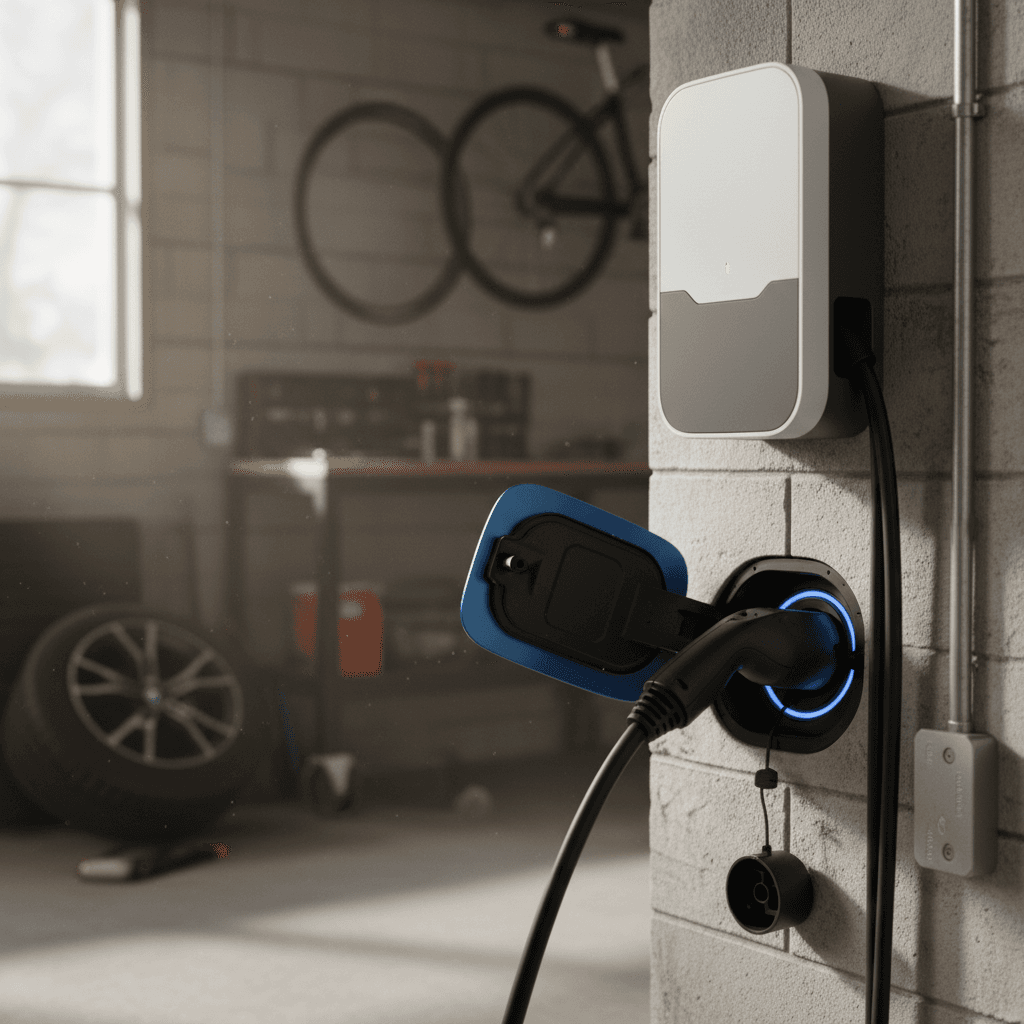
Walk to the rear right side of the car. Press on the fuel‑door‑style flap to release it and expose the CCS/J1772 port.
3. Wake up your home charger
If you have a smart wallbox, make sure it’s online and not locked. For some units you may need to tap a button to "wake" it before plugging in.
4. Plug in until you hear the click
Insert the connector firmly into the port. You should feel and hear a positive click as the latch engages. The LED ring around the port should glow to confirm charging status.
5. Confirm charge limit and schedule in the iDrive or My BMW app
Set your preferred charge limit (often 80–90% for daily use) and, if you like, a departure time or off‑peak schedule so the car finishes charging right before you leave.
6. Unplug only after charging has stopped
When you’re ready to leave, stop charging via the app, charger, or by unlocking the car. Press the button on the connector, remove it, and close the charging flap.
Visual cues are your friend
Choosing the right home charger for a BMW i4
Shopping for a home EVSE can feel like standing in front of a wall of nearly identical toasters. The i4 helps by having clear needs: J1772/CCS compatibility, 240V power, and ideally enough amperage to keep up with the 11 kW onboard charger.
Key decisions when picking an i4 home charger
You don’t need the most expensive box on the internet, just the right one for your panel and lifestyle.
Amperage & speed
Look for a charger that delivers at least 32A at 240V; 40–48A is ideal to get close to the i4’s 11 kW ceiling.
Make sure your electrical panel can support the breaker size required.
Plug‑in vs. hard‑wired
- Plug‑in (NEMA 14‑50/6‑50): Easier to replace or move, limited to 40A continuous in many cases.
- Hard‑wired: Cleaner install, often up to 48A, but requires an electrician either way.
Smart features
Wi‑Fi/app control can track energy use, lock the unit, and coordinate with time‑of‑use rates. Not mandatory, but very nice to have, especially if you manage more than one EV.
Budget realistically
Smart charging schedules and off-peak rates
The i4 is perfectly happy to start charging the instant you plug in, but your utility company might prefer you wait. Many regions now offer time‑of‑use (TOU) rates with cheaper electricity overnight. With the My BMW app and most smart chargers, you can have the car automatically chase those cheap electrons.
- Check your utility’s website or bill for EV or time‑of‑use plans and sign up if they make sense for your driving.
- In the My BMW app, set a preferred departure time on weekdays (for example, 7:30 a.m.).
- Enable the option to "charge in low‑tariff period" or similar so the i4 prioritizes off‑peak hours.
- If your wallbox has its own schedule, make sure it doesn’t conflict with the car’s settings, pick one device to be in charge of timing.
- After a week, review your kWh usage and cost in the app or charger portal and fine‑tune as needed.
Let the car do the thinking
Battery health best practices for home charging
The BMW i4’s battery is built to outlast the average lease, but your habits still matter. The good news: battery‑friendly behavior mostly overlaps with what’s convenient anyway.
Healthy charging habits for your i4
Aim for 20–80% for daily use
For commuting and errands, there’s no prize for being at 100% all the time. Keeping the state of charge roughly between 20–80% reduces stress on the cells over years of use.
Save 100% for trips
Charging to 100% is fine for road trips, just time it so you start driving soon after reaching full, rather than letting the car sit at 100% overnight.
Avoid deep, cold-soaked discharges
Try not to leave the car parked near empty in very cold or very hot conditions for long stretches. If you know it’ll sit, park it around 40–60% SOC instead.
Use preconditioning on cold mornings
If you can, warm the cabin and battery while still plugged in. The energy comes from the grid instead of the pack, preserving range and reducing stress.
Don’t obsess over occasional DC fast charging
Home Level 2 is easier on the battery, but occasional DC fast‑charging on trips is absolutely within the design brief. Just lean on home charging when you can.
Storage tip
What it really costs to charge a BMW i4 at home
Home charging is where EVs quietly unhook you from gas‑station economics. The exact math depends on your local kWh rate, but we can sketch out ballpark numbers using typical U.S. pricing.
Ballpark home charging economics for a BMW i4
In practical terms, if your electricity is around $0.18/kWh and your i4 averages 3.5 mi/kWh, you’re paying roughly 5–6 cents per mile. At $4 per gallon in a 30‑mpg sedan, that’s 13 cents per mile. The spread adds up quickly if you commute.
Track it like a utility bill
Common BMW i4 home charging mistakes to avoid
- Relying on Level 1 forever when your commute clearly demands Level 2, resulting in constant low‑battery anxiety.
- Installing a 48A charger on a marginal panel without consulting an electrician, leading to nuisance breaker trips or worse.
- Letting both the wallbox and the car manage schedules, so they quietly double‑block each other and the car never charges.
- Leaving the i4 parked at 100% for days at a time “just in case,” which isn’t great for long‑term battery health.
- Running the charging cable across sidewalks or driveways without protection, inviting trip hazards or damage to the cable.
Safety first, always
FAQ: BMW i4 home charging
Frequently asked questions
Bringing it all together
Living with a BMW i4 is easiest when your home garage doubles as your personal charging station. A basic Level 1 setup will keep you afloat; a properly installed Level 2 charger turns the car into a “wake‑up‑full” appliance you barely think about. Set a sensible charge limit, lean on off‑peak rates when you can, and treat 100% as a road‑trip setting, not a daily destination.
If you’re shopping for an i4, or weighing it against other used EVs, home charging should be part of the decision from day one. At Recharged, every car comes with a Recharged Score Report so you can see battery health and real‑world charging performance before you buy, plus EV‑savvy support to help you plan your home setup. Get the infrastructure right once, and the rest of i4 ownership becomes blissfully uneventful.