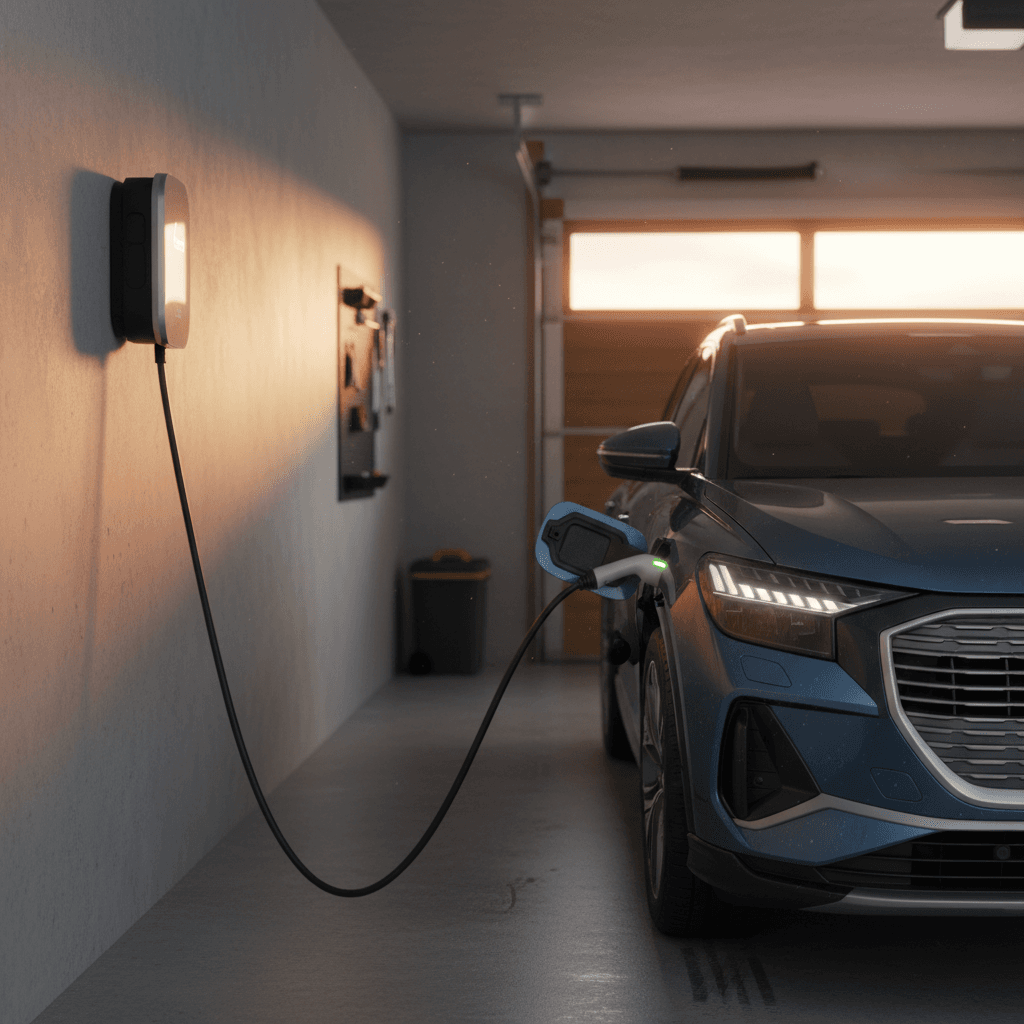
If you’ve just brought home an Audi Q4 e-tron (or you’re shopping for a used one), figuring out how to charge your Q4 e-tron at home is the key to making EV life easy. The good news: once you’re set up, charging becomes as automatic as plugging in your phone at night.
Quick take
Audi Q4 e-tron home charging basics
Before you start stringing cords across the garage, it helps to understand how the Q4 e-tron wants to be fed. Under the skin, it has an onboard AC charger of about 11 kW, which is the maximum power it can accept from any home or public Level 2 AC station. At home you’re not trying to match that perfectly; you’re aiming for something that fits your driving, budget, and house wiring.
Two main ways to charge a Q4 e-tron at home
Both use the same port on the car, but very different wall plugs
Level 1 – 120V household outlet
What it is: The regular three‑prong wall outlet in your garage or driveway.
- Uses the portable charging cable that comes with the car (or similar)
- Power: roughly 1–1.4 kW
- Adds only a few miles of range per hour
- Best for very light daily driving or temporary use
Level 2 – 240V home charger
What it is: A dedicated 240V circuit, like an electric dryer or range uses.
- Wall‑mounted or plug‑in EVSE rated 32–48 amps
- Power: typically 7–11 kW
- Adds dozens of miles of range per hour
- Best for most Q4 e-tron owners
Safety first
What you need to charge an Audi Q4 e-tron at home
The Q4 e-tron uses a standard Type 2 / J1772-style AC inlet for home and public Level 2 charging in most markets (in North America, that’s a J1772-style AC connector, with DC fast charging handled separately). That means you don’t need an Audi-branded box on the wall, the car will happily charge from most quality third‑party home chargers, as long as they’re wired correctly and sized for your electrical panel.
- A safe parking space within cord reach of the charge port (driver’s side rear on most Q4 e-tron models)
- Access to at least one reliable 120V outlet while you get started
- Longer term: a 240V circuit near the parking spot (often 40–60 amps) for a Level 2 charger
- A UL‑listed home EV charging station (often 32–48 amps) with a J1772-style connector
- Wi‑Fi or cellular at home if you want smart features like scheduling and usage tracking
- Your utility login handy so you can look up off‑peak EV rates before you set charge timers
Used Q4 e-tron shopping tip
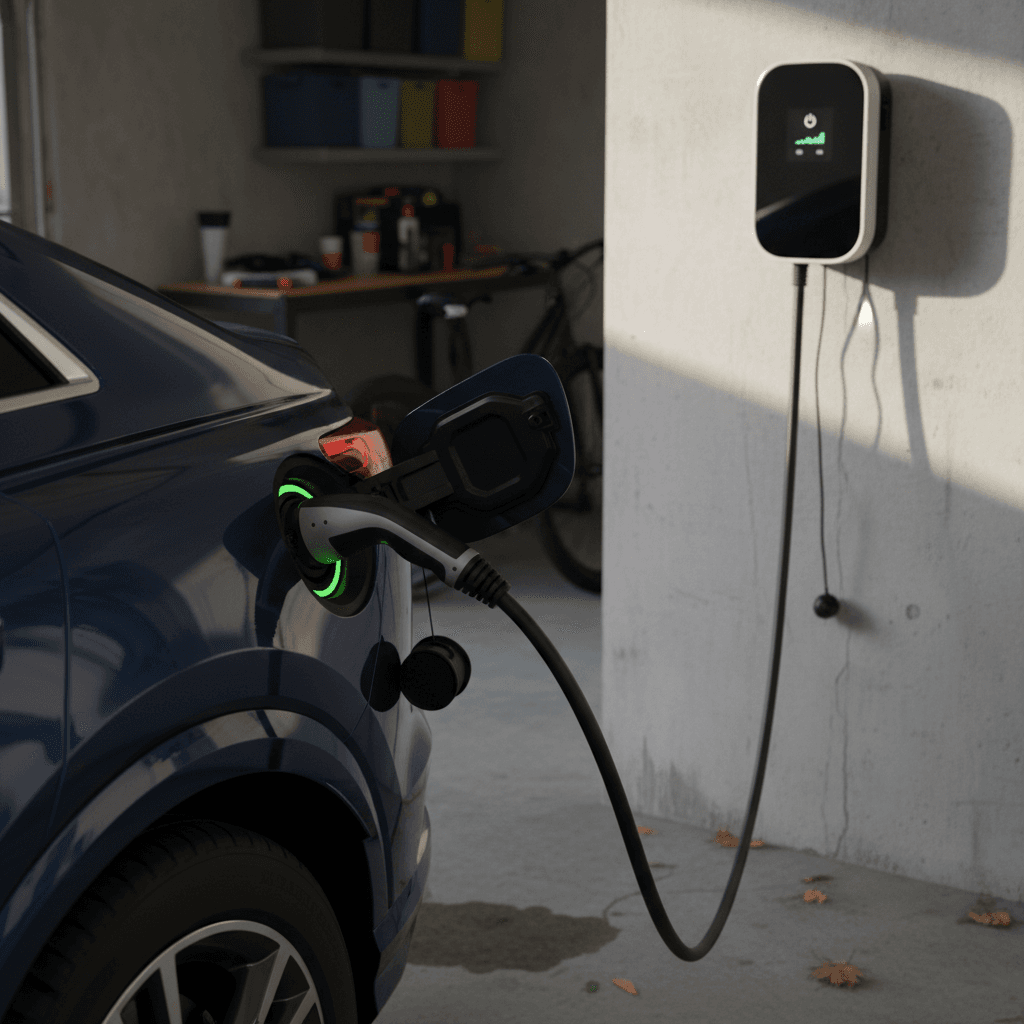
Step-by-step: How to charge from a standard 120V outlet (Level 1)
If you drive modest miles most days, or you’re waiting on an electrician, your Q4 e-tron can live on a 120V outlet for a while. It’s not fast, but it works.
Charging your Q4 e-tron from a 120V outlet
1. Find the right outlet
Pick a grounded 120V outlet on its own circuit if you can, no space heaters, freezers, or power tools sharing that circuit while you charge.
2. Use the portable EVSE correctly
Plug the Audi portable charging cable (or equivalent) into the wall first, then into the charge port on the Q4 e-tron. Make sure any status lights on the EVSE show normal operation.
3. Check the car’s settings
On the center screen or in the app, confirm the target state of charge (SoC) and any scheduled charging times. If you pay time‑of‑use rates, set charging to start in your off‑peak window.
4. Verify charging has started
The charge port light and in‑car display should indicate that AC charging is active, with an estimated completion time. On Level 1, don’t be surprised if it shows 20–40 hours from very low state of charge.
5. Avoid extension cords
Use the cable at its full, original length. Extension cords can overheat under continuous load and are generally not recommended for EV charging.
6. Be realistic about range
A 120V outlet typically restores only a handful of miles of range per hour. If you regularly drive more than 25–30 miles a day, start planning for Level 2.
Watch for overheating
Step-by-step: How to charge with a 240V Level 2 home charger
For most Audi Q4 e-tron owners, a 240V Level 2 charger turns the car into a true set‑and‑forget daily driver. Here’s how to get there without drama.
A. Getting the hardware and wiring right
- Talk to an electrician first. Have them look at your panel and recommend a safe circuit size (40A, 50A, or 60A are common).
- Pick a charger that matches the circuit. For example, a 40A circuit supports a 32A charger (about 7.7 kW). A 60A circuit can support a 48A charger (about 11.5 kW).
- Decide: hardwired or plug‑in. Hardwired installs are cleaner and often preferred outdoors. A NEMA 14‑50 plug‑in can be easier to replace later.
- Mount it where the cable reaches easily. You want a gentle cable droop, not a tightrope across the garage.
B. Day‑to‑day charging routine
- Set your charge limit. In the car’s settings, choose 80–90% as your daily target to protect battery longevity.
- Use scheduled charging. If your utility offers cheaper “EV” or off‑peak hours, program those into the car or the charger app.
- Plug in when you get home. With Level 2, there’s no need to run it down; topping up frequently is fine.
- Glance at the estimate. You should see a full overnight top‑up even when you arrive home near empty.
What “good enough” looks like
How long an Audi Q4 e-tron takes to charge at home
The exact time depends on your specific Q4 e-tron battery, how low you run it, and weather, but we can put some useful guardrails around your expectations. Later Q4 models use a roughly 77 kWh usable battery pack; earlier and smaller‑battery variants will be in the same ballpark for home‑charging math.
Approximate Audi Q4 e-tron home charging times
Rough estimates from very low state of charge to 80%, the sweet spot most owners target for daily driving.
| Charging method | Power at the car | Typical daily use case | Time to ~80% from low SoC |
|---|---|---|---|
| Level 1 – 120V, 12A portable cable | ~1.4 kW | Low‑mileage drivers, temporary/backup | ~35–40 hours from near empty |
| Level 2 – 240V, 32A home charger | ~7.5 kW | Common home setup on 40A circuit | ~8–10 hours from very low |
| Level 2 – 240V, 40A home charger | ~9.6 kW | Higher‑amp home circuits | ~6–8 hours from very low |
| Level 2 – 240V, 48A home charger | Up to ~11 kW (onboard limit) | Aggressive overnight top‑ups, heavy drivers | ~5–7 hours from very low |
Assumes a ~77 kWh usable battery and mild temperatures. Cold weather can stretch these times.
Why your numbers may differ
What it costs to charge your Q4 e-tron at home
One of the pleasures of home charging is watching your “fuel” bill shrink. Instead of paying per minute or per kWh at a public station, you’re simply buying more electricity on the same utility bill you already pay.
Back‑of‑the‑envelope cost math
To put that another way: on typical U.S. electricity prices, many Q4 e-tron owners pay the equivalent of 30–40 mpg fuel costs or better, with the convenience of waking up to a “full tank” most mornings. Time‑of‑use EV rates can push those costs even lower if you’re willing to charge only in off‑peak windows.
Grab your utility’s EV rate plan
Protecting your battery with smart home charging habits
You don’t have to baby the Q4 e-tron’s battery, but a few simple habits at home will keep it happy well past the warranty window. This matters whether you’re the first owner or buying used, battery health shows up in real‑world range and resale value.
Battery‑friendly habits for home charging
Simple changes that add up over years of ownership
Live between 20–80% most days
For routine commuting, try not to arrive home at 0% or charge to 100% every single night. Set an 80–90% daily limit in the car’s charging menu and keep the “emergency” 100% for big trips.
Mind the temperature
In extreme cold, consider pre‑conditioning the battery while plugged in so the car uses grid power, not stored energy, to warm itself. In extreme heat, shaded parking helps reduce thermal stress.
Don’t fast charge at home
Home charging is all AC; the very fast DC sessions happen on the road. Use those only when necessary. Your gentle, daily overnight AC charging is exactly what the chemistry likes.
Why this matters for used buyers
Troubleshooting common home charging issues
Even when the hardware is right, the first few weeks with a new EV can feel like learning a new appliance. Here are the snags Q4 e-tron owners most often run into at home, and how to sort them out.
Quick fixes for Q4 e-tron home charging quirks
Car shows “charging error” right after you plug in
Check that the connector is fully seated and the cable isn’t under strain. Then look at the charger’s status lights; if it’s faulted, reset it per the manual or power‑cycle the breaker once. If errors persist, call the installer or charger maker.
Charging is much slower than you expected
Confirm what the charger is actually delivering. A 120V Level 1 cable will always be slow; a 240V unit may be set to a reduced amp limit. In the car’s menu, make sure the AC current limit isn’t dialed down for that location.
Breaker trips after an hour or two
That’s a sign the circuit may be undersized, overloaded, or poorly wired. Don’t just flip it back on repeatedly, have an electrician inspect and possibly upsize the circuit or run a dedicated line.
You plug in but nothing starts
If you’ve set preferred charge times, the Q4 may be patiently waiting for cheap rates. The cluster will usually show a start time. You can override with “charge now” if you need range sooner.
Outlet or plug feels hot
Stop charging and let everything cool. Heat means resistance somewhere in the circuit. This is particularly common with old 120V outlets not meant for continuous 12‑amp loads.
Don’t ignore weird behavior
Home charging checklist for Audi Q4 e-tron owners
If you like things neat and orderly, here’s the 10,000‑foot view of what “dialed‑in” looks like when you’re charging an Audi Q4 e-tron at home.
Dialing in your Q4 e-tron home setup
1. Confirm your driving pattern
Roughly how many miles do you drive on a typical day and a busy day? Under 25 miles, Level 1 may be tolerable; over that, put Level 2 on the shopping list.
2. Assess your electrical panel
Have an electrician tell you what extra load you can safely add. A 40A circuit for a 32A charger is usually a sweet spot for home Q4 e-tron charging.
3. Choose a reputable Level 2 charger
Look for UL listing, a J1772-style connector, a weather rating suited to where you’ll mount it, and smart features you’ll actually use (Wi‑Fi, app, scheduling).
4. Set a sensible charge limit
In the car, set an 80–90% daily limit and enable scheduled charging, especially if you have off‑peak or EV‑specific utility rates.
5. Practice the routine
For a week, plug in when you get home and glance at the morning range. Adjust your charge limit or schedule until it matches your life without you ever thinking about it.
FAQ: Audi Q4 e-tron home charging
Common questions about charging an Audi Q4 e-tron at home
Where Recharged fits in if you’re shopping for a used Q4 e-tron
If you’re still on the hunt for an Audi Q4 e-tron, especially a used one, the home‑charging story should be part of your shopping checklist. You want a car with a healthy battery and a seller who can talk clearly about how they charged it.
Every EV sold through Recharged comes with a Recharged Score battery health report, so you’re not guessing about pack condition. Our EV specialists can also walk you through real‑world charging behavior, help you choose a home charging setup, and even coordinate financing and nationwide delivery so the car (and its new daily charging routine) slide right into your life.
Whether your Q4 e-tron is already in the driveway or still on your wish list, getting home charging right is what turns it from “interesting new gadget” into “quiet, effortless daily driver.” Once you’ve plugged in a few dozen times, you’ll wonder why you ever bothered with gas stations.