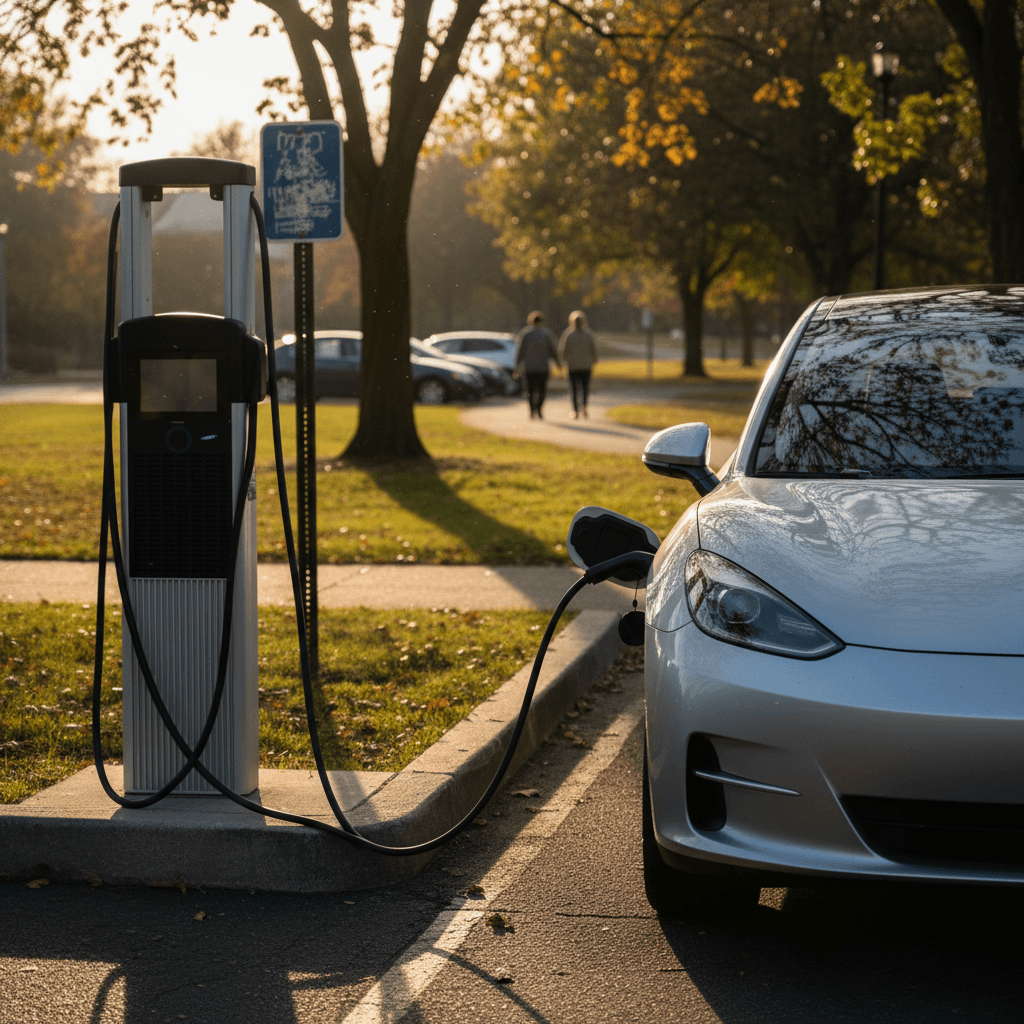
You’ve mapped the route, booked the Airbnb, the kids are arguing over snacks, and now you’re staring at your electric car wondering: how much does an EV road trip actually cost? Is it really cheaper than gas once you factor in DC fast charging prices, hotel stops, and detours? Let’s pull this out of the theoretical and put real dollars to real miles.
Quick answer
EV road trip cost basics
When people ask, “how much does an EV road trip cost?” they’re really asking two things: how much will I pay to charge, and how does that compare with a gas car. The honest answer is that there’s no single number, your cost is a mix of your EV’s efficiency, where you charge, local electricity prices, and how fast you like to drive.
- Energy in: You pay for electricity in kWh (kilowatt-hours), the same unit on your home power bill.
- Distance out: Your EV turns those kWh into miles. Efficient models can get 3.5–4.0 miles per kWh on the highway; big trucks and SUVs may see closer to 2.0–2.5.
- Price per kWh: Public DC fast chargers in late 2025 often run around $0.40–$0.50 per kWh nationally, with cheaper and more expensive regions on either side.
- Compare with gas: With national gas prices hovering around $2.90–$3.10 per gallon, a 30 mpg car is paying roughly $0.10 per mile at the pump, before any EV advantages like home charging or off-peak rates.
The big mental shift
Key factors that drive EV road trip costs
6 things that make your EV road trip cheaper or more expensive
The same EV can cost dramatically different amounts to run depending on these knobs.
1. Efficiency (mi/kWh)
2. Charger pricing
3. Your cruising speed
4. Weather & climate
5. Terrain & load
6. Home vs. away
A simple rule of thumb
Typical EV efficiency and what it means per mile
Let’s put some bookends on real-world efficiency. For 2024–2025 models, the EPA and independent testers show a spread from roughly 1.5 to 4.0 miles per kWh depending on size and shape. Efficient compact and midsize EVs sit on the high end; huge off-roaders and pickups on the low end.
Realistic EV highway efficiency bands
What that efficiency means for cost per mile
Assuming a mid-range DC fast charge price of $0.45/kWh.
| Vehicle type | Realistic highway efficiency (mi/kWh) | Cost per mile at $0.45/kWh | Electric "MPG" equivalent* |
|---|---|---|---|
| Sleek sedan | 4.0 mi/kWh | $0.11/mile | ≈ 28 mpg at $3.00/gal |
| Compact crossover | 3.0 mi/kWh | $0.15/mile | ≈ 22 mpg at $3.00/gal |
| Large SUV / truck | 2.2 mi/kWh | $0.20/mile | ≈ 16 mpg at $3.00/gal |
Your EV’s shape and size have almost as much impact on road trip cost as the charger price itself.
About that MPG equivalent
How much does DC fast charging cost?
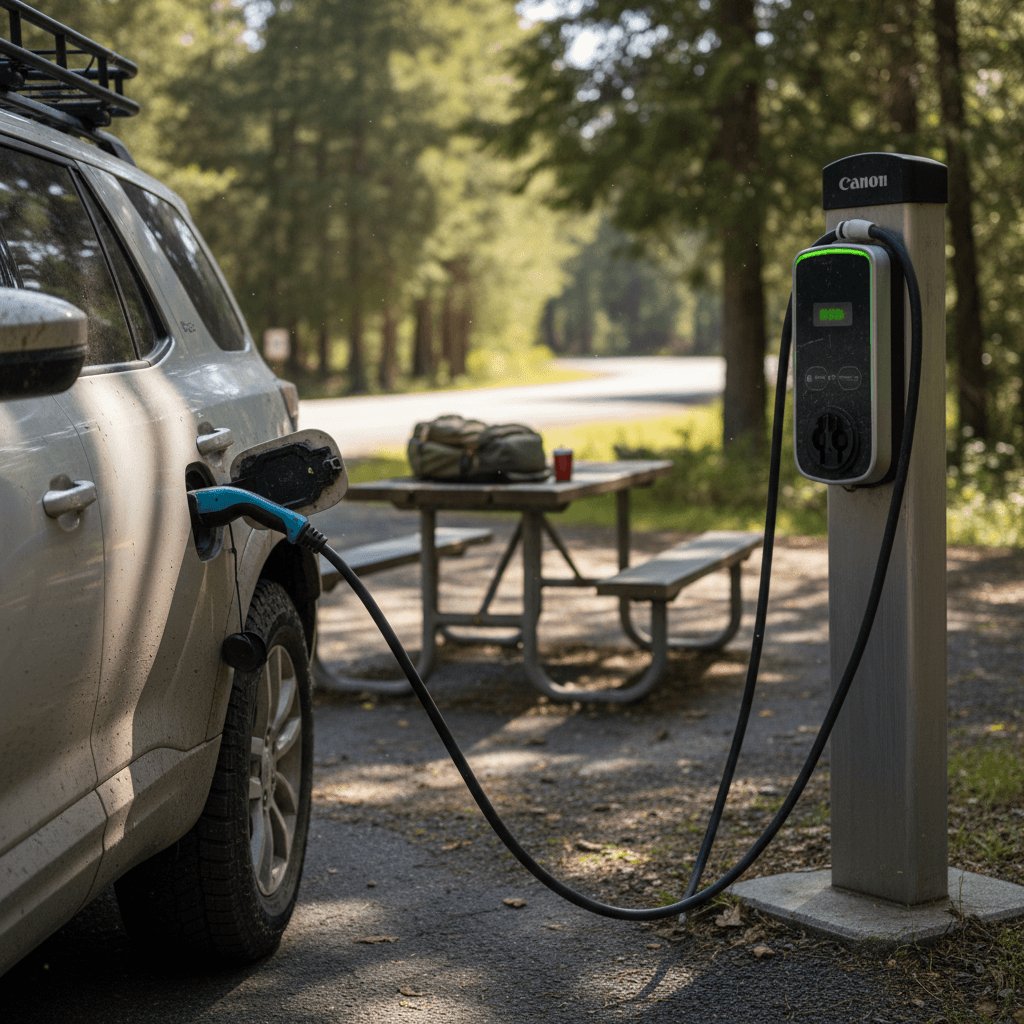
For road trips, DC fast charging is where most of your cost lives. You’re paying for speed and convenience. In late 2025, many U.S. highway fast chargers cluster around $0.40–$0.50 per kWh, but that national average hides a lot of local variation.
Typical DC fast charging prices in the U.S.
Numbers here are ballpark, always check the app for the exact rate before you plug in.
Lower-cost regions
High-cost regions
Time-of-use pricing
Per-minute pricing
Watch for idle fees
EV road trip cost vs gas road trip
Now for the big comparison. If you take the same 1,000‑mile highway trip in an EV and a gas car, who wins? The answer: it depends which EV, which gas car, and where you’re charging. But we can sketch out some honest, middle‑of‑the‑road scenarios.
EV on DC fast charging only
- Compact crossover at 3.0 mi/kWh
- Electricity at $0.45/kWh
- Cost per mile ≈ $0.15
- 1,000‑mile trip ≈ $150
If you’re in a high‑cost region at $0.60/kWh, the same trip climbs to about $200.
Gas car on regular unleaded
- Modern 30 mpg crossover
- Gas at $3.00/gal (recent national average ballpark)
- Cost per mile = $3 ÷ 30 = $0.10
- 1,000‑mile trip ≈ $100
A thriftier 40 mpg hybrid would do that trip for about $75 at the same gas price.
So is EV or gas cheaper on a road trip?
Sample EV road trip budgets (realistic scenarios)
Let’s get out of theory and into glovebox math. Here are three example trips using simple, conservative numbers. You can plug in your own efficiency and local prices to adapt these to your situation.
Three example EV road trip cost scenarios
All prices approximate and rounded for easy back‑of‑the‑envelope budgeting.
| Scenario | Trip distance | Vehicle type & efficiency | Charging mix | Estimated charging cost |
|---|---|---|---|---|
| Weekend 600‑mile loop | 600 miles | Efficient sedan at 3.5 mi/kWh | Start at home full, 2 DC fast sessions at $0.45/kWh | ≈ $60–$75 |
| Family 1,200‑mile vacation | 1,200 miles | Compact crossover at 3.0 mi/kWh | Mostly DC fast at $0.45–$0.50/kWh | ≈ $180–$220 |
| 1,000‑mile truck & trailer run | 1,000 miles | Electric truck towing at 2.0 mi/kWh | All DC fast at $0.50–$0.60/kWh | ≈ $250–$300 |
Use these as mental templates, not exact predictions, your EV, weather, and route will nudge the numbers up or down.
Bring your own "calculator"
How to lower your EV road trip costs
7 ways to cut your EV road trip charging bill
1. Leave with a cheap, full battery
If you can, charge to 90–100% at home the night before using off‑peak electricity. Every kWh you start with at $0.12–$0.20 is a kWh you’re not buying at $0.45 on the highway.
2. Target 10–70% fast-charge windows
Most EVs charge fastest between roughly 10% and 60–70% state of charge. Shorter, more frequent stops in that window usually cost less per mile than dragging the car all the way to 90–100% on DC fast.
3. Drive 5 mph slower than you want to
I know, it’s a road trip and you’re in a hurry. But backing off from 78 to 72 mph can bump your efficiency enough to shave a surprising amount off your electricity bill, and reduce how often you have to stop.
4. Pack smarter, not higher
Rooftop boxes, bikes on top, and giant cargo baskets act like parachutes at 75 mph. If you can fit things inside or behind the car instead of on top, you’ll pay less per mile at the charger.
5. Compare charger prices in the app
Many EV routing apps and network apps show <strong>pricing before you arrive</strong>. If two stations are close together on your route, choose the cheaper one, or the one offering off‑peak discounts when you’ll actually be there.
6. Use destination charging when you can
Hotels, vacation rentals, and some attractions offer Level 2 charging, sometimes free or at lower rates than highway DC fast. Even a few overnight hours can replace an expensive roadside session.
7. Keep the battery warm in winter
In cold weather, precondition the cabin and battery while plugged in if your car supports it. A warm battery charges faster and wastes less energy getting up to temperature, so you spend less time and money at each stop.
Planning charging stops like a pro
Good planning doesn’t just reduce stress, it reduces cost. Stopping at the right chargers, at the right state of charge, for the right amount of time is the secret sauce to keeping your EV road trip bill in check.
Tools that make EV road trip planning easier
Most EVs now bundle decent route planning, but it’s worth learning at least one dedicated app as a backup.
In-car route planner
Third-party apps
Hotel & destination filters
Don’t chase "free" charging blindly
Used EVs, battery health, and road trip costs
If you’re road‑tripping in a used EV, or thinking about buying one specifically for longer drives, battery health matters as much as sticker price. A healthy pack won’t necessarily cost more per mile on a given trip, but it will change how often and how long you have to stop, which affects both cost and convenience.
How degradation affects cost
- A smaller usable battery means more frequent stops.
- You may spend more time in the slower, high‑state‑of‑charge portion of the charging curve.
- If you’re forced to use pricier stations because others are just out of reach, your total bill can creep up.
Why transparency helps
- A verified battery health report lets you plan with confidence.
- You’ll have a clearer sense of realistic highway range today, not when the car was new.
- That makes it easier to compare a used EV’s total ownership and road trip costs against a newer model or a gas alternative.
Where Recharged fits in
FAQ: EV road trip costs
Common questions about EV road trip costs
Bottom line: what you should budget
Once you translate everything into kWh and miles, how much an EV road trip costs stops being a mystery and starts looking like any other line on your travel budget. For most drivers leaning on DC fast charging, you’re in the neighborhood of $0.11–$0.20 per mile, with efficient cars on cheap power at the low end and big trucks in pricey regions at the high end.
If you like the idea of crossing state lines quietly on electrons, the real homework happens before you ever leave the driveway: choosing an EV with the right efficiency and range for your style, and understanding how charging prices look along your favorite routes. That’s exactly where a transparent used‑EV marketplace like Recharged helps, pairing verified battery health and fair pricing with expert guidance so your next road trip is about the journey, not anxiety over the next charging bill.