If you’re considering a Kia EV9, or already drive one, the first practical question is simple: how long does it take to charge a Kia EV9? The answer depends a lot on where you plug in: a regular outlet, a Level 2 home charger, or a high‑power DC fast charger on a road trip. This guide breaks down realistic charging times so you can plan daily driving and long-distance travel with confidence.
EV9 charging headline numbers
Kia EV9 charging time: quick overview
- Level 1 (120V household outlet): ~3–4 miles of range per hour; 40–55 hours from low state of charge to near full on the large‑battery trims.
- Level 2 (240V, 40–48A home or public): roughly 7–9 hours from about 10% to 100%, depending on battery size and charger rating.
- DC fast charging (up to ~210–215 kW peak on a 350 kW station): roughly 20–24 minutes from 10% to 80% in good conditions, and closer to 30+ minutes when the charger or conditions aren’t ideal.
- Battery sizes: most U.S. EV9 trims use a ~99.8 kWh (often rounded to 100 kWh) pack; the base Light trim in some markets uses a smaller ~76 kWh pack.
- On‑board AC charger: the EV9 includes roughly an 11 kW on‑board charger, which is what sets the upper limit for Level 2 AC charging speed.
Manufacturer vs. real‑world times
Kia EV9 battery sizes and charging basics
Kia builds the EV9 on the E‑GMP platform it shares with the EV6 and Hyundai Ioniq 5, which means an 800‑volt architecture and strong fast‑charging performance. For charging time, two specs matter most: battery capacity and the charging power you can feed into it.
Kia EV9 battery and charging specs at a glance
Why your trim and charger type both matter for charging time
Battery options
- Standard battery: ~76 kWh (Light RWD in some markets)
- Long‑range battery: ~99.8 kWh (often rounded to 100 kWh) on most trims
- Usable capacity is slightly lower than the gross pack size, but the ~100 kWh figure is a good planning number.
On‑board charger and DC peak
- AC on‑board charger: about 10.9–11 kW on all trims, which caps Level 2 charging speed.
- DC fast‑charging peak: roughly 210–215 kW at a high‑power station when conditions are ideal.
- The 800‑V system lets the EV9 hold higher power for longer than many 400‑V SUVs.
A quick way to estimate charging time
How long to charge a Kia EV9 at home
Most EV9 owners will do the bulk of their charging at home. That’s where time and convenience matter more than raw speed. There are two basic options: Level 1 (a regular household outlet) and Level 2 (a 240‑volt circuit with a wallbox or hard‑wired EVSE).
Level 1: 120V household outlet (slow but workable in a pinch)
A standard U.S. 120V outlet supplies what’s called Level 1 charging. With the EV9’s large pack, this is extremely slow. You’ll usually see around 1.2–1.4 kW going into the pack, or roughly 3–4 miles of range per hour of charging.
- Adding about 30–40% of charge (roughly 90–120 miles of city range) can take an entire overnight window of 10–12 hours.
- Charging from very low to near full on a ~100 kWh pack can take 40–55 hours of continuous charging.
- This setup is best for very light daily use or as a backup when you’re away from home or waiting on a Level 2 installation.
Don’t rely on Level 1 long‑term
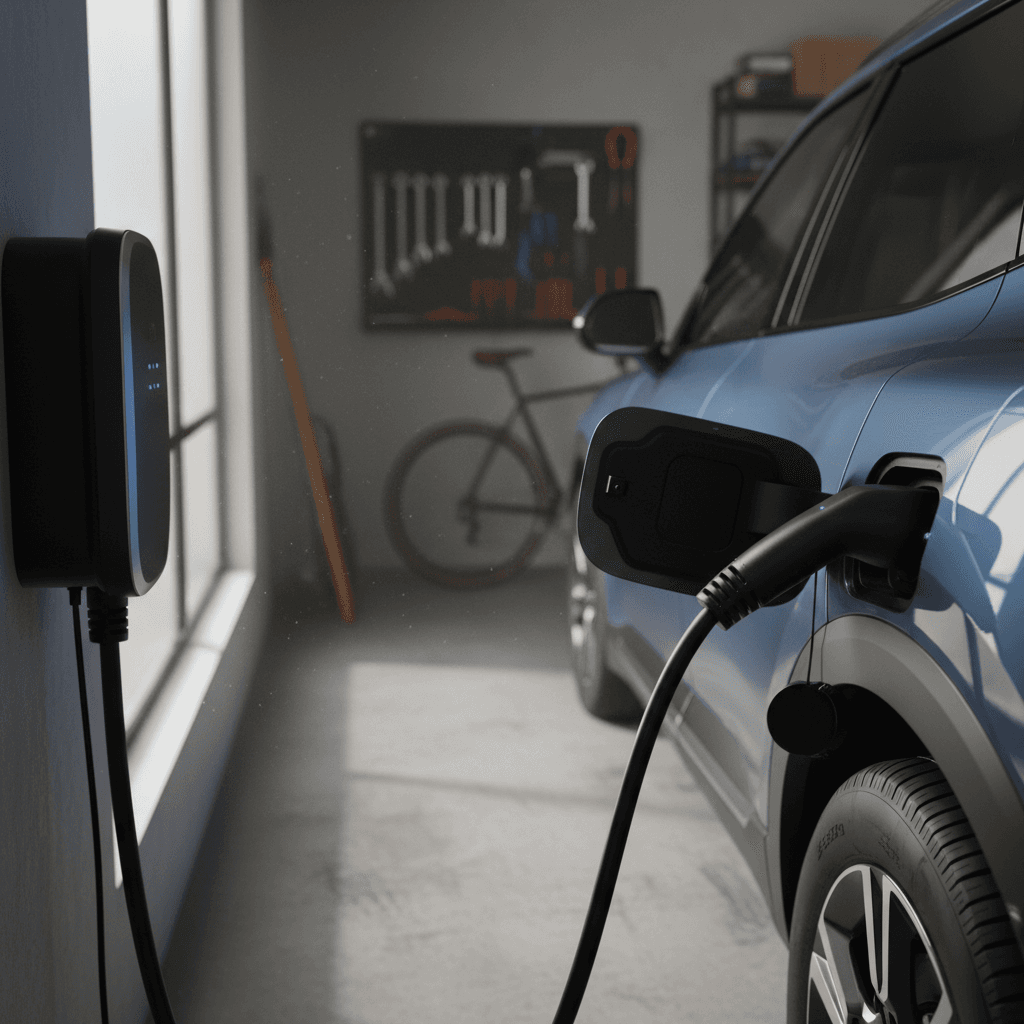
Level 2: 240V home charging (the sweet spot for EV9 owners)
Level 2 uses a 240‑volt circuit, similar to an electric dryer, with a dedicated EV charger. This is where the EV9 really settles into a comfortable ownership rhythm. Kia’s own specs for an 11 kW AC charger put a near‑empty to full charge for the large‑battery EV9 in roughly the 8–9 hour range, depending on trim and market data.
Approximate Kia EV9 home charging times
Realistic ranges assuming typical U.S. setups and the large ~100 kWh pack. Times are from a low state of charge (about 10–15%) to near full.
| Setup | Approx. Power to Car | Typical Use Case | Estimated Time (10–100%) |
|---|---|---|---|
| Level 1 – 120V, 12A | ~1.4 kW | Backup / very light use | 40–55 hours |
| Level 2 – 240V, 30A (24A continuous) | ~5.7 kW | Townhome / older wiring | 15–18 hours |
| Level 2 – 240V, 40A (32A continuous) | ~7.7 kW | Common homeowner upgrade | 11–13 hours |
| Level 2 – 240V, 48A (40A continuous)* | ~9.6 kW | High‑capacity home charger | 9–11 hours |
| Level 2 – 240V, 60A (48A continuous, maxing the OBC) | ~11 kW | Top‑end home setup | 7–9 hours |
Your exact charging time will vary with temperature, state of charge window, and circuit limitations.
Why home charging “feels” faster than the numbers
Kia EV9 DC fast charging: 10–80% in the real world
On road trips, you’ll lean on DC fast charging to add a lot of range quickly. Kia describes the EV9’s 10–80% DC fast‑charging window in the low‑to‑mid 20‑minute range on a strong 350 kW station, thanks to its 800‑V architecture and roughly 210–215 kW peak intake capability.
Typical DC fast‑charging performance for the EV9
In Recharged’s own charging‑curve analysis, a representative 10–80% DC session on the ~99.8 kWh EV9 at a strong high‑power station lands in that 20–30 minute band under favorable conditions. We’ve also seen real owners report similar times at modern 350 kW sites when they arrive with a warm, low‑state‑of‑charge battery and stalls aren’t derated.
You probably won’t see 350 kW on the screen
Kia EV9 charging time table by charger type
Pulling it all together, here’s a simplified look at how long it takes to charge a Kia EV9 from about 10% to a practical upper limit in everyday scenarios. These are planning numbers, not guarantees, you’ll see faster or slower sessions depending on weather, elevation, and station health.
Kia EV9 approximate charging times by scenario
Times below assume the large ~100 kWh pack and typical conditions. "Daily top‑up" assumes adding ~40% charge (for example, 40–80%).
| Charger Type & Scenario | SOC Window | Approx. Time | Best Use Case |
|---|---|---|---|
| Level 1 – 120V outlet | 10% → 80% | 30–40 hours | Emergency/backup only |
| Level 2 – moderate (7–8 kW) | 10% → 80% | 8–10 hours | Overnight top‑ups for moderate commuters |
| Level 2 – strong (9–11 kW) | 10% → 80% | 6–8 hours | Overnight top‑ups, heavy usage or multiple drivers |
| Level 2 – strong (9–11 kW) | 40% → 80% | 3–4 hours | Typical nightly "refuel" window |
| DC fast – 150 kW station | 10% → 80% | 25–35 minutes | Older or shared highway sites |
| DC fast – 350 kW station | 10% → 80% | 20–30 minutes | Modern high‑power hubs with good maintenance |
| DC fast – any | 80% → 100% | 25–45 minutes | Only when you truly need max range; power tapers heavily here |
Use these as conservative estimates when planning trips or deciding on home hardware.
Trip‑planning rule of thumb
5 factors that change your EV9 charging time
Key variables that speed up, or slow down, Kia EV9 charging
1. Battery temperature
The EV9 likes its battery in a moderate temperature window. If you sprint to a DC fast charger with a cold pack or plug in after sitting in extreme heat, the car will limit power to protect itself. Using navigation that can precondition the pack before arrival helps you hit those 200+ kW peaks more often.
2. State of charge when you plug in
All lithium‑ion packs charge fastest when they’re more empty. Power rises quickly from ~10% to the mid‑range, then tapers as you approach 80–90% and crawls from 90–100%. That’s why two “30‑minute sessions” can add very different amounts of range depending on your starting and ending state of charge.
3. Charger rating vs. what you actually get
A station labeled 350 kW doesn’t guarantee 350 kW to your car. Power may be shared between stalls, limited by the site’s grid connection, or throttled because of heat. Similarly, a "48‑amp" home charger will only deliver its rated power if your electrical panel and wiring support it.
4. Weather and climate control use
Extreme cold thickens the electrolyte and slows chemistry inside the pack; extreme heat triggers aggressive cooling. In both cases the battery management system may reduce charging power. Running HVAC while fast charging also pulls a few kilowatts away from the battery itself.
5. Battery age and health
As an EV9 ages, minor degradation in the pack and changes in how the car manages heat can shave a little off peak charging speeds. A healthy pack will still fast‑charge well, but a used EV9 with heavy DC fast‑charging history may show slower curves than a brand‑new one.
Home charging recommendations for Kia EV9 owners
Choosing the right home charger size
For most Kia EV9 owners in the U.S., a 40A or 48A Level 2 charger (delivering about 7.7–9.6 kW) strikes the best balance of cost, speed, and panel load. That’s enough to comfortably recover a full workday’s driving, 50–80 miles, in a typical overnight window.
- If you regularly drive 100+ miles per day or share the EV9 between drivers, stepping up to a 48A or 60A circuit that can feed the full 11 kW OBC is worth considering.
- Apartment or condo dwellers may be limited to 30A circuits; that’s still workable if you can plug in most nights.
Electrical panel and installation considerations
A 40–60A 240V circuit is a serious appliance, just like an electric range or large AC unit. Plan your installation carefully:
- Have a licensed electrician evaluate panel capacity and run the proper gauge wire.
- Consider a load‑sharing or smart panel solution if your main service is 100A or 125A.
- Locate the charger so the cable comfortably reaches your EV9’s charge port without stretching across walkways.
If you’re shopping used, you can often roll home‑charging hardware costs into financing, something platforms like Recharged can help you evaluate alongside the vehicle itself.
Daily routine that works for most EV9 drivers
Fast-charging best practices to protect your EV9 battery
The EV9’s pack is built to handle DC fast charging, but how you use it still matters, especially if you plan to keep the SUV for a decade or you’re thinking about resale value. A few simple habits can shorten your stops without shortening battery life.
Smart DC fast‑charging habits for Kia EV9 owners
Cut your stop times and keep your pack happy
Arrive low, leave around 70–80%
Try to arrive at highway fast chargers around 10–20% and unplug in the 60–80% range. These are the portions of the curve where the EV9 charges fastest. Staying on the charger beyond 80% adds time with relatively few miles gained.
Precondition when possible
If your EV9 offers battery preconditioning tied to navigation, use it before big DC fast‑charge stops, especially in winter. Warming the pack ahead of time lets the BMS accept higher power right away instead of ramping up slowly.
Limit “just because” fast charges
Occasional high‑power sessions are fine, but there’s no reason to DCFC from 60% to 100% if you’ll be parking shortly after. For local driving, home Level 2 charging is easier on the pack and your wallet.
Watch idle fees at fast chargers
Kia EV9 charging time: FAQ
Frequently asked questions about Kia EV9 charging times
Charging time and shopping for a used Kia EV9
Understanding how long it takes to charge a Kia EV9 is key to making the SUV fit your life, whether that means a robust Level 2 setup in the garage or confidence in 20–30‑minute fast‑charge stops on family road trips. If you’re looking at a used EV9, dig a little deeper than the spec sheet: battery health, DC fast‑charging history, and how the previous owner charged at home all influence both charging times and long‑term range.
At Recharged, every used EV we list comes with a Recharged Score Report that includes verified battery health and charging insights, so you’re not guessing about how the last owner treated the pack. Pair that with EV‑specialist guidance, financing options, trade‑in support, and nationwide delivery, and you can focus on the fun part, deciding how you want to charge and use your EV9, rather than worrying about what’s hiding behind the charging curve.