If you’ve heard that EV tires wear out faster than tires on gas cars, you’re not imagining things. Understanding how long EV tires last is critical to knowing your real cost of ownership, especially as more people shop for used EVs and high-torque crossovers.
Quick answer
How long do EV tires last, really?
There isn’t one single number that applies to every EV, but recent owner data and industry studies give us a realistic range.
Typical EV tire life in the real world
By comparison, many all-season tires on gas cars are rated for 50,000–70,000 miles. So even if an EV is easy on tires, you should assume: you’ll likely replace tires more often over the life of the vehicle, especially if you drive a heavy SUV or love instant torque.
Don’t rely on warranty miles alone
Why EV tires often wear faster than gas-car tires
EVs aren’t cursed with bad tires; they just place different demands on them. Three forces drive most of the difference:
The three big reasons EV tires wear quickly
More weight, more torque, and different tire design all play a role.
1. Extra weight
2. Instant torque
3. Special EV tire design
What “20% faster wear” really means
7 factors that determine your EV tire lifespan
The spread between a tire that dies at 18,000 miles and one that goes 45,000+ miles usually comes down to how and where the car is used. Here are the levers you actually control:
- Driving style: Frequent full-throttle launches, late braking, and hard cornering will chew through EV tires shockingly fast.
- Vehicle type & weight: A compact hatchback on narrow tires is far easier on rubber than a three-row electric SUV with 22-inch wheels.
- Tire type & compound: Max-performance summer tires grip and stop beautifully but rarely last as long as touring all-season tires.
- Wheel size: Larger-diameter wheels usually mean shorter sidewalls and wider tread, great for looks and handling, harder on tread life and your wallet.
- Alignment & suspension health: Even slight misalignment on an EV can produce rapid, uneven wear on the inner or outer edges.
- Tire pressure & rotation: Underinflation and skipped rotations are two of the fastest ways to take thousands of miles off a tire’s life.
- Climate & roads: Hot climates, rough pavement, heavy rain, and lots of stop‑and‑go traffic all add up over tens of thousands of miles.
A simple rule of thumb
Signs your EV tires need to be replaced
EVs often mask traditional warning signs, quiet cabins and smooth electric power can hide tire problems until they’re serious. Instead of waiting for obvious squealing or sliding, look for these earlier indicators.
Critical checks before your next road trip
1. Low tread depth
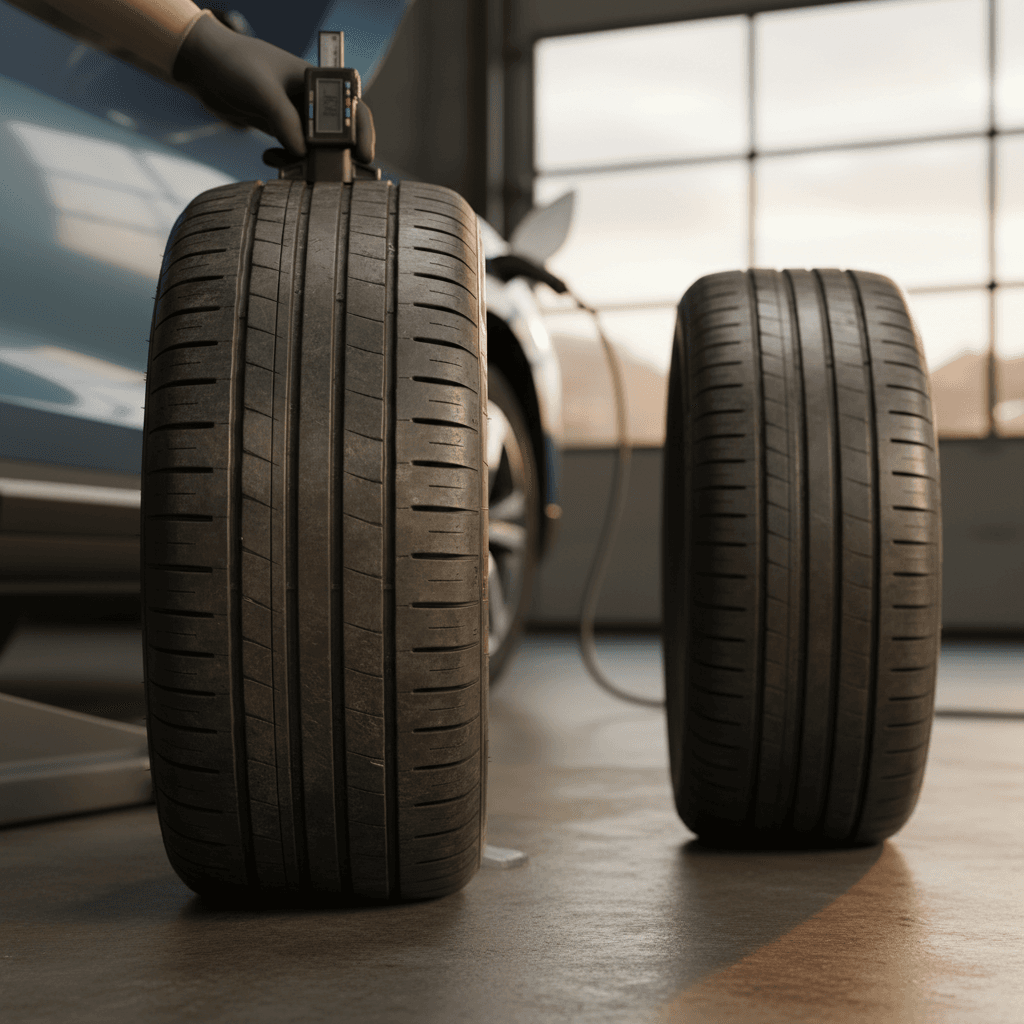
Use a tread depth gauge or the penny test. If tread is at or below 2/32 inch, the tire is legally worn out. For EVs driven in rain or snow, many experts recommend replacing closer to 4/32–5/32 inch for safety.
2. Uneven wear patterns
Feathering, cupping, or one shoulder wearing faster than the other often points to misalignment or suspension issues. Fixing the cause early can save your next set of tires.
3. Age cracks or sidewall damage
Even if tread looks good, visible cracks, bulges, or sidewall cuts are reasons to replace a tire immediately, especially on heavier EVs that load tires harder.
4. Increased stopping distances
If your EV’s driver-assist systems are working harder, or you notice braking feels less confident in the wet, your tires may have quietly crossed from “okay” to “marginal.”
5. Vibration or noise changes
New hums, thumps, or vibrations at highway speed can indicate uneven wear, a separated belt, or a damaged wheel. Don’t ignore new noises just because the car itself is silent.
How to make your EV tires last longer
You can’t change physics, your EV will always be heavier than a comparable gas car, but you can absolutely stretch tire life with a few habits and maintenance choices.
Six high-impact ways to extend EV tire life
Most of these cost little or nothing and pay back in thousands of miles.
Drive smoother
Rotate on schedule
Watch tire pressure
Keep alignment in spec
Choose seasonal tires wisely
Buy the right tire
Bonus: Range and comfort win too
EV tire replacement costs and how to budget
Tires are one of the few maintenance items EVs don’t dramatically reduce compared with gas cars, if anything, they’re a bit of a hidden cost. But once you know what to expect, you can budget realistically.
Typical EV tire replacement costs in 2025
Approximate U.S. retail pricing for a full set of four tires, excluding tax and installation. Actual prices vary by size, brand, and region.
| EV Type | Typical Tire Size | Approx. Cost per Tire | Approx. Cost per Set (4) | Typical Life (miles) |
|---|---|---|---|---|
| Compact / midsize EV sedan (e.g., Bolt EUV, Model 3 RWD) | 17"–18" all-season | $150–$220 | $600–$880 | 30,000–40,000 |
| Mainstream crossover (e.g., Ioniq 5, Mustang Mach‑E) | 18"–20" all-season | $180–$260 | $720–$1,040 | 25,000–35,000 |
| Large SUV / performance EV (e.g., Rivian R1S, Model X, EV9) | 20"–22" performance or all-season | $220–$350+ | $880–$1,400+ | 20,000–30,000 |
Use these numbers as planning tools, not quotes, your local tire shop or service center will give exact pricing for your tire size.
Don’t cheap out on load rating
How often you’ll likely pay for tires
If you drive 12,000 miles a year and your EV gets 30,000 miles out of a set, you’re buying tires about every 2.5 years. At 40,000 miles, it stretches to roughly every 3.5 years.
Run the math against your own mileage so tire costs don’t come as an unpleasant surprise, especially if you’re stretching your budget to get into a nicer EV.
How this compares to gas cars
A similar gas car on 50,000–60,000‑mile tires may only need two sets over 100,000 miles of ownership. An EV could realistically need three in the same span.
That doesn’t erase fuel and maintenance savings, but it’s worth baking into your total cost-of-ownership calculation.
What EV tire wear means when you’re buying used
If you’re shopping the used market, tires are one of the quickest windows into how an EV was driven and maintained. They also represent a very real near-term expense, up to $1,000+ for a set on larger vehicles.
How to read a used EV’s tires before you buy
Check tread depth on all four corners
Uneven front-to-rear or side-to-side wear can indicate skipped rotations, aggressive driving, or alignment issues. Budget for a new set soon if tread is already low.
Look for mixed or cheap tires
A patchwork of mismatched or ultra-budget tires may signal a previous owner who cut corners. That can hint at similar shortcuts elsewhere in maintenance.
Confirm load rating and EV suitability
Make sure the installed tires meet the vehicle’s specified load rating and speed rating. For powerful models, EV-specific or XL (extra load) tires are strongly preferred.
Ask for rotation and alignment history
Service records showing regular rotations and any alignment corrections are a positive sign the previous owner cared about how the car drove and wore its tires.
At Recharged, every vehicle gets a comprehensive Recharged Score Report. We don’t just look at battery health and pricing; we also document tire condition so you know if you’re likely to face a $700–$1,200 tire bill soon after purchase. That transparency is a big part of why buyers are increasingly comfortable shopping for used EVs online.
FAQ: Common questions about EV tire life
EV tire life: your questions answered
Bottom line: What to expect from your EV tires
Owning an EV means trading oil changes and exhaust repairs for a different set of maintenance realities. Tires are at the top of that list. In practice, you should plan for 30,000–40,000 miles from a well-chosen set of EV tires under normal driving, and less if you own a heavy or performance-focused model.
If you drive smoothly, stay on top of rotation, pressure, and alignment, and choose tires designed to handle EV weight and torque, you’ll keep both your tire costs and your safety under control. And when you’re evaluating a used EV, take tire condition as seriously as you take battery health, it’s a key piece of the total cost-of-ownership puzzle that companies like Recharged are finally making transparent.