If you’ve ever pulled into a DC fast charger on a cold day and watched the numbers crawl instead of climb, you’ve already met the problem battery preconditioning is designed to solve. EV battery preconditioning quietly heats or cools your pack before a fast charge or departure so it can accept power more quickly, deliver better range, and stay healthier over the long haul.
In plain English
What is EV battery preconditioning?
EV battery preconditioning is the process of actively heating or cooling the high‑voltage battery so it’s near its ideal operating temperature before a demanding event, usually DC fast charging or departure in very cold or very hot weather. Modern EVs do this with built‑in heaters, coolant loops, and sometimes a heat pump that can move heat in or out of the battery pack.
Your car may call this feature Battery Preconditioning, Battery Conditioning, Battery Care, or simply roll it into a broader Scheduled Departure or Departure Timer setting, but the goal is the same: get the pack into a temperature sweet spot so it can charge fast and perform consistently.
- Most EV batteries are happiest roughly in the 60–95°F (15–35°C) range.
- Below freezing, charging speed and available power can drop sharply.
- Preconditioning nudges the battery back into that comfort zone before you plug into a powerful DC fast charger.
Why battery temperature matters so much
A lithium‑ion battery doesn’t “store electricity” like a tank of gas. Instead, it holds a mix of chemicals that create electricity through a reaction. When the pack is too cold or too hot, that reaction slows down or becomes stressed. The result is exactly what you feel behind the wheel: slower charging, less range, and sometimes reduced performance or regenerative braking.
How temperature affects your EV battery
Same battery, very different behavior at different temps
Too cold
- Sluggish charging speeds
- Reduced regenerative braking
- Temporary loss of range
Too hot
- Battery management limits power
- Fast charging may be throttled
- More long‑term wear if unmanaged
Just right
- Maximum fast‑charge speed
- Predictable range and performance
- Less thermal stress over time
Cold pack, slow charger
How EV battery preconditioning works, step by step
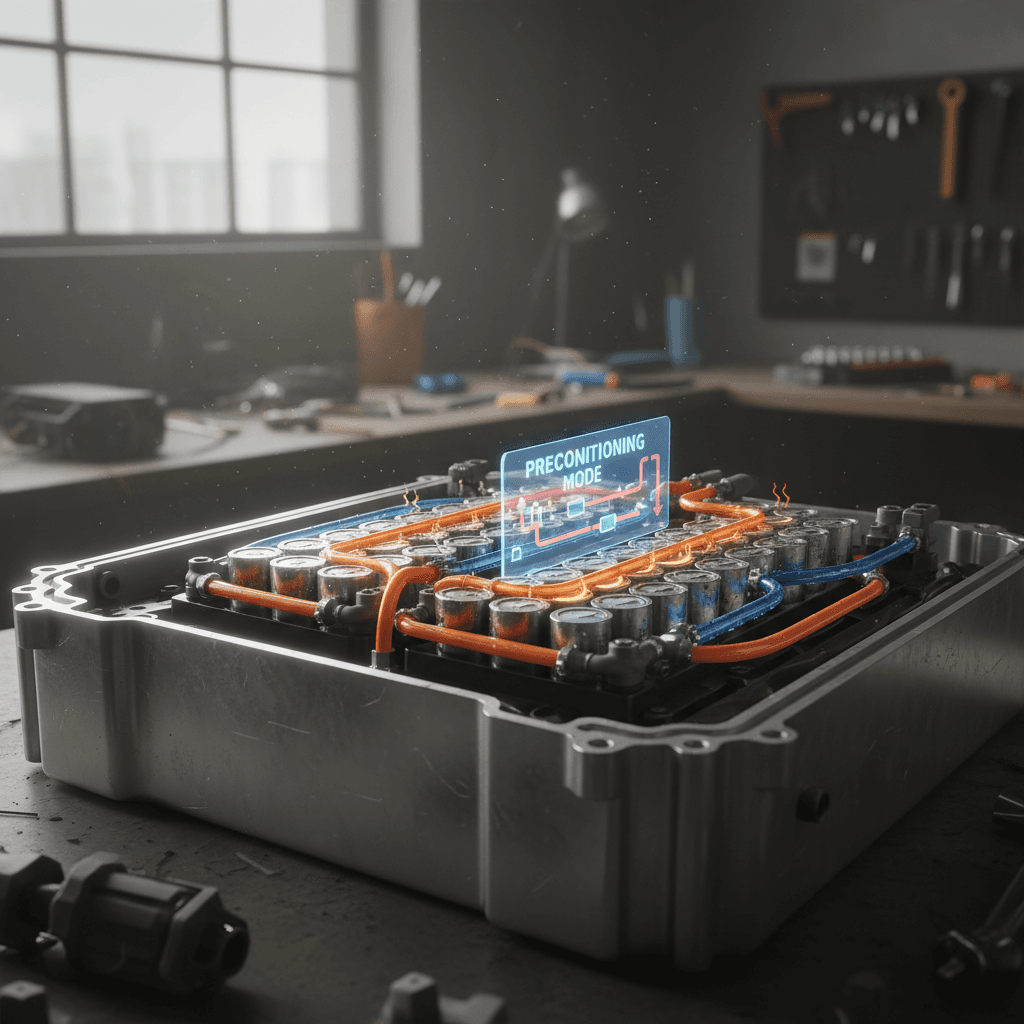
Under the floor, your EV’s battery pack is wrapped in a thermal management system, coolant channels, pumps, valves, and, on many newer EVs, a heat pump. Preconditioning is essentially the software telling that hardware to go to work ahead of time.
- Sensing the need. The car constantly monitors battery temperature and, depending on the brand, your navigation destination, scheduled departure time, or manual settings.
- Deciding on a target. The battery management system picks an optimal temperature window (often somewhere around 60–95°F / 15–35°C) based on the conditions and the type of charging you’re about to do.
- Heating or cooling the pack. The car uses built‑in electric heaters, a heat pump, or coolant loops tied to the drive units to warm or cool the battery toward that target. In cold weather, you may see a snowflake or heating‑coil icon on the dash while this happens.
- Managing energy sources. If you’re plugged in, most EVs draw power from the grid for this work; if you’re driving, the energy comes from the battery itself.
- Holding temperature. As you arrive at the DC fast charger, or at your departure time, the pack is already near its sweet spot, so the car can accept higher charging power immediately and deliver consistent performance.
Look for icons on the dash
Automatic vs. manual preconditioning (Tesla, Kia/Hyundai, others)
Not all EVs handle preconditioning the same way. Some are largely automatic; others expect you to push the right buttons or use the navigation system in a specific way. Here’s how the feature commonly shows up in today’s market.
How popular brands handle battery preconditioning
Exact menus and names vary by model year and software version, but these are typical behaviors you’ll see.
| Brand | Typical name | How it usually works | Best use cases |
|---|---|---|---|
| Tesla | Preconditioning / Scheduled Departure | Automatically warms battery when you navigate to a Supercharger in the Tesla app or on the screen; also preconditions before a scheduled departure if needed. | On the way to a Supercharger, winter road trips, daily morning departure in cold climates. |
| Kia / Hyundai | Battery Conditioning mode | When you set a DC fast charger as a waypoint or destination in the built‑in navigation, the car heats or cools the pack automatically; many newer models also allow manual activation in EV menus or connected apps. | Route‑based fast‑charging stops; cold‑weather charging at 150 kW+ stations. |
| Ford, GM, VW and others | Battery preconditioning / DC fast‑charge optimization | Often tied to navigation (setting a DC fast charger as your destination) or a Scheduled Departure setting; some allow one‑touch manual preconditioning in the app. | Fast‑charging stops on longer drives; scheduled morning departures in extreme temperatures. |
| Older or entry‑level EVs | May not offer full battery preconditioning | Some older or budget‑focused models lack active battery heating/cooling, or only warm the battery to prevent damage when it’s very cold. | Rely more on gentle driving, slower initial charge rates, and timing charges in milder parts of the day. |
Always double‑check your owner’s manual or in‑car help for the latest steps for your specific EV.
Don’t assume your car has it
When you should actually precondition your EV battery
Preconditioning is powerful, but you don’t need it every time you plug in. In many situations, especially slow home charging in mild weather, the benefit is tiny. Here’s when it’s worth the effort.
Smart times to precondition your battery
Cold‑weather DC fast charging
If the outside temperature is below about 50–60°F (10–15°C) and you’re heading to a 100 kW+ DC fast charger, preconditioning can dramatically increase initial charging speed.
First charge of the day after sitting outside
If your car has been parked in the cold overnight, the pack will be cold‑soaked. Warming it before a fast charge or long highway drive can restore range and regen more quickly.
Extreme heat before a big fast charge
In very hot climates, some EVs use preconditioning to cool the battery ahead of a DC session so it can accept high power without overheating or throttling.
Scheduled morning departures in winter
Using a Scheduled Departure feature while plugged in lets the car precondition the battery and cabin using grid power, giving you full range and instant cabin comfort without a big hit to state of charge.
Not usually needed for Level 1 or Level 2
At home or work on slower AC chargers, the pack doesn’t need to accept huge power. The car will warm the battery enough to charge safely, so manual preconditioning is usually optional.
Rule of thumb
Does preconditioning hurt or help battery life?
It’s natural to wonder whether running heaters and pumps before every charge is wearing your battery out faster. In practice, short, targeted preconditioning sessions are more likely to protect battery life than harm it, especially if you fast‑charge often in cold weather.
How it can help
- Warmer cells can accept charge more evenly, reducing stress during hard DC fast charges.
- Keeping the battery in a moderate temperature window reduces time spent at damaging extremes.
- Shorter fast‑charge sessions (thanks to higher power) mean less time at high voltage and high temperature.
Where to be thoughtful
- Preconditioning while unplugged consumes some of your usable range, since the energy comes from the pack.
- Running heaters for long periods when you don’t end up fast‑charging is mostly wasted effort.
- As with any system, using it constantly in very harsh climates may add a tiny amount of wear, but usually far less than repeated cold fast‑charges without it.
Big picture for longevity
Real‑world impact on fast charging and range
Drivers often underestimate just how much a cold battery can slow down fast charging. In community testing and owner reports, the difference between arriving with a cold pack and a preconditioned pack can easily be the difference between a quick restroom stop and a long lunch.
What preconditioning can change in the real world*
*These are illustrative ranges based on public testing and automaker guidance. Exact gains depend on your EV, charger, state of charge, and weather, but the pattern is consistent: a warm, well‑managed battery charges faster and feels better to drive.
How to use preconditioning on a road trip
On a long drive, preconditioning is the difference between your EV arriving at a fast charger ready to gulp down power, or slowly sipping while you watch the clock. The trick is to let the car know, in time, where you plan to charge.
Road‑trip playbook: fast‑charge like a pro
1. Plan stops around real fast chargers
Use apps (or the built‑in planner) to target DC stations that can actually deliver 100–350 kW and are compatible with your connector or adapter.
2. Set the charger as a destination in your car
Many EVs only start preconditioning if the charger is set in the factory navigation, not just in Apple CarPlay, Android Auto, or a third‑party app on your phone.
3. Aim to arrive with 10–30% battery
Fast charging is quickest when arriving at a lower state of charge; your EV’s route planner will often do this automatically if you let it.
4. Watch for preconditioning indicators
On the way, keep an eye out for a snowflake, heater coil, or battery icon that signals the pack is being heated or cooled.
5. Don’t start too early
Most systems begin preconditioning 20–45 minutes before arrival. If you’re much farther away, it’s okay if nothing happens yet.
6. Stay plugged in for scheduled departures
If you’re leaving a hotel or home in the morning, use Scheduled Departure while plugged in so the grid, not your battery, pays for the warm‑up.
Navigation matters more than you think
Preconditioning tips if you’re buying a used EV
If you’re shopping for a used EV, how the car manages its battery, including preconditioning, can make a noticeable difference in day‑to‑day usability. That’s especially true if you depend on public fast charging or live where winters are long.
Questions to ask or test
- Does this model support full battery preconditioning? Some older or base models don’t.
- Is there a Battery Conditioning or Scheduled Departure menu? Ask the seller to show you where it lives in the infotainment system.
- How does it behave at a DC fast charger in cold weather? If possible, test a winter fast‑charge or ask for recent experience from the owner.
How Recharged can help
Every EV sold through Recharged includes a Recharged Score Report with verified battery health and model‑specific insights. Our EV specialists can explain how preconditioning works on that particular car and what to expect on road trips or in winter.
If you plan to rely heavily on DC fast charging, tell your Recharged specialist. They can help you compare models and trims where battery thermal management and preconditioning are especially robust.
Buying with confidence
Frequently asked questions about EV battery preconditioning
EV battery preconditioning: quick answers
Key takeaways
Battery preconditioning isn’t just another buried menu option, it’s one of the best tools you have to make your EV feel quick to charge and predictable to live with, especially in tough weather. By getting the pack into its comfort zone before high‑power charging or a cold‑morning commute, you’re trading a little advance planning for faster stops, better range, and less stress on the battery.
If you already own an EV, spend a few minutes in the manual or EV settings to learn exactly how your car handles preconditioning, and practice it before your next road trip. If you’re shopping for a used EV, especially through a digital retailer like Recharged, ask specifically how battery heating and preconditioning work on that model. The more you understand what’s happening behind the scenes, the easier it is to make your EV ownership experience feel seamless, even when the temperature swings.