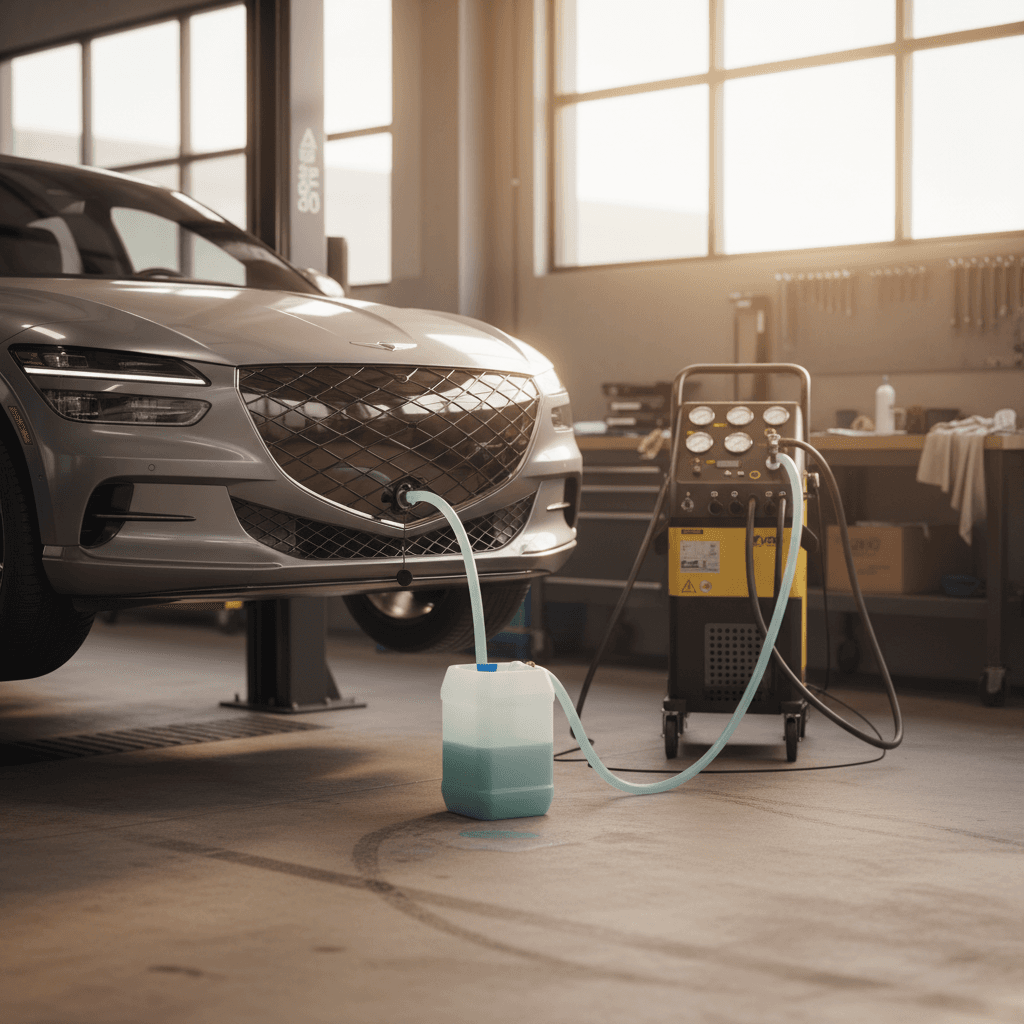
If you’re planning ahead for maintenance, it’s natural to wonder what a Genesis GV60 coolant flush costs and how often you’ll actually face that bill. The GV60 doesn’t need coolant changes very often, but when it does, it’s a specialized job tied directly to battery and inverter health, so it’s worth understanding both the price and the stakes.
Quick takeaway
Why coolant matters on a Genesis GV60
Unlike an internal‑combustion Genesis, your GV60 uses coolant primarily for the high‑voltage battery pack, drive motors, and power electronics. A liquid thermal management system circulates coolant through plates and channels to keep those components in a safe temperature window during fast charging, hot‑weather driving, and cold‑weather preconditioning.
- The battery pack relies on stable coolant chemistry and low electrical conductivity to prevent shorts and hotspots.
- Drive motors and inverters generate significant heat during spirited driving or towing and depend on effective cooling.
- Poor coolant quality can accelerate battery degradation, limit DC fast‑charge speeds, or trigger derating and warning lights.
Don’t DIY this one
Official Genesis GV60 coolant change intervals
Genesis doesn’t talk much about coolant service in marketing materials, but the owner’s manual and maintenance schedule do spell out when to change it. For U.S.‑spec GV60s, the pattern looks like this:
Typical Genesis GV60 coolant service intervals
Always confirm against your specific model year and market manual, but this is the general pattern many GV60 owners will see.
| Component/system | First replacement | Subsequent interval | Notes |
|---|---|---|---|
| High‑voltage battery & e‑Powertrain coolant | Around 120,000 miles or 120 months (whichever comes first) for many Hyundai/Genesis EVs | Often every 24,000–30,000 miles or 24–36 months after the first change | Exact numbers vary by market and coolant type; low‑conductivity coolant may have shorter intervals. |
| General coolant level & leak check | Every service visit (typically 7,500–10,000 miles) | Every visit | Visual inspection and top‑off if needed. |
| Brake fluid (often bundled with cooling checks) | ~40,000–48,000 miles or 48 months | Same | Different fluid, but commonly done during the same EV health visit. |
Genesis uses long coolant intervals, especially for high‑voltage systems, but regular inspections are still important.
Always check your specific manual
How much a Genesis GV60 coolant flush costs
Most owners don’t see a line item called “GV60 coolant flush” until the car is several years old. When you do, the bill is driven by three things: dealer labor rates, whether the car uses standard or low‑conductivity coolant, and how much disassembly is required on your particular configuration.
Typical Genesis GV60 coolant flush cost ranges (U.S.)
To put that in context, many Hyundai and Genesis dealers quote roughly $380–$450 for an EV coolant service on related platforms. In markets with higher labor rates or where low‑conductivity coolant procedures are required, owners report out‑the‑door bills in the $600–$800 range on comparable Hyundai Ioniq 5 and Kia EV models. The GV60 shares much of that thermal architecture, so its pricing tends to land in the same neighborhood.
Ask how many loops they’re servicing
What’s included in a GV60 coolant flush
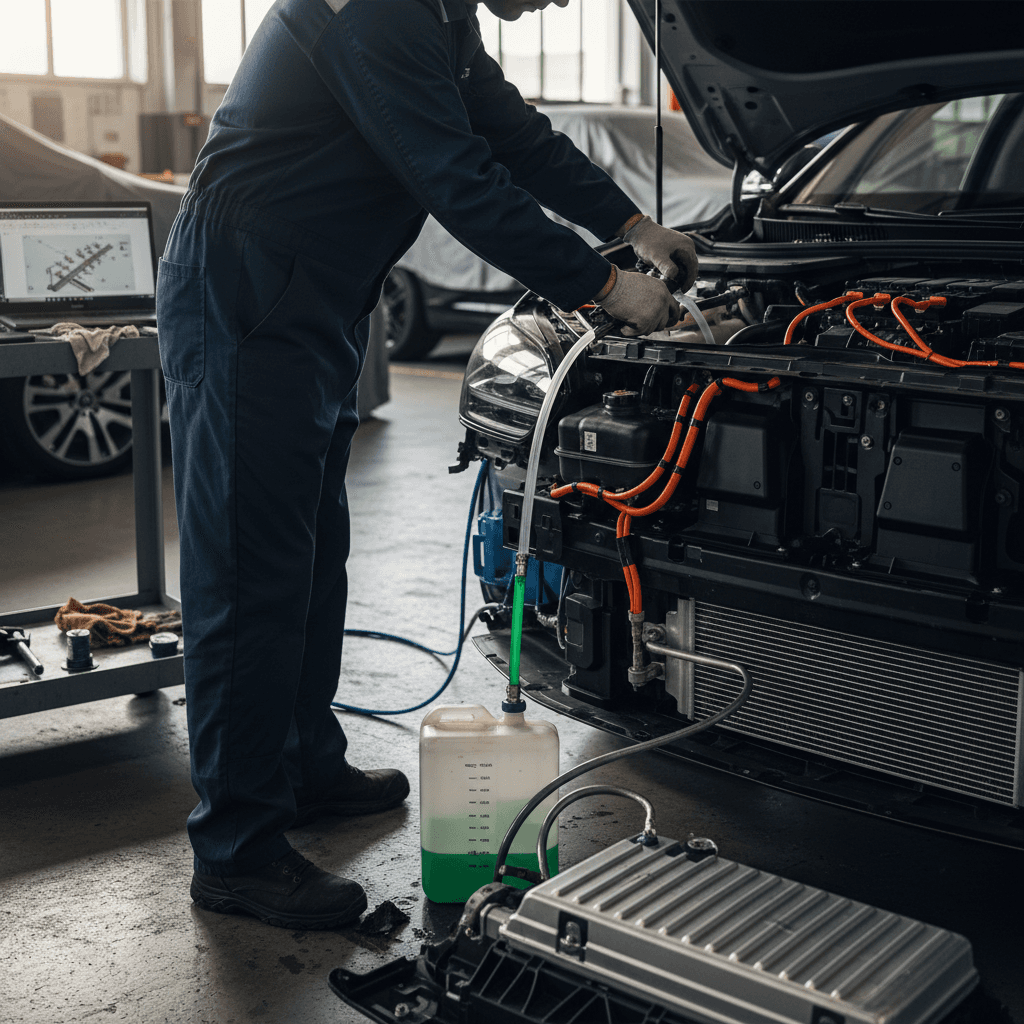
Because the GV60’s coolant protects high‑voltage components, a proper service is more than just swapping fluid. A thorough job typically includes:
- Confirming the correct Genesis‑approved coolant type (standard or low‑conductivity, depending on loop and model year).
- Safely powering down and locking out the high‑voltage system as required by Genesis procedures.
- Draining coolant from the reservoir and low points in the circuit, often including bleed ports near the battery and e‑motor modules.
- Vacuum‑filling the system to avoid air pockets that could damage pumps or create hot spots.
- Running the GV60’s electric water pumps through a scan‑tool‑controlled bleed routine to purge remaining air.
- Inspecting hoses, clamps, pumps, and heat exchangers for leaks or corrosion.
- Resetting maintenance reminders and verifying system operation with a test drive or charge session.
Why air pockets are a big deal
Dealer vs independent shop pricing
Genesis dealer service
- Factory‑trained techs familiar with GV60 quirks and updated procedures.
- Access to the latest software, bleed routines, and technical service bulletins.
- Higher hourly labor rate, often $180–$250+ in major metros.
- More likely to bundle coolant service into scheduled EV checkups.
Independent EV specialist
- Hourly rates often 10–20% lower than premium dealers in the same market.
- Can be more transparent about line‑item labor and coolant costs.
- Capability varies widely, some shops are EV pros, others are still learning.
- May need to order OEM coolant and seals ahead of time, adding a day.
For something as central to battery health as coolant, I’d prioritize experience with modern EV thermal systems over saving the last $50–$75. If you do choose an independent shop, ask specifically whether they’ve serviced Ioniq 5/EV6/GV60 platforms and whether they follow Genesis procedures rather than generic coolant‑flush playbooks.
Signs your GV60 may need coolant service early
Most GV60s will age into their first official coolant interval without drama. Still, there are a few situations where you might face coolant work earlier than the book schedule:
Common early‑warning signs
These don’t always mean you need a full flush, but they do justify a professional inspection.
Thermal warnings
Coolant loss
HV service history
Don’t ignore thermal‑related warnings
How coolant flushes fit into total GV60 ownership costs
From an economics standpoint, a coolant flush is a relatively small line item in the GV60’s total cost of ownership. Think of it like this: over 10 years, you may see one or two high‑voltage coolant services. Even at the top end, say $700 each, that’s still far less than what a comparable luxury ICE crossover would rack up in oil changes and cooling‑system work alone.
- No engine oil or transmission services to pay for.
- Brake wear is reduced thanks to regenerative braking, delaying pad and rotor replacements.
- Coolant intervals are measured in years or tens of thousands of miles, not every other visit.
- Battery and thermal health have an outsized impact on resale value compared with traditional engines.
Where Recharged fits in
Ready to find your next EV?
Browse VehiclesTips to save money on GV60 coolant service
Smart ways to keep coolant costs in check
1. Confirm you really need a flush
Before you authorize a $500+ job, ask the advisor to show you where your VIN sits against the official Genesis maintenance schedule. You don’t want to pay for a “recommended” flush that isn’t actually due.
2. Get an itemized estimate
Request a written breakdown listing coolant type and quantity, labor hours, shop supplies, and taxes. That makes it much easier to compare a dealer quote to an independent EV shop.
3. Ask about combining services
If your brake fluid, cabin filter, or inspection visit are coming up, doing them along with the coolant flush can save on labor overlap and reduce the number of days you’re without the car.
4. Shop around, but vet EV experience
Call a few shops within driving distance and ask for a quote specifically for a <strong>Genesis GV60 battery/e‑powertrain coolant service</strong>. Filter out any shop that sounds unsure about EV‑specific procedures.
5. Leverage warranties and prepaid plans
If you bought new, check whether you have any <em>prepaid maintenance</em> or dealer‑specific service plans. They sometimes cover or discount first coolant changes and EV health checks.
6. Plan for it in your ownership budget
Rather than treating a coolant flush as a surprise, budget a small monthly amount toward long‑term EV maintenance. That way, when the GV60 finally hits its first coolant interval, the money’s already there.
Coolant flush cost & used Genesis GV60 shopping
If you’re considering a used GV60, especially a high‑mileage 2023–2024 example, it’s smart to think about where you are in the coolant interval. A low‑priced GV60 that’s just about to hit a major coolant and brake‑fluid service may effectively cost more than one with slightly fewer miles and fresher maintenance.
Questions to ask the seller
- "Has the high‑voltage coolant ever been changed? If so, when and where?"
- "Do you have invoices or service history showing what loops were serviced?"
- "Any battery, inverter, or drive‑unit repairs that involved draining coolant?"
How Recharged helps
When you shop a GV60 on Recharged, we pair service history with our Recharged Score battery health diagnostics. That gives you a clearer sense of how the pack and thermal system have behaved across fast charges, hot summers, and cold snaps, well beyond what a traditional test drive or Carfax entry can show.
Genesis GV60 coolant flush FAQ
Frequently asked questions about GV60 coolant flush cost
Bottom line on GV60 coolant flush costs
When you zoom out, a Genesis GV60 coolant flush is one of the less frequent and less painful maintenance events you’ll face. Expect it to cost a few hundred dollars, potentially more in high‑labor‑cost markets, but only every several years. In return, you’re protecting the single most expensive component on the vehicle: the battery pack and its supporting hardware.
If you’re already a GV60 owner, treat coolant service as a long‑term investment in reliability and resale, not just another line item on a service invoice. And if you’re shopping for a used Genesis GV60, consider working with a platform like Recharged that combines verified battery health diagnostics with transparent service history, so you know whether that seemingly small maintenance item has been handled properly, or is waiting right around the corner.