If you live in the Seattle area, you feel every swing at the pump. In 2026, many drivers are asking a simple question: how do gas prices vs EV charging costs in Seattle really compare? Not in theory, but on your monthly budget. This guide walks through real‑world numbers for Seattle fuel prices, electricity rates, home and public charging, and what it all means if you’re thinking about a used EV.
Quick snapshot
Why Seattle drivers are rethinking fuel costs in 2026
Seattle is a near‑perfect case study for gas vs EV economics. Fuel prices are consistently higher than the U.S. average, electricity is relatively clean, and the region has one of the most developed EV charging networks in the country. Add in steep rush‑hour traffic and growing climate policies, and it’s no surprise thousands of Puget Sound drivers are running the math on their next vehicle.
Seattle’s cost and charging landscape at a glance
Three reasons EVs pencil out here sooner than in many U.S. cities
High fuel prices
Washington historically ranks among the priciest states for gasoline. That means every extra mile you drive makes the EV option relatively more attractive.
Dense charging network
Between public Level 2, DC fast chargers and workplace options, you can now cross the metro area without worrying too much about where to plug in.
Clean, stable electricity
Seattle’s grid leans heavily on hydro and other renewables. That keeps electricity prices relatively stable and emissions per kWh low.
Baseline assumptions: how we compare gas and EV costs
To keep this 2026 Seattle comparison grounded, we’ll use realistic, but rounded, numbers. You can swap in your own later, but here’s the baseline we’ll reference throughout the article:
- Annual driving: 12,000 miles (about 1,000 miles per month)
- Commute pattern: Mix of city and highway typical for I‑5 / SR‑520 / I‑90
- Gas car: 30 MPG compact crossover (many popular models land near this)
- Efficient hybrid: 45 MPG (for comparison)
- EV efficiency: 3.0–3.5 miles per kWh for a compact or midsize EV
- Home electricity: around $0.14–$0.16/kWh all‑in for Seattle residential rates
- Public Level 2 charging: often free at work, roughly $0.20–$0.35/kWh when paid
- DC fast charging: approximately $0.35–$0.55/kWh in the Seattle region, depending on network, time of day and membership plans
Numbers are estimates, not guarantees
Seattle gas prices in 2026: what you’re likely paying
If you’ve filled up anywhere from Northgate to Federal Way lately, you already know Washington is rarely a “cheap gas” state. In 2026, many Seattle‑area stations are still posting prices materially above the national average, especially for regular unleaded. On top of crude oil swings, state carbon policies and local taxes help keep per‑gallon costs elevated.
Illustrative 2026 fuel cost benchmarks (Seattle area)
Gas prices swing, your cost per mile does too
Home EV charging cost in Seattle
Home charging is where EVs usually shine. You’re not paying for station overhead, demand charges or a profit margin in the same way you do at a public fast charger. In Seattle, residential electricity rates have been comparatively stable, especially when you factor in how much energy you actually need to move a car one mile.
Illustrative home charging math for a Seattle driver in 2026
Approximate cost per mile and monthly “fuel” bill for a typical EV charging at home.
| Scenario | Assumed rate (all‑in) | Efficiency (mi/kWh) | Energy per 1,000 mi | Monthly cost | Cost per mile |
|---|---|---|---|---|---|
| Conservative EV | $0.16/kWh | 3.0 | ~333 kWh | ~$53 | 5.3¢ |
| Typical EV | $0.16/kWh | 3.5 | ~286 kWh | ~$46 | 4.6¢ |
| Off‑peak friendly plan | $0.13/kWh | 3.5 | ~286 kWh | ~$37 | 3.7¢ |
Assumes 1,000 miles per month and Seattle‑area residential rates in the mid‑teens per kWh.
Leverage time‑of‑use if your utility offers it
Public and fast charging costs around Seattle
Not everyone can plug in at home, and even if you can, road trips and long days will push you toward public options. Seattle and the broader I‑5 corridor now host a mix of workplace Level 2, municipal chargers, retail‑lot stations and high‑power DC fast charging hubs.
Level 2 public charging
- Cost structure: Often priced per kWh or per hour. Roughly comparable to or slightly above residential rates when you pay, sometimes higher in premium locations.
- Speed: Adds roughly 15–30 miles of range per hour depending on charger power and your EV.
- Typical use: Workplace, parking garages, shopping trips where the car stays put for several hours.
DC fast charging (50–350 kW)
- Cost structure: Commonly between ~$0.35 and $0.55 per kWh in the Seattle region, varying by network, membership, time of day and demand fees.
- Speed: Can add 100+ miles in 20–30 minutes for many modern EVs when the battery is in the optimal state of charge.
- Typical use: Highway travel on I‑5, I‑90 and SR‑99 or quick top‑ups when you can’t wait for Level 2.
Illustrative Seattle public charging cost per mile
How per‑mile cost changes by charger type using the same EV efficiency assumptions.
| Charger type | Price assumption | Mi/kWh | Cost per mile (low) | Cost per mile (high) |
|---|---|---|---|---|
| Paid Level 2 | $0.22–$0.30/kWh | 3.5 | 6.3¢ | 8.6¢ |
| Workplace Level 2 | Often free | 3.5 | 0¢ | ~6¢ (if partially paid) |
| DC fast charging | $0.35–$0.55/kWh | 3.0 | 11.7¢ | 18.3¢ |
Assumes 3.0–3.5 miles per kWh and typical 2026 pricing bands for the Seattle region.
Relying 100% on fast charging can erase savings
Real‑world examples: EV vs gas cost per mile
Let’s translate all of this into a few clear Seattle scenarios using those baseline assumptions. These aren’t lab tests; they’re the kind of blended patterns many local drivers actually follow.
Three typical Seattle driver scenarios
1. Apartment driver, mostly public Level 2
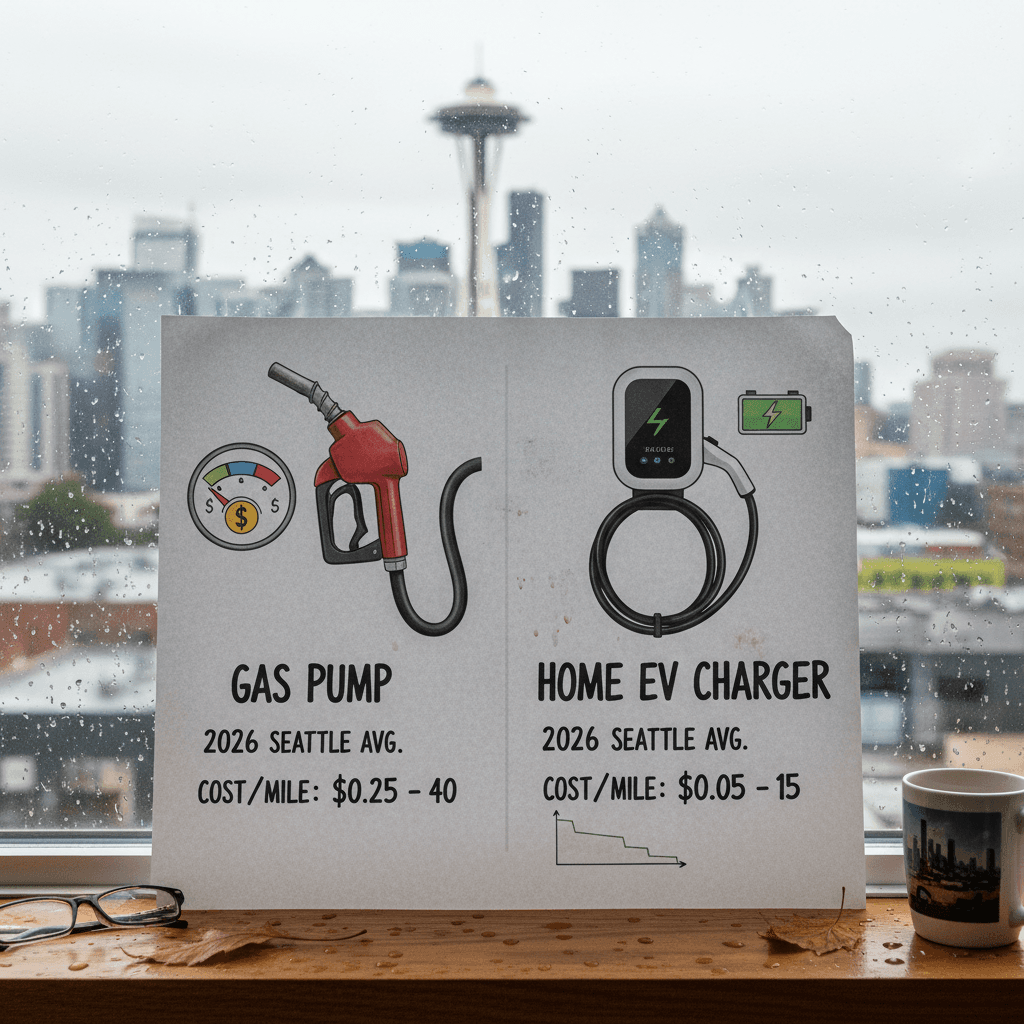
You drive 1,000 miles per month, charging 80% on paid Level 2 at about $0.25/kWh and 20% on DC fast at $0.45/kWh. At ~3.3 miles per kWh, your blended cost per mile lands around 8–10¢. That’s still better than a 30‑MPG gas car at 14¢/mile, but not as good as at‑home charging.
2. Homeowner, mostly home charging
You have a driveway or garage in Ballard or Renton and charge 90% at home at ~$0.16/kWh, 10% on road‑trip fast charging around $0.45/kWh. With typical 3.5 mi/kWh efficiency, your blended cost often sits around 4–6¢ per mile, less than half of the 14¢/mile gasoline baseline.
3. High‑mileage rideshare driver
You clock 2,000+ miles a month and carefully plan charging to favor low‑cost home or workplace Level 2. Because your gas bill would scale up rapidly with mileage, the per‑mile savings from an EV become even more powerful, helping offset higher maintenance and depreciation from heavy use.
Beyond fuel: maintenance, parking and other costs
Fuel or charging is only one line item in your total cost of owning a car in Seattle. Maintenance, insurance, parking and depreciation can equal or even exceed what you pay at the pump, or the plug.
Key non‑fuel cost differences for Seattle drivers
Where EVs save you money, and where they don’t
Maintenance & repairs
EVs eliminate oil changes, exhaust issues and many moving parts in the powertrain. You’ll still buy tires and brake fluid, but over several years most owners see lower routine maintenance bills than with similar gasoline cars.
Parking & HOV perks
Some Seattle‑area garages offer reduced‑rate EV parking or reserved charging spots. Washington’s HOV lane rules for clean vehicles have evolved over time, so it’s worth checking current eligibility, especially for commuters crossing Lake Washington.
Insurance & risk
Insurance for EVs can be higher, comparable or lower depending on model, repair costs and theft risk. Popular mainstream EVs often land close to similar gasoline models, while high‑end or newer‑to‑market EVs can be pricier to insure.
Battery health & resale
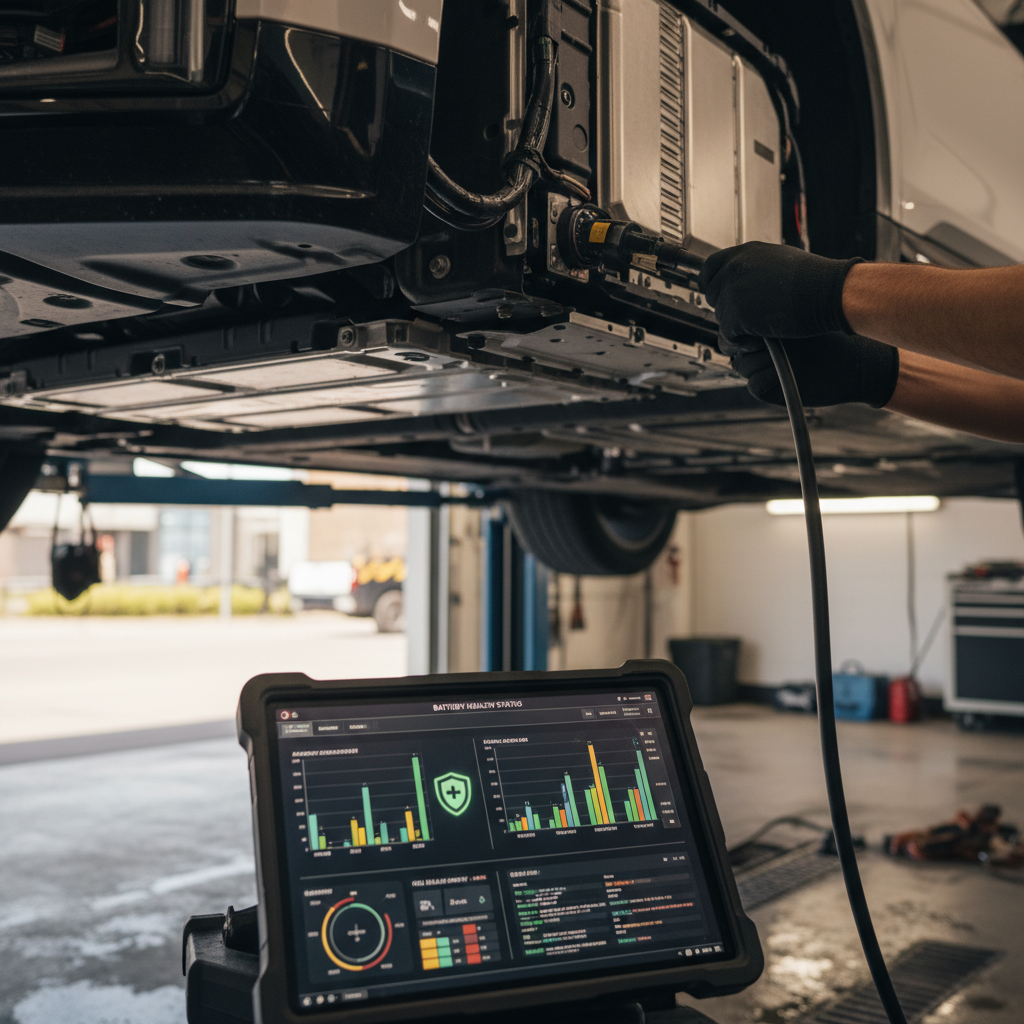
Battery condition is a unique EV factor. A healthy pack helps resale value and your day‑to‑day range. That’s why credible battery health diagnostics are critical when you’re shopping used.
Where Recharged fits in
Ready to find your next EV?
Browse VehiclesWhat this means for used EV buyers in Seattle
If you’re on the fence about a used EV in the Seattle market, the fuel vs charging math is only part of the story, but it’s an important one. With gas likely to stay relatively expensive, the ability to drive on electricity priced more like a utility than a commodity is a structural advantage.
When a used EV makes strong financial sense
- You can charge at home or at work most days.
- Your commute runs through stop‑and‑go Seattle traffic, where EV efficiency stays high while gas mileage drops.
- You plan to keep the car several years, giving fuel savings time to outweigh a possible higher purchase price.
- You qualify for used‑EV incentives or affordable financing that lower your upfront cost.
When you should think twice, or run the numbers harder
- You rely on curbside parking in dense neighborhoods with no nearby chargers.
- You expect to use DC fast charging for most of your miles.
- You rarely drive and fuel costs are already a small slice of your monthly budget.
- Your road‑trip patterns take you frequently beyond major corridors where charging is still sparse.
Use total cost of ownership, not just the sticker
How to estimate your own Seattle fuel vs charging bill
Every household’s numbers are different, but you don’t need a degree in energy economics to map out your own Seattle‑specific comparison. Here’s a simple framework you can run in a spreadsheet or even on paper.
DIY Seattle gas vs EV cost calculator
1. List your current monthly miles
Look at your odometer or app history for the last few months and average them. If you commute regularly, include both weekday and weekend use.
2. Calculate your gas cost per mile today
Divide your current pump price by your car’s real‑world MPG. If you’re not sure about MPG, track a couple of full tanks or use your car’s trip computer as a starting point.
3. Estimate your EV efficiency
For most compact and midsize EVs around Seattle, 3.0–3.5 miles per kWh is a reasonable planning number. If you have a specific model in mind, look up owner‑reported figures for an extra reality check.
4. Check your electricity rate
Pull up your latest Seattle‑area power bill and divide the total charge (including fees) by total kWh used. That gives you an all‑in cents‑per‑kWh figure for home charging comparisons.
5. Decide your charging mix
Roughly estimate what share of your charging would be at home, at work (possibly free) and on DC fast chargers. Multiply each share by a representative price per kWh and sum them to get a blended rate.
6. Multiply through to get monthly costs
Once you know cost per mile for gas and electricity, multiply each by your monthly miles. Then add any differences in maintenance (oil changes, brakes) to see your total monthly picture.
FAQ: Gas vs EV charging costs in Seattle
Common questions about 2026 Seattle fuel and charging costs
Bottom line: should you go electric in Seattle in 2026?
If you spend much time stuck in traffic on I‑5 or weaving through Capitol Hill, the math in 2026 leans toward electricity, especially if you can charge at home or work. For many Seattle‑area drivers, EVs cut fuel costs per mile by half or more compared with a conventional gas car, while also trimming maintenance over the long haul. Rely exclusively on high‑priced fast charging and the advantage narrows or disappears, but that’s increasingly the exception rather than the norm.
The next step is simple: estimate your own miles, charging mix and access to home or workplace charging, then line that up against your current fuel and maintenance spend. If you’re considering a used EV, Recharged can plug in the rest, battery health, fair‑market pricing, financing and trade‑in options, plus expert support so you’re not making a five‑figure decision on guesswork. In a city where gas rarely feels cheap, that kind of clarity can be worth just as much as the fuel savings themselves.